The .45-75 Winchester Cartridge
The .45-75 Winchester centerfire cartridge was first introduced in 1876. It was developed for the Winchester Centennial Model 1876 lever-action repeating rifle, created to celebrate the 100th anniversary of the United States. The cartridge and the rifle were both geared primarily towards civilian use, particularly for hunting and sport shooting.
Design and Specifications
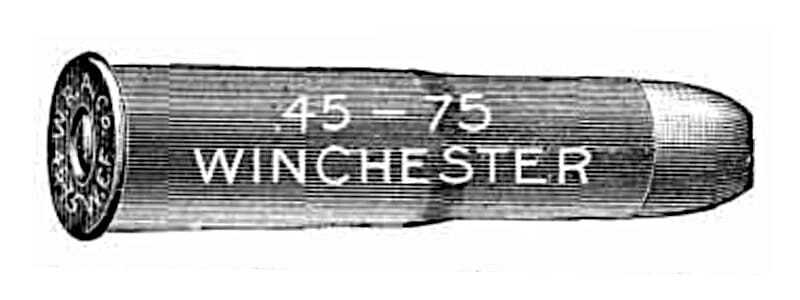
The .45-75 Winchester is a rimmed, bottlenecked centerfire cartridge. The bottleneck design was key -- it facilitated smoother feeding in the Winchester 1876's lever action compared to straight-walled cartridges. The bullet diameter is .458 inches (11.63mm), the same as the .45-70 Government.
- Bullet Diameter: .458 inches (11.63mm)
- Case Length: 1.88 inches (47.75-48mm)
- Overall Cartridge Length: ~2.25 inches (57mm)
- Rim Diameter: 0.618 inches (15.7mm)
- Neck Diameter: 0.481 inches (12.2mm)
- Base Diameter: 0.563 inches (14.3mm)
- Powder Charge: 75 grains of black powder
Ballistics and Performance
The .45-75 was a capable performer for its time. With a 350-grain bullet at approximately 1,375-1,385 feet per second from the 28-inch barrel of a Winchester 1876, it delivered muzzle energy of around 1,490 foot-pounds. That was sufficient power for most big game animals in North America. Compared to the .45-70 Government, the .45-75 was faster at short range but had less long-range capability due to a lower ballistic coefficient and black powder limitations. Effective range was realistically 150-200 yards.
The Winchester 1876 and the NWMP
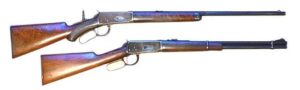
The Winchester Model 1876 was the primary rifle chambered for the .45-75. Introduced at the 1876 Centennial Exposition, it was a scaled-up version of the Winchester 1873, designed to handle more powerful cartridges.
The North-West Mounted Police (NWMP) in Canada adopted the Winchester 1876 in .45-75, making it one of the few repeating rifles officially used by a law enforcement agency during that era. The NWMP found it well-suited for the demands of frontier law enforcement, offering superior firepower compared to single-shot carbines.
Decline and Obsolescence
The .45-75 was quite popular in the late 19th century, especially in the American West. But it was soon eclipsed by the introduction of the Winchester Model 1886, a John Browning-designed rifle that could chamber more powerful cartridges like the .45-70 Government, .50-110 Express, and .40-82 Winchester. The stronger toggle-link action of the 1886 made the earlier 1876 design obsolete by the early 20th century.
Availability Today
The .45-75 Winchester is considered obsolete, with no major ammunition manufacturers producing it in bulk. However, dedicated enthusiasts and historical reenactors still shoot and reload the cartridge. Brass cases can be formed from .348 Winchester brass, though the neck must be sized properly. Specialty companies such as Buffalo Arms, Ten-X Ammunition, and Jamison Brass & Ammunition have produced small runs of .45-75 cases and ammunition.
Uberti manufactures a modern reproduction of the Winchester 1876 in .45-75, allowing shooters to experience this historic cartridge. Cast bullets and black powder substitutes like Pyrodex or Triple Seven allow safe reloading for original and reproduction rifles.
Safety Note
Because the .45-75 was designed for black powder, shooters must be cautious when handloading. Using modern smokeless powder can generate excessive pressure, potentially damaging firearms originally designed for black powder. If using a reproduction firearm, always consult the manufacturer's recommendations for acceptable loads.
Despite its obscurity today, the .45-75 Winchester holds a place in firearms history as one of the early centerfire cartridges developed for repeating rifles. It was part of the evolution of firearms technology that led to the powerful and versatile cartridges we have today. You may also be interested in our coverage of The .32-40 Winchester aka .32-40 Ballard Cartridge.
Forums on the Centennial Rifle can be found here.
If you know of any forums or sites that should be referenced on this listing, please let us know here.