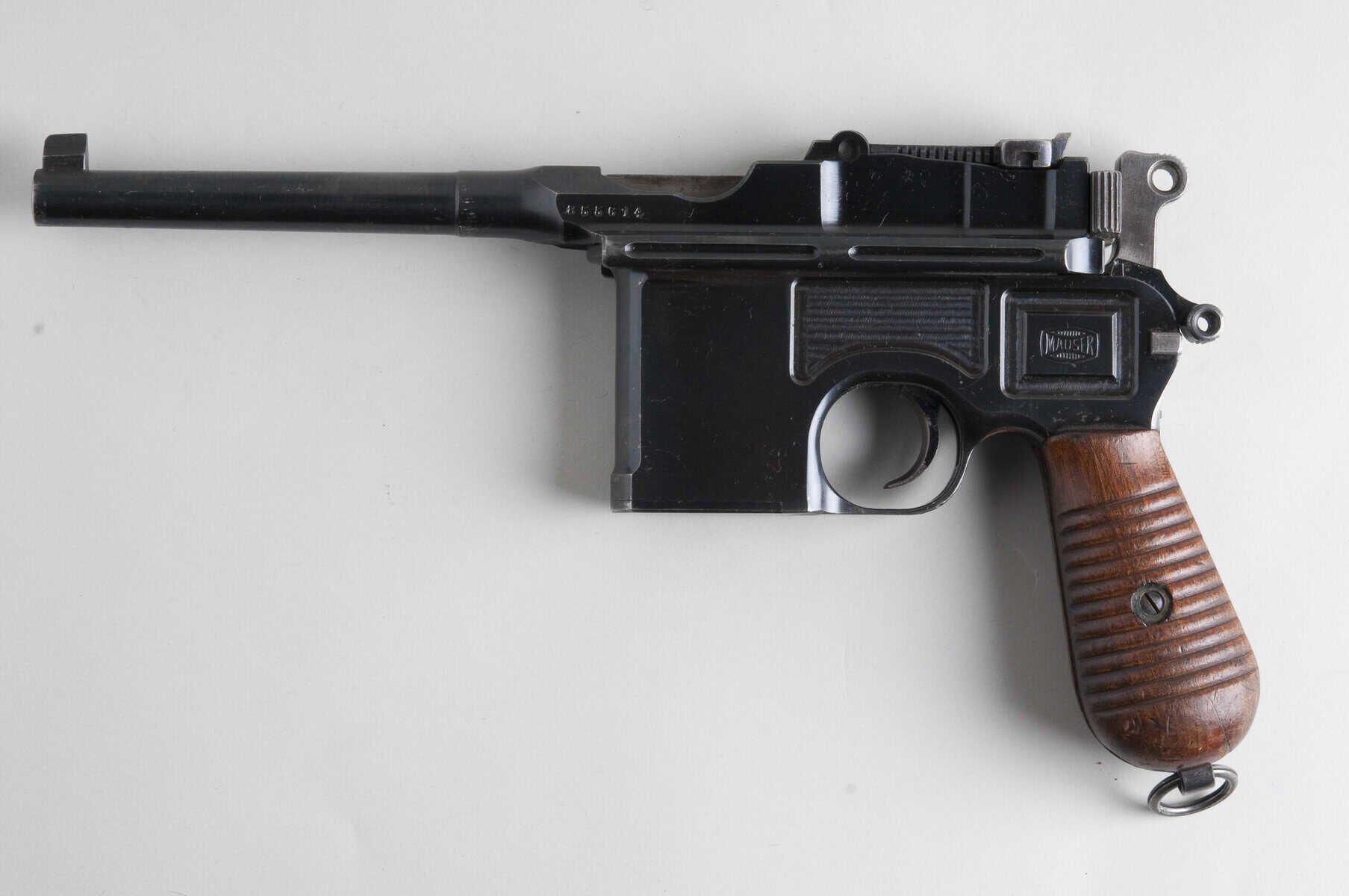
The Mauser C96 Broomhandle is one of the most recognizable firearms ever made, and also one of the least understood. That boxy frame, the long barrel, the integral box magazine ahead of the trigger, the round wooden grip that earned it the nickname "Broomhandle" -- there is nothing else that looks like it. It was one of the first commercially successful semi-automatic pistols in history. It was carried into battle on every inhabited continent. It armed warlord armies in China, revolutionaries in Russia, and a young cavalry officer named Winston Churchill at the Battle of Omdurman. And long after it had faded from military service, it was reborn as the most famous science fiction weapon ever put on screen.
Oberndorf Origins: The Feederle Brothers and Mauser
The C96 wasn't designed by Paul Mauser himself. The pistol was developed by the Feederle brothers -- Fidel, Friedrich, and Josef -- who worked at the Mauser factory in Oberndorf am Neckar, Germany. The design work began around 1893, and the pistol was patented in Mauser's name in 1895. Paul Mauser, who was focused on his bolt-action rifle designs (including the revolutionary Gewehr 98 that would arm the German military for decades), apparently had little direct involvement in the pistol's development, though his name went on the patent because the Feederle brothers were his employees. Our coverage of The Mauser Model 98 Rifle adds to this story. Our piece on SIG Sauer: A Comprehensive History and Analysis provides additional perspective.
The gun that bears Mauser's name was designed by three brothers whose names most firearms enthusiasts have never heard.
Production began in 1896 -- hence the designation C96, for "Construktion 96." The pistol was chambered in 7.63x25mm Mauser, a bottlenecked cartridge that was essentially an enlarged version of the 7.65mm Borchardt cartridge used in Hugo Borchardt's C-93 pistol. The 7.63mm Mauser round pushed an 85-grain bullet at approximately 1,400 feet per second from the C96's long barrel -- making it, at the time, the highest-velocity commercially produced handgun cartridge in the world.
A Radical Design for 1896
To understand how radical the C96 was, consider the landscape of handguns in 1896. The dominant military sidearms were revolvers -- Colt Single Action Armies, Smith & Wesson top-breaks, Webley Mk IIs. Semi-automatic pistol design was in its infancy. The Borchardt C-93, introduced in 1893, was arguably the first practical semi-automatic pistol, but it was bulky, awkward, and expensive. The Bergmann pistols were still experimental. The Luger wouldn't appear until 1900. The Mauser C96 was one of the very first semi-automatic pistols that was reliable enough, powerful enough, and durable enough for real-world use.
The design was unconventional by any standard. The barrel was fixed to the frame -- it didn't tilt, rotate, or move during firing. The action was short-recoil operated, with the barrel and bolt recoiling together for a short distance before a locking block dropped out of engagement, allowing the bolt to continue rearward while the barrel stopped. The magazine was an integral box located ahead of the trigger guard, loaded from the top using 10-round stripper clips. This forward magazine placement gave the pistol its distinctive appearance and also shifted the balance point forward, which some shooters found helped stabilize the gun during rapid fire.
The wooden holster doubled as a detachable shoulder stock. Clipped to the grip, it transformed the pistol into a carbine-length weapon with a reasonable stock weld. With the stock attached and at ranges out to 100-150 meters, the C96 was surprisingly accurate -- more so than any revolver and competitive with many rifles of the era at those distances. This dual-purpose holster/stock was an ingenious feature that military buyers found extremely attractive.
Churchill at Omdurman: The C96's Baptism of Fire
The C96's most famous early combat use came at the hands of a 23-year-old lieutenant in the British 21st Lancers. Winston Spencer Churchill, serving as both a cavalry officer and a war correspondent during the Anglo-Egyptian reconquest of Sudan, carried a Mauser C96 at the Battle of Omdurman on September 2, 1898.
Churchill had injured his shoulder earlier and couldn't reliably use a sword in a cavalry charge. He purchased a C96 privately (officers in the British Army of this era were expected to provide their own sidearms) specifically because it could be fired one-handed while on horseback. During the famous charge of the 21st Lancers against a much larger Dervish force, Churchill used his Mauser to shoot his way through the melee.
Churchill later wrote about the experience, crediting the C96's rapid-fire capability and 10-round capacity with helping him survive an engagement that killed 21 Lancers and wounded 50 more. "I was able to make good use of my Mauser pistol," he noted. The future Prime Minister carried the C96 again during the Boer War. His account of the Omdurman charge remains one of the most vivid first-person descriptions of cavalry combat ever written, and it served as unintentional advertising for the Mauser C96 across the British Empire.
You could not buy that kind of publicity.
A Pistol Without an Army
For all its technical merits, the C96 failed to achieve what Mauser wanted most: adoption as a standard military sidearm by a major European power. Germany adopted the Luger P08 in 1908. Britain stayed with its Webley revolvers. France, Russia, Austria-Hungary -- all passed on the C96 in favor of other designs.
The reasons weren't hard to find. The C96 was expensive to manufacture -- all that precision machining cost money. The integral magazine, loaded from stripper clips, was slower to reload than a detachable box magazine. The pistol was large and heavy for a sidearm. And its unique ergonomics, while praised by some, were considered awkward by others. Military procurement boards tend to be conservative, and the C96 was anything but conventional.
What the C96 lacked in official military adoption, it made up for in commercial sales and unofficial military use. Officers in armies around the world purchased C96s privately. It was particularly popular with officers in the Ottoman Empire, Persia, and various South American nations. The pistol developed a reputation as a status symbol -- a weapon for men who could afford the best and wanted everyone to know it.
The Chinese Love Affair
No country embraced the Mauser C96 more enthusiastically than China. During the chaotic Warlord Era of the 1920s and 1930s, when regional military leaders fought for control of China with private armies, the C96 became the most sought-after sidearm in the country. Chinese warlords became Mauser's biggest customers for the pistol.
The reasons were partly practical and partly circumstantial. International arms embargoes attempted to restrict the flow of rifles and machine guns to Chinese factions, but pistols were often exempted from these restrictions. The C96 with its shoulder stock functioned as a quasi-carbine, giving Chinese soldiers a weapon that was technically a pistol but could serve as a short-range rifle. A loophole, and Chinese buyers exploited it aggressively.
An estimated 300,000 Mauser C96 pistols were shipped to China, including a substantial number of select-fire models. The select-fire variant, known as the Schnellfeuer (fast fire) or Model 712, featured a detachable 20-round magazine and a selector switch for fully automatic fire. At a cyclic rate of approximately 900 rounds per minute, the Schnellfeuer was essentially a machine pistol -- wildly difficult to control in full auto but devastating at very close range.
Chinese arsenals also produced their own copies of the C96 in staggering variety. The most notable were the pistols produced at the Shanxi Arsenal (Taiyuan Arsenal) under warlord Yan Xishan, who ordered copies chambered in .45 ACP rather than the standard 7.63mm Mauser. Approximately 8,500 of these Shanxi .45-caliber "Broomhandles" were produced. They are prized by collectors today as some of the most distinctive C96 variants ever made.
The C96 was so ubiquitous in China that it acquired local nicknames. In Chinese, it was commonly called the "box cannon" (boxed pistol). In Chinese popular culture, the Broomhandle Mauser occupies roughly the same position that the Colt Peacemaker holds in American Western mythology -- it is the gun of the era, the symbol of a turbulent and violent period in national history.
World War I and the "Red 9"
The German military finally came around to the C96 during World War I, though not by first choice. As the war dragged on, the German army faced a shortage of Luger P08 pistols. Mauser was contracted to produce C96 pistols as a substitute standard sidearm, but with one critical change: instead of the standard 7.63x25mm Mauser cartridge, these wartime pistols were chambered in 9x19mm Parabellum -- the same cartridge used by the Luger.
To prevent soldiers from loading the wrong ammunition (7.63mm Mauser and 9mm Parabellum are dimensionally similar enough to chamber in each other's guns, with potentially dangerous results), the grips of the 9mm C96 pistols were marked with a large "9" carved into the wood and filled with red paint. These pistols became known as "Red 9" Mausers and are among the most collectible C96 variants today. Approximately 137,000 to 150,000 Red 9 pistols were produced during the war -- contracted for 150,000, though actual deliveries before the Armistice were closer to 137,000-140,000.
A carved numeral filled with red paint. Simple, effective, and now worth thousands of dollars to collectors. The Feederle brothers couldn't have predicted that.
Other Wars, Other Hands
The C96 turned up in an extraordinary number of conflicts during its long life. Irish Republicans used C96 pistols during the Easter Rising of 1916 and the subsequent Irish War of Independence. The Bolsheviks used them during the Russian Revolution and Civil War -- the C96 was reportedly a favorite sidearm of Bolshevik commissars, and Soviet propaganda posters from the era frequently depicted revolutionary heroes wielding Broomhandles.
T.E. Lawrence owned a C96, which he used during his earlier time in the Middle East, though evidence suggests he later switched to a Colt 1911 during the Arab Revolt. The C96 dominated an era when semi-automatic pistol design was still finding its footing — a story we explore further in our article on The 1911 Pistol Legacy.
During the Spanish Civil War (1936-1939), C96 pistols from various sources armed combatants on both sides. Spanish manufacturers, particularly Astra, produced their own copies and variants of the C96, some of which were select-fire. These Spanish copies varied considerably in quality -- some were well-made, others were dangerously crude.
In World War II, the C96 saw service primarily with second-line German units and with Chinese forces fighting Japan. By 1939, the C96 was thoroughly obsolete as a military sidearm -- the Walther P38 and the Luger P08 were both superior combat pistols -- but the Broomhandle refused to disappear entirely. Surplus C96s continued to turn up in conflicts well into the Cold War era.
From Oberndorf to a Galaxy Far, Far Away
The C96's most unexpected second career began in 1977, when prop designer Roger Christian needed to create a futuristic weapon for a cocky space smuggler in a low-budget science fiction film called Star Wars. Christian grabbed a Mauser C96 from a prop warehouse (the specific gun had previously appeared in the 1967 Frank Sinatra film The Naked Runner), bolted on a Hensoldt Wetzlar scope and a flash hider from a German MG81 machine gun, added some other small parts, and handed the result to Harrison Ford.
Han Solo's DL-44 blaster became one of the most recognizable props in film history. The C96's distinctive silhouette -- that long barrel, the boxy receiver, the forward-mounted magazine housing -- translated perfectly into a science fiction aesthetic. When the original prop sold at a Rock Island Auction Company sale for $1,057,500, it confirmed what fans had known for decades: the Mauser C96 had achieved a level of cultural immortality that no military adoption could match.
The irony is that Roger Christian chose the C96 specifically because it looked weird and futuristic -- the same qualities that had made military procurement boards uneasy about adopting it 80 years earlier.
The Mauser C96 Broomhandle as a Collector's Piece
Mauser produced approximately one million C96 pistols between 1896 and 1937. Add the Chinese copies, the Spanish copies, and the licensed variants, and the total number produced is significantly higher -- though exact figures are impossible to determine because many Chinese and Spanish manufacturers kept poor records or none at all.
Today, the C96 is one of the most collected military pistols in the world. Values vary enormously depending on variant, condition, and provenance. Standard commercial models in good condition sell for $1,500 to $3,000. Red 9 variants command $3,000 to $6,000 or more. Early "cone hammer" models, flat-side models, and other rare variants can reach five figures. Shanxi .45-caliber copies, being both rare and historically interesting, are highly prized. And anything with documented provenance to a famous owner or a specific historical event can sell for whatever the market will bear.
The C96 is a challenging gun to shoot by modern standards. The grip angle is steep, the trigger pull is long, and the sights are small by contemporary standards. But loaded with proper 7.63mm Mauser ammunition (or the dimensionally similar 7.62x25mm Tokarev, though the Soviet cartridge is loaded to higher pressures), the C96 is accurate and surprisingly pleasant to fire. The weight absorbs recoil well, and the long barrel wrings impressive velocity out of the cartridge. It isn't a gun you would choose for a defensive situation in 2026, but it is a gun that rewards range time with an appreciation for what the Feederle brothers accomplished in the 1890s.
Legacy: The Pistol That Did Everything
The Mauser C96 was never the best military pistol. It was too big, too expensive, too complicated, and too difficult to reload quickly. The 1911, the Luger, and the Browning Hi-Power all surpassed it in specific ways. But no other handgun in history has led such a varied and improbable life. It charged with the 21st Lancers at Omdurman. It fought in the trenches of the Western Front. It armed Chinese warlord armies and Irish revolutionaries. It traveled to a galaxy far, far away and became the most famous movie prop ever made from a real firearm.
The C96 is proof that a great design doesn't have to be a perfect design. It just has to be interesting enough, capable enough, and distinctive enough to find its way into the hands of people who will do extraordinary things with it.
On that score, the Broomhandle has no peers.
Further Reading
For serious Mauser C96 Broomhandle research and collecting:
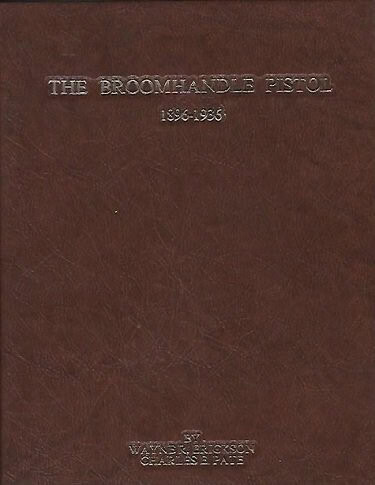
The Broomhandle Pistol, 1896-1936 by Wayne R. Erickson and Charles E. Pate -- The standard American reference on the C96, with detailed variant identification, photographs of rare models, and breakdown procedures.
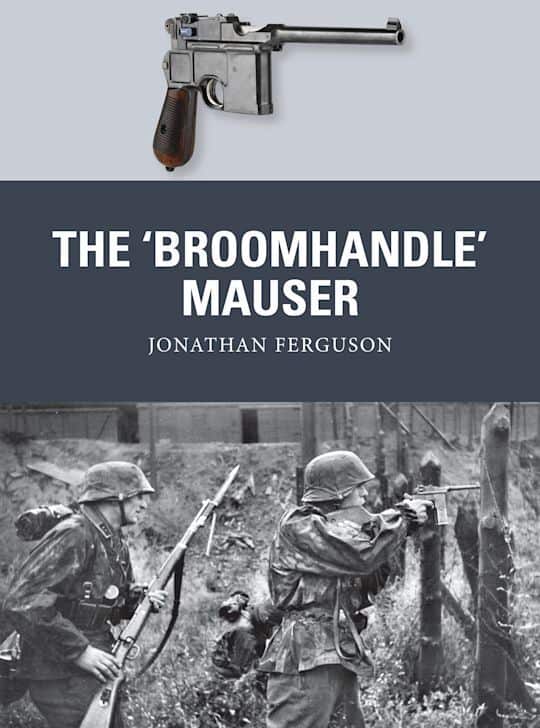
The 'Broomhandle' Mauser by Jonathan Ferguson -- Part of Osprey's Weapon series, this is a more accessible overview with excellent illustrations and a concise combat history.
- Mauser C96 - Wikipedia -- A comprehensive overview with good variant details and service history for those beginning their research.
If you know of any forums or sites that should be referenced on this listing, please let us know here.