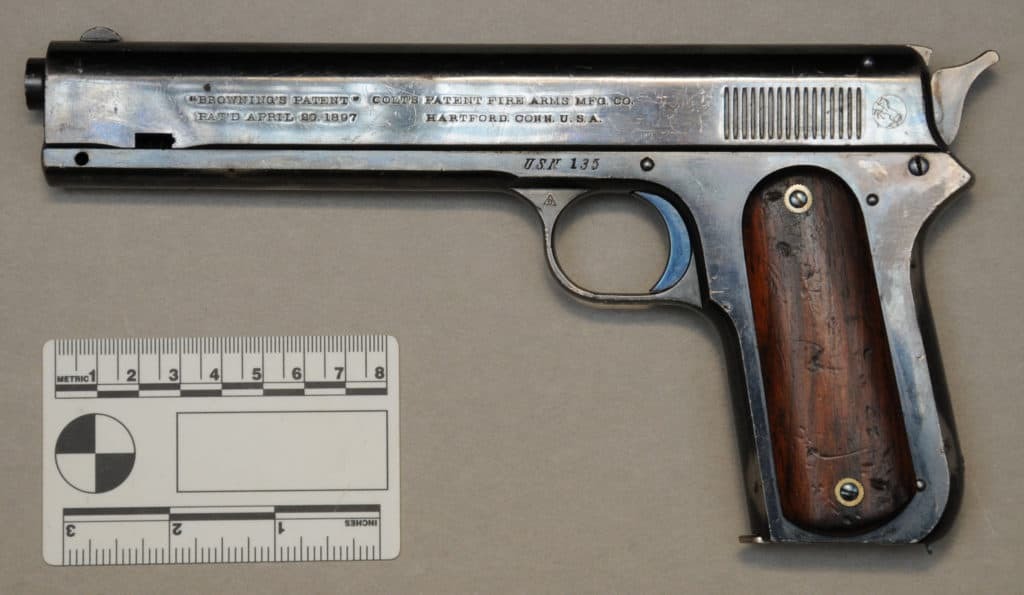
“Pistol US Colt M1900” by Naval History & Heritage Command is licensed under CC BY 2.0 
 .
.
Introduction
The Colt Model 1900, or M1900 Pistol, was the first semi-automatic pistol Colt’s Manufacturing Company put into production. Sold commercially as the Colt .38 Automatic Pistol, it carried design ideas that ran on through later Colt models and into semi-automatic handgun design generally.
The pistol came out of a working arrangement between John Moses Browning and Colt’s Manufacturing Company, and it was an early attempt to put a self-loading pistol in the place the service revolver held. Production ran from February 1900 to May 1902, and roughly 4,274 were built.
What follows covers the M1900’s development, its specifications, how it shot, the military trials it went through, and what it left behind.
Origins and Development of the Colt Model 1900
John Browning and the Evolution of the Semi-Automatic Pistol
By the late 1890s several designers were working on self-loading pistols. Hugo Borchardt had produced the C-93. At Mauser’s works in Oberndorf, the brothers Fidel, Friedrich and Josef Feederle developed the C96 “Broomhandle”, which Paul Mauser patented in his own name as owner of the factory. Georg Luger was working on the Parabellum design that became the P08. In the United States, John Moses Browning was working along a different line.
Browning started with simple blowback pistols, then found the limits of unlocked blowback for larger cartridges. By 1897 he had a short-recoil, locked-breech system that used a pivoting swinging link to tie the barrel to the frame and control how it moved against the slide. He filed on October 31, 1896, and the patent, U.S. Patent No. 580,924, was granted on April 20, 1897. The same principle carried forward into the Colt M1911.
Browning took his prototypes to several manufacturers. Carl Ehbets, Colt’s patent and design expert, pushed the company to come to terms with him. Colt filed the patents in Browning’s name and held the rights to build under them, paid a royalty of $1 on every pistol sold, and marked each slide “Browning’s Patent”. Of the designs Browning brought, the recoil-operated one is what Colt took up, and that became the Model 1900.
Production, 1900 to 1902
Colt built about 4,274 Model 1900 pistols between February 1900 and May 1902. The military orders inside that total were small: 100 pistols on a first Army contract in April 1900 (serial numbers 11 to 207), 250 on a Navy contract later the same year (1001 to 1250), and 200 on a second Army contract (1501 to 1700). The balance went to commercial buyers. That small total is why the M1900 is now a collector’s pistol rather than a shooter’s.
Colt Model 1900: Design and Technical Specifications
The Colt Model 1900 was chambered for the .38 ACP (Automatic Colt Pistol) cartridge, a semi-rimmed, straight-walled, smokeless-powder round. It was faster than the .38 Long Colt the Army was then issuing in revolvers, and it fell well short of the .45 Colt in bullet weight and frontal area.
Key Specifications
- Caliber: .38 ACP (not to be confused with .38 Super, a later higher-pressure cartridge)
- Bullet Diameter: .356 inches (9.0mm)
- Case Length: .900 inches
- Overall Cartridge Length: 1.28 inches
- Muzzle Velocity: the first factory loads drove a 130-grain full metal jacket bullet at about 1,260 feet per second. That load proved hard on the pistol, and factory velocities were cut to under 1,200 fps.
- Operating Mechanism: short recoil, swinging-link locked breech, single action
- Magazine Capacity: 7 rounds (single-stack, detachable box magazine)
- Overall Length: 8.9 inches
- Barrel Length: 6 inches
- Weight: about 35 ounces (unloaded)
The M1900 also ran a full-length slide over the barrel in place of the bolt-in-receiver arrangement used in pistols such as the Mauser C96. That layout is now the ordinary one.
Sight Safety Mechanism: A Short-Lived Experiment
The odd feature on the M1900 was its sight safety. The rear sight pivoted. Pushed down, it blocked the firing pin. Raised, it served as the rear sight, so a shooter could see the pistol’s condition while aiming.
In use it was a nuisance. Working the slide could flip it on or off without the shooter meaning to, and soldiers found it awkward to handle under stress. Colt phased it out during 1901, fitting a fixed rear sight with a plug in the old safety’s cut, which meant both patterns left the factory in the same year. Roughly the first 3,000 pistols carried the sight safety. Pistols sent back to Colt for repair were often brought up to the later pattern, which is part of why examples that still have the sight safety are scarce and sought after.
Performance and Military Trials
The .38 ACP was faster than the revolver rounds of the day, but doubts about .38-caliber handguns were already settling in at the Army. Those doubts came out of the Philippine-American War of 1899 to 1902, where officers reported that .38 Long Colt revolvers failed to stop charging Moro juramentados. The complaint was about the revolver cartridge rather than the M1900, but it turned the Army against .38-bore sidearms in general.
The pistol itself went through War Department trials. The Department had asked for self-loading designs in 1899 and carried three forward: the Mauser C96, the Steyr Mannlicher M1894, and the Colt. Testing began in February 1900 and covered accuracy, penetration, endurance, handling, which mattered for cavalry use, and abuse with dust and forced rusting. The Colt arrived with badly fitted trigger parts and needed the maker’s attention. After that it finished its share of the endurance course and another 150 rounds with no malfunctions. Across some 5,800 test rounds the weak point the board settled on was the link pins. The board recommended buying M1900s for field trials.
Field use turned up occasional feeding and ejection trouble, and users asked for a longer grip and a lanyard ring. The Army’s conclusion was that the design was not ready for general issue.
The Thompson-LaGarde Tests (1904)
In 1904 the Army put the caliber question to a formal test. Colonel John T. Thompson and Major Louis Anatole LaGarde fired .38 Long Colt, .38 ACP, .30 Luger, 9mm Parabellum, .45 Colt, .455 Webley and .476 Eley into live cattle and cadavers at a Chicago stockyard. Their finding was that a military pistol bullet should be not less than .45 inch. That pointed the Army toward the .45 ACP cartridge and, in time, the M1911 pistol.
Despite its limited U.S. military adoption, the Colt M1900 was issued in small numbers to various law enforcement agencies and foreign governments, including Argentina, China, Mexico, and the Philippines.
Influence on Future Firearms
For a pistol built in such small numbers over such a short run, the Colt Model 1900 settled a great deal about what a semi-automatic handgun would be. Features that carried forward include:
- The short-recoil, locked-breech system, which became standard in most modern semi-automatic pistols.
- The slide-operated mechanism, which replaced the bolt-based designs of earlier semi-automatic pistols.
- The magazine housed in the grip, which set a precedent for pistol ergonomics and function.
Successor Models: The Colt Model 1902 and Beyond
Colt answered the field reports in the Colt Model 1902, which took a longer grip frame, a heavier slide, and a reworked trigger mechanism. Those changes led to the Colt Model 1905 in .45 ACP, the direct predecessor of the M1911.
Conclusion: A Landmark in Firearms History
The Colt Model 1900 is where Colt’s semi-automatic line starts. John Moses Browning designed it, Colt’s Manufacturing Company built it, and the mechanism it carried, short recoil with a locked breech, is still the basis of most service pistols. The run was short and the U.S. military never took it for general issue, but the line from this pistol runs through the Model 1902 and the Model 1905 to the M1911. You may also be interested in our coverage of Drulov Model 70 .22 Target Pistol. You may also be interested in our coverage of The Lamson, Goodnow & Yale Special Model 1861.
Surviving examples are prized by collectors, and the ones that still carry the original sight safety most of all. Fewer than 4,300 were ever made, and the design principles in them outlasted the pistol by a century.
If you know of any forums or sites that should be referenced on this listing, please let us know here.