The Thompson submachine gun is one of those rare firearms that transcended its original purpose so completely that it became a cultural symbol. Designed for trench warfare, it arrived too late for the trenches. Marketed to law enforcement, it was adopted by criminals. Dismissed as too expensive for military use, it became one of the most important infantry weapons of World War II. The "Tommy Gun" earned its reputation the hard way -- by showing up at the wrong time, in the wrong hands, and somehow becoming indispensable anyway.
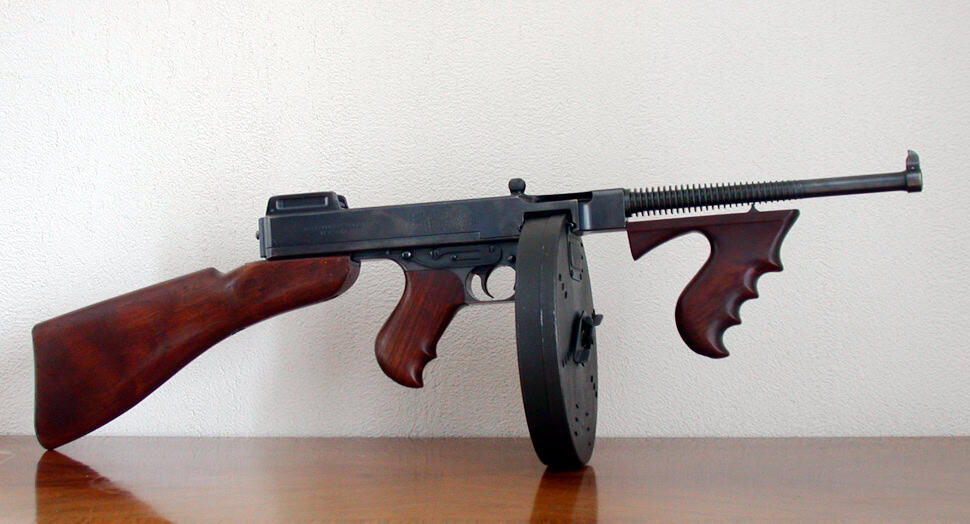
General John T. Thompson and the Birth of Auto-Ordnance
John Taliaferro Thompson wasn't some backyard tinkerer. He was a career U.S. Army officer, a graduate of West Point (Class of 1882), and he had spent decades in the Ordnance Department. Thompson oversaw the testing that led to the adoption of the .45 ACP cartridge and the M1911 pistol. He understood military procurement, he understood what soldiers needed, and he understood ballistic terminal performance better than almost anyone alive.
Thompson retired from the Army in 1914 as a colonel (he would later be promoted to brigadier general). By that point, World War I was tearing Europe apart, and Thompson was watching the carnage of trench warfare with a professional eye. He saw the problem clearly: soldiers needed a portable, fully automatic weapon that one man could carry and fire from the shoulder or hip. Machine guns were devastating but heavy and crew-served. Rifles were accurate but slow. Pistols were close-range only.
There was a gap in the middle, and Thompson intended to fill it.
In 1916, Thompson founded the Auto-Ordnance Corporation with financial backing from Thomas Fortune Ryan, a wealthy New York investor. The company's sole purpose was to develop what Thompson initially called a "trench broom" -- a handheld automatic weapon that could sweep enemy trenches clear of defenders. Thompson also coined the term "submachine gun" to describe this new class of weapon: a fully automatic firearm chambered in pistol caliber, smaller than a machine gun, designed for individual use.
The Blish Principle: Genius or Illusion?
Thompson's design hinged on a concept called the Blish Principle, developed by Commander John Bell Blish of the U.S. Navy. Blish had observed -- or believed he had observed -- that certain dissimilar metals would resist sliding against each other under high pressure but would slide freely under low pressure. He called this "adhesion of metals" and received a patent for it in 1915.
Thompson seized on the Blish Principle as the operating mechanism for his new weapon. The idea was that a bronze H-piece locking the bolt to the receiver would resist opening under the high pressure of firing, then release as pressure dropped, allowing the bolt to cycle. This would provide a delay that functioned like a locked-breech mechanism without the complexity of a true locking system.
Whether the Blish Principle actually works as described has been debated by engineers for a century. The modern consensus is that the Thompson operates essentially as an advanced primer ignition blowback system, and the bronze H-piece functions primarily as a friction delay rather than a true adhesion lock. In practical terms, it doesn't matter much -- the gun works, and it works reliably. But it is one of the more interesting cases in firearms history of a weapon succeeding despite its theoretical foundation being, at best, questionable.
A gun built on disputed science that ran like a sewing machine. There is a lesson in that somewhere.
The Model 1919 and 1921: A Gun Looking for a Customer
Theodore Eickhoff, Oscar Payne, and George Goll -- engineers working under Thompson at Auto-Ordnance -- built the first working prototypes in 1918 and 1919. The earliest version, dubbed the "Annihilator," was chambered in .45 ACP and used a delayed blowback action based on the Blish Principle. About 40 Model 1919 prototypes were produced.
The timing was terrible. The Armistice was signed on November 11, 1918, and the "trench broom" concept suddenly had no trenches to sweep. At an Auto-Ordnance board meeting in 1919, with the war over, the weapon was officially renamed the "Thompson Submachine Gun." Thompson needed a new market.
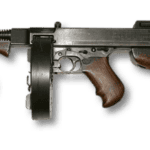
In 1920, Auto-Ordnance contracted with the Colt Patent Fire Arms Manufacturing Company in Hartford, Connecticut, to manufacture 15,000 Thompson Model 1921 submachine guns. The M1921 was a beautifully made weapon -- finely machined parts, quality walnut furniture, a blued finish that wouldn't look out of place on a sporting arm. It could accept either a 20-round box magazine or the distinctive 50- and 100-round drum magazines that would become its visual signature. The cyclic rate was approximately 800 rounds per minute.
The M1921 was also expensive. The retail price was $200 -- roughly equivalent to $3,200 today. For comparison, a Ford Model T cost about $310 at the time, and an M1911 pistol cost the government roughly $15-$20. Auto-Ordnance marketed the Thompson aggressively to law enforcement, the military, ranchers, and private security firms. Sales were slow. The gun was too expensive for most police departments, and the military saw no urgent need for a peacetime submachine gun.
Of those 15,000 guns manufactured by Colt, it took years to sell them all. Auto-Ordnance spent the 1920s hemorrhaging money. Thomas Fortune Ryan's investment wasn't paying off.
The Roaring Twenties: Gangsters, Bootleggers, and the Tommy Gun
The Eighteenth Amendment and the Volstead Act created Prohibition in 1920, and Prohibition created the organized crime empires that would make the Thompson famous for all the wrong reasons. Bootlegging was enormously profitable, competition was violent, and gangsters had the cash to buy expensive weaponry. The Thompson -- portable, devastating at close range, and available for purchase by anyone who walked into a hardware store with $200 -- was exactly the tool they needed.
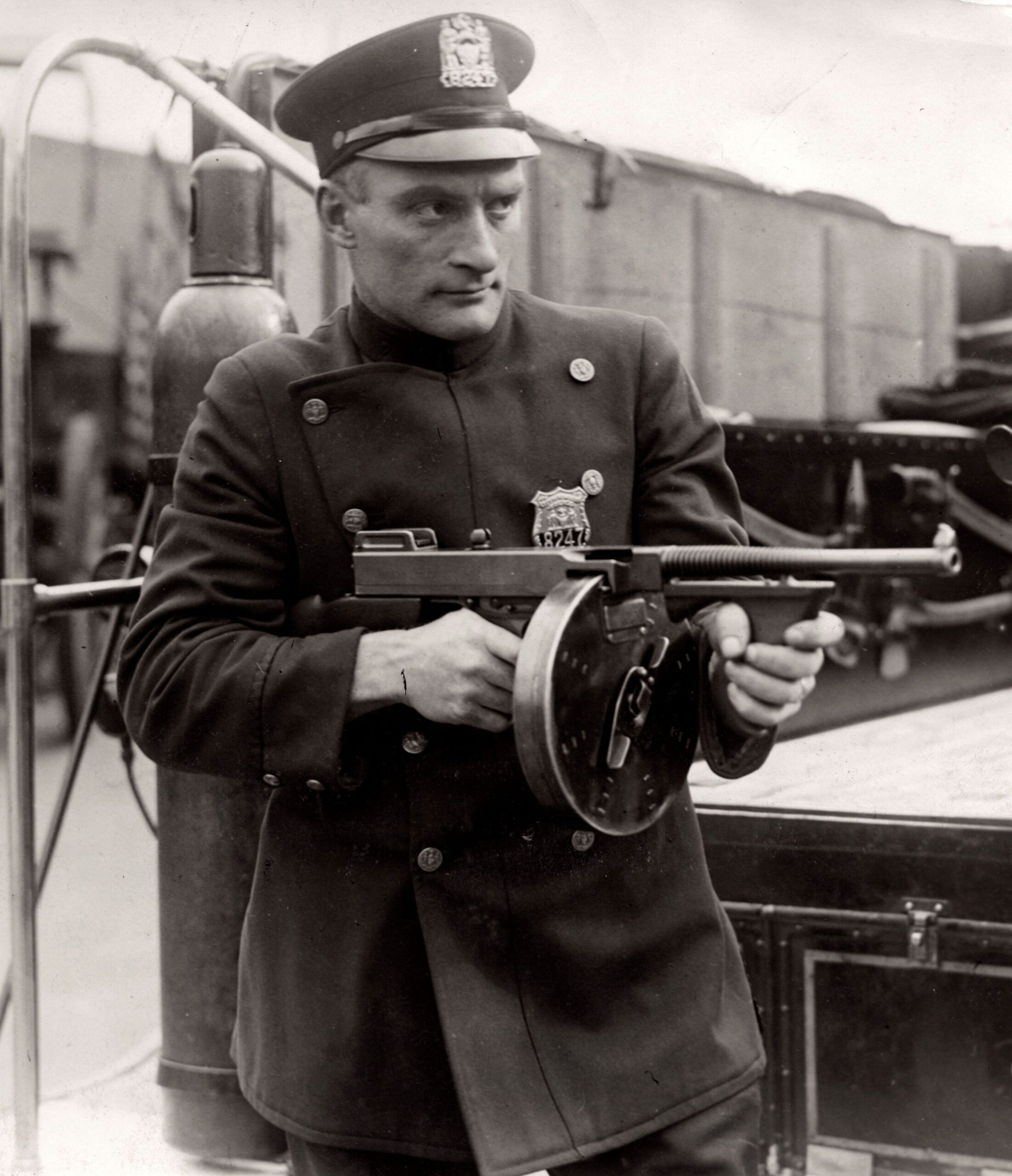
The Thompson first made national headlines during gang warfare in Chicago. Al Capone's organization and its rivals used Thompsons extensively. The newspapers dubbed it the "Tommy Gun," the "Chicago Typewriter," and the "Chopper." The weapon's profile -- especially with the drum magazine attached -- became an instantly recognizable symbol of Prohibition-era violence.
The most infamous event in the Thompson's criminal career was the St. Valentine's Day Massacre on February 14, 1929. Members of Capone's organization, disguised as police officers, lined up seven members and associates of Bugs Moran's North Side Gang in a garage at 2122 North Clark Street in Chicago and executed them. Two Thompson submachine guns and a shotgun were used in the killings. The massacre horrified the nation and became a turning point in public opinion about both organized crime and the availability of automatic weapons to civilians.
The irony was brutal for Auto-Ordnance. The company that couldn't sell its product to law enforcement and the military was now watching gangsters provide the most effective advertising campaign imaginable -- advertising that would eventually lead to legislation restricting the very product they were trying to sell.
The National Firearms Act of 1934
The Thompson's association with gangland violence was a major driver behind the National Firearms Act of 1934 (NFA), the first significant federal firearms regulation in American history. The NFA imposed a $200 tax on the transfer of machine guns, short-barreled rifles, short-barreled shotguns, and suppressors. That $200 tax was deliberately set to match the retail price of a Thompson -- the intent was to make the tax as expensive as the weapon itself, effectively pricing automatic weapons out of the hands of criminals.
The NFA didn't ban automatic weapons outright, but it created a registration and tax system that dramatically reduced civilian access. For Auto-Ordnance, which was already struggling to sell guns, it was another blow. The company's civilian market essentially evaporated overnight.
Military Adoption: The M1928A1
The military had been tinkering with the Thompson since the early 1920s. The U.S. Marine Corps purchased small numbers and used them in operations in Nicaragua and China during the late 1920s and 1930s. The M1928 variant -- essentially an M1921 with a reduced cyclic rate of about 600-725 rounds per minute, achieved by adding a heavier actuator -- became the standard military designation. The M1928A1 added a horizontal foregrip to replace the earlier pistol grip on the forend.
But the Thompson remained expensive and complicated to manufacture. Each gun required extensive machining. The receiver was milled from a solid block of steel. The Lyman adjustable rear sight and Cutts compensator added cost and complexity. The military liked the gun's firepower but balked at its price tag. As late as 1939, Auto-Ordnance was still trying to convince the War Department that the Thompson was worth the investment.
Then Germany invaded Poland on September 1, 1939, and everything changed.
The fall of France in June 1940, followed by the desperate British need for small arms after Dunkirk, created an urgent demand for automatic weapons that the existing supply couldn't meet. Britain placed large orders for Thompsons through Lend-Lease, and the U.S. military began ordering in quantity as rearmament accelerated.
The M1 and M1A1: Simplification for Total War
The M1928A1 was a superb weapon, but it was too expensive and too slow to manufacture for the demands of global war. In 1942, Auto-Ordnance and the Savage Arms Company (which had been brought in as a second manufacturer) introduced the simplified M1 Thompson.
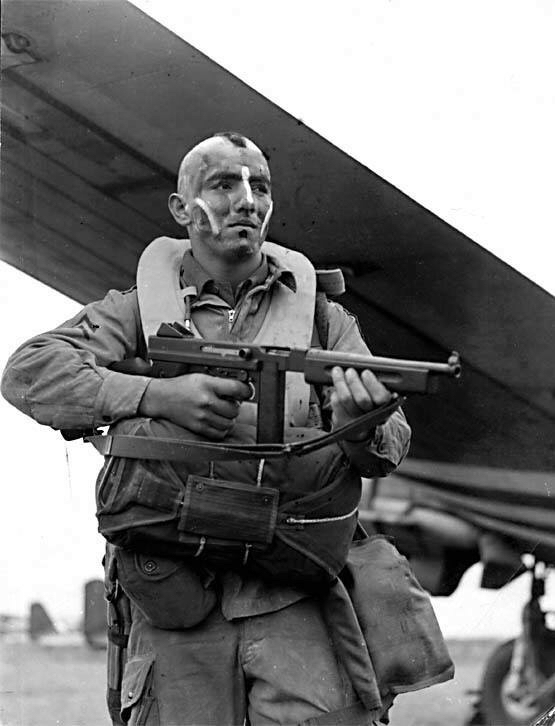
The M1 eliminated several features to speed production. The Blish lock and the H-piece were replaced by a simple blowback system -- proving that the Blish Principle wasn't actually necessary for the gun to function. The Cutts compensator was removed. The adjustable Lyman rear sight was replaced with a fixed aperture. The barrel fins were eliminated. Most importantly, the drum magazine was dropped entirely. The M1 accepted only the 20- and 30-round box magazines, which were cheaper to make, lighter to carry, and more reliable in combat. The drum magazines had a well-earned reputation for rattling, jamming, and being heavy even when empty.
The M1A1, which followed shortly after, simplified the design further by replacing the firing pin -- previously a separate, floating component -- with a fixed pin machined into the bolt face. This reduced the parts count and made production even faster.
Production numbers tell the story. Approximately 1.7 million Thompson submachine guns were produced during World War II. Of these, roughly 1,387,134 were the simplified M1 and M1A1 variants. Auto-Ordnance produced the majority of wartime Thompsons (approximately 848,000), with Savage Arms handling a significant share (approximately 539,000). The cost per gun dropped significantly, but the Thompson was never cheap -- even the simplified M1A1 cost approximately $45 each, compared to roughly $21 for the M3 "Grease Gun" that would eventually replace it.
Combat Performance: What Soldiers Thought
Soldiers generally loved the Thompson and hated carrying it. The gun was heavy -- about 10.8 pounds empty (closer to 11.75 pounds loaded with a 30-round magazine), and considerably more with the older drum. By comparison, a loaded M1 Garand weighed about 9.5 pounds. Adding several spare 30-round magazines (each weighing about 1.4 pounds loaded) to a soldier's kit turned the Thompson into a serious physical burden.
Pick one up sometime. The weight tells you something about the era that built it.
But in close combat, the Thompson was devastating. The .45 ACP round hit hard at the short ranges where submachine guns were used, and the Thompson's rate of fire -- controllable in short bursts -- gave a single soldier enormous firepower. The gun was used extensively in every theater: the Pacific islands, the North African desert, the hedgerows of Normandy, the forests of the Ardennes. It was a favorite of paratroopers, rangers, and NCOs.
The Thompson also had a reputation for reliability that was better than its competitors. It functioned well in the mud of European winters and the dust of North Africa, though the Pacific's humidity and coral sand could cause problems for any weapon. Compared to the M3 Grease Gun, which eventually replaced it, soldiers almost universally preferred the Thompson's balance, ergonomics, and build quality. The M3 was cheaper to make, but most troops considered it a step backward in everything except weight and production cost.
After the War: Cold War Service and Beyond
The Thompson continued in U.S. military service through the Korean War, where it was widely used by infantry, military police, and vehicle crews. It was officially replaced by the M3A1 Grease Gun in the late 1950s but lingered in reserve stocks and second-line units for years afterward. Some Thompsons saw service in Vietnam with South Vietnamese forces and U.S. advisors in the early years of the conflict.
Surplus Thompsons were distributed to allied nations around the world through military aid programs. They turned up in conflicts from Central America to Southeast Asia to the Middle East. The gun's durability ensured that it remained functional decades after manufacture -- Thompsons built in the 1940s were still being fired in anger well into the 1980s.
In the civilian world, original Thompsons became highly sought-after collectibles after the passage of the Firearm Owners Protection Act of 1986, which banned the civilian manufacture of new machine guns. The fixed supply of transferable Thompsons -- mostly M1921 and M1928 models -- has driven prices into the tens of thousands of dollars. A well-documented M1921 can sell for $30,000 to $50,000 or more at auction.
The Thompson Today
If you've read this far and find yourself wanting one, you're not alone -- and you don't need $30,000 or a time machine. Auto-Ordnance, the same company General Thompson founded in 1916, still exists. Kahr Arms acquired them in 1999 and moved production to Worcester, Massachusetts, where they manufacture semi-automatic-only reproductions of the Thompson available to civilians without an NFA tax stamp. Since these fire one round per trigger pull, they're legally rifles -- not machine guns -- and they're sold through standard FFL dealers like any other long gun.
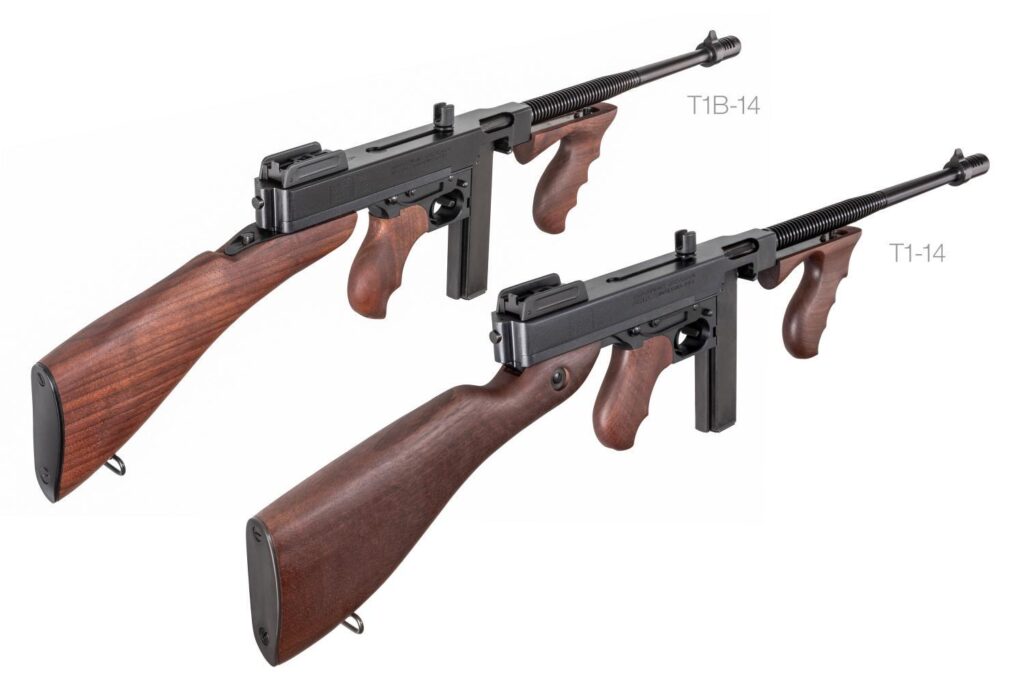
The current lineup includes several configurations, all chambered in .45 ACP. The T1-14 is the 1927A-1 Deluxe with a walnut fixed stock and vertical foregrip -- the classic Tommy Gun profile. It uses a finned 14.5-inch barrel with a permanently affixed Cutts compensator that brings the overall barrel length to 16.5 inches, meeting the federal rifle minimum. The T1B-14 swaps in a detachable buttstock, dropping the overall length to about 31.5 inches when the stock is removed. For shooters who want the look without hauling 12-plus pounds of steel and walnut, the 1927A-1C Lightweight uses an aluminum receiver and polymer furniture to cut weight to roughly 8 pounds -- its 16.5-inch barrel with compensator extends to 18 inches total. All of them ship with a 20-round stick magazine, though they'll accept the classic drum magazines too. MidwayUSA typically stocks several models if you want to compare what's currently available.
MSRP runs roughly $1,500 to $2,000 for base configurations with a stick magazine, depending on model -- though dealer pricing can run lower if you shop around. Deluxe packages with drum magazines push well past $2,000. That is real money for a pistol-caliber carbine, but it buys you a gun that feels like holding a piece of history -- the weight, the walnut, the distinctive profile. And as mentioned above, compared to what it costs to own an original transferable full-auto Thompson, a semi-auto reproduction starts to look like a bargain.
The Thompson's Legacy
The Thompson didn't start the submachine gun era -- the German MP 18, designed by Hugo Schmeisser and used in the last months of World War I, holds that distinction. But the Thompson defined what a submachine gun was supposed to be: a compact, powerful, select-fire weapon that gave individual soldiers automatic firepower at close range. Every SMG that followed -- the Sten, the MP 40, the PPSh-41, the MP5 -- exists in a conceptual space that Thompson and his engineers created.
The Thompson also holds a unique place in American culture. No other firearm is so thoroughly associated with both crime and heroism. It is simultaneously the weapon of Al Capone and the weapon of the soldiers who stormed Normandy. It appears on recruiting posters and in gangster movies. It is a symbol of lawlessness and a symbol of the fight against fascism. That duality -- beautiful and dangerous, beloved and feared -- is why the Tommy Gun endures in the American imagination long after it was replaced on the battlefield.
John Thompson died on June 21, 1940, at the age of 79, just as the weapon he had spent decades promoting was finally about to be produced in the quantities he had always envisioned. He never saw the Thompson become the standard-issue submachine gun of the world's most powerful military. He never saw it help win the war he'd spent his career preparing for. But the gun that bore his name did exactly what he had designed it to do: it gave the individual soldier overwhelming firepower at close range.
That was always the idea.
Further Reading
If you want to go deeper on the Thompson's history, these are worth your time:
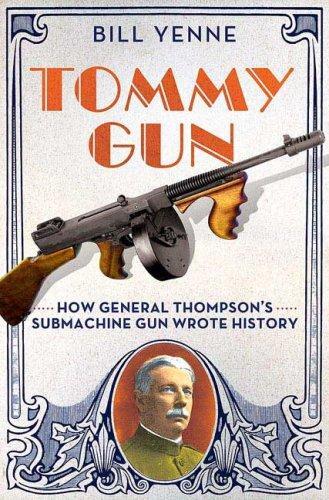
Tommy Gun: How General Thompson's Submachine Gun Wrote History by Bill Yenne -- An accessible, well-researched narrative history covering the full Thompson story from inception through WWII and beyond.
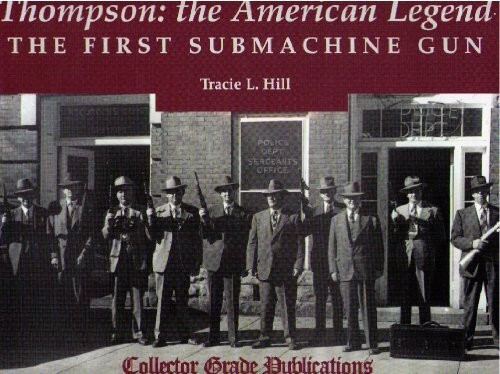
Thompson: The American Legend: The First Submachine Gun by Tracie L. Hill -- The definitive collector's reference, packed with technical details, variant identification, and serial number data.
The Thompson Submachine Gun by Roger A. Cox -- A solid historical account with extensive photographic documentation.
If you know of any forums or sites that should be referenced on this listing, please let us know here.