Disclosure: Powder & Lead may earn a commission on purchases made through affiliate links on this page, at no extra cost to you.
The .40 S&W history runs from a 1986 gunfight in Miami to a 2014 FBI memo that explained the Bureau’s return to the 9mm. Smith & Wesson and Winchester announced the cartridge in January 1990. It put the FBI’s reduced-power 10mm load into a case short enough for a 9mm-size pistol. For most of the next two decades it was the leading police handgun cartridge in the country. The account below draws on FBI records, the Sporting Arms and Ammunition Manufacturers’ Institute (SAAMI) drawing, trade reporting from 1987 on, and the accounts of people who took part.
Where the .40 S&W history begins: Miami, 1986
On the morning of April 11, 1986, FBI agents in three cars forced a stolen car off the road just outside Miami. Eight agents were directly involved. The two men inside, Michael Platt and William Matix, were wanted for a series of violent robberies. In the gunfight that followed, Special Agents Benjamin Grogan and Jerry Dove were killed and five other agents were wounded. Both robbers were wounded and kept firing. The FBI’s own account says: “Our guns had not stopped them.”
Bill Vanderpool, then an instructor in the FBI’s Firearms Training Unit (FTU), went to the scene with the team that studied how the agents’ training and equipment had performed. He wrote later that one shot stood out. A 9mm bullet fired by Agent Dove hit one of the robbers in the arm, passed into his chest and stopped short of the heart.
The FTU’s answer was to measure bullets. In September 1987 it brought wound ballistics specialists, including Dr. Martin Fackler of the Army’s wound ballistics laboratory, to the FBI Academy at Quantico for a three-day seminar. The participants agreed that a handgun bullet has to reach the large organs and blood vessels to stop someone reliably, and that this takes deep penetration. The FBI set 12 inches in 10 percent ballistic gelatin as the minimum and 18 inches as the desirable maximum. They could not agree on whether the 9mm or the .45 did it better.
The FTU then built a test series of eight events, including bare gelatin, heavy clothing, sheet steel, wallboard, plywood and windshield glass, and fired each cartridge type 40 times. In the meantime the Bureau adopted Winchester’s 147-grain subsonic 9mm hollow point as a stopgap, because it penetrated deeper than the lighter 9mm loads.
The 10mm and the FBI’s reduced load
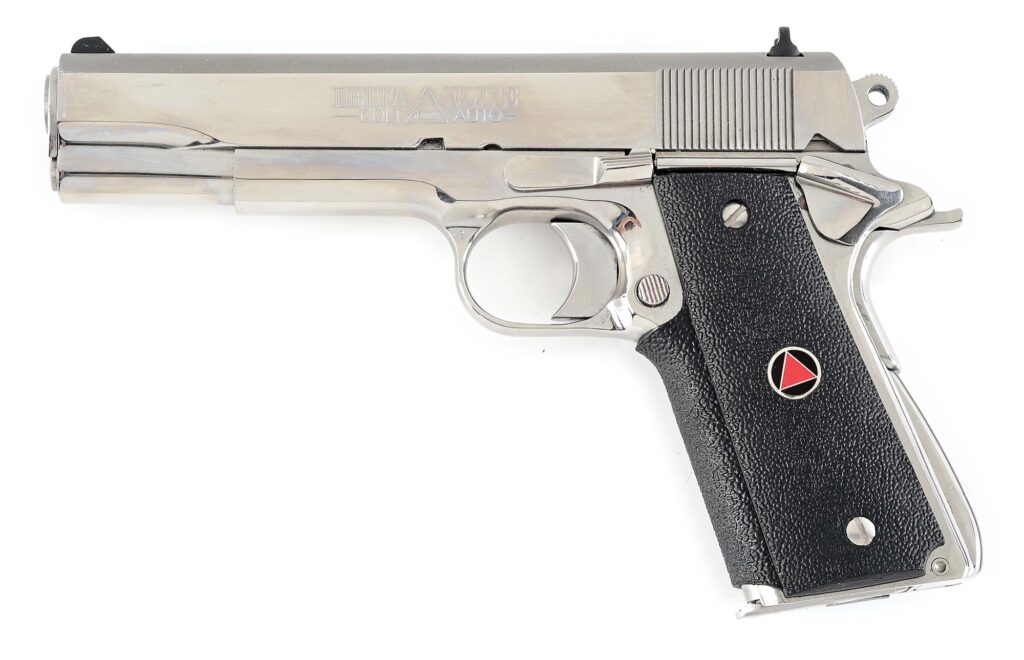
The 10mm Auto came from a different direction. It was developed in the early 1980s for the Bren Ten, a large double-action pistol from Dornaus & Dixon of Huntington Beach, California, with Jeff Cooper as consultant. American Rifleman’s Jeremiah Knupp credits Michael Dixon with designing the cartridge, Norma of Sweden with developing it and Cooper with naming it. Norma’s original load drove a 200-grain bullet at about 1,200 feet per second. Knupp dates the Bren Ten’s release to 1984 and the company’s closing to 1986, after about 1,500 pistols. The next year Colt chambered its Government Model for the round as the Delta Elite.
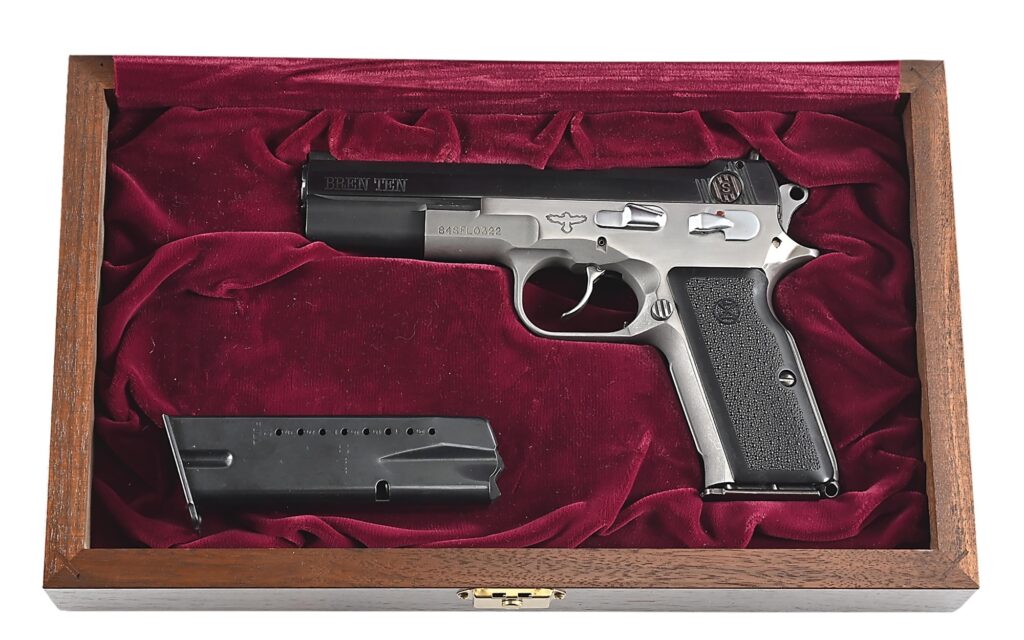
John C. Hall, the FTU agent who ran the pistol evaluation, described what happened next in the November 1989 FBI Law Enforcement Bulletin. The FTU tested commercial 10mm ammunition and found the heavy recoil and muzzle blast “tended to offset the otherwise excellent performance of the round.” The unit then made its own load: a 180-grain hollow point handloaded to 950 feet per second, about the same speed as the 9mm and .45 test rounds. Factory ammunition built to that specification followed. Knupp adds that the 10mm pistol in the original tests was Hall’s own Delta Elite.
Hall reported how many shots in each caliber reached the 12-inch minimum: 39 of 40 for the 10mm, 37 of 40 for the .45 and 27 of 40 for the 9mm. The FBI Director approved the 10mm as the new standard caliber. In January 1990 the FBI signed a contract with Smith & Wesson for the Model 1076, a large stainless 10mm pistol.
Building the .40 S&W: Smith & Wesson, Winchester and the Centimeter
A 10mm cartridge loaded to 950 feet per second leaves empty space in a long case, and the long case forces a large frame. A shorter .40 caliber cartridge for a 9mm-length pistol was an old idea by then.
The .40 G&A and the Centimeter
In 1972 Whit Collins of Guns & Ammo described a wildcat he called the .40 G&A in a two-part article in that magazine. Gunsmith John French built the test guns, first on a single-shot Martini action and then on a modified Browning Hi-Power. The cases were cut down and reamed from .30 Remington brass, and the bullet was the 180-grain .40 caliber bullet of the old .38-40 Winchester. Cameron Hopkins, in his 1990 history of the cartridge for American Handgunner, reported a velocity of 1,110 feet per second, and gave 1,050 elsewhere in the same article. Mike Wood, writing in the same magazine in 2019, ties the 1,110 figure to French’s Hi-Power.
After the 10mm Auto appeared, Collins went back to his idea using a trimmed 10mm case and renamed it the Centimeter. Pachmayr Gun Works considered offering it as the “10mm PGW.” According to Hopkins, Federal would load the ammunition only on a minimum order of 250,000 rounds, and Pachmayr dropped the project. Paul Liebenberg, a South African pistolsmith who had run Pachmayr’s custom shop, kept building Centimeter guns at his own shop, Pistol Dynamics. American Handgunner put one on its July/August 1987 cover, with an article on the cartridge by Collins.
The 1978 .40 B&S
Two Smith & Wesson men had tried a .40 of their own more than a decade earlier. In 1978 Dick Baker, an S&W engineer, and Norm Spencer, an S&W model maker, built a round they called the “.40 B&S.” Hopkins described it in 1990, Wood told the fuller story in 2019, and Dean Speir named both men in 2002 among those who had a part in the .40’s birth.
The sources differ on how the cases were made. Hopkins says they were turned from brass rod on a lathe in the S&W model shop and that a rebated rim gave nothing but problems. Wood, whose article shows Baker’s surviving cases, says Spencer machined them from .41 Magnum brass, with the rim cut down to fit a 9mm breech face. Wood says the bullet was pulled from a .38-40 cartridge; Hopkins says they tried both .38-40 and .41 Magnum bullets. Wood says the test gun was an S&W Model 59, the company’s 9mm, first with a smoothbore .40 barrel and then a rifled one.
Wood dates the first firing to April 28, 1978. That exact date, and Baker’s visit to Herman Bockstruck at Olin, Winchester’s parent company, in May 1978, rest on Wood’s 2019 account alone. By Wood’s account Bockstruck said Winchester could make the ammunition if S&W ordered it. Management turned the project down, and Wood says Baker retired in 1986 and was not on the 1989-90 team.
From a custom 5906 to a SAAMI drawing
Hopkins, who knew several of the people involved, gave the sequence in September 1990. Tom Campbell, a competition shooter who worked for Smith & Wesson, was a friend of Liebenberg’s. At the January 1989 SHOT Show, Hopkins saw a folder marked “Centimeter” in Campbell’s briefcase. By February 1989 Liebenberg had built a Smith & Wesson Model 5906, the company’s double-stack 9mm, chambered for the Centimeter.
The FBI’s coming pistol contract gave the project a target. The Bureau’s 10mm load and the Centimeter both launched a 180-grain hollow point at about 950 feet per second. Hopkins reports that S&W president Steve Melvin took the idea to Jerry Bersett of Winchester at a SAAMI meeting, and the two companies agreed on a secret joint development. Vanderpool, writing from the FBI side, says the Bureau did not know about it. To him the new cartridge was “a closely held secret between Smith & Wesson and Winchester.”
Two engineering changes came out of that work. S&W’s design team found that the large primer of the 10mm case could be struck by the ejector of a 5900-series pistol when the slide was drawn back over a loaded round. The new case was given a small pistol primer. It was also shortened from the Centimeter’s .865 inch to .850 inch to fit the 9mm pistol’s cycle length. Hopkins notes that this also kept the new round from chambering properly in guns built for the earlier wildcats.
SAAMI’s drawing for the “40 Smith & Wesson” carries the issue date February 1, 1990. Its case length is .850 inch, against .992 inch for the 10mm Automatic, whose drawing was issued on July 18, 1989. SAAMI sets the maximum average pressure for the .40 S&W at 35,000 psi, the same as the 9mm Luger and lower than the 10mm’s 37,500 psi.
January 1990: the 4006 and the race to market
Cameron Hopkins’s “Industry Insider” column in American Handgunner reported ahead of the 1990 SHOT Show that S&W would show “a brand-new cartridge that will be called the .40 S&W.” On January 17, 1990, at a conference room in Las Vegas, Smith & Wesson and Winchester announced the cartridge and the Model 4006 to fire it. Wiley Clapp writes that Tommy Campbell gave the presentation.
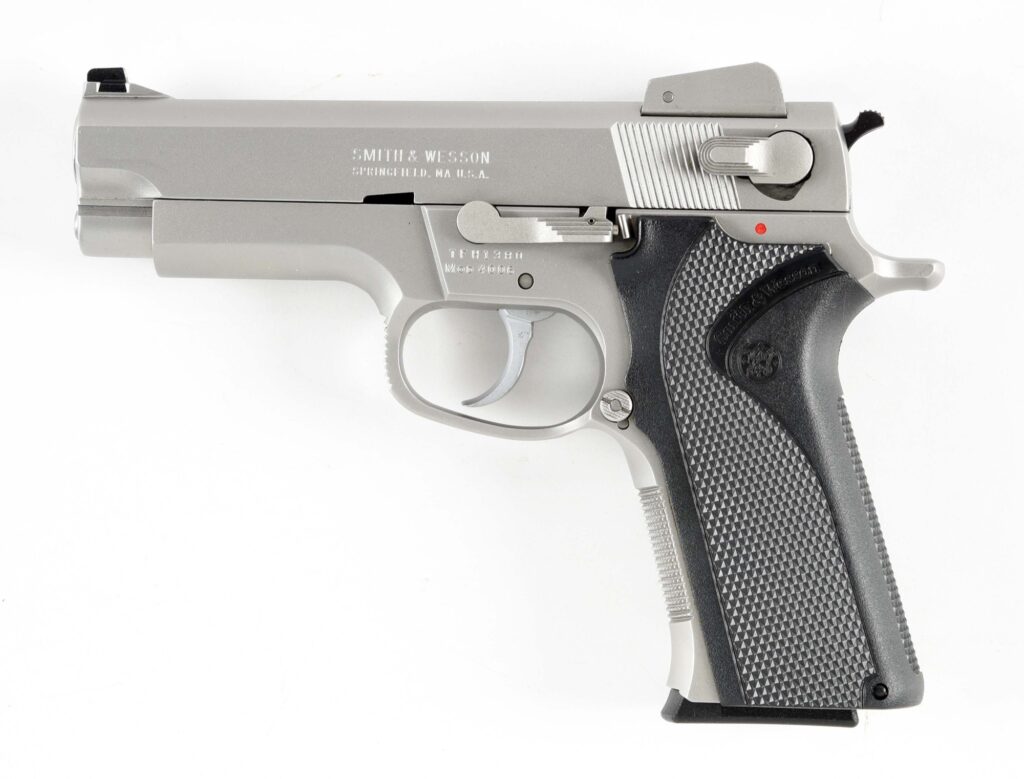
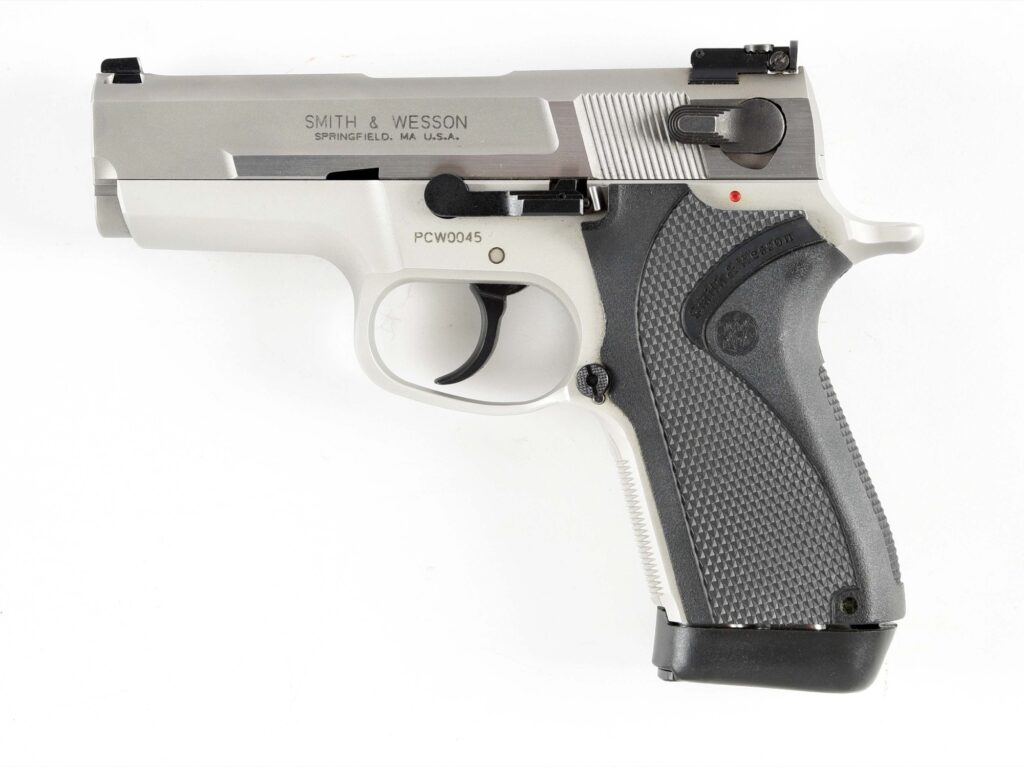
The 4006 was one of S&W’s stainless third-generation pistols, with a double-action first shot and an 11-round magazine. Winchester at first had the ammunition to itself. American Handgunner’s May/June 1990 issue listed two loads: a 180-grain hollow point at 990 feet per second and a 155-grain round nose at 1,150 feet per second. The custom shop opened as the S&W Performance Center, with Liebenberg and John French in charge.
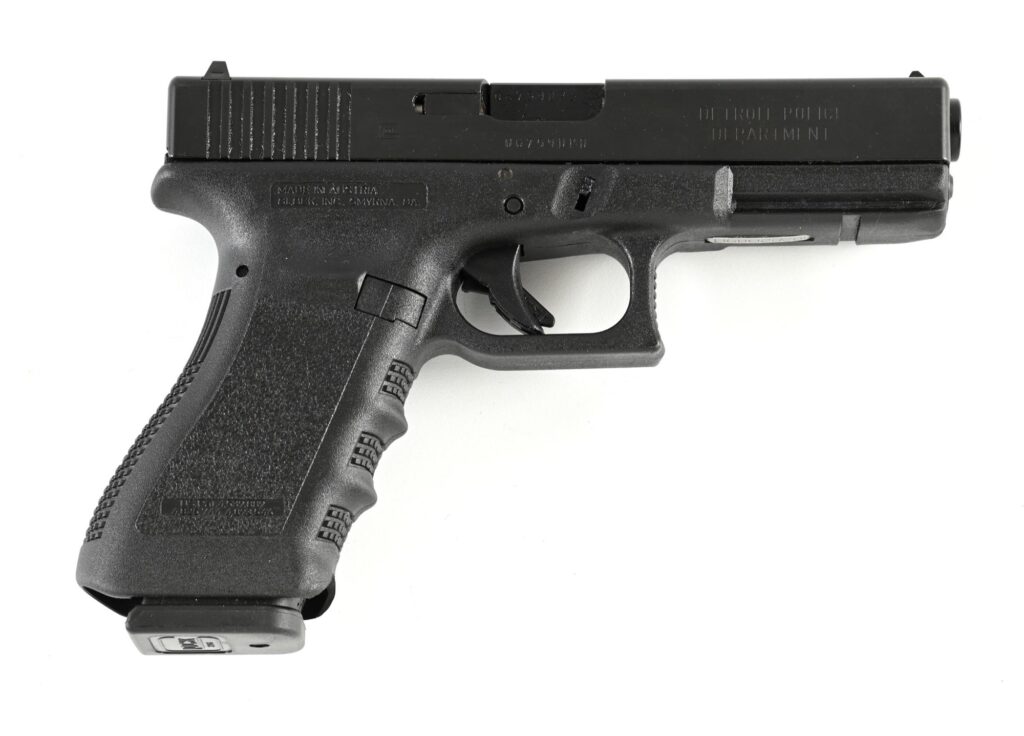
Clapp writes that “Glock actually got its pistols on the market before S&W.” Glock’s .40 caliber pistols were the Model 22 and the compact Model 23, the .40 versions of its 9mm Models 17 and 19.
What Smith & Wesson and Winchester knew
Smith & Wesson and Winchester presented the .40 S&W as their own joint design. A company release quoted by John Taffin in American Handgunner in early 1991 has Melvin recalling the time “we and Winchester decided to cooperatively develop the .40 S&W cartridge.” Charles Petty, who said he was involved with the cartridge “almost from the outset,” wrote in GUNS Magazine in 2005 that executives of both companies told him “the project was begun with a blank sheet of paper and a handshake” between Bersett and Melvin. Petty alone reports that Winchester ran its ammunition work under the code name “Swordfish.” He did not hide the earlier history: “There had been some work done with shortened 10mm brass,” he wrote. He described the brief as a round for S&W’s 9mm pistols that matched the FBI’s 180-grain load at 9mm pressure, and called the fit an “Amazing coincidence.”
Hopkins had drawn the same conclusion in 1990: “The coincidence was not exactly accidental.” The sources show what Smith & Wesson had in hand before the handshake.
- A working pistol. Hopkins dates Liebenberg’s Centimeter conversion of an S&W Model 5906 to February 1989 and prints a photograph of it with Collins. Wood’s 2019 account, a second and separate source, also describes the Centimeter 5906, and says that after Campbell had shot it with good results he took the proposal to S&W’s management. Hopkins is the only source on what Melvin himself knew: he writes that Melvin knew the Centimeter “works beautifully” in that pistol.
- The people. Campbell was an S&W employee. Liebenberg, by his own company’s account, “continued the technical development of the 40-caliber pistol cartridge that eventually became the 40 S&W” after 1986 and joined S&W in 1989. Hopkins reported before the January 1990 announcement that Liebenberg “has been doing research for Smith on this .40 S&W.” John French, who built the first .40 G&A guns in 1972, joined him at the Performance Center.
- Massad Ayoob’s accounts. In 2017 Ayoob credited Liebenberg, once he was at S&W, and Campbell with persuading the company to build the guns and Winchester to load the ammunition. In a remark only Ayoob reports, Liebenberg told him Collins “never got the credit he deserved for creating the Centimeter that morphed into the .40 S&W.” Writing in 2024, after Campbell’s death, Ayoob said Campbell, working with Liebenberg “among others,” turned “Paul’s wildcat Centimeter cartridge” into the .40 S&W.
- The trade press. The .40 G&A was on the cover of the June 1972 Guns & Ammo, and the Centimeter was American Handgunner’s July/August 1987 cover story. The FBI published its 180-grain, 950 feet per second standard in its own Law Enforcement Bulletin.
Winchester’s side is thinner, and what exists comes one source at a time. The FBI’s issue 10mm ammunition was made by Federal, according to Dean Speir and Richard Mann. Hopkins’s “Industry Insider” column reported in September 1990 that Winchester had also bid for that ammunition and lost to Federal despite the lower bid. Winchester filed a protest with the General Accounting Office and then withdrew it. Winchester therefore knew the FBI load in detail. Two earlier contacts with the .40 idea are on record, each from a single source. Hopkins says that when S&W brought Winchester in, it asked for a round that would cycle in its 5900-series pistols and told the company to “make a round like the Centimeter.” Wood alone records the earlier one: Baker’s 1978 visit to Olin, described above. No source found shows Winchester’s own engineers working on the Centimeter before 1989.
Two people link the 1978 project to the 1989-90 one. Dean Speir told DefenseReview’s David Crane in 2002 that Campbell and three S&W engineers, “Foley, Baker, and Spencer,” had a part in the .40’s birth. No other source found names Foley. Wood’s 2019 account, drawn from Baker’s papers and interviews, says Campbell was the test technician who fired the first 1978 round. Wood also relays Spencer’s recollection that the rifling broach made for the 1978 barrel was used to cut the first production 4006 barrels. Those two details rest on American Handgunner’s 2019 reporting alone.
How a .40 S&W fits a 9mm-size pistol
A semi-automatic pistol’s frame and slide are sized around the overall length of the cartridge. The 9mm Luger is short, and the 10mm and .45 ACP are long. A 10mm round loaded down to 950 feet per second does not need its full case. Cutting the case to .850 inch let the same .40 caliber bullet sit in a cartridge that fits a 9mm-length magazine and slide. Clapp notes that double-column 9mm magazines needed only a change to the feed lips, and sometimes the follower, to take the .40.
Hopkins noted in 1990 that the .40 case walls taper more sharply near the base than the 10mm’s, and the small primer pocket leaves more brass in the head. Charles Petty wrote in American Rifleman in 1991 that the cartridge was already “at or near the maximum pressure and recoil levels” that pistols of its size could take. He warned that “the .40 is emphatically not a small 10 mm.”
Capacity came down a little: Clapp gives the era’s typical figures as 15 to 17 rounds in a double-stack 9mm magazine and 11 to 12 in the .40 version of the same pistol.
The police decade
Petty, writing about a year and a half after the launch, contrasted the .40 S&W’s “phenomenal acceptance” with the slow start of most new cartridges. He listed the California Highway Patrol as the first major agency to adopt it. Hopkins’s column had reported in 1990 that the South Carolina State Police came first, with Glock 22s, and the California Highway Patrol second. Petty listed South Carolina’s State Law Enforcement Division next, then the Charlotte, North Carolina, police (the first large city department to buy .40 pistols) and the U.S. Border Patrol. By the 1991 SHOT Show, every major American ammunition maker had at least one .40 S&W load in production or on the way. By that September, Petty counted more than 50 agencies using it.
The FBI itself took longer. Its Model 1076 10mm pistols ran into reliability problems in service. In August 1991 S&W recalled its decocking 9mm, 10mm and .45 pistols, the 1076 among them. Vanderpool quotes the FTU’s September 5, 1991, report on the gun: “S&W has not demonstrated the ability to produce a reliable, durable weapon for the FBI.” The Bureau went back to SIG Sauer 9mm pistols as an interim measure. In May 1997 it adopted Glock pistols in .40 S&W for general agent use, Models 22 and 23, and first issued them to New Agent Class 98-1 in October 1997.
Federal law helped as well. Clapp points out that the 1994 limit of 10 rounds on newly made magazines applied to every caliber. That erased the 9mm’s capacity advantage for civilian buyers until the law expired in 2004.
Problems along the way
Richard Mann, who carried an issued .40 caliber Glock for 13 years as a police officer, described two problems in American Rifleman in 2013. Some pistols, Glocks in particular, left part of the case head unsupported above the feed ramp, and case-head failures followed. Officers who rechambered the same round day after day could push the bullet deeper into the case, which Mann writes “had the potential of doubling chamber pressures.” Stronger cases and firmer crimps addressed both. Patrick Sweeney added in 2018 that the standard 180-grain truncated-cone load penetrated far too deeply. Detroit’s police were required to carry full metal jacket ammunition in their .40 Glocks, and the rule changed only after incidents.
Why the FBI went back to the 9mm
On May 6, 2014, the FBI Training Division issued an executive summary for its law enforcement partners explaining a move back to the 9mm Luger. Since 2007, it said, premium 9mm bullets had improved enough that some were outperforming most premium .40 S&W and .45 Auto bullets in the FBI’s own tests. The summary listed the 9mm’s other advantages as “higher magazine capacities, less recoil, lower cost (both in ammunition and wear on the weapons) and higher functional reliability rates (in FBI weapons).” In a Bureau test of similar-sized Glock pistols, most shooters were faster and more accurate with the 9mm.
In June 2016 the FBI awarded Glock a contract for new service pistols. American Rifleman’s Mark Keefe noted at the time that FBI agents had carried Glock 22 or 23 pistols in .40 S&W since 1997. He added that many agencies were taking another look at the 9mm. New service pistols such as the Ruger American were coming out without a .40 version.
Claims and the record
Several popular accounts of the .40 S&W’s origin conflict with the documents. Each claim below is set against what the sources show.
Claim: Winchester and Smith & Wesson started the .40 S&W from a blank sheet. That is the executives’ account, as Petty reported it. Hopkins traced the concept to Collins’s .40 G&A and Centimeter. He traced the working prototype to Liebenberg’s 5906 and the engineering to Winchester and S&W. Clapp says S&W “followed up on an idea their custom shop had been playing with.”
Claim: The FBI downloaded the 10mm because agents could not handle the full-power round. Hall’s 1989 article shows that the FTU created the 950 feet per second load during testing, before the Bureau chose a pistol, because commercial loads kicked too hard in its trials. The reduced load came before the Bureau issued a single 10mm pistol.
Claim: The S&W 4006 was the first .40 S&W pistol on the market. The 4006 was the pistol S&W and Winchester announced with the cartridge on January 17, 1990. Clapp writes that Glock reached the market with its .40 pistols first, and Petty wrote in 2005 that “Glock actually was shipping pistols first.”
Claim: An S&W engineer designed the .40 in 1978 and the company ignored him. The 1978 .40 B&S was real and management did turn it down, as described above. Wood, the fullest source on it, says the two projects were independent. The links to 1989 that the sources describe run through people and, by Spencer’s account, one rifling broach.
Claim: The FBI dropped the .40 because it failed. The 2014 summary does not say that. It says better 9mm bullets had closed the gap in wound performance. It adds that the 9mm’s capacity, recoil, cost, reliability in FBI guns and shooter results made it the better choice.
Classic .40 S&W pistols still made
The pistols that carried the .40 S&W through its police years are still sold new. These links go to current listings at Guns.com:
- Glock G22 Gen 5. The full-size .40 Glock, with a 15-round magazine. The FBI issued the G22 from 1997.
- Glock G23 Gen 5 Compact MOS. The compact .40 Glock, with a 13-round magazine and a slide cut for an optic.
- Smith & Wesson M&P40 M2.0 Compact. Smith & Wesson’s current polymer-frame .40, with a 4-inch barrel and a 13-round magazine.
- Smith & Wesson M&P40 Shield M2.0. A single-stack carry pistol in .40 S&W with a 3.1-inch barrel.
Further reading
-

Cartridges of the World, 17th Edition: The Essential Guide to Cartridges for Shooters and Reloaders
Purchase on Amazon -
Sale!

Standard Catalog of Smith & Wesson, 5th Edition
Purchase on Amazon -

Winchester: An American Legend: The Official History of Winchester Firearms and Ammunition from 1849 to the Present
Purchase on Amazon
More on Powder & Lead
For the companies behind the cartridge and its best-known pistols, see our histories of Smith & Wesson and Glock. For the 9mm cartridge that the .40 challenged and then gave way to, see the Luger pistol and the 9mm Parabellum. For the pistol that set the pattern for big-bore service autos, see the 1911.
The Morphy Auctions (morphyauctions.com) catalog archive is one of the standout marketplaces for rare and historically significant American firearms. The pistols photographed on this page (the Smith & Wesson 4006, the Bren Ten, the Colt Delta Elite, the Shorty Forty and the Detroit Police Glock 22) come from their archive. Their sales are worth following whether you are buying, researching modern service pistols and their predecessors, or just looking at very good firearms photography.
Sources
- Federal Bureau of Investigation, “A Byte Out of History: Fatal Firefight in Miami,” April 11, 2011.
- John C. Hall, “The FBI’s 10mm Pistol,” FBI Law Enforcement Bulletin 58, no. 11 (November 1989): 2-8, NCJ 122334.
- Urey W. Patrick, Handgun Wounding Factors and Effectiveness, FBI Academy Firearms Training Unit, July 14, 1989 (copy at the Internet Archive).
- FBI Training Division, executive summary of the justification for the 9mm Luger, May 6, 2014, as reproduced by Soldier Systems Daily, September 25, 2014.
- SAAMI, ANSI/SAAMI Z299.3-2022, Centerfire Pistol and Revolver: 40 Smith & Wesson drawing (issued 02/01/1990) and 10mm Automatic drawing (issued 07/18/1989), and pressure tables.
- Bill Vanderpool, “10mm Handguns and the FBI,” Gun Digest, July 25, 2018.
- Bill Vanderpool, “A History of FBI Handguns,” American Rifleman, August 22, 2011.
- Whit Collins, “Centimeter: The Cartridge,” and Cameron Hopkins, “Centimeter: The Gun,” American Handgunner, July/August 1987.
- Cameron Hopkins, “Industry Insider,” American Handgunner, March/April 1990, and May/June 1990, and September/October 1990, p. 122.
- Cameron Hopkins, “.40 S&W,” American Handgunner, September/October 1990, pp. 75-78, 80, 83, 86.
- Charles E. Petty, “.40 S&W Ammo: Choices Aplenty,” American Rifleman, September 1991, reprinted April 9, 2015.
- Smith & Wesson release on the California Highway Patrol order, quoting Steve Melvin, in John Taffin’s article, American Handgunner, January/February 1991, p. 44.
- Charles E. Petty, “The .40 Smith & Wesson: this round came along at the right time in the right place,” GUNS Magazine, September 1, 2005.
- Massad Ayoob, “A Few Steps Down Memory Lane,” Backwoods Home Magazine blog, December 2017.
- Massad Ayoob, “The Legacy of Tommy Campbell,” GUNS Magazine, October 31, 2024.
- Pistol Dynamics, “About Paul,” accessed November 19, 2026.
- David Crane, “Pistol Dynamics Custom Retro .45 by Paul Liebenberg,” DefenseReview, May 1, 2002 (Dean Speir’s comments).
- Dean Speir, “The ‘.40 G&A’” (2006) and “10mm v. .40 S&W FAQ,” The Gun Zone, archived copies.
- Wiley Clapp, “The Short, Happy Life Of The .40 Smith & Wesson,” American Rifleman, February 22, 2025.
- Jeremiah Knupp, “Nine Lives of the 10 mm Auto,” American Rifleman, July 18, 2018.
- Richard Mann, “The .40 S&W,” American Rifleman, March 5, 2013.
- Patrick Sweeney, “The .40-Caliber Didn’t Meet Expectations,” America’s 1st Freedom, August 4, 2018.
- Mark A. Keefe IV, “Keefe Report: FBI Selects New Service Pistol,” American Rifleman, June 30, 2016.
- Mike Wood, “The .40 Story,” American Handgunner, posted November 5, 2019.
If you know of any forums or sites that should be referenced on this listing, please let us know here.