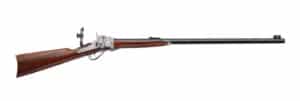
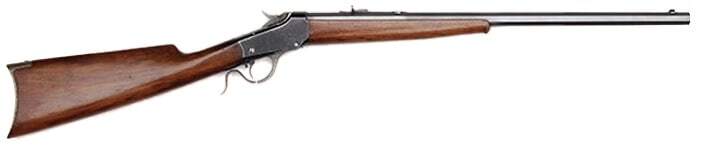
The High-Wall Rifle: An Icon of American Craftsmanship
The Winchester Model 1885 High-Wall is a single-shot falling block rifle designed by John Moses Browning and built by Winchester Repeating Arms from September 1885 to June 1920. Winchester made close to 140,000 of them and chambered them for 91 different cartridges, from .22 rimfire up to the .50-110 and the .577 Eley.
Two things account for the rifle’s reputation. The falling block action is very strong, strong enough that Winchester used it in the factory to test new rifle cartridges. And the rifle shoots well, which is why target shooters bought it in numbers and why shooters still buy reproductions of it today.
Origins and Design by John Browning
Browning built his first falling block single-shot in 1878, at the age of 23, in his father’s shop in Ogden, Utah. He filed his application for an improvement in breech-loading firearms in May 1879 and received U.S. Patent No. 220,271 on October 7, 1879. He and his brothers went on to make roughly 600 of the rifles by hand.
In 1883 Thomas G. Bennett, vice president and general manager of Winchester Repeating Arms, traveled to Ogden and bought the rights to the design for $8,000. Winchester’s engineers angled the face of the breechblock by six degrees to give a positive breech seal, and the rifle went on sale in 1885 as the Winchester Model 1885. Winchester’s own catalogs simply called it the Single Shot Rifle.
It was a different animal from the rifle most people associate with the Winchester name in that period. The Model 1873 was a lever-action repeater built around pistol-size cartridges. The Model 1885 was a single-shot built for full-power rifle cartridges, and it competed against the other strong single-shots of the day, the Sharps and the Remington Rolling Block.
Falling Block Action: Where the Strength Comes From
Lower the lever and the breechblock drops straight down in its slot, opening the chamber for loading and unloading. Close the lever and the block rises and locks behind the cartridge, with the full thickness of the receiver walls behind it. There is no bolt and no locking lug to stretch, and nothing in the action moves once the block is up.
Advantages of the Falling Block Design:
- Strength – Winchester used the action to test new rifle cartridges, which is a fair measure of what it would take.
- Consistent lockup – No bolt to flex and no carrier or magazine to move, so the cartridge sits the same way in the chamber every shot.
- Simple operation – Few moving parts, and nothing to work but the lever and the hammer.
- Range of cartridges – The same basic frame handled .22 rimfire in the Low-Wall and the heaviest black powder rounds Winchester sold in the High-Wall.
High-Wall vs. Low-Wall Variants
The names describe the receiver. The Model 1885 was made on two basic frames:
- High-Wall – The sidewalls rise high enough that only the top of the breechblock shows. That extra steel supports the block and takes the powerful rifle cartridges, including the .45-70 Govt., .50-110 and .38-55.
- Low-Wall – The sidewalls are cut down and roughly a third of the breechblock is exposed. This frame took the rimfire and pistol cartridges such as .22 LR, .32-20 and .25-20, which suited small game and target work.
Hunters and target shooters who wanted the heavy cartridges bought the High-Wall. It was a black powder rifle when it was introduced, and it carried the black powder rounds of the 1880s and 1890s. The smokeless chamberings came later in the production run, not at the start.
Cartridge Selection and Performance
Ninety-one cartridges passed through the Model 1885 over 35 years of production, more than any other Winchester rifle. A handful accounted for most of the sales:
- .32-40 Winchester – A target round with mild recoil, a favorite in Schuetzen shooting.
- .38-55 Winchester – Accurate, and heavy enough for deer.
- .40-70 – A black powder cartridge for larger game.
- .45-70 Govt. – The standard heavy American black powder cartridge of the period.
- .50-110 Winchester – One of the heaviest rounds Winchester put in the frame, sold for big game.
- .30-40 Krag – One of the early smokeless rounds added in the later production years.
The list ran a long way past those. Winchester also offered the .40-90, .45-90, .45-120, and the .577 Eley on the black powder side, and the .30 W.C.F., .303 British, .32 Winchester Special and .405 W.C.F. once smokeless ammunition was established. That spread is why one design served for varmints, deer, and the largest North American game.
Accuracy and Precision Engineering
The High-Wall built its name at the target range, and several features are behind that:
- Rigid lockup – The falling block holds the cartridge in the same place shot after shot.
- Barrel choice – Winchester would fit barrels from 14 to 36 inches on special order. Target rifles were usually ordered at the long, heavy end of that range, which lengthens the sight radius and steadies the rifle.
- Set triggers – Double-set triggers were a factory option, and match rifles generally had them. The shooter sets the trigger for a very light break.
- Target sights and scopes – Wind gauge front sights, tang sights and telescopes were all on the special order list.
Winchester cataloged a Schuetzen Rifle on the High-Wall frame, and the rifle was aimed at the long-range match shooting of the Creedmoor era. Major Ned H. Roberts, who shot and wrote about single-shots for decades, called it the most reliable, strongest and altogether best single-shot rifle ever produced.
Craftsmanship and Aesthetics
A plain sporting rifle was exactly that, plain. The walnut, the checkering, the carving and the engraving were special order items, along with nickel, silver and gold plating and takedown construction. That is worth knowing before you value one. A High-Wall with factory engraving and carved stocks is a rifle somebody paid extra for in the 1890s, and it is the kind collectors chase now.
Military Contracts and Match Rifles
The Model 1885 was never a general service rifle. Its government work was training. Winchester built large numbers of the rifle in .22 as the Winder musket, used by the U.S. Army for marksmanship instruction.
There were also small batches for competition. Winchester made 40 High-Walls in .30-06 Springfield with close-coupled double-set triggers and wind gauge front sights, and shipped 25 of them to Camp Perry in August 1913. These were match rifles for the national matches rather than an experiment in military adoption, and they show the action taking a modern high-pressure smokeless cartridge without complaint.
Modern Reproductions and Continued Legacy
You do not have to buy an antique to shoot one. Several makers build the High-Wall now:
- Uberti – Italian-made reproductions with case-hardened frames, 30 inch and 32 inch barrels, chambered in .45-70, .45-90 and .45-120.
- C. Sharps Arms – American-made rifles built in Big Timber, Montana, with receivers machined from billet steel and finished by hand, and a long special order list of its own.
- Browning and Winchester – Modern High-Wall variants in smokeless chamberings, built with modern steels. Winchester’s are made by Miroku in Japan, and the 2005 Limited Series covered rounds like .243 Winchester and .30-06 Springfield alongside .38-55, .45-70 and .45-90.
Davide Pedersoli builds a version as well. Between them these rifles cover both camps, the hunter who wants a single-shot in a modern cartridge and the black powder cartridge shooter who wants the original chamberings and the long barrel.
Why the High-Wall Remains a Favorite Today
A design from 1885 does not stay in production this long by accident. The reasons are straightforward:
- Strength – The action handles black powder cartridges and high-pressure modern ones.
- Accuracy – Still competitive in black powder cartridge and Schuetzen matches.
- Craftsmanship – The special order options produced rifles that are worth looking at, not just shooting.
- Historical significance – Browning’s first patented design, and the start of a working relationship with Winchester that ran to 1902.
- Versatility – Hunting, long-range target shooting and formal competition, in one frame.
Conclusion
The Winchester Model 1885 High-Wall was Browning’s first design to reach the market in quantity, and it held its place for 35 years and nearly 140,000 rifles. Strong action, long barrel, one cartridge at a time, and a factory willing to build it to order. Whether you keep one in the safe as a collector’s piece or carry a reproduction into the field, the appeal is the same now as it was in 1885.
Read more here:
-

Shooting Buffalo Rifles of the Old West
Purchase on Amazon -

The history of Winchester firearms, 1866-1975
Purchase on Amazon -
Sale!

Winchester: An American Legend: The Official History of Winchester Firearms and Ammunition from 1849 to the Present
Original price was: $65.00.$61.94Current price is: $61.94. Purchase on Amazon
Discussions on the High-wall Rifle can be found here.
If you know of any forums or sites that should be referenced on this listing, please let us know here.