Best Hearing Protection for Shooting: 2026 Top Picks
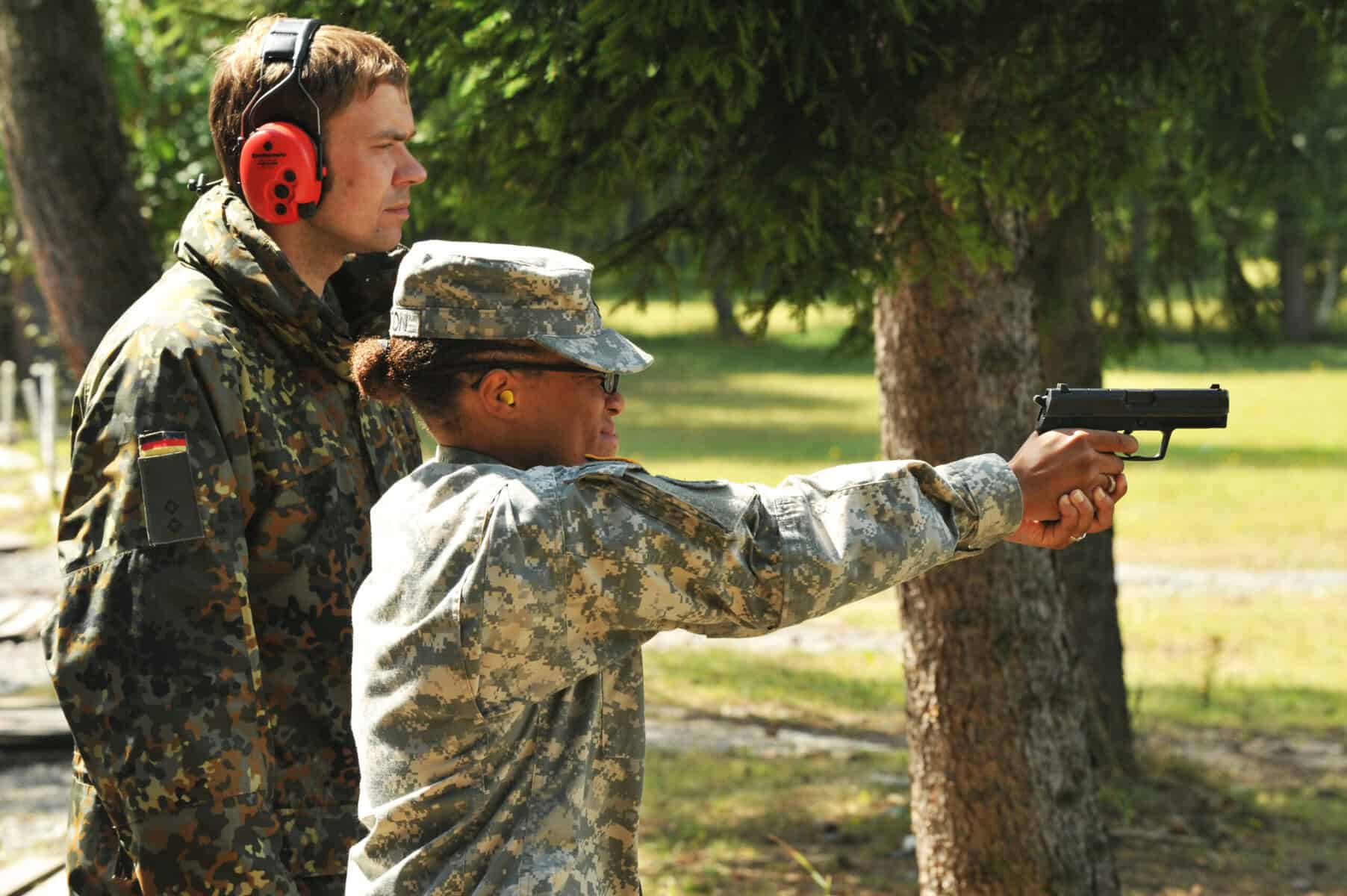
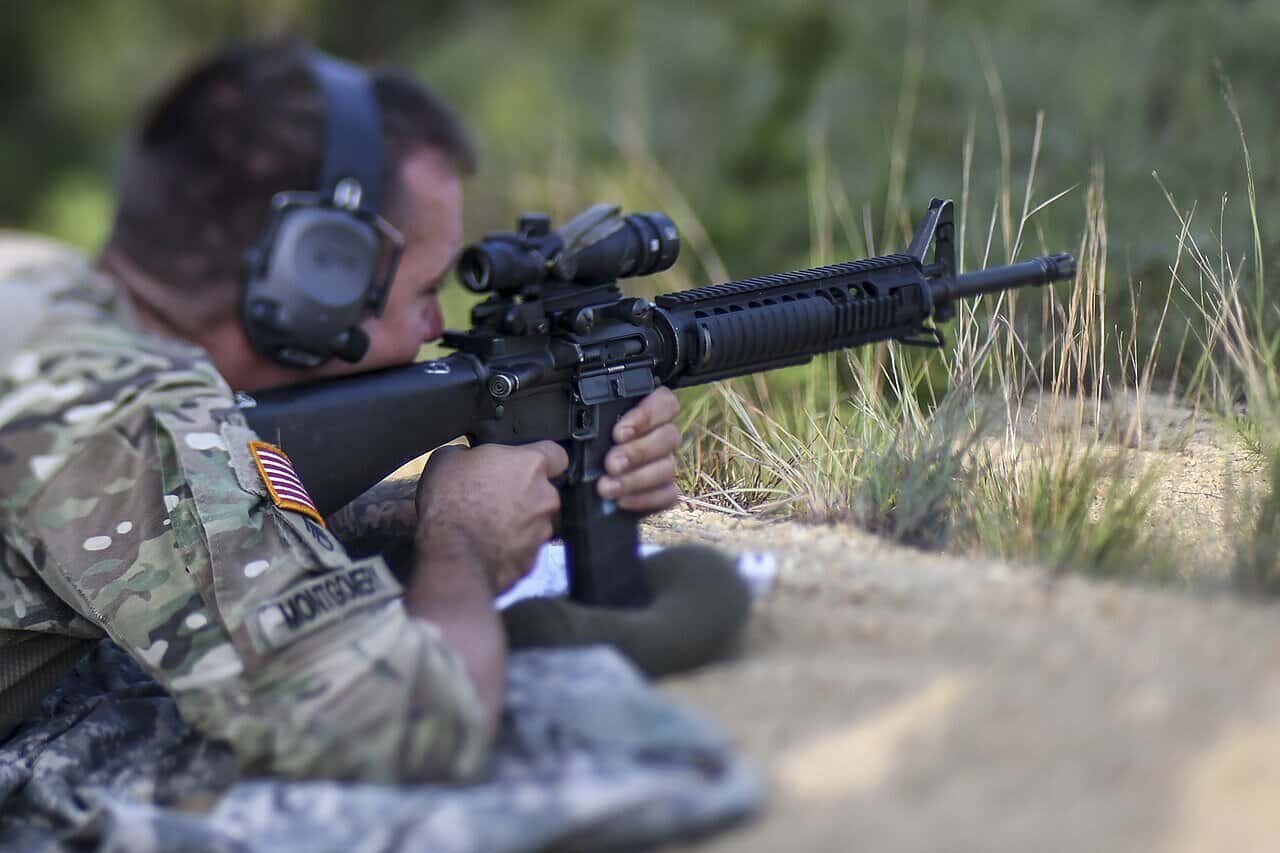
U.S. Department of Defense photo by Markus Rauchenberger (public domain)
Hearing damage from gunfire is permanent, cumulative, and completely preventable. A single unprotected shot from a rifle generates 140-175 decibels — well above the 85 dB threshold where damage begins. Whether you shoot at an indoor range, hunt in the field, or run drills at a carbine class, the right hearing protection is not optional gear. It is the single most important piece of safety equipment you own. This guide covers the best options available in 2026, from budget-friendly passive plugs to premium electronic earmuffs.
Affiliate Disclosure: Powder & Lead is a participant in the Amazon Services LLC Associates Program and other affiliate programs including AvantLink (Brownells, MidwayUSA). This means we earn a small commission when you purchase through our links at no additional cost to you. This helps us keep producing honest, in-depth gear reviews. All recommendations are based on our own research — we only recommend products we would use ourselves. Full disclosure.
Quick Comparison: Best Hearing Protection for Shooting
Dual protection note: For indoor ranges, magnum calibers, muzzle brakes, or any shooting environment above 160 dB, we strongly recommend doubling up: in-ear plugs underneath electronic earmuffs. The combined NRR is not additive — per OSHA guidance, the effective combined NRR is approximately the higher rating plus 5 dB. Doubling up is the gold standard for maximum hearing protection.
Detailed Reviews: Best Hearing Protection for Shooting
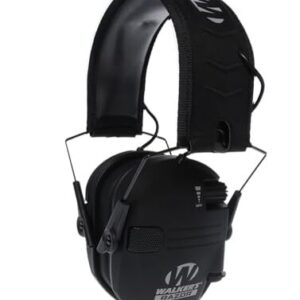
The Walker’s Razor Slim has become the single most popular electronic shooting earmuff in America, and the reasons are straightforward: a slim profile that works with rifle stocks, sound-activated compression that reacts faster than human perception, and a price point that makes electronic protection accessible to every shooter.
NRR:
23 dB
Type:
Electronic over-ear earmuff
Power Source:
2x AAA batteries
Microphones:
2 omnidirectional (stereo)
Compression:
Sound-activated, 0.02-second response time
Audio Input:
3.5mm AUX jack
Weight:
Approximately 7.5 oz
What We Like
Ultra-slim ear cup profile — best-in-class for rifle cheek weld clearance
NRR 23 edges out the competition in this price tier
Available in dozens of colors and camo patterns (great for family members who want options)
Sound-activated compression is fast and reliable
AUX input for connecting phone or radio
Widely available at virtually every firearms retailer
What We Don’t
Foam ear cushions compress with heavy use and should be replaced annually
Voice amplification can sound slightly tinny at higher volume settings
NRR 23 is adequate for outdoor ranges but marginal for indoor ranges — double up indoors
No Bluetooth connectivity (available on some newer Walker’s models at higher price points)
Wind noise is noticeable at high amplification settings outdoors
Best For: Rifle shooters who need slim-profile muffs for cheek weld. Outdoor range use with standard calibers (.22 LR, 9mm, .223, .308). Hunters who want electronic awareness at a reasonable price. Shooters who want color/pattern options. Excellent first electronic earmuff for any shooter.
Pro Tip: The foam ear cushions on the Razor Slim compress over time — swap them for gel ear pads and it is like getting a new set of muffs. Gel pads seal better, feel cooler during long sessions, and last longer than the stock foam. Walker’s makes their own gel replacements: Walker’s Gel Filled Ear Pads. There are also solid third-party options at a lower price point: PROHEAR Gel Ear Pads. Either way, your ears and your comfort will thank you.
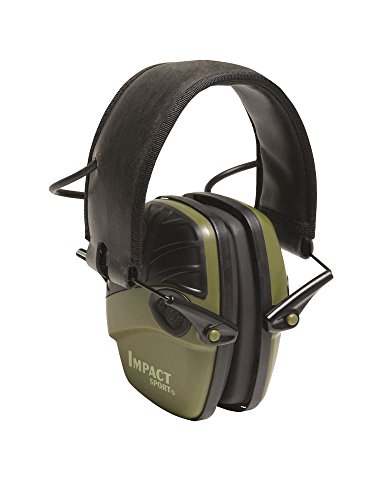
The Howard Leight Impact Sport is the industry standard electronic shooting earmuff — and has been for over a decade. Ask any ten experienced shooters what electronic ear pro they recommend for a beginner, and at least half will say “Impact Sport” before you finish the question. There is a reason these are ubiquitous at every range in America: they work, they last, and the price makes it almost irresponsible to shoot without electronic protection.
Honeywell’s Air Flow Control technology manages the sound compression system, using directional microphones to deliver stereo ambient sound with spatial awareness — you can tell where a sound is coming from, not just that it exists. The automatic noise cutoff activates at 82 dB with a 0.02-second response time, blocking impulse noise from gunshots while allowing normal conversation to pass through uninterrupted. A four-hour automatic shutoff prevents dead batteries from leaving you unprotected (though with a 350-hour battery life on two AAA batteries, you will rarely think about power).
NRR:
22 dB
Type:
Electronic over-ear earmuff
Power Source:
2x AAA batteries (~350 hours battery life)
Microphones:
2 directional (stereo)
Compression:
Air Flow Control, 82 dB cutoff, 0.02-second response
Audio Input:
3.5mm AUX jack
Auto Shutoff:
4 hours
Weight:
Approximately 10.6 oz
What We Like
350-hour battery life on AAA batteries is exceptional — charge anxiety is nonexistent
Directional stereo microphones let you locate the source of sounds
4-hour auto-shutoff is a smart safety feature
AUX input for music or podcasts during range sessions
Decade-plus track record of reliability — the most battle-tested consumer shooting muff available
Replacement ear cushions are widely available and inexpensive
What We Don’t
NRR 22 is on the lower end — adequate for outdoor ranges, but double up indoors
Slightly bulkier profile than the Walker’s Razor Slim — can interfere more with rifle cheek weld
Foam ear cushions degrade with regular use; plan to replace them annually
Wind noise at high amplification outdoors
No Bluetooth (the Impact Sport Bolt model adds Bluetooth at a higher price)
Best For: Every shooter’s first electronic earmuff. Outdoor range sessions with standard calibers. Range regulars who value proven reliability. Shooters on a budget who want electronic amplification and compression without compromise on the fundamentals.
Bluetooth connectivity is seamlessly integrated. Pair your phone once, and you can take calls, stream music, or listen to a podcast between strings of fire. When a shot is fired, the audio cuts instantly as the compression system engages, then resumes automatically once the impulse has passed. It is the kind of feature that sounds like a gimmick until you use it, and then you cannot go back.
NRR:
26 dB
Type:
Electronic over-ear earmuff
Power Source:
2x AAA batteries (~40 hours with Bluetooth active)
Bluetooth:
Yes (Bluetooth connectivity for calls and audio)
Microphones:
Recessed for wind noise reduction
Special Features:
Clear Voice Tracking, dynamic suppression time
Ear Cushions:
Foam (included; aftermarket gel upgrade available)
Weight:
Approximately 12.5 oz
What We Like
NRR 26 is the highest of any earmuff on this list — adequate for indoor ranges without doubling up in most situations
Bluetooth integration is seamless and genuinely useful
Clear Voice Tracking makes range commands and conversation noticeably clearer
Foam ear cushions are comfortable out of the box, and aftermarket gel upgrades seal even better around glasses
Dynamic suppression adapts to sustained vs. impulse noise
What We Don’t
Battery life drops to approximately 40 hours with Bluetooth active — a significant step down from the Impact Sport’s 350 hours
Nearly double the price of the budget electronic muffs
Bluetooth pairing can occasionally be finicky
Heavier than the Walker’s Razor Slim and Howard Leight Impact Sport
Best For: Indoor range shooters who want the highest muff NRR without always doubling up. Shooters who want Bluetooth for phone calls or audio streaming. Competition shooters who need the clearest possible range commands. Anyone who wants the best overall electronic earmuff under $100.
The design is simple and clever. Each earplug has a removable filter cap. With the caps open, the tuned acoustic port allows low-energy sounds — conversation, range commands, environmental awareness — to pass through while still attenuating high-energy impulse noise. With the caps closed (inserted), you get full passive isolation at the rated NRR 24 dB. You choose your protection level based on your environment, and you switch between them in seconds.
The triple-flange design, made from medical-grade polymer, creates a reliable and comfortable seal in most ear canals. Unlike foam plugs that require rolling, compressing, and careful insertion, the SureFire EP4s insert with a simple push and twist. They are reusable, washable, and will last for years with basic care. At their price point, they are among the best values in all of shooting accessories.
Filter bypass system provides genuine ambient sound awareness in open mode — conversation and range commands come through
No batteries, no electronics, no charging — always ready
Reusable for years with soap-and-water cleaning
Low-profile design works perfectly underneath electronic earmuffs for dual protection
Comfortable for all-day wear — medical-grade polymer is soft and hypoallergenic
Outstanding value — essentially free over time compared to disposable foam
What We Don’t
No sound amplification — ambient sound in open mode is muffled compared to unprotected hearing
Filter caps are small and easy to lose if removed in the field
Ear canal anatomy varies — not every shooter achieves a perfect seal with flanged plugs
Must be sized correctly; ordering the wrong size means no seal and no protection
Best For: Budget-conscious shooters who want better-than-foam protection with ambient sound capability. Hunters who need quiet, lightweight ear protection. The ideal “inner layer” for doubling up under electronic earmuffs. Backup ear pro that lives permanently in your range bag. Shooters who find earmuffs uncomfortable.
No cheek weld interference. No conflict with shooting glasses. No bulk under hats or helmets. No headband pressing down on your head during a four-hour range session. For rifle shooters especially, the ergonomic advantages of electronic earbuds over earmuffs are dramatic and immediate. If you are still building out your setup, check out our picks for the best .22 LR rifles in 2026.
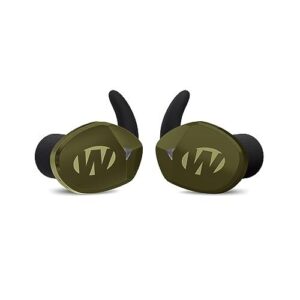
The Silencer 2.0 uses electronic processors to amplify ambient sounds — conversation, range commands, game movement — to natural listening levels through integrated speakers. When a gunshot impulse exceeds the safe threshold, compression engages instantly, reducing the harmful noise while maintaining the NRR 24 protection provided by the physical seal of the ear tips.
NRR:
24 dB
Type:
Electronic in-ear earbud
Power Source:
Rechargeable lithium-ion (with charging case)
Microphones:
Integrated for ambient sound pickup
Compression:
Sound-activated electronic compression
Features:
Rechargeable, multiple ear tip sizes, compact carrying case
Weight:
Approximately 1 oz (combined)
What We Like
Zero interference with rifle cheek weld — the single biggest advantage over muffs for long gun shooters
No conflict with shooting glasses, hats, helmets, or communication headsets
Compact and lightweight — you barely notice them after a few minutes
NRR 24 provides solid protection for outdoor shooting
Ideal for hunters who need electronic awareness in a nearly invisible form factor
What We Don’t
Price is significantly higher than electronic earmuffs of comparable NRR
In-ear devices require a good ear tip seal to achieve rated NRR — fit is critical
Sound spatialization is less natural than over-ear muffs (sounds originate inside your head rather than directionalized)
Electronic components in an earbud are inherently less durable than the simpler mechanics of earmuffs
Rechargeable battery means you must remember to charge before range day
Easier to lose or drop than earmuffs
Best For: Rifle shooters who struggle with earmuff cheek weld interference. Shooters who wear prescription glasses or eye protection. Hunters who want electronic amplification in a nearly invisible package. Anyone who finds over-ear earmuffs uncomfortable for extended sessions. Competition shooters running rifles or shotguns.
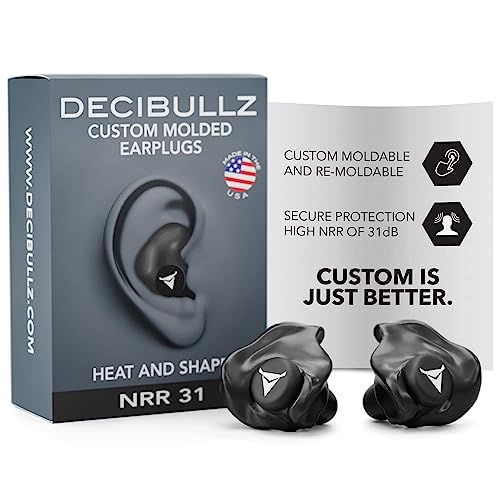
If universal-fit earplugs have never worked for you — if foam plugs slowly work their way out of your ear canal, if flanged plugs never quite seal right — Decibullz may be the solution. These are thermoplastic earplugs that you custom-mold to the unique shape of your individual ears using nothing more than a pot of boiling water and a few minutes of patience.
The payoff for that custom fit is the highest NRR on this list: 31 dB. Because the seal is formed to your specific ear anatomy, there are no gaps, no slow migration out of the canal, and no inconsistency between one wearing and the next. That consistent, high-NRR seal makes Decibullz particularly effective as the inner layer of a dual-protection setup — Decibullz underneath electronic earmuffs is one of the highest-protection combinations available without going to professional-grade custom-molded hearing protection.
Thermoplastic custom-mold body with silicone ear tips
Remoldable:
Yes, unlimited times
Colors:
Multiple options available
Weight:
Negligible
What We Like
NRR 31 is the highest protection on this list — only surpassed by disposable deep-insert foam plugs
Custom fit eliminates the seal inconsistency that plagues universal-fit earplugs
Remoldable unlimited times — if the fit is wrong, just reheat and try again
Excellent as the inner layer of dual protection (Decibullz + electronic muffs)
Reusable for years — tremendous long-term value
No batteries, no electronics, no charging — always ready
What We Don’t
Molding process requires boiling water, a mirror, and some patience — not a range-day activity
Fully passive: blocks all sound with no ambient filtering or amplification
Thermoplastic material is slightly firmer than foam, which some shooters find less comfortable for very long sessions
No ambient sound pass-through in any mode — conversation and range commands are significantly muffled
Best For: Shooters who want the highest passive NRR in a reusable format. The gold standard inner layer for doubling up (Decibullz + electronic earmuffs) at indoor ranges or with magnum calibers. Shooters who have tried universal-fit plugs and cannot get a reliable seal. Anyone who wants custom-fit ear protection without the $100+ cost of audiologist-molded plugs.
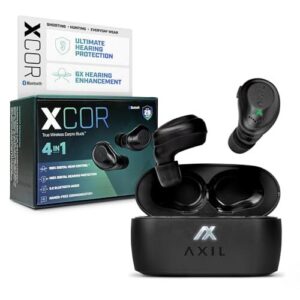
The AXIL XCOR PRO represents the current state of the art in electronic hearing protection earbuds. These true wireless earbuds combine automatic sound compression above 85 dB with 6x hearing enhancement, Bluetooth 5.2 streaming, and a rechargeable design that delivers up to 13 hours of battery life in hear-only mode. If you shoot rifles and cheek weld is sacred to you, earbuds are the answer — and the XCOR PRO is the best electronic earbud available. The Bluetooth integration means you can stream music or take calls at the range without removing your hearing protection. The automatic compression is seamless: normal conversation and range commands come through clearly, but the instant a shot breaks, the electronics clamp down. Both silicone and foam tips are included for different NRR levels and fit preferences.
NRR:
21–23 dB (up to 29 dB SNR with foam tips)
Type:
True wireless electronic earbuds
Power Source:
Rechargeable (USB-C), 7–13 hrs
Microphones:
Dual MEMS with 6x enhancement
Compression:
Automatic above 85 dB
Audio Input:
Bluetooth 5.2
Weight:
~8g per earbud
What We Like
Zero cheek weld interference — the earbuds for rifle shooters
Bluetooth 5.2 for music, calls, and 2-way radio at the range
6x hearing enhancement for full situational awareness
Automatic compression is seamless — conversation stays clear, gunshots get clamped
Both silicone and foam tips included for different NRR levels
What We Don’t
Price is steep at ~$300–350
NRR 21–23 is lower than over-ear options — double up for indoor ranges or magnum calibers
Battery drops to ~5 hours with Bluetooth and hearing protection active simultaneously
Small form factor — easier to lose at the range
Best For: Rifle shooters who refuse to compromise cheek weld. Hunters who want Bluetooth connectivity in the field. Shooters who find earmuffs uncomfortable for long sessions.
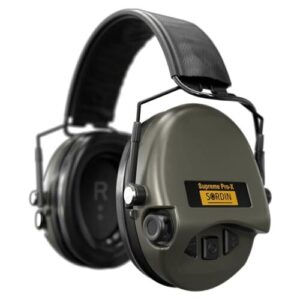
The Sordin Supreme Pro-X SFA is what serious competitive shooters, military personnel, and law enforcement professionals wear when they get to choose their own hearing protection. Made in Sweden, the SFA (Sordin Flexible Attenuation) adds a removable distance ring and absorbent liner to the proven Supreme Pro-X platform — with the ring installed, passive attenuation jumps to SNR 31 dB, and you can remove it for a lighter, slimmer profile when conditions allow. The dual waterproof directional microphones deliver true stereo sound — someone calling from your left sounds like they are on your left — and the SordinHEAR2 system provides four selectable audio profiles: Hunting, Shooting, Focus, and Comms. IP67 waterproofing means rain, mud, and humidity are non-issues. The slim tapered cup design is purpose-built for rifle stocks, and the gel ear seals are the most comfortable on this list.
Attenuation:
SNR 31 dB with SFA ring (SNR 25 without ring)
Type:
Electronic over-ear earmuff
Power Source:
2x AAA batteries (~400 hours)
Microphones:
2 IP67 waterproof (true stereo directional)
Audio Profiles:
4 (Hunting, Shooting, Focus, Comms)
Audio Input:
3.5mm AUX (cable included)
Weight:
~347g with SFA ring
Waterproofing:
IP67
What We Like
Flexible attenuation — add the SFA ring for SNR 31 or remove it for a lighter fit
True stereo directional microphones — sounds come from the direction they actually are
Four selectable audio profiles tuned for different shooting scenarios
Slim tapered cup design works beautifully with rifle stocks and optics
Gel ear seals are the most comfortable on this list
IP67 waterproof — rain, mud, humidity are non-issues
5-year warranty on electronics
What We Don’t
Premium price at ~$450–560 — this is top-shelf gear
Heavier than the standard Pro-X (~347g vs. ~310g) with the SFA ring installed
No Bluetooth — only wired AUX input
No official NRR rating yet (pending US ANSI testing) — SNR 31 is the European standard
Best For: Competitive shooters who need true directional sound awareness and adjustable protection levels. Military and law enforcement professionals who choose their own gear. Rifle shooters who want premium comfort, IP67 waterproofing, and the flexibility to dial attenuation up or down.
The Noise Reduction Rating (NRR) is a single-number rating, measured in decibels, that describes how much a hearing protection device reduces incoming noise under laboratory conditions. Higher numbers mean more reduction. But the real-world math is less generous than the marketing suggests.
OSHA’s formula for estimating real-world protection from an NRR rating is:
Estimated real-world reduction = (NRR – 7) / 2
By this calculation, a device rated NRR 23 provides roughly 8 dB of estimated real-world reduction. This seems low — and it is conservative by design. The laboratory protocol tests under ideal conditions with a perfect fit; real-world conditions include imperfect seals, head movement, glasses breaking the seal of earmuffs, and the specific frequency characteristics of gunshot impulse noise.
In practice, a well-fitting NRR 22–26 earmuff provides meaningful and adequate protection for outdoor shooting with standard calibers. But the OSHA formula underscores an important point: proper fit matters as much as the NRR number. A perfectly sealed NRR 22 earmuff can outperform a poorly fitted NRR 30 device. For additional reading, see NRA gun safety rules.
Doubling Up: Muffs + Plugs
Doubling up — wearing in-ear earplugs underneath over-ear earmuffs — is the single most effective way to increase your hearing protection. However, the NRR values do not simply add together. Per OSHA guidelines, the combined NRR of a dual-protection setup is approximately:
Photo by Kaboompics.com (Pexels, free commercial use)
Combined NRR = higher NRR + 5 dB
For example, Decibullz (NRR 31) underneath Peltor Tactical 500 (NRR 26) would provide a combined effective NRR of approximately 36 dB — the highest practical protection available to a consumer without professional audiologist-fitted devices.
Doubling up is strongly recommended in the following situations:
Indoor ranges (enclosed concrete or steel bays amplify and reflect sound, increasing effective exposure)
Shooting next to rifles with muzzle brakes or compensators (the shooter beside you may be louder than your own firearm)
Shotgun shooting in enclosed bays
Extended range sessions exceeding one hour
Electronic vs. Passive Hearing Protection
Passive hearing protection — foam plugs, molded plugs, non-electronic muffs — blocks all sound proportionally. It is effective, inexpensive, requires no power, and never fails electronically. The trade-off is that you cannot hear conversation, range commands, or environmental sounds without removing or partially unseating your protection. At a busy public range, missing a “ceasefire” command is a safety issue. In the field, losing situational awareness can be a serious problem.
Photo by Mikhail Nilov (Pexels, free commercial use)
Electronic hearing protection uses external microphones to capture ambient sound, amplifies it through internal speakers at a safe volume, and then compresses or clips impulse noise that exceeds a safe threshold. You hear everything normally — often better than unprotected hearing, because the amplification enhances quiet sounds — until a shot is fired, at which point the electronics suppress the dangerous impulse in milliseconds.
For most shooters who can accommodate the price difference, electronic protection is a meaningful upgrade to the range experience and to safety, because you will never miss a range command and never need to lift a muff cup to hear someone speaking to you.
Indoor vs. Outdoor Shooting Considerations
Outdoor ranges allow sound to dissipate in all directions. The primary noise source is your own firearm and those of nearby shooters. NRR 22–23 provides adequate protection for standard calibers at outdoor ranges.
Indoor ranges are significantly louder due to sound reflection off concrete walls, steel baffles, and low ceilings. The same firearm that produces 155 dB outdoors may produce an effective exposure exceeding 165 dB indoors due to reflections. Doubling up is standard practice at indoor ranges, and we recommend it without exception.
Environment
Minimum NRR
Recommended
Outdoor range, standard calibers (.22, 9mm, .223)
22 dB
23–26 dB
Outdoor range, magnum/large bore (.300 WM, 12 ga)
25 dB
26+ dB or dual protection
Indoor range, any caliber
26 dB
Dual protection
Shooting with muzzle brake (any environment)
Dual protection
Dual protection
What to Look for in Shooting Hearing Protection
NRR Rating
Start with the NRR, but do not stop there. A higher NRR is generally better, but a device with NRR 31 that does not fit your ears properly will protect you less than one with NRR 22 that seals perfectly. Think of NRR as the ceiling of protection — fit determines how close you actually get to that ceiling.
For outdoor recreational shooting, NRR 22–23 is the starting point. For indoor ranges, look for NRR 26+ or plan to double up. For the inner layer of dual protection, higher NRR is always better. If you are still building out your setup, check out our guide to the best shooting gloves.
Comfort for Long Sessions
If your hearing protection is uncomfortable, you will eventually take it off, adjust it, or wear it improperly. Every one of those actions exposes you to potential hearing damage. Comfort is not a luxury — it is a safety requirement.
For over-ear earmuffs: Clamping pressure is the primary comfort factor. Muffs that clamp too tightly cause headaches and hot spots within an hour. Muffs that clamp too loosely do not seal properly. Head size and shape vary, so if possible, try before you buy. Gel ear cushions are consistently more comfortable than foam for sessions longer than 30 minutes, and they seal better around the arms of shooting glasses.
For in-ear devices: Ear tip selection is everything. Most electronic earbuds and reusable earplugs ship with multiple tip sizes. Take the time to find the size that seals comfortably without pressure. An ill-fitting ear tip means reduced NRR and discomfort that will tempt you to remove your protection. For additional reading, see OSHA noise exposure standards.
Electronic Features Worth Paying For
Sound-activated compression — The core feature that makes electronic ear pro worth the investment. Response time should be 0.02 seconds or faster.
Directional/stereo microphones — Allows you to localize the source of sounds. Important for range awareness and hunting.
Bluetooth — Useful for phone calls and audio streaming. Not essential, but hard to give up once you have it.
Volume control — Adjustable amplification lets you tune ambient sound to a comfortable level for your environment.
Wind noise reduction — Recessed microphones or wind guards reduce the buffeting sound that outdoor shooters encounter, especially on exposed ranges.
Auto shutoff — Prevents dead batteries by turning the muffs off after a period of inactivity.
Compatibility with Cheek Weld and Rifle Stocks
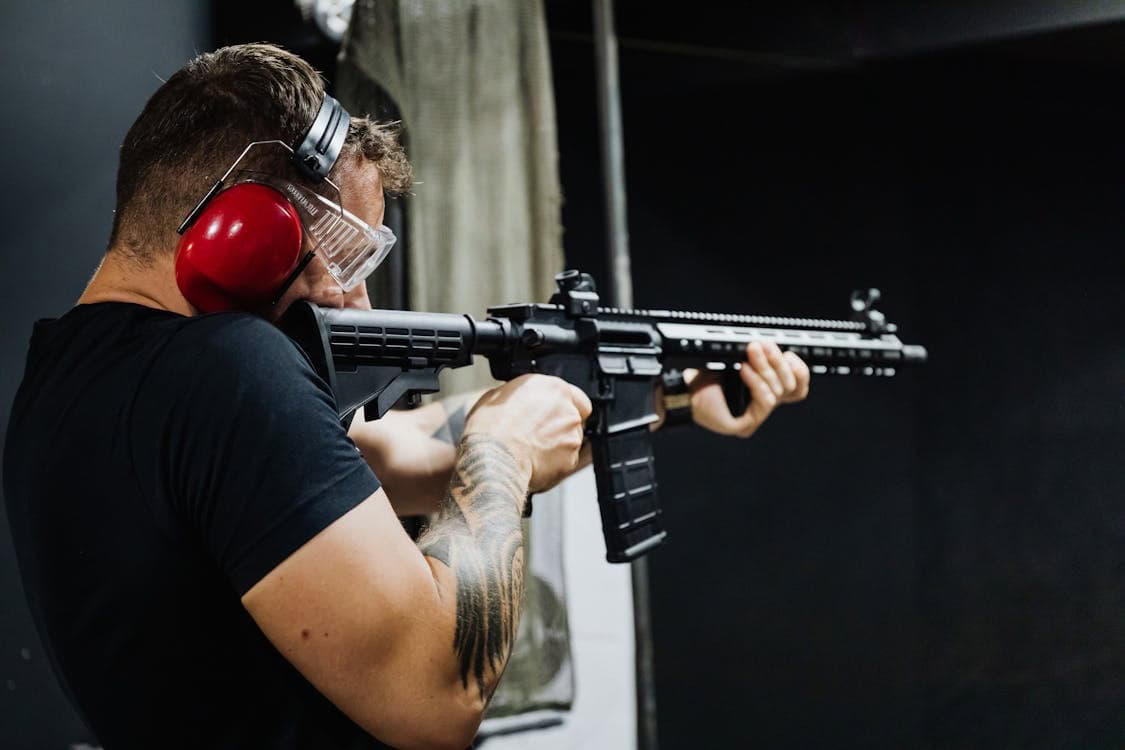
This is the most under-discussed factor in hearing protection selection, and it affects every rifle and shotgun shooter. When you mount your cheek to the stock to acquire a sight picture, the stock presses into the area covered by your ear protection. Over-ear earmuffs get compressed on the stock side, breaking the seal and reducing protection by potentially 5–10 dB — exactly when you need it most, because you are about to fire.
Noah Wulf (public domain)
Solutions, in order of effectiveness:
Electronic earbuds (Walker’s Silencer 2.0) — eliminate the problem entirely. Nothing on the outside of your ear to interfere with the stock.
Slim-profile earmuffs (Walker’s Razor Slim) — minimize interference. The thinner the cup, the less compression against the stock.
In-ear plugs under slim muffs — even if the muff seal is compromised by the stock, the underlying plug maintains protection.
If you primarily shoot rifles or shotguns, cheek weld compatibility should be one of your top selection criteria. See our AR-15 upgrades guide and AR-15 slings guide for more on optimizing your rifle setup.
Frequently Asked Questions
Can I double up ear protection (plugs + muffs)?
Yes — and you should in many situations. Wearing earplugs underneath earmuffs is the gold standard for maximum hearing protection. The combined NRR is not additive; per OSHA guidelines, the effective combined rating is approximately the higher NRR plus 5 dB. For example, Decibullz (NRR 31) under Peltor Tactical 500 (NRR 26) yields an effective NRR of roughly 36 dB. Doubling up is strongly recommended for indoor ranges, magnum calibers, muzzle brakes, and extended shooting sessions.
What NRR do I need for indoor ranges?
Indoor ranges are significantly louder than outdoor ranges because sound reflects off concrete walls, steel baffles, and ceilings. We recommend a minimum NRR of 26 for indoor ranges, and strongly recommend dual protection (plugs + muffs) regardless of caliber. Even 9mm handgun fire in an enclosed bay can produce effective exposure levels exceeding 160 dB with reflections. The Peltor Sport Tactical 500 (NRR 26) is the minimum standalone earmuff we would recommend for indoor use; for lower-NRR muffs like the Walker’s Razor Slim or Howard Leight Impact Sport, always add earplugs underneath.
Can a single gunshot really cause permanent hearing damage?
Yes. This is not an exaggeration. A single gunshot from a rifle or magnum handgun produces 140–170+ dB of impulse noise. OSHA identifies 140 dB as the threshold for immediate hearing damage from impulse noise. The hair cells in the cochlea that convert sound to nerve signals do not regenerate — once damaged, the hearing loss and any associated tinnitus (ringing) are permanent. “Just one shot without ear pro” is the single most common regret among shooters with hearing loss. Wear your hearing protection for every shot, every time, without exception.
Are electronic earmuffs safe? What happens if the batteries die?
Electronic earmuffs are completely safe. The NRR rating (the passive noise reduction provided by the physical ear cups and cushions) functions independently of the electronics. If the batteries die, the muffs simply revert to passive mode — you lose the ambient sound amplification and electronic compression features, but you retain the full NRR protection of the physical earmuff. The electronics only add features (amplification, compression); they do not replace the passive protection. You are never unprotected because of a dead battery.
Can I use AirPods or consumer earbuds as hearing protection?
No. Consumer earbuds and wireless earphones — including those with Active Noise Cancellation (ANC) — do not provide adequate protection against gunshot impulse noise. ANC technology is designed for steady-state noise like airplane cabin hum or office chatter; it cannot respond quickly enough to compress the instantaneous impulse of a gunshot (which peaks and decays in less than 2 milliseconds). Consumer earbuds typically provide only 15–25 dB of passive isolation, with no testing or certification for impulse noise. Never use consumer audio products as hearing protection while shooting.
How do I choose between electronic earmuffs and electronic earbuds?
The primary considerations are shooting discipline and personal comfort preference. Choose electronic earmuffs if you primarily shoot handguns, want the simplest possible setup, prefer the security of a physical ear cup surrounding your ear, or want to maximize battery life and durability. Choose electronic earbuds if you primarily shoot rifles or shotguns (no cheek weld interference), wear shooting glasses (no seal-breaking from glasses arms), want maximum portability, or find earmuffs uncomfortable for long sessions. Many serious shooters own both and choose based on the day’s activity.
Conclusion: Our Recommendations by Use Case
Every product on this list is one we would use ourselves. The right choice depends on how you shoot, where you shoot, and what you prioritize.
Best All-Around Electronic Earmuff
Walker’s Razor Slim | Find at Brownells — The slim profile, NRR 23, and accessible price make this the best overall pick for most shooters. If you shoot rifles, the cheek weld clearance advantage alone justifies the choice. If you are buying your first electronic earmuff, start here.
Best Budget Electronic Earmuff
Howard Leight Impact Sport | Find at Brownells — The industry standard for a reason. If you primarily shoot handguns at outdoor ranges and want the most proven, widely available electronic muff at the lowest price, the Impact Sport remains the benchmark. The 350-hour battery life is unmatched.
Best for Indoor Ranges
Peltor Sport Tactical 500 | Find at Brownells — NRR 26 provides the most protection of any earmuff on this list. Foam cushions are comfortable, and aftermarket gel upgrades seal even better around glasses. Bluetooth is a bonus. If you shoot at indoor ranges regularly, the Tactical 500 is worth the step up. For maximum indoor protection, pair it with Decibullz | Find at Brownells underneath.
Best for Rifle Shooters
Walker’s Silencer 2.0 Electronic Earbuds | Find at Brownells — If cheek weld interference is your primary frustration with earmuffs, electronic earbuds eliminate the problem completely. NRR 24 is solid, the rechargeable design is convenient, and the compact form factor disappears once inserted.
Best for Doubling Up
Decibullz Custom Molded | Find at Brownells underneath Peltor Sport Tactical 500 | Find at Brownells — NRR 31 custom-fit plugs under NRR 26 electronic muffs gives you approximately NRR 36 effective protection with electronic ambient sound, Bluetooth, and the highest NRR combination on this list. This is the setup for indoor ranges, magnum calibers, and muzzle brakes.
Best Budget Passive Earplugs
SureFire EP4 Sonic Defenders Plus | Find at Brownells — Reusable, comfortable, and the filtered bypass provides ambient sound awareness that foam plugs cannot match. At their price, every shooter should own a pair as backup ear pro in the range bag.
Best Premium Electronic Earbuds
AXIL XCOR PRO — The premium choice for shooters who want it all: electronic hearing protection with NRR 22, Bluetooth 5.2 for music and calls, and 6x hearing enhancement for situational awareness. At ~$350 these are an investment, but if you shoot frequently and hate earmuffs interfering with cheek weld, rifle stocks, or helmets, the XCOR PROs are the best electronic earbuds on the market.
Best Premium Electronic Earmuff
Sordin Supreme Pro-X SFA — The gold standard in premium electronic earmuffs. The SFA system lets you add a removable ring for SNR 31 dB protection or run lighter without it. True stereo directional microphones, four selectable audio profiles, IP67 waterproofing, gel ear seals, and a slim tapered cup that plays beautifully with rifle stocks. If budget is not a constraint, this is the earmuff to own.
The most important recommendation: Wear your hearing protection. Every shot. Every time. No exceptions. The specific product matters far less than consistent use. A $15 pair of SureFire EP4s worn for every shot will protect your hearing infinitely better than a $200 pair of electronic earbuds sitting in your range bag because you forgot to charge them.
Hearing damage from shooting is permanent. It is also entirely preventable. Protect your hearing today so you can keep enjoying shooting for decades to come.
Powder & Lead is a participant in affiliate programs including the Amazon Services LLC Associates Program and AvantLink (Brownells, MidwayUSA). Purchases through our links help support this site at no extra cost to you. All recommendations are based on our own research — we only recommend products we would use ourselves.
If you know of any forums or sites that should be referenced on this listing, please let us know here.
Join the inner-circle! Sign up now for exclusive articles, offers, and discounts straight to your mail!