Flintlock to Percussion: How American Military Muskets Evolved from 1795 to 1855
Between 1795 and 1855, the United States Army underwent one of the most significant small-arms transformations in military history. In just sixty years, the standard infantry weapon evolved from a smoothbore flintlock musket copied from a French design to a domestically engineered, rifled percussion arm capable of accurate fire at ranges that would have seemed fantastical to the soldiers at Fallen Timbers. This article traces that evolution through the major models that defined each era, examining the technological breakthroughs, manufacturing advances, and battlefield pressures that drove the change. For a detailed look at where this story begins, see our companion article on the U.S. Model 1795 Musket.
The Starting Point: The Model 1795 and the Charleville Legacy
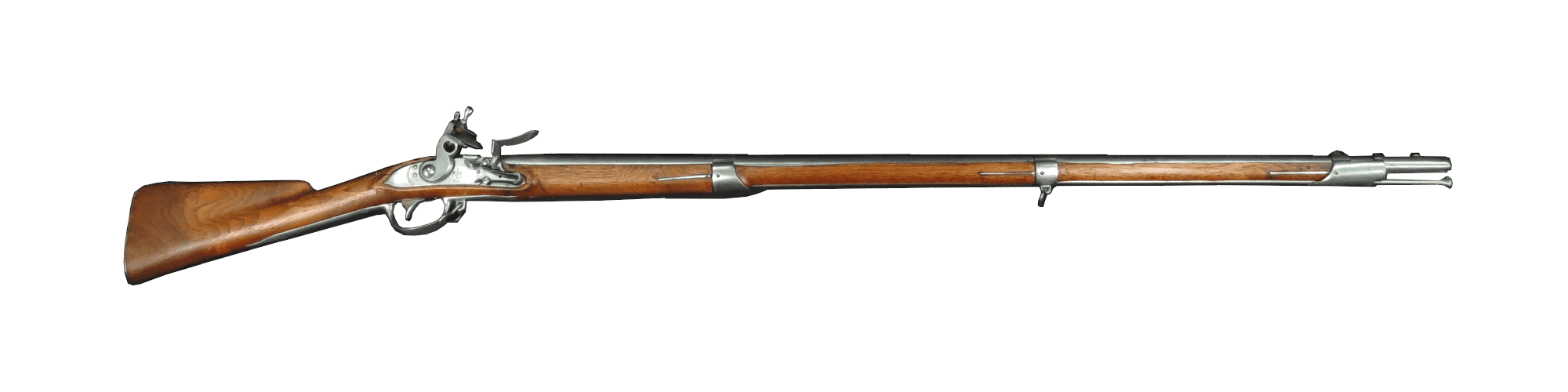
When Springfield Armory produced its first musket in 1795, the design was essentially a copy of the French Charleville Model 1763/66. This was a deliberate choice. The Charleville had served American troops well during the Revolution, and France had supplied tens of thousands of them. American armorers knew the design intimately, and standardizing on it meant that existing knowledge of maintenance, repair, and drill could transfer directly.
The Model 1795 was a .69 caliber smoothbore flintlock with a 44-inch barrel, weighing roughly ten pounds. Its effective combat range was perhaps 50 to 75 yards, though volley fire doctrine meant soldiers were rarely expected to aim at individual targets. The flintlock ignition system — a piece of flint striking a steel frizzen to shower sparks into a priming pan — was the universal standard of the age. It was reasonably reliable in dry weather but suffered badly in rain, with misfire rates climbing dramatically when the powder in the open pan got damp.
Springfield and Harpers Ferry produced the Model 1795 through three recognized pattern variations until approximately 1814, manufacturing roughly 85,000 to 100,000 muskets between them. These arms saw service from the Quasi-War through the War of 1812 and beyond.
The Model 1812: Refinement Under Fire
The War of 1812 exposed serious shortcomings in American arms production. The nation entered the conflict with inadequate stockpiles, and the federal armories could not produce muskets fast enough to meet wartime demand. The Model 1812 Musket emerged from this crisis as an incremental improvement over the 1795 pattern.
The Model 1812 shortened the barrel to 42 inches and the overall length to approximately 58 inches, making it slightly handier in the field. The lock mechanism was made more robust, and the stock was reinforced at stress points that had proven vulnerable in service. It retained the .69 caliber smoothbore flintlock configuration — the fundamental ballistic concept remained unchanged. Production began around 1814 at both Springfield and Harpers Ferry, supplemented by contract manufacturers, and continued through approximately 1832.
What made the Model 1812 era significant was less the musket itself than the manufacturing system surrounding it. The push toward interchangeable parts, championed at both federal armories, was accelerating. While true interchangeability remained aspirational rather than fully achieved, the armories were developing gauging systems, specialized machinery, and division-of-labor practices that would eventually make it a reality.
The Model 1816: America’s First Mass-Produced Musket
The Model 1816 represented the first U.S. musket produced in truly massive quantities — over 325,000 units between Springfield, Harpers Ferry, and numerous contract manufacturers. It remained a .69 caliber smoothbore flintlock, but incorporated lessons learned from two decades of production experience.
The Model 1816 featured a redesigned lock with a more reliable frizzen spring, a rounded lockplate replacing the earlier flat profile, and improved barrel bands instead of pins for securing the barrel to the stock. These bands made field disassembly and repair dramatically easier — a soldier could remove the barrel from the stock without specialized tools, a significant advantage for maintenance in the field.
The 1816 served as the backbone of the U.S. infantry arsenal for over two decades. Many were still in service during the Seminole Wars and the Mexican-American War, and thousands were later converted to percussion ignition as that technology matured. This conversion process itself became one of the most important chapters in the evolution of American military arms.
The Percussion Revolution: From Forsyth to the Maynard Tape Primer
The single most important technological shift in this sixty-year span was the transition from flintlock to percussion cap ignition. The concept originated with Scottish clergyman Reverend Alexander John Forsyth, who patented a detonating compound ignition system in 1807. By the 1820s, the copper percussion cap — a small cup containing fulminate of mercury that detonated when struck by a hammer — had emerged as a practical replacement for the flintlock.
The advantages were transformative. Percussion caps were far less susceptible to moisture than loose priming powder in an open pan. Misfire rates dropped dramatically. The lock mechanism could be simplified since it no longer required a frizzen, frizzen spring, or pan. The time between pulling the trigger and the main charge igniting (the “lock time”) was reduced, improving practical accuracy. And soldiers no longer needed to carry a separate priming horn or worry about keeping their pan dry.
The U.S. Army was cautious in adopting the new system. While percussion sporting arms became widely available in the 1820s and 1830s, the military did not begin large-scale conversion until the late 1830s. Tens of thousands of Model 1816 flintlock muskets were converted to percussion by replacing the flintlock mechanism with a percussion hammer and adding a cone (nipple) where the touchhole had been. These conversions extended the service life of existing arms while the Army evaluated purpose-built percussion designs.
The Model 1842: The First Percussion Musket from the Ground Up
The Model 1842 was the first U.S. musket designed from the outset as a percussion arm, and it holds another crucial distinction: it was the first American military firearm manufactured with fully interchangeable parts. A lock from one Model 1842 could be fitted to any other Model 1842 without hand fitting — a manufacturing achievement that had been pursued for nearly half a century.
Still a .69 caliber smoothbore, the Model 1842 was in many ways the perfected version of the smoothbore musket concept that had begun with the Model 1795. Its percussion lock was robust and reliable, its manufacturing quality was consistent, and its interchangeable parts made logistics and repair vastly simpler. Over 275,000 were produced, and the musket saw extensive service in the Mexican-American War of 1846-1848, where American infantry used it to devastating effect in volley fire.
Yet even as the Model 1842 entered production, the technology that would render it obsolete was already proven: rifling.
The Rifling Question: From the Model 1841 “Mississippi Rifle” to the Minie Ball
Rifling — cutting spiral grooves inside a barrel to spin the projectile for greater accuracy — was nothing new. American frontiersmen had used rifles since the colonial period, and the U.S. Army had issued limited numbers of rifles such as the Model 1803 Harpers Ferry. But rifles had a critical drawback for military use: because the ball had to grip the rifling grooves, it had to fit tightly in the bore. This made loading slow and difficult, especially after a few rounds when fouling built up. A soldier with a smoothbore musket could fire three rounds per minute; a rifleman was doing well to manage one.
The Model 1841 percussion rifle, famously known as the “Mississippi Rifle” after Jefferson Davis’s regiment used it with distinction at the Battle of Buena Vista, was issued to select units as a specialized arm. It was a .54 caliber rifle of exceptional accuracy, but its slow rate of fire limited it to skirmishing and flanking roles rather than the main line of battle.
The breakthrough came with the Minie ball (properly the Minie system), developed by French Army Captain Claude-Etienne Minie in the late 1840s. The Minie ball was a conical bullet with a hollow base that was undersized relative to the bore, allowing it to be loaded as quickly as a smoothbore round ball. When fired, the expanding gases forced the hollow base outward into the rifling grooves, imparting spin. For the first time, a rifled arm could be loaded as fast as a smoothbore but shoot with dramatically greater accuracy and range.
The Model 1855: The Rifled Musket Arrives
The U.S. Model 1855 rifled musket represented the culmination of sixty years of evolution. It combined percussion ignition with a rifled .58 caliber bore designed for the Minie ball, and it introduced the Maynard tape primer system — a roll of paper caps similar to a modern cap gun that automatically advanced a fresh primer with each cocking of the hammer, further increasing the rate of fire.
The results were transformative. Where the Model 1795 smoothbore was effective at 50 to 75 yards, the Model 1855 rifled musket was accurate and lethal at 300 yards or more, with some soldiers making hits at 500 yards. The tactical implications were profound and would be written in blood during the Civil War: frontal assaults that had been viable against smoothbore-armed defenders became suicidal against troops armed with rifled muskets. The entire nature of infantry combat changed.
The Maynard tape primer proved unreliable in service and was eventually abandoned in favor of individual percussion caps, but the rifled musket concept was here to stay. The Model 1855 led directly to the well-known Model 1861 Springfield, the primary Union infantry arm of the Civil War and one of the most produced military firearms of the 19th century.
Sixty Years of Change: What Drove the Evolution
Looking at the full arc from 1795 to 1855, several forces drove the transformation:
Manufacturing technology. The American system of manufactures, developed in large part at Springfield and Harpers Ferry, moved from hand-fitting every part to true interchangeability. This was as significant in its way as any change to the weapons themselves, enabling mass production at scales that would prove decisive in the Civil War.
Chemical innovation. The percussion cap depended on the discovery of fulminate compounds. Without advances in chemistry, the flintlock would have persisted far longer, and the entire timeline of small-arms development would have been delayed.
Projectile design. The Minie ball solved a problem that had vexed military planners for centuries: how to get the accuracy of a rifle with the loading speed of a smoothbore. This single innovation did more to change the face of battle than any other development in the period.
Battlefield experience. Each major conflict — the War of 1812, the Seminole Wars, the Mexican-American War — exposed limitations in the existing arms and created political pressure for improvement. The Army’s Bureau of Ordnance was often conservative, but the accumulation of combat experience eventually forced adoption of new technologies.
Conclusion
The soldier who carried a Model 1795 musket at the Battle of Fallen Timbers in 1794 and the soldier who shouldered a Model 1855 rifled musket sixty years later were both American infantrymen carrying the standard-issue arm of their day. But the weapons they held were separated by a technological chasm. The smoothbore flintlock was a weapon of massed volleys at close range, dependent on dry weather and good flints. The rifled percussion musket was an instrument of aimed fire at ranges that would have seemed impossible a generation earlier, reliable in nearly any weather, and manufactured to standards of precision that made every part interchangeable.
Understanding this evolution is essential for anyone interested in American military history, early firearms collecting, or the broader story of how technology transforms warfare. Each model along the way — the 1795, the 1812, the 1816, the 1842, and the 1855 — represents not just an incremental improvement but a chapter in the story of American industrial and military development.
Discussion groups on muzzleloading muskets can be found here.
If you know of any forums or sites that should be referenced on this listing, please let us know here.