Springfield Armory History: George Washington and the Founding (1777-1794)
Any account of Springfield Armory history has to start before the arsenal was formally established. During the Revolutionary War, General Henry Knox recommended Springfield, Massachusetts, as a site for storing military supplies. The location offered strategic advantages: it was far enough inland to be safe from British naval raids, situated on the Connecticut River for transportation, and positioned at the crossroads of roads connecting New England to New York and the mid-Atlantic states.

In 1777, General George Washington approved the establishment of a military supply depot at Springfield. The site initially served as a storage and repair facility for muskets, cannon, and ammunition during the Revolution. Cartridges were manufactured there, and damaged weapons were repaired. But it was not yet a manufacturing arsenal.
The event that demonstrated Springfield’s strategic importance, and its vulnerability, was Shays’ Rebellion in 1786-1787. Daniel Shays and a force of discontented western Massachusetts farmers marched on the Springfield arsenal to seize weapons. The militia defending the arsenal fired cannon into the advancing rebels, dispersing them and ending the immediate threat. But the incident exposed a critical weakness: the new United States had no secure, purpose-built facility for manufacturing and storing military arms.
On April 2, 1794, President Washington signed legislation establishing the Springfield Armory as a federal arms manufacturing facility, one of only two national armories (the other at Harpers Ferry, Virginia, where Washington chose the site in 1796 and construction began in 1799). The mission was clear: the United States would manufacture its own military firearms rather than depending on foreign imports or unreliable private contractors.
The Early Arsenal: Muskets and the American System (1794-1842)
The early Springfield Armory produced muskets modeled on French Charleville patterns, reflecting the military alliance that had helped win the Revolution. The first Springfield musket, the Model 1795, was a .69 caliber flintlock smoothbore closely based on the Charleville Model 1763. It was a serviceable weapon built for reliable production rather than for design advancement.
The Birth of Interchangeable Parts
The most consequential development at Springfield had nothing to do with the firearms themselves and everything to do with how they were made.
In the late 18th and early 19th centuries, firearms were craft products. Each musket was hand-fitted by a skilled armorer. Parts from one musket would not fit another without extensive reworking. This meant that a broken part in the field required a skilled armorer to repair, or the entire weapon was lost.
The concept of interchangeable parts, manufacturing components to such precise tolerances that any part would fit any weapon of the same model, was revolutionary. It would transform arms manufacturing and, in time, the whole of American industry.
The conventional story credits Eli Whitney with inventing interchangeable parts for his musket contract with the government in 1798. The reality is more complex. Whitney’s demonstration for President John Adams in 1801, where he allegedly assembled muskets from randomly selected parts, was likely staged. His parts were not truly interchangeable. The actual development of practical interchangeable-parts manufacturing was a gradual process involving multiple innovators.
At Springfield, the key figures were Roswell Lee (superintendent from 1815 to 1833) and Thomas Blanchard. Lee systematized production, imposing inspection standards and organizing production into discrete steps. Blanchard, working at Springfield from 1818 onward, invented a series of specialized machines, most famously the Blanchard lathe, a copying lathe that could replicate irregular shapes like gunstocks from a master pattern. The Blanchard lathe reduced the time to shape a gunstock from days of hand labor to hours of machine work and produced stocks that were dimensionally consistent.
By the 1840s, Springfield Armory had developed what contemporaries called the “Armory Practice”, a system of gauges, jigs, fixtures, and specialized machine tools that produced parts to consistent dimensions. This was the foundation of what became known internationally as the “American System of Manufacturing.” British engineers visiting Springfield in the 1850s were so impressed that they arranged for American machinery to be purchased for the British Royal Small Arms Factory at Enfield.
The irony is profound: Springfield’s manufacturing techniques, developed to arm the American military, were exported to the nation that would become America’s most important military ally, and the techniques themselves eventually spread across all of American industry, from clocks to sewing machines to automobiles.
The Model 1842: Last of the Smoothbores
The Springfield Model 1842 was the last smoothbore musket produced at Springfield and the first American military arm manufactured with fully interchangeable parts. Every part of every Model 1842 would fit every other Model 1842 without hand fitting. This was the realization of the vision that had driven armory practice for four decades.
The Model 1842 was also the end of an era. Rifled barrels, with spiral grooves that spin the bullet for dramatically improved accuracy, had existed for centuries but were considered too expensive and slow-loading for general military issue. That was about to change.
The Rifled Era: Allin Conversions and the Trapdoor (1855-1892)
The introduction of the Minie ball in the 1850s transformed military firearms. The Minie ball (actually a conical bullet, not a ball) was slightly undersized, allowing it to be loaded quickly down a rifled barrel. Upon firing, the hollow base expanded into the rifling grooves, engaging the spin. This gave every infantryman the accuracy of a rifle at the loading speed of a smoothbore.
Springfield produced the Model 1855 and Model 1861 rifled muskets, the latter becoming the primary infantry arm of the Union during the Civil War. Over 800,000 Model 1861 Springfield rifles were produced, more than any other single model of the war. The Model 1861, with its .58 caliber Minie ball and accurate range of 300-500 yards, was the weapon that made the Civil War so devastatingly lethal. Infantry tactics had not yet adapted to the killing range of the rifled musket, and the result was casualties on a scale that shocked the world. For related history, see our article on The Springfield Model 1861.
Erskine Allin and the Trapdoor Conversion
After the Civil War, the U.S. military faced a familiar problem: warehouses full of muzzle-loading rifles and an emerging technology, breech-loading metallic cartridges, that made them obsolete. The government had neither the budget nor the political will to purchase entirely new rifles.
The solution came from Erskine S. Allin, the Master Armorer at Springfield. Allin designed a conversion that turned muzzle-loading Springfield rifles into breech-loaders by cutting open the top of the barrel at the breech and installing a hinged “trapdoor” that flipped forward to expose the chamber. A metallic cartridge could then be loaded into the chamber and the trapdoor closed and latched. The hammer struck a firing pin mounted in the trapdoor block.
The first Allin conversion, the Model 1865, altered existing .58 caliber rifle muskets just enough to accept the breech mechanism and a .58 rimfire cartridge; about 5,000 were made. The second conversion, the Model 1866, relined those .58 barrels down to .50 caliber for the new .50-70 Government centerfire cartridge. The Model 1868 that followed paired a newly made receiver with a sleeved .50 caliber barrel in the same chambering. The definitive version, the Model 1873 “Trapdoor Springfield,” was chambered in the new .45-70 Government cartridge and was manufactured as a purpose-built rifle rather than a conversion. For more on this manufacturer, see our article on The Springfield Trapdoor Rifle.
The Model 1873 Trapdoor Springfield became the standard U.S. infantry rifle and served through the Indian Wars, including the Battle of the Little Bighorn in 1876. At Little Bighorn, the 7th Cavalry’s Trapdoor carbines have long been blamed for jamming, with copper cases expanding in hot chambers and having to be pried out with knives. Archaeological work at the battlefield later found extraction marks on only a small proportion of the cases recovered, so how widespread the problem was is disputed. The disaster highlighted the Trapdoor’s limitations, but the Army retained the design for nearly two more decades due to budget constraints and institutional inertia.
The Trapdoor Springfield served until 1892, when it was replaced by the Krag-Jorgensen. By then, every major European army had adopted magazine-fed, bolt-action repeating rifles. The United States was behind.
The .45-70 Government Cartridge
The .45-70 Government cartridge was developed at Springfield Armory for the Model 1873. Originally loaded with a 405-grain lead bullet over 70 grains of black powder (hence the designation), the .45-70 was a powerful, versatile cartridge that served as the standard U.S. military round for nearly two decades.
Introduced in 1873, the .45-70 remains in production today, over 150 years later. Modern lever-action rifles from Marlin and Henry are still chambered in .45-70, loaded with modern smokeless powder and jacketed bullets that transform the old cartridge into a potent hunting round capable of taking any game animal in North America. Few military cartridges from the black powder era remain in common use.
The Krag-Jorgensen: A Scandinavian Interlude (1892-1903)
The Spanish-American War of 1898 was a wake-up call. American soldiers armed with .30-40 Krag rifles faced Spanish troops carrying 7x57mm Mauser rifles at the battles of San Juan Hill and El Caney. The Mauser was faster to reload (its charger-loaded box magazine was superior to the Krag’s side-loading gate), more powerful, and more accurate at range. The Krag-Jorgensen, while a fine rifle in many respects, was not competitive with the Mauser.
The Krag-Jorgensen had been adopted by the U.S. military in 1892 after competitive trials. It was a bolt-action rifle with a unique side-loading magazine, a hinged gate on the right side of the receiver opened to reveal a magazine box that held five rounds of .30-40 Krag ammunition. Rounds were loaded individually through the gate, which was slower than the Mauser’s stripper-clip loading.
Springfield Armory manufactured approximately 475,000 Krag rifles and carbines between 1894 and 1904. The Krag was a well-made rifle with a smooth bolt action, but its single-locking-lug bolt was not strong enough for higher-pressure cartridges, and its magazine system was inherently slower to reload than the Mauser’s. The experience in Cuba made it clear that the Krag was an interim solution at best.
The Springfield Model 1903: America’s First Modern Rifle (1903-1936)
The Springfield Model 1903 was born from the lessons of the Spanish-American War and the frank admission that the Mauser was the superior military rifle design. The 1903 was an American-made Mauser, derived closely enough from the Mauser 98 action that the U.S. government paid a royalty to Mauser for patent infringement.
The 1903 featured a dual-locking-lug bolt (like the Mauser), a five-round internal box magazine loaded from stripper clips (like the Mauser), and a cock-on-opening action. It was initially chambered in .30-03 (a .30 caliber round with a 220-grain round-nose bullet), but in 1906, the Army adopted a new loading with a 150-grain pointed (spitzer) bullet at higher velocity. This new cartridge was designated the .30 Caliber, Model of 1906, universally known as the .30-06 Springfield. Shooters interested in related calibers should check out our piece on The .30-06 Springfield Cartridge.
The .30-06 Springfield Cartridge
The .30-06 may be the most important American military cartridge ever developed. It served as the standard U.S. military rifle and machine gun cartridge from 1906 through the 1950s (in the M1 Garand and the M1919 Browning machine gun) and remains one of the most popular hunting cartridges in the world today. The .30-06 does everything well: it is accurate, powerful enough for any North American game, and available in a vast range of bullet weights from 110 grains to 220 grains.
The .30-06 was developed at Springfield Armory, tested at Springfield Armory, and first manufactured at Springfield Armory. It is perhaps the Armory’s most enduring legacy: the cartridge outlived the institution that created it by more than half a century and shows no signs of obsolescence.
The Model 1903 in World War I
When the United States entered World War I in April 1917, the Model 1903 Springfield was the standard infantry rifle. But production capacity was insufficient to arm the rapidly expanding Army. Springfield Armory and Rock Island Arsenal (the other government manufacturer of the 1903) could not produce rifles fast enough.
The solution was the M1917 Enfield, an American adaptation of the British P14 Enfield rifle, manufactured by Winchester, Remington, and Eddystone (a Remington subsidiary). The M1917, chambered in .30-06, actually armed more American soldiers in World War I than the 1903 Springfield did. But the 1903 retained its status as the prestige weapon and the rifle of choice for marksmen and snipers.
The Model 1903 Springfield, in various configurations (including the A3 and the A4 sniper rifle), served the U.S. military from 1903 through the Korean War, a service life of half a century. It is one of the finest bolt-action military rifles ever produced, and original 1903 Springfields remain prized by collectors and competitive shooters today.
John C. Garand and the M1: The Greatest Battle Implement (1919-1957)
The development of the M1 Garand rifle is one of the most significant chapters in small arms history, and it took place almost entirely within the walls of the Springfield Armory.
John Cantius Garand
John C. Garand was born in Quebec, Canada, in 1888 and grew up in Connecticut. A self-taught mechanical genius with a gift for firearms design, Garand submitted a light machine gun design to the War Department in 1917 and 1918. He came to Springfield Armory in 1919 from the Bureau of Standards as a civilian engineer, a position he would hold for the next 34 years.
Garand spent the 1920s and early 1930s developing and refining his semi-automatic rifle design. The challenge was enormous: create a rifle that would fire a full-power .30-06 cartridge, reload automatically after each shot, be reliable enough for combat use in every environment from arctic cold to tropical heat, and be simple enough for a conscript soldier to maintain.
The design that emerged used a long-stroke gas piston system. When the rifle fired, gas from the propellant was tapped from a port near the muzzle and drove a piston backward. The piston was connected to the operating rod, which rotated and unlocked the bolt, extracted and ejected the spent case, and drove the bolt forward to strip a fresh round from the magazine and chamber it. The entire cycle took a fraction of a second. The shooter simply pulled the trigger for each shot.
The M1 Garand used an eight-round en-bloc clip, a stamped steel clip that held eight rounds and was inserted into the top of the receiver as a unit. When the last round was fired, the clip was ejected automatically with a distinctive metallic “ping.” This en-bloc clip system was a compromise: it allowed faster reloading than single-round loading but limited magazine capacity to eight rounds and made partial reloads awkward.
Adoption and Controversy
The M1 Garand was officially adopted as the United States Rifle, Caliber .30, M1 on January 9, 1936. It was the first semi-automatic rifle adopted as the standard infantry arm of any major military power.
The adoption drew controversy. The Army’s testing board had recommended a .276 Pedersen version of Garand’s rifle, and in February 1932 General Douglas MacArthur, then Army Chief of Staff, overruled it and ordered all .276 work stopped. He insisted on the .30-06 to maintain compatibility with existing ammunition stocks and the Browning machine guns. This decision forced Garand to redesign the rifle for the more powerful cartridge, delaying production but ultimately proving wise: the .30-06’s power and the existence of massive ammunition stockpiles would prove critical in World War II.
Production was slow initially. By the time the United States entered World War II in December 1941, roughly 430,000 M1 Garands had been produced. The Army was not yet fully equipped with the new rifle, and many units still carried M1903 Springfields.
World War II: The Garand Proves Itself
The M1 Garand’s combat debut vindicated decades of development. In the hands of American infantrymen, the semi-automatic Garand provided a decisive advantage over the bolt-action rifles carried by German (Karabiner 98k), Japanese (Arisaka Type 99), and Italian (Carcano) soldiers. An American rifleman could deliver aimed fire at roughly twice the rate of his bolt-action-armed opponent: eight aimed rounds in the time it took a bolt-action shooter to fire and reload four or five.
General George S. Patton called the M1 Garand “the greatest battle implement ever devised.” The quote is famous, and while Patton was given to dramatic pronouncements, in this case, the assessment was largely accurate. The Garand was reliable, accurate, powerful, and gave the individual American soldier a significant firepower advantage.
Springfield Armory was the primary manufacturer, producing approximately 3.5 million M1 Garands during World War II. Winchester manufactured an additional 513,880. After the war, Springfield continued production, and additional contracts were awarded to International Harvester, Harrington & Richardson, and others during the Korean War era. Total M1 Garand production across all manufacturers was approximately 5.4 million rifles.
The M1 Garand’s Legacy
The M1 Garand served as the standard U.S. infantry rifle through World War II and the Korean War, and continued in service in various capacities into the Vietnam era. It was also adopted or supplied to dozens of allied nations worldwide.
The Civilian Marksmanship Program (CMP) continues to sell surplus M1 Garands to qualified American citizens, making it one of the few historic military rifles that can still be purchased from a government source. CMP Garands, refurbished at the Anniston Army Depot, are prized by collectors and competitive shooters.
John Garand himself received no royalties for his design. He was a government employee, and the rifle was government property. A Congressional bill was introduced to award Garand $100,000 for his invention of the M1 rifle, but the bill never passed. He retired from Springfield Armory in 1953 with no special compensation beyond his government salary and died in 1974.
The M14: Springfield’s Last Rifle (1957-1968)
The M14 rifle was the last firearm designed and manufactured at the Springfield Armory before its closure. It was also one of the most controversial American military rifles ever adopted.
Development
The M14 was developed in the late 1940s and 1950s as a replacement for four weapons: the M1 Garand rifle, the Browning Automatic Rifle (BAR), the M3 “Grease Gun” submachine gun, and the M1 Carbine. The idea was ambitious: a single selective-fire weapon that could serve as a standard rifle, an automatic rifle for squad fire support, and a replacement for the submachine gun.
The M14 was essentially a modernized M1 Garand with a detachable 20-round box magazine and selective-fire capability (semi-automatic and fully automatic). It was chambered in the new 7.62x51mm NATO cartridge, which was dimensionally similar to a shortened .30-06 but loaded to the same pressure levels.
The M14 was officially adopted in 1957, the last rifle adopted from Springfield Armory. The Armory tooled up a production line in 1958 and delivered the first service rifles to the Army in July 1959.
Problems
The M14’s design compromises became apparent quickly. As an automatic rifle, it was nearly uncontrollable in full-automatic fire. The 7.62 NATO cartridge was too powerful for accurate sustained automatic fire from a nine-pound shoulder weapon without a bipod. Most M14 rifles had their selector switches removed or locked in the semi-automatic position. The BAR replacement mission failed.
The M14 was heavy (9.2 pounds empty, 10.7 pounds with a loaded magazine), long (44.3 inches), and produced from machined steel and walnut using traditional manufacturing methods. Its per-unit cost was significantly higher than that of its eventual replacement.
In the jungle warfare of Vietnam, the M14’s length and weight were liabilities. Soldiers in dense vegetation found the long rifle unwieldy. And the 7.62 NATO’s advantages in long-range accuracy were irrelevant in jungle combat where engagements typically occurred at ranges under 100 yards.
Replacement by the M16
In 1964, the U.S. military began issuing the M16 rifle, chambered in the lighter, smaller 5.56x45mm NATO cartridge. The M16 was lighter (6.3 pounds), shorter, and its smaller cartridge allowed soldiers to carry more ammunition. By 1968, the M16 had largely replaced the M14 as the standard infantry rifle.
The M14, however, proved exceptionally durable as a designated marksman rifle (DMR). Re-barreled and accurized M14s served in this role from Vietnam through Iraq and Afghanistan. The M21 and M25 sniper rifles were M14 variants. The Mk 14 Enhanced Battle Rifle (EBR), with a modern chassis stock and optical sight, served with Army and Marine marksmen well into the 2010s.
The M14 is a lesson in military procurement: a weapon that tries to do everything often excels at nothing. But the underlying action, Garand’s gas-operated rotating-bolt design, proved adaptable enough to serve for decades beyond the rifle’s official replacement.
The Closure: Politics and Controversy (1968)
Secretary of Defense Robert McNamara announced the closure of the Springfield Armory in November 1964, as part of a broader realignment of the arsenal system. Production ceased in April 1968, and the facility was deactivated later that year. The closure ended 174 years of continuous government arms manufacturing at Springfield.
Why Did It Close?
The official reasons were economic. McNamara’s Pentagon, obsessed with cost-effectiveness and systems analysis, determined that government arsenals were more expensive than private contractors for arms production. The M16 was manufactured by Colt, a private company. The era of the government arsenal as the primary source of military small arms appeared to be over.
The closure cost the region thousands of jobs. Whether political considerations influenced the decision has been debated ever since, though no definitive evidence of political retaliation has been established.
The closure was controversial from the start. Supporters argued that private industry could produce military arms more efficiently. Critics argued that the loss of the Armory meant the loss of an independent government capability to design, test, and manufacture small arms, a capability that had produced the 1903 Springfield, the M1 Garand, and the .30-06 cartridge.
The Aftermath
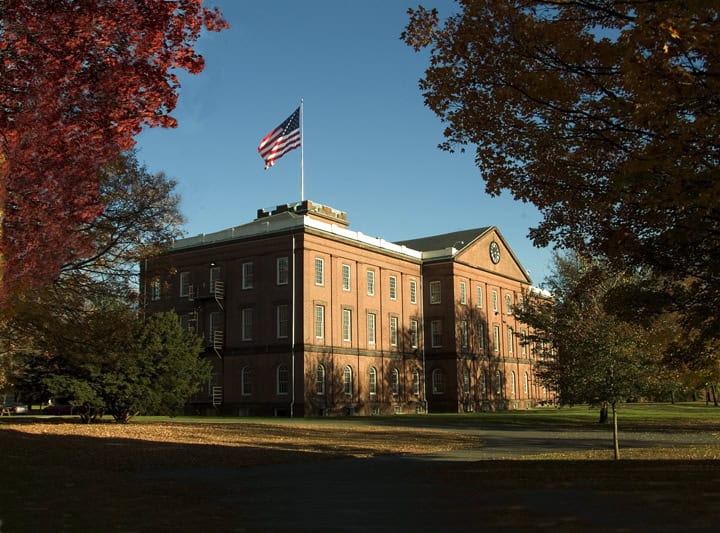
The Springfield Armory facility was transferred to the City of Springfield and Springfield Technical Community College. In 1974, Congress established the Springfield Armory National Historic Site, which opened to the public in 1978 and is operated by the National Park Service. The museum houses one of the largest collections of American military firearms in the world, including examples of virtually every weapon manufactured at the Armory.
The government’s small arms development capability was transferred to other facilities, principally the Rock Island Arsenal and later the Picatinny Arsenal (for ammunition) and various Army research laboratories. But the unique institutional knowledge accumulated over 174 years at Springfield, the combination of design, engineering, manufacturing, and testing expertise in a single facility, was never fully replaced.
Springfield Armory, Inc.: The Name Continues (1971-Present)
The commercial Springfield Armory, Inc. traces to Elmer Ballance, who took up the Springfield Armory name after the government armory closed and began building the M1A in Texas in 1971. In 1974, Robert Reese bought the company from Ballance and moved it to Geneseo, Illinois, where it remains.
Springfield Armory, Inc. initially produced M1A rifles, civilian semi-automatic versions of the M14. The M1A became the company’s signature product and remains in production today. The company later expanded into 1911 pistols and, more recently, the XD series of polymer-framed striker-fired pistols (manufactured in Croatia by HS Produkt and imported/marketed by Springfield Armory, Inc.).
Springfield Armory, Inc. has no institutional, corporate, or historical connection to the original United States Springfield Armory beyond the use of the name. The company did not acquire any assets, intellectual property, or manufacturing equipment from the government armory. They are entirely separate entities.
The Springfield Armory Legacy
The Springfield Armory’s contributions to American military and industrial history are difficult to overstate:
Manufacturing Innovation: Springfield pioneered the American System of Manufacturing (interchangeable parts, precision gauges, specialized machine tools) that became the foundation of American industrial mass production. The techniques developed at Springfield for making muskets eventually built automobiles, appliances, and aircraft.
Cartridge Development: The .45-70 Government and .30-06 Springfield cartridges, both developed at the Armory, remain in use over a century after their introduction. The 7.62x51mm NATO cartridge was developed in conjunction with the Armory’s M14 program.
Rifle Design: The Model 1903 Springfield and the M1 Garand are among the most consequential military rifles in history. The Garand, in particular, was the weapon that gave the American infantryman a decisive individual advantage in World War II.
Institutional Knowledge: For 174 years, Springfield maintained a continuous tradition of firearms design, engineering, and manufacturing expertise under a single roof. The Armory trained gunsmiths, engineers, and machinists who spread their knowledge throughout American industry.
The closure in 1968 ended an institution that had been operating since George Washington was president. Whether that closure was a rational economic decision or a shortsighted mistake depends on how you value institutional knowledge versus cost savings. The scale of what was lost is beyond dispute. No private contractor, however efficient, replicated the Springfield Armory’s unique combination of research, design, engineering, testing, and manufacturing under government control and in the public interest.
The rifles that Springfield produced, from the Model 1795 musket to the M14, armed American soldiers through every war the nation fought. The manufacturing methods Springfield pioneered built modern America. And the cartridges Springfield developed, the .45-70, the .30-06 and the 7.62 NATO, remain in use worldwide, outlasting the institution that created them.
That is a legacy that 174 years of service earned.
Want One?
If reading about the M1 Garand made you want to own one, you have two good paths. The Civilian Marksmanship Program (thecmp.org) sells refurbished surplus M1 Garands to qualified U.S. citizens, real USGI rifles, most rebuilt at the Anniston Army Depot, at prices well below the collector market. CMP rifles sell out in waves; check their site regularly. For a modern production option, Springfield Armory, Inc. (the Geneseo, Illinois, company, no connection to the original government armory, as noted above) produces the M1A, a civilian semi-automatic version of the M14 in .308 Winchester. The M1A Standard, Loaded, and SOCOM 16 models cover everything from traditional walnut-stocked rifles to compact tactical configurations.
For Garand and M1A accessories (clips, slings, cleaning kits, match sights), check Brownells.
About Powder & Lead: We cover firearms, reloading, and shooting sports for enthusiasts who want substance over hype. New articles weekly.
Recommended Books
- The Springfield 1903 Rifles by William S. Brophy. Lt. Col. Brophy’s exhaustive reference on the Springfield 1903 rifle, covering every variant, accessory, and production detail. The standard work on one of Springfield Armory’s most important products.
- Hatcher’s Book of the Garand by Julian S. Hatcher. Julian Hatcher’s classic account of the M1 Garand’s development and adoption, written by the Army ordnance officer who oversaw the testing program. A firsthand historical document.
- Harpers Ferry Armory and the New Technology by Merritt Roe Smith. Merritt Roe Smith’s award-winning study of how Harpers Ferry and Springfield Armories pioneered interchangeable-parts manufacturing and transformed American industry.
Sources and Further Reading:
- Dougherty, Martin J. Small Arms: From the Civil War to the Present Day (2005)
- Brophy, William S. The Springfield 1903 Rifles (1985)
- Hatcher, Julian S. Hatcher’s Book of the Garand (1948)
- Canfield, Bruce N. Complete Guide to United States Military Combat Shotguns (2007)
- Duff, Scott A. The M14 Owner’s Guide and Match Conditioning Instructions (1996)
- National Park Service, Springfield Armory National Historic Site interpretive materials
- Smith, Merritt Roe. Harpers Ferry Armory and the New Technology (1977)
- Hounshell, David A. From the American System to Mass Production, 1800-1932 (1984)
- U.S. Army Ordnance Department historical records
If you know of any forums or sites that should be referenced on this listing, please let us know here.