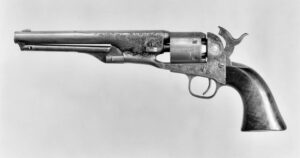
When the German Empire unified in 1871, it inherited a logistical headache that would have made any quartermaster reach for a bottle of schnapps. Prussian officers carried one sidearm, Bavarians another, Saxons something else entirely. The Franco-Prussian War had exposed the absurdity of fielding an army where even the revolvers spoke different dialects. The solution was the Reichsrevolver — a weapon designed by committee, built like a bank vault, and obsolete almost from the day it was adopted. It served the Kaiser’s army for three decades anyway.
Why Germany Needed the Reichsrevolver
German unification was a political triumph that left the new empire’s military sorting through a patchwork of incompatible equipment from dozens of formerly independent states. Standardizing rifles was the obvious priority — the Gewehr 71 took care of that — but sidearms needed attention too. In the 1870s, the Gewehr-Prüfungs-Kommission (GPK), the empire’s weapons testing commission based at the Spandau Arsenal, took on the job of selecting a unified revolver for officers, NCOs, and mounted troops.
The GPK wanted simplicity, ruggedness, and reliability above all else. Speed of reloading? Not a priority. Rapid fire capability? Unnecessary. The sword was still the primary sidearm for cavalry in the 1870s, and the revolver was a backup — a last resort, not a fighting tool. Single-action was considered entirely adequate for a weapon most soldiers would rarely fire in anger.
Initial trials began in 1878. The commission examined contemporary designs from Belgium, France, and the United States and chose manufacturing simplicity over mechanical sophistication every time. The result was a solid-frame, gate-loading, single-action revolver with no integral ejection system. Smith & Wesson was already producing top-break revolvers with automatic ejection for the Russian Empire. The Germans looked at that and said no, too complicated.
The M1879: The “Cavalry Model”
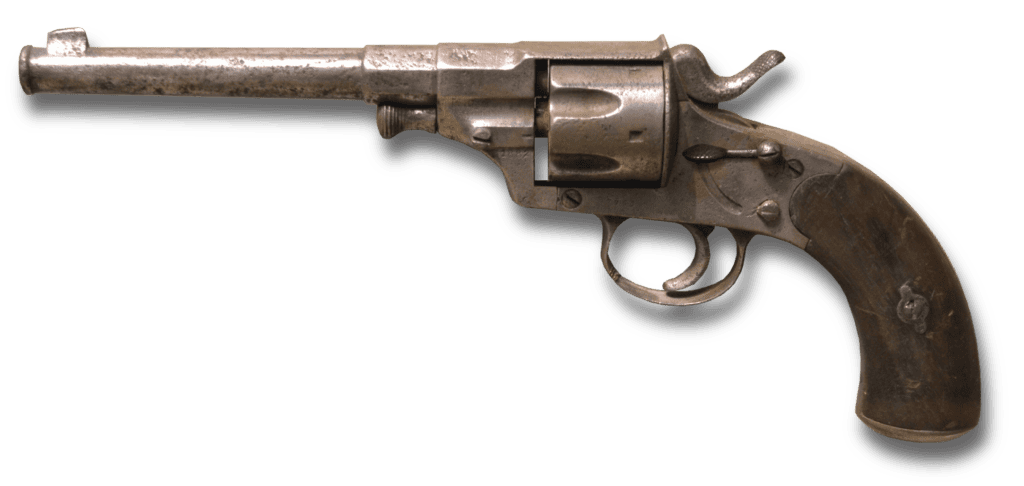
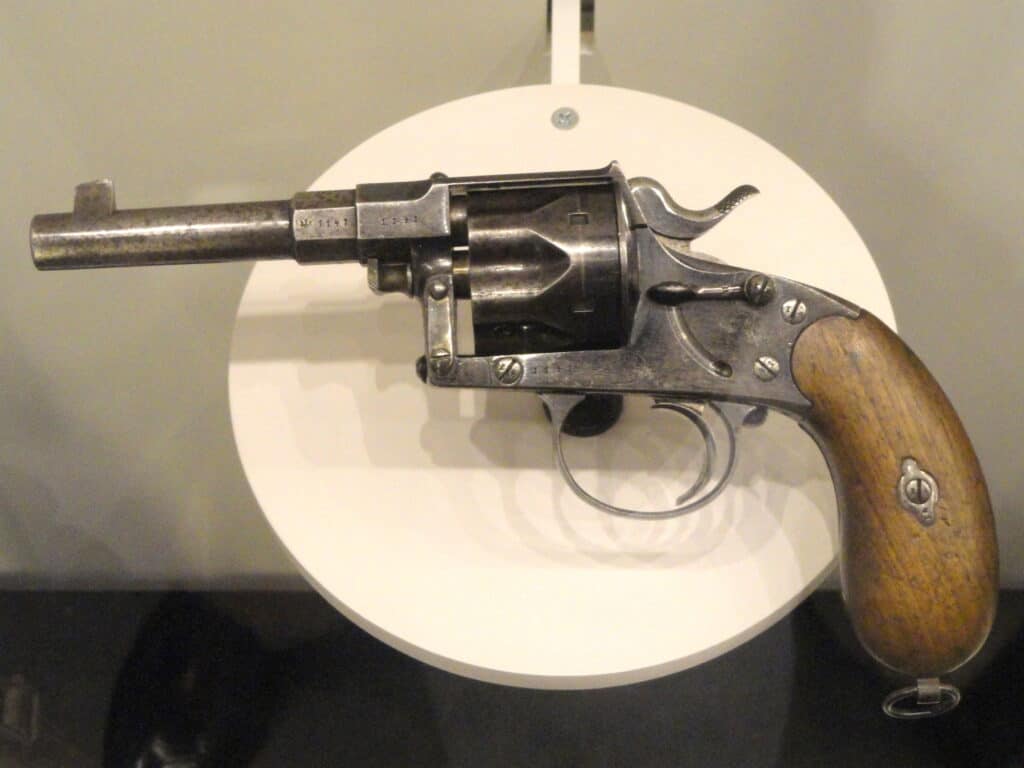
The Reichs-Commissions-Revolver Modell 1879, approved for service that year, was a substantial piece of hardware. With its 7-inch (180mm) barrel and overall length of approximately 14 inches (356mm), it was a large revolver by any standard. Unloaded weight came in around 2.5 pounds (1.13 kg). Heavy enough to double as a club, and given the ejection system, you might need to.
The revolver was chambered for the new 10.6x25mmR German Ordnance cartridge and held six rounds in a fluted cylinder. The action was single-action only, requiring the shooter to manually cock the hammer for each shot. Trigger pull ran heavy at an estimated 4.5 to 5 kg. Fixed sights consisted of a blade front and V-notch rear, effective to perhaps 20 or 25 meters — which was about as far as anyone expected to use a revolver in combat.
The frame was solid blued steel fitted with two-piece smooth walnut grips secured by screws. A lanyard ring at the base of the grip allowed attachment to military equipment — critical for mounted troops who could not afford to lose their sidearm during a charge. The M1879 also had a muzzle swell, called a Mundungswulst (literally “fat mouth”), intended to protect the crown from damage. Gives the revolver a slightly bulbous look at the business end — not pretty, but practical.
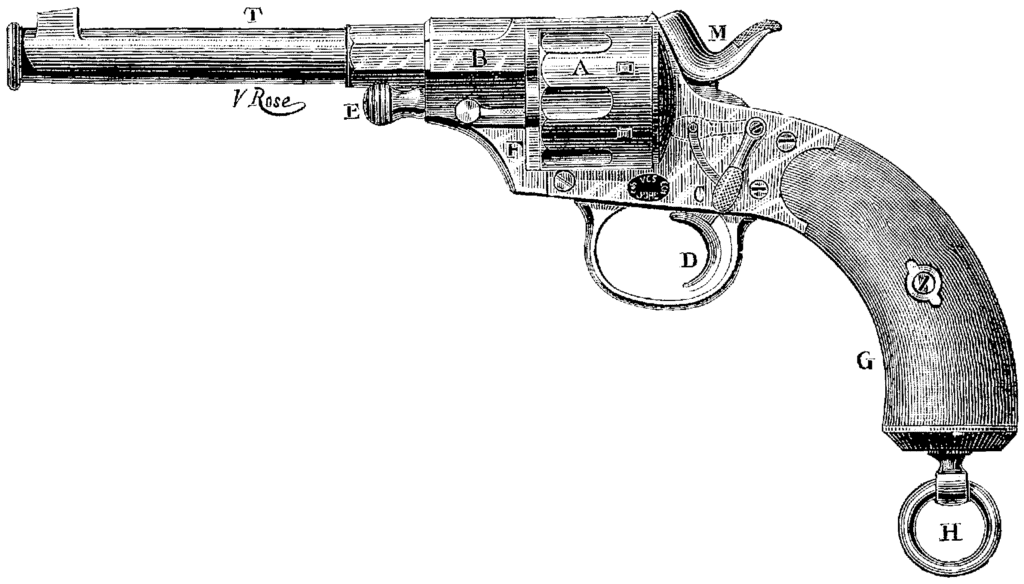
Loading was accomplished through a gate on the right side of the frame. Pulling the hammer to half-cock released the cylinder for rotation, allowing the shooter to insert cartridges one at a time. So far, nothing unusual for the era — Colt’s Single Action Army worked the same way. But unloading was where the Reichsrevolver earned its reputation for impracticality. There was no ejector rod. None. Spent cases had to be poked out individually using a small rod stored in the ammunition pouch, or by pulling the cylinder axis pin to remove the entire cylinder for manual extraction. In the heat of any engagement, this was an eternity.
There was a manual safety lever on the left side of the frame — unusual for a revolver of any era. Engaged, it prevented the hammer from being cocked and blocked the trigger at half-cock. Sensible enough for a weapon bouncing around on horseback, though a single-action revolver with a half-cock notch doesn’t exactly cry out for additional safety mechanisms.
The M1883: Shorter, Lighter, Still Stubborn
Four years of field experience with the Reichsrevolver made it clear that the M1879 was too large and heavy for many of its intended users. Officers in particular found the cavalry-length revolver unwieldy. In 1883, the GPK approved a revised model that collectors now call the “officer’s model,” though this was never an official designation.
The M1883 shortened the barrel to approximately 5 inches (127mm) and reduced overall length to roughly 10 inches (254mm). Weight dropped to around 2 pounds (0.9-1.0 kg) — nearly a full pound lighter than the M1879. The muzzle swell was eliminated as unnecessary machining. The grip was reshaped with a more curved, ergonomic profile, and the metal butt cap of the M1879 gave way to a simpler design. A spring button replaced the side thumb screw for cylinder retention, making field disassembly marginally faster.
The M1883 also received a more prominent frame-mounted safety lever with the same hammer-blocking function. Otherwise, the operating principles remained identical to the M1879 — same single-action mechanism, same loading gate, same lack of an ejector rod, same 10.6x25mmR cartridge. A lighter, handier gun. Still no ejector rod.
The 10.6x25mmR: A Big Bullet Going Nowhere Fast
The proprietary 10.6x25mmR German Ordnance cartridge — also known as the 10.6mm Reichsrevolver — was behind the curve even at adoption. Loaded with approximately 20 grains of black powder behind a 262-grain lead round-nose bullet, it produced a muzzle velocity of roughly 700 feet per second (215 m/s) and approximately 290 foot-pounds of muzzle energy. Think .44 Russian territory — the cartridge Smith & Wesson had developed for the Imperial Russian Army. Big, slow-moving projectile. All mass, no velocity.
The 1870s logic was straightforward: big caliber, heavy bullet, problem solved. That philosophy was already being challenged by the time the Reichsrevolver entered service, and by the 1890s smokeless powder and better metallurgy were making smaller, faster cartridges practical. The 10.6mm never made the transition. The cartridge ran black powder its entire service life — all the fouling, smoke, and corrosion that smokeless would have eliminated.
None of that mattered much at the distances where revolvers actually got used. At 5 to 10 meters, 262 grains of lead at 700 fps will rearrange your priorities regardless of what the ballistic charts say.
Who Built the Reichsrevolver
Production was split across multiple manufacturers. The government wanted industrial redundancy, and the constituent German states all wanted a piece of the contract.
Three primary sources built the M1879. Gebrüder Mauser & Cie in Oberndorf supplied Bavaria and Württemberg. Franz von Dreyse in Sömmerda — same firm whose founder had given Prussia the needle gun — supplied Prussia and Bavaria. The Suhl consortium, consisting of Spangenberg & Sauer, V.C. Schilling & Cie, and C.G. Haenel & Cie, supplied Prussia, Bavaria, and Saxony. Approximately 85,000 M1879 revolvers were produced between 1879 and 1883.
M1883 production was more centralized. The Königliche Gewehrfabrik (Royal Arsenal) at Erfurt manufactured the lion’s share — roughly 95,000 of the approximately 132,656 documented M1883 revolvers produced between 1883 and 1896 (total production including later runs may have reached 400,000), accounting for about 72% of production. The Suhl consortium, Dreyse, and Mauser continued as secondary contractors. Of the Suhl production, 10,000 went to Prussia, 7,296 to Bavaria, and 5,000 to Saxony. Dreyse supplied 13,000 to Prussia and 860 to Bavaria. Mauser’s output went entirely to Württemberg.
Quality control was rigorous. Every revolver got imperial inspection and proofing marks — crown stamps, acceptance marks. Serial numbers went on all major components: frame, barrel, cylinder, even grip panels and screws. Regimental unit markings were stamped on butt caps (M1879) or backstraps (M1883). Collectors still trace those markings today.
Service Life: From Colonial Outposts to the Western Front
Cavalry officers, artillery NCOs, train battalion personnel, naval ratings — the Reichsrevolver went everywhere. Unit markings on surviving examples document assignment to infantry regiments, Kürassiere cavalry, artillery batteries, and the Imperial German Navy.
The revolvers went overseas with the Schutztruppe into German East Africa and German South West Africa during the 1880s and 1890s. During the Boxer Rebellion of 1900-1901, they equipped the German East Asian Expeditionary Corps — approximately 15,000 troops deployed to China. At least one surviving M1883, Erfurt-made in 1892, bears unit markings that may link it to forces stationed near Peking during the uprising.
The Pistole Parabellum 1908 — the Luger P08 — officially retired the Reichsrevolver from front-line service. Of course, “officially retired” and “actually gone” are different things in any military. When the First World War created demand that far exceeded Luger production, the old Reichsrevolvers came back out of storage. Landsturm and Landwehr reserve units, rear-echelon personnel, messengers — anyone who needed a handgun but didn’t rate a modern pistol got one. The solid-frame construction actually proved its worth in the trenches. Mud and debris that would have jammed a more sophisticated mechanism bounced off a Reichsrevolver. Ammunition was the real problem. Production of 10.6x25mmR had been wound down in favor of 9mm Parabellum.
After the war, Weimar Republic police and border guard units kept them in service. When the Wehrmacht rearmed after 1933, the old revolvers surfaced again — Ordnungspolizei units, factory security guards, second-line roles. Never standard Wehrmacht sidearms (the Walther P38 and Luger filled those slots), but wartime shortages brought them back yet again. The last confirmed military chapter reportedly came in 1945, with Volkssturm militia carrying revolvers adopted in the optimism of Bismarck’s new empire into its final, desperate hours.
Why the Reichsrevolver Was So Conservative
The Germans would go on to produce the Luger, the Mauser C96, and some of the most sophisticated firearms in history. So why did they adopt something so deliberately primitive? By 1879, Smith & Wesson’s top-break revolvers with simultaneous ejection were well established. Colt at least gave you an ejector rod on the Single Action Army. The French Chamelot-Delvigne and Belgian Nagant designs offered more refined mechanisms. The GPK looked at all of these and chose the simplest possible path.
Part doctrine, part industrial logic. German cavalry doctrine still regarded the sword as the primary weapon. The revolver was for firing a few shots at close range before the real business of cutting began. Single-action discouraged ammunition waste, and the simpler mechanism was cheaper and faster to manufacture at scale — important when the new empire was rearming rapidly across multiple states. The GPK needed weapons that could be produced in large quantities by multiple manufacturers with interchangeable parts. A single-action solid-frame revolver is about as simple as a repeating firearm gets.
And then there was plain institutional inertia. The Prussian military establishment that dominated the unified German army was deeply conservative about small arms. Innovation went into rifles and artillery — the weapons that won battles. Handguns were an afterthought. The Reichsrevolver was designed like one.
The Private Purchase Market
Officers who found the standard-issue Reichsrevolver inadequate — and plenty did — could buy commercial upgrades out of pocket. Starting around 1889, manufacturers including Franz von Dreyse and Spangenberg & Sauer produced double-action versions of the M1883. These private-purchase revolvers had dual-trigger mechanisms (front trigger cocked the hammer, rear trigger released it), lighter trigger pulls in the 3-4 kg range, and options like checkered grips, nickel plating, engraving, and — finally — patent ejector rods. Forty to fifty Reichsmarks per unit. Money well spent.
What Replaced Them
By the turn of the century, the Reichsrevolver was hopelessly outclassed. The Mauser C96 “Broomhandle” had appeared in 1896, proving that semi-automatic pistols were viable military weapons. Georg Luger’s toggle-locked pistol — refined from Hugo Borchardt’s earlier design — offered everything the Reichsrevolver lacked: rapid reloading via detachable magazine, a modern smokeless cartridge (the 9x19mm Parabellum), and a flat profile that rode easily in a holster. The Luger P08 was officially adopted in 1908, ending the Reichsrevolver’s three decades as Germany’s standard military sidearm. On paper, at least. The trenches six years later had other ideas.
Collecting the Reichsrevolver: What to Look For
Both models turn up regularly on the collector market, though condition varies enormously after 140-plus years. As antique firearms manufactured before 1899, most Reichsrevolvers are exempt from federal firearms licensing requirements in the United States — no FFL needed, which opens the door for collectors who don’t want to deal with transfers.
The M1879 with its long barrel is the scarcer of the two — smaller production run (roughly 85,000) and a longer service life that wore many of them out. The M1883 turns up more often, especially Erfurt-made examples from that massive 95,000-unit production run. Pricing depends on condition, matching serial numbers, provenance, and original accessories. Good examples with clear unit markings and matching numbers run $900 to $1,800 at auction, with specialty dealers asking more. Exceptional specimens with documented provenance go higher.
What to look for: manufacturer markings (Erfurt, Suhl consortium, Dreyse, or Mauser), matching serial numbers across all components (frame, barrel, cylinder, grips, screws), legible regimental unit stamps, and original blued finish. The private-purchase double-action variants are considerably rarer and command a premium when they surface.
Ammunition is the practical problem for anyone who wants to shoot one. The 10.6x25mmR has been out of production for over a century. Factory ammunition is nonexistent. Handloaders can reportedly use .44 Russian brass directly or form cases from .44 Special, but that’s strictly experienced-reloader territory — antique firearms and modern loads are a combination that demands respect. Most collectors wisely keep their Reichsrevolvers behind glass.
The Reichsrevolver’s Place in History
The Reichsrevolver was neither innovative nor elegant. Heavy, slow to reload, impossible to unload efficiently, chambered in a cartridge that was borderline obsolete at adoption. And yet it worked. Thirty years as the standard sidearm of one of Europe’s most powerful military forces. Combat on multiple continents. Durable enough to keep turning up in conflicts six decades after its introduction.
The same nation that would produce the Luger and the Walther P38 first armed its officers with a revolver that required a stick to unload. But in the 1870s, the handgun was an afterthought — the sword hadn’t finished dying yet, and the semi-automatic pistol hadn’t been born. The Reichsrevolver filled that gap. Not gracefully. But it filled it.
Recommended Reading
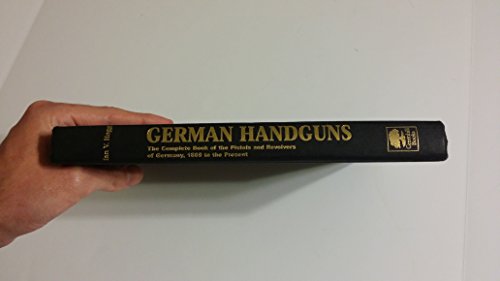
For those who want to dig deeper into the Reichsrevolver and its context in German military handgun development:


If you know of any forums or sites that should be referenced on this listing, please let us know here.