
Introduction
The American Civil War (1861-1865) saw officers on both sides carrying a wide range of firearms, chosen on availability, personal preference, and what the fighting demanded. Enlisted men were issued standardized weapons. Officers had far more discretion over their sidearms and long guns, and senior commanders could obtain nearly any weapon they wanted. The result ran from Colt revolvers to the Sharps breech-loader and repeating rifles like the Spencer and Henry.
This article covers the firearms most commonly carried by Civil War officers, their specifications, the officers associated with them, and the part they played in battlefield tactics.
Colt Model 1851 Navy Revolver: A Favorite Among Officers
One of the most widely carried sidearms among officers was the Colt Model 1851 Navy Revolver, a six-shot, single-action percussion revolver chambered in .36 caliber. Its manageable weight, accuracy, and reliability made it a popular choice on both sides of the conflict. It went most often to cavalry and to some artillery, it was used extensively throughout the war, and it stayed in production until 1873 (National Park Service).
Specifications:
- Caliber: .36 percussion
- Action: Single-action revolver
- Capacity: 6 rounds
- Barrel Length: 7.5 inches
- Effective Range: ~75 yards
Notable Users:
Robert E. Lee owned and used a Colt Model 1851 Navy. The revolver, serial number 37698, is in the collection of the American Civil War Museum in Richmond, which records that, according to Lee’s son, his father carried it in a saddle holster rather than in his belt holster on the field of battle (American Civil War Museum, catalog no. 0985.13.00062).
Colt Model 1860 Army Revolver: The Union Standard
By the start of the war, the Colt Model 1860 Army Revolver had become the standard-issue sidearm for Union officers and cavalry units. An evolution of the Colt 1851, it was chambered in the more powerful .44 caliber, which gave it significantly greater stopping power.
Specifications:
- Caliber: .44 percussion
- Action: Single-action revolver
- Capacity: 6 rounds
- Barrel Length: 8 inches
- Effective Range: ~100 yards
Notable Users:
Union General George B. McClellan carried a Colt 1860, and Confederate General Nathan Bedford Forrest was also known to favor this model.
Remington Model 1858: The Rugged Alternative
The Remington Model 1858 Revolver grew out of the earlier Remington Beals design and gave Colt its strongest competition. It was a single-action, six-shot percussion handgun in .44 caliber. Its solid frame, with a top strap carried over the cylinder, made it stronger than the open-top Colts and better suited to sustained use. The unconventional Savage 1861 Navy revolver, with its distinctive double-trigger mechanism, also saw service as an alternative Union sidearm.
Specifications:
- Caliber: .44 percussion
- Action: Single-action revolver
- Capacity: 6 rounds
- Barrel Length: 8 inches
- Effective Range: ~100 yards
Notable Users:
Remington ranked second only to Colt among suppliers of revolvers to the U.S. government. Army deliveries came to 12,251 revolvers in .36 caliber and 115,557 in .44 caliber, and the Navy took a further 5,960 in .36 (American Rifleman). Union General George Meade was presented with an ornate example of the New Model Army (NRA National Firearms Museum). On the Confederate side, Colonel John S. Mosby and his command took Remingtons from Union cavalry and carried them.
Confederate Revolvers: Limited but Notable
Blockade and industrial shortage meant the Confederacy struggled to manufacture its own firearms, and Southern output stayed small. Several Southern makers produced viable alternatives, and a number of officers carried them as a matter of pride. Augusta Machine Works and Rigdon, Ansley & Co. also built revolvers for Confederate service.
- Dance Brothers Revolver – A .44 caliber percussion revolver built in Columbia, Texas, and recognizable by its flat frame with no recoil shields behind the cylinder.
- Griswold & Gunnison Revolver – A .36 caliber revolver modeled after the Colt 1851, featuring a brass frame due to material shortages.
- LeMat Revolver – A nine-shot sidearm with a .42 caliber revolver barrel above a 16-gauge smoothbore shotgun barrel. Roughly 2,500 reached Confederate forces out of an order for 8,000. Generals J.E.B. Stuart, P.G.T. Beauregard and Thomas J. “Stonewall” Jackson all carried one, and Stuart was firing his LeMat when he was mortally wounded at Yellow Tavern in 1864.
- Spiller & Burr Revolver – Based on the Whitney revolver, chambered in .36 caliber.
Sharps Carbine: A Precise Long-Range Choice
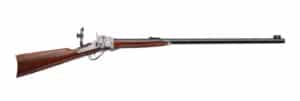
Officers who wanted a long-range firearm often turned to the Sharps Carbine, a single-shot, breech-loading rifle. Unlike muzzleloaders, which took time to reload, the Sharps used a falling block action that opened at the breech. Known for its accuracy, the Sharps Carbine was chambered in .52 caliber percussion during the Civil War. The .50-70 Government cartridge was adopted in 1866 and the .45-70 in 1873, both after the war.
Specifications:
- Caliber: .52 percussion
- Action: Falling block, single-shot
- Effective Range: ~500 yards
Notable Users:
Union General John Buford, a key figure at the Battle of Gettysburg, carried a Sharps Carbine.
Spencer Repeating Rifle: A Game Changer
The Spencer Repeating Rifle was lever-action and fed from a tube magazine in the buttstock that held seven rimfire cartridges, which let officers and cavalrymen fire several shots before reloading. That was rapid fire a single-shot Sharps could not match.
The Spencer was a Union weapon only. Christopher Spencer refused to sell to the Confederacy, and the South could not manufacture the rimfire ammunition it required.
Specifications:
- Caliber: .56-56 rimfire
- Action: Lever-action
- Capacity: 7 rounds
- Effective Range: ~500 yards
Notable Users:
President Abraham Lincoln personally tested and approved the Spencer for military use. Union General George A. Custer carried one in combat, and Union General John C. Fremont recognized its effectiveness. Confederate commanders including John Bell Hood met Spencer-armed Union troops in the field.
Henry Repeating Rifle: The 16-Shot Wonder
The Henry Rifle held up to 16 rounds of .44 Henry rimfire ammunition in a tube magazine under the barrel, far more than the single-shot arms alongside it. It went primarily to Union troops, and a few Confederate officers obtained captured examples. Confederate cavalry under Wade Hampton III took more than 200 Henry rifles during the 1864 Beefsteak Raid, though there is no evidence Hampton carried one himself.
Specifications:
- Caliber: .44 Henry rimfire
- Action: Lever-action
- Capacity: 16 rounds
- Effective Range: ~300 yards
Notable Users:
Union Brigadier General Benjamin H. Grierson carried a Henry Repeating Rifle during deep raids into Confederate territory.
Conclusion
Civil War officers carried firearms that suited their needs, their means, and their habits, from Colt and Remington revolvers to the Sharps and Spencer rifles and the repeating rifles that followed them. Those choices shaped close combat and cavalry tactics, and the repeaters in particular pointed toward the military small arms of the decades after the war.
Read more about these weapons here.
If you know of any forums or sites that should be referenced on this listing, please let us know here.