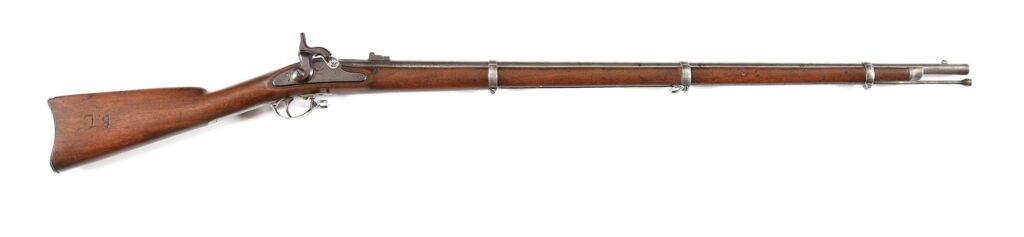
The Civil War musket most infantrymen carried was a rifle musket. It was a muzzleloader of full musket length, fired by a percussion cap, with a rifled bore and a hollow-based lead bullet that expanded into the grooves. The United States adopted its .58 caliber rifle musket in 1855. Between January 1, 1861, and June 30, 1866, the Union Ordnance Department bought or made 1,472,614 Springfield rifle muskets. It also bought 428,292 long Enfield rifles and 226,294 Austrian rifles. The Confederacy built copies on machinery taken from Harpers Ferry and bought rifles in Europe.
What Made a Musket a Rifle Musket
The infantry musket of the 1840s was a smoothbore. Its round ball fit the bore loosely, which made it quick to load, and the ball left the muzzle with no spin. A rifle’s spiral grooves spin the bullet and steady its flight. The old difficulty was loading. A bullet tight enough to grip the grooves was hard to push down a barrel fouled by black powder.
The expanding bullet solved it. The National Park Service describes the Minié bullet as “a conical slug of lead slightly more than half an inch in diameter and about an inch long, with a hollow base which expanded when the rifle was fired.” The bullet went down the bore easily. On firing, the gas spread its base into the rifling and sealed the bore behind it. James H. Burton became acting master armorer at Harpers Ferry Armory in 1849 and experimented with improved designs for the next four years. The U.S. Army adopted his modified version in 1855. Our history of the Minié ball covers the bullet’s French origins.
“Rifle musket” was the Army’s own term. The 1861 Ordnance Manual (third edition) lists two among the small arms adopted for service: “The rifle musket, model 1855” and “The rifle musket, model 1842.” The second was the old .69 caliber Model 1842 smoothbore with its bore grooved and a rear sight added.
The 1855 Decision Behind the Civil War Musket
On June 26, 1855, Colonel H. K. Craig, the Army’s Colonel of Ordnance, sent Secretary of War Jefferson Davis the Ordnance Board’s recommendations for new small arms. The board proposed “a smaller calibre than that of our present musket, but greater than that of our rifle, viz: .58 inch” for all small arms. It wanted a 40-inch musket barrel and a lock “with magazine for 50 Maynard primers.” The barrels were to be “rifled with three grooves, decreasing depth,” with a twist of one turn in six feet. Davis approved the .58 calibre, the 40-inch barrel and the lock on July 5, 1855.
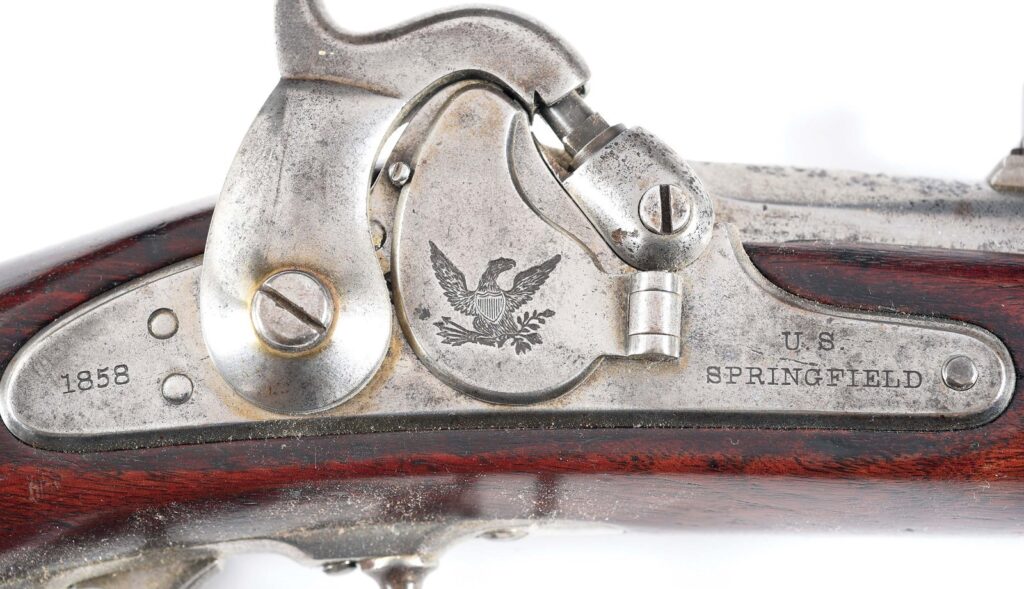
The 1861 Ordnance Manual gives the finished arm. The rifle musket, model 1855, had a .58 inch bore and a 40-inch barrel. It measured 55.85 inches long without the bayonet and 73.85 inches with it. Its three grooves made one turn in six feet. They were .015 inch deep at the breech and .005 inch at the muzzle. The arm weighed 9.18 pounds, or 9.90 pounds with the bayonet.

The lock held a magazine of Maynard primers, fed to the cone by a “feeding-finger.” A patch box was added to the butt on July 9, 1859. The 1861 manual then records a change: “The muskets made at this time have not the self-priming lock nor the patch-box.” Springfield Armory’s rules of 1863 describe the new rifle musket of that year by its differences from the “model of 1861.” They add that the rules for the model 1855 apply to the newer arm once “the parts of the lock that apply to the ‘Maynard primer'” are left out.
Harpers Ferry and the Confederate Rifle Musket
Two national armories made the new rifle musket before the war: Springfield Armory in Massachusetts and Harpers Ferry Armory in Virginia. On April 18, 1861, with Virginia militia advancing on the town, Lieutenant Roger Jones ordered the Musket Factory set on fire at 10 p.m. The militia dismantled the armory machinery in the first weeks of May, with Colonel Thomas J. Jackson supervising. It ended up in Richmond, Virginia, and Fayetteville, North Carolina.
The Richmond Armory used the rifle musket machinery. The Springfield Armory museum calls its product “a close copy of the US rifle musket.” The Richmond Armory’s superintendent from June 1861 was James H. Burton. He had left Harpers Ferry in 1854. In June 1855 he became chief engineer of the Royal Small Arms Manufactory at Enfield, in England, where he set up new machinery bought in the United States. The Park Service says his “complete familiarity with the machinery for manufacturing United States firearms proved indispensable to the Confederacy.”
Fayetteville received the Harpers Ferry rifle machinery.
Southern arsenals held about 175,000 modern shoulder arms at the start of the war, by the museum’s count, and about 140,000 of them were smoothbores. It estimates that the Confederacy made about 107,000 shoulder arms by April 1865. Our article on Confederate firearms covers the Southern armories and makers.
The Springfield Rifle Musket: Models 1861 and 1863
The Ordnance Department also bought from private makers. On July 11, 1861, Chief of Ordnance James W. Ripley contracted with Lamson, Goodnow & Yale of Windsor, Vermont, for 25,000 muskets “of the exact pattern of the muskets made at the United States armory in Springfield.” In June 1862 he signed more contracts for “muskets of the Springfield pattern.” On June 17 the Amoskeag Manufacturing Company of Manchester, New Hampshire, agreed to make 10,000 at twenty dollars each, appendages included. Each was to be “in all respects identical with the standard rifle-musket made at the United States armory at Springfield, Massachusetts,” and to “interchange with it and with each other in all their parts.” James T. Hodge of New York had signed for 25,000 to the same specification on June 9.
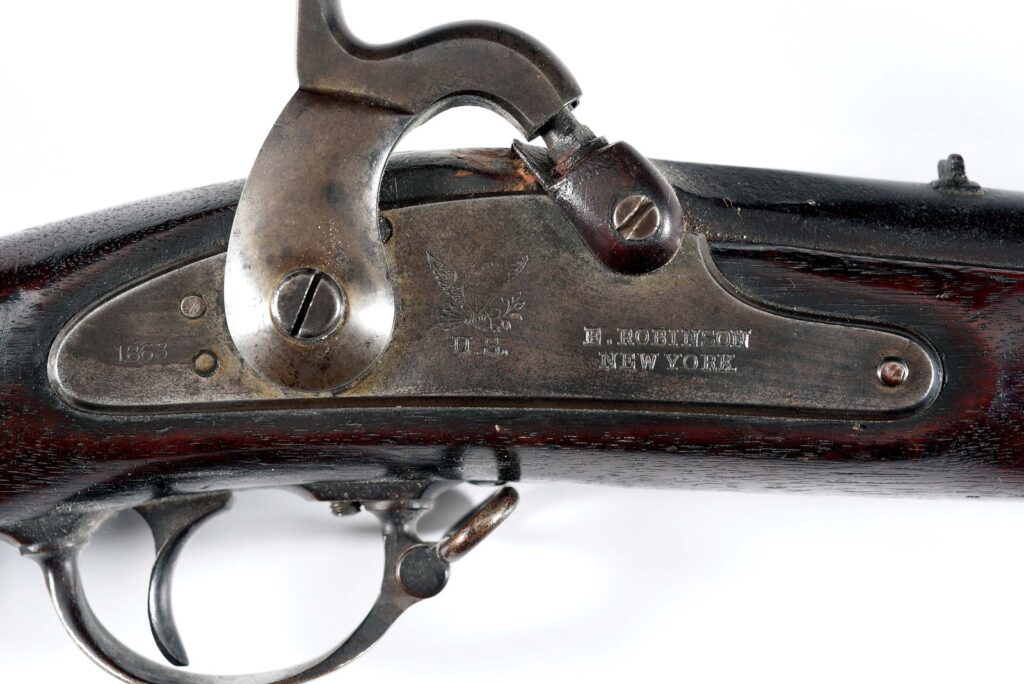
Springfield Armory issued its rules for the Model 1863 on April 28, 1863. They list the changes from the Model 1861:
- a shorter cone seat with no cone-seat screw, and a rounded muzzle;
- a reshaped hammer;
- a ramrod without the old swell, held by a new ramrod spring;
- open bands fastened by screws, with the band springs dropped;
- a lock case-hardened in colors, with the bands, swivels and guard blued.
The Chief of Ordnance, A. B. Dyer, totalled the war’s output in his report of October 23, 1866. From January 1, 1861, to June 30, 1866, the department bought 670,617 Springfield rifle muskets and made 801,997 itself, 1,472,614 in all. Dyer also worked out how fast they were used up. Infantry rifle muskets were lost or worn out at 13 per cent a year in active service, an average service life of seven years. Our history of the Springfield Model 1861 covers that rifle in more detail.
Enfields, Austrians and Other Imported Rifle Muskets
Both governments bought abroad. Dyer’s statement of purchases lists 428,292 “Enfield rifles, long, calibre .577, triangular bayonet” and 8,034 short Enfields with sword bayonets. It lists 226,294 Austrian rifles, 162,533 Boker’s rifles, 59,918 Prussian rifles, 57,467 Belgian rifles and 44,250 French rifles, among others. His summary puts “all other muskets and rifles,” everything beyond the Springfields and Enfields, at 795,544.
On July 14, 1862, Assistant Secretary of War P. H. Watson made the New York arms merchant Marcellus Hartley the government’s “special and confidential agent” for buying arms in Europe. Watson wanted “rifled muskets, with angular bayonets, of the calibre of .577 and .580, and conforming, in their distinguishing characteristics, to the long Enfield rifles.” He ranked the European makes in five classes. First came “The machine-made English Enfield, with interchangeable parts, manufactured only by the London Armory Company.” Last came “The Vienna and Austrian Enfield.” Hartley was to secure the London Armory Company’s whole output until January 1, 1863.

Caleb Huse, the Confederacy’s purchasing agent, told his side in a memoir published in 1904. His orders were “to purchase 12,000 rifles and a battery of field artillery.” In London he went to the London Armory Company. There he met an American engineer he suspected of buying for the United States. Within a few days Huse closed a contract for all the arms the company could make “after filling a comparatively small order for the United States agent.” He wrote that the company “during the remainder of the war, turned all its output of arms over to me.” In Vienna he later contracted for “100,000 rifles of the latest Austrian pattern” and ten batteries of field artillery, shipped from Hamburg to Bermuda.
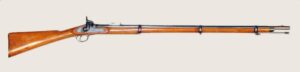
The Austrian rifle best known in America is the Lorenz, which the National Firearms Museum says “ranked second only to the British long arm in numbers imported.” The National Park Service at Fort Smith gives it a .54 caliber bore and a 37 1/2 inch barrel, and says both governments imported it. The museum credits the Northern arms merchants George L. Schuyler and Marcellus Hartley with buying “over 226,000” of them. An 1861 offer of Austrian rifles to the Union by S. Dingee & Co. of New York promised that “the calibre of each arm shall be in accordance with the United States standard, to wit: fifty-eight one-hundredths.” Our Enfield Pattern 1853 history covers the British rifle and the reproductions made today.
Loading and Firing the Rifle Musket
The 1861 Ordnance Manual sets out the service cartridge for the 1855 musket and rifle. It held an “expanding ball” .5775 inch in diameter and weighing 500 grains, with a powder charge of 60 grains, in a paper wrapper. The balls were made “by compression” in machines, and the manual reckons one man could press 30,000 in ten hours. They were greased by dipping in a melted mixture of “1 part of tallow and 8 of beeswax.”
Those are the Ordnance Department’s 1861 figures for a military cartridge, given here as history. They are no guide for loading a reproduction today. Use the manual that comes with your rifle.
Hardee’s Rifle and Light Infantry Tactics drilled the soldier to “load in nine times,” each on its own command:
- Load: the butt goes between the feet and the right hand to the cartridge box.
- Handle cartridge: “place it between the teeth.”
- Tear cartridge: tear the paper to the powder.
- Charge cartridge: empty the powder into the barrel and set the ball in the bore, “the pointed end uppermost.”
- Draw rammer.
- Ram cartridge: “press the ball home.”
- Return rammer.
- Prime: half-cock, remove the old cap and press a new percussion cap on the nipple.
- Shoulder arms.
With Maynard’s primer there was no capping step, and the drill was eight times. The rear sight on the Model 1863 had a notch for 100 yards and two leaves marked for 300 and 500 yards. The War Department adopted Henry Heth’s System of Target Practice on March 1, 1858, for troops armed with “the Musket, Rifle-Musket, Rifle, or Carbine.” Its aiming drill says that a skirmisher “can take any line of sight from 260 to 1,000 yards.”
Range on Paper and Range in Battle
The Model 1863’s sights reached 500 yards, and Heth’s manual drilled aiming out to 1,000. The National Park Service’s history of Burton says of the Minié bullet: “Its effective range was from 200 to 250 yards.” How far men actually fought is a long-running argument among historians.
Grady McWhiney and Perry Jamieson argued that the rifle had a tremendous impact on the war and its tactics. Paddy Griffith argued that it had relatively little effect. Earl J. Hess made the case for a small effect in The Rifle Musket in Civil War Combat: Reality and Myth (2008). Timothy B. Smith summed up his two main arguments for Civil War Times. First, battlefields were so cluttered that a soldier rarely could see past the effective range of a smoothbore. Second, when soldiers could see a distant enemy, they lacked the training to aim accurately. Hess concludes that most fighting still took place at smoothbore distances. He finds the rifle musket’s real effect in skirmishing and sniping. Our histories of Hiram Berdan’s sharpshooters and the Sharps rifle cover that side of the war.
After the War
The government ended the war with more than one million .58 caliber muzzle-loading rifle muskets on hand, according to the Springfield Armory museum. General Orders No. 101 priced a musket at six dollars for a soldier who kept his, and many thousands of surplus arms passed into private hands that way. The museum shows the muster-out roll of Private John J. Chase, Company G, 6th Vermont Infantry, dated June 19, 1865. It records six dollars taken from his pay “for gun & equipts retained under G.O. 101 W.D.”
Dyer reported in October 1866 that no arms had been made at Springfield during the past year. The armory had cleaned and repaired the arms turned in after the war and prepared to convert Springfield muskets into breechloaders. “About five thousand muskets have been converted into efficient breech-loaders,” he wrote, and he expected two hundred a day by February. That conversion became the trapdoor Springfield. For the breechloading carbines bought for the cavalry during the war, see our guide to Civil War carbines.
Where the Record and the Legend Disagree
- “Effective out to 500 yards.” The Model 1863’s sights reached 500 yards, and the 1858 target practice manual drilled aiming to 1,000. The Park Service gives the Minié bullet an effective range of 200 to 250 yards. Hess argues that most fighting took place at smoothbore distances.
- “Progressive-depth rifling was the Enfield’s feature.” Both rifle muskets had it. Peter Smithurst’s study of Enfield manufacture says that when production began at Enfield the factory cut “progressive rifling,” grooves “of decreasing depth from breech to muzzle.” The American 1855 board called for three grooves of “decreasing depth,” and the 1861 manual gives .015 inch at the breech and .005 inch at the muzzle.
- “More than a million Model 1861s.” Dyer’s tables count “Springfield rifle muskets,” 1,472,614 bought or made from January 1861 to June 1866. They do not separate the Models 1855, 1861 and 1863.
- “The London Armory Company’s whole output went South.” Huse wrote in 1904 that the company gave him its whole output for the rest of the war. The War Department’s instructions to Hartley in July 1862 show the Union still hoped to buy that same output through January 1863. Huse was writing about forty years after the events.
- “The Lorenz was inaccurate because the Union bored it out unevenly.” The Fort Smith history blames bullets “inferior to the mine ball” and barrels “inconsistent in quality.” It quotes Private Henry Strong of the 12th Kansas Infantry, who was glad when his Austrian rifle was replaced with a British Enfield.
- “The rifle musket made Civil War battles deadlier.” Historians still dispute it. McWhiney and Jamieson argued for a tremendous effect. Griffith argued that it had relatively little effect on the battlefield. Hess argued that it changed little in the main battle lines and placed its real effect in skirmishing and sniping.
Books on the Civil War Musket
Book links go to Amazon, and Powder & Lead earns a commission on qualifying purchases.
-
Sale!

The Rifle Musket in Civil War Combat: Reality and Myth (Modern War Studies)
Purchase on Amazon -

Civil War Firearms: Their Historical Background and Tactical Use
Purchase on Amazon -

The Pattern 1853 Enfield Rifle (Weapon, 10)
Purchase on Amazon -

Springfield Armory Shoulder Weapons 1795-1968
Purchase on Amazon -

Manual of Arms: Drill, Tactics, & Rifle Maintenance for Infantry Soldiers During the American Civil War-Rifle and Light Infantry Tactics by W J … & Infantry Tactics, for the Instruction
Purchase on Amazon -
Sale!

Civil War Collector's Encyclopedia: Arms, Uniforms and Equipment of the Union and Confederacy
Purchase on Amazon
- Earl J. Hess, The Rifle Musket in Civil War Combat: Reality and Myth (University Press of Kansas).
- Joseph G. Bilby, Civil War Firearms: Their Historical Background and Tactical Use (Da Capo).
- Peter Smithurst, The Pattern 1853 Enfield Rifle (Osprey, Weapon 10).
- Robert W. D. Ball, Springfield Armory Shoulder Weapons 1795-1968 (Antique Trader Books).
- W. J. Hardee and Silas Casey, Manual of Arms, a reprint of their infantry tactics (Leonaur).
- Francis A. Lord, Civil War Collector’s Encyclopedia (Dover).
Sources
- H. K. Craig to Jefferson Davis, June 26, 1855, and Davis’s approval of July 5, 1855, in Reports of Experiments with Small Arms for the Military Service, by Officers of the Ordnance Department, U.S. Army (Washington: A. O. P. Nicholson, 1856), pp. 85 and 86.
- The Ordnance Manual for the Use of the Officers of the United States Army, third edition (Philadelphia: J. B. Lippincott, 1862; preface dated September 2, 1861), pp. 177 to 179, 183, 266 and 270, and the plates.
- Springfield Armory, Rules for the Management and Cleaning of the Rifle Musket, Model 1863, for the Use of Soldiers (Washington: Government Printing Office, 1863).
- W. J. Hardee, Rifle and Light Infantry Tactics, vol. 1 (Nashville: J. O. Griffith, 1861), pp. 36 to 40.
- Henry Heth, A System of Target Practice, for the Use of Troops When Armed with the Musket, Rifle-Musket, Rifle, or Carbine (New York: D. Van Nostrand, 1862), with the War Department order of March 1, 1858.
- A. B. Dyer, Chief of Ordnance, report of October 23, 1866, with the “Summary statement of purchases and fabrications” and the “Statement of ordnance and ordnance stores purchased by the Ordnance Department from January 1, 1861, to June 30, 1866,” in Report of the Secretary of War (Washington, 1866), pp. 655 to 657 and 664.
- Ordnance Department: Message from the President of the United States, January 14, 1868, House Executive Document No. 99, 40th Congress, 2nd Session: contract with the Amoskeag Manufacturing Company, pp. 75 and 76; contract with Lamson, Goodnow & Yale, pp. 241 and 242; contract with Edward Robinson, pp. 427 to 429; S. Dingee & Co. proposition, pp. 129 and 130; instructions to Marcellus Hartley and contract with James T. Hodge, pp. 166 and 167.
- Caleb Huse, The Supplies for the Confederate Army: How They Were Obtained in Europe and How Paid For (Boston: T. R. Marvin & Son, 1904), pp. 19 to 21, 26 and 27.
- National Park Service, Harpers Ferry National Historical Park, Armory Grounds and James H. Burton.
- National Park Service, Springfield Armory National Historic Site, The Arms of the Confederacy, Products and A Springfield Rifle-Musket.
- National Park Service, Fort Smith National Historic Site, 1854 Austrian Lorenz Rifle.
- NRA National Firearms Museum, Lorenz Model 1855 Percussion Rifle, on loan from the Smithsonian’s National Museum of American History.
- Peter G. Smithurst, The Development, Technology and Application of Mechanised Manufacture to the Enfield Pattern 1853 Rifle and the Achievement of Interchangeability (doctoral thesis, University of Huddersfield, 2020), p. 305.
- Timothy B. Smith, review of The Rifle Musket in Civil War Combat, Civil War Times, April 2009.
- Morphy Auctions, Collectible Firearms & Militaria, March 15 to 17, 2022: lot 1187, Model 1861 rifle musket by E. Robinson, dated 1863; lot 1188, Model 1863 rifle musket by Springfield; lot 1190, Model 1855 rifle musket by Springfield, dated 1858. Firearms & Militaria, December 16 to 18, 2025: lot 3211, Pattern 1853 Enfield rifle musket by E. P. Bond.
The Morphy Auctions (morphyauctions.com) catalog archive is one of the standout marketplaces for rare and historically significant American firearms. The rifle musket photography that appears in this article (the Springfield Model 1863, the Model 1855 lock with its Maynard primer, the E. Robinson contract lock and the E. P. Bond Enfield) comes from their archive. Their sales are worth following whether you are buying, researching original Civil War arms and their period contemporaries, or just looking at very good firearms photography.
If you know of any forums or sites that should be referenced on this listing, please let us know here.