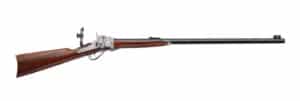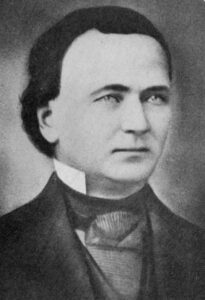
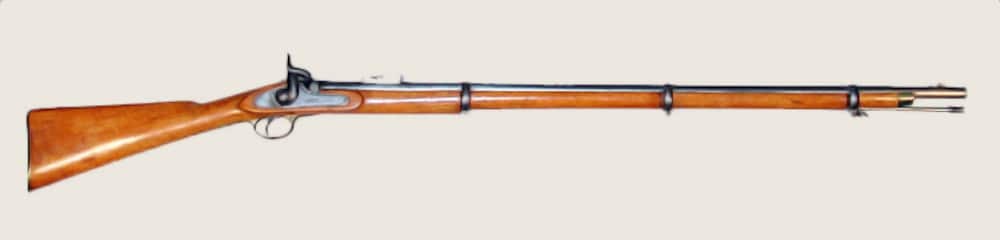
The Enfield Pattern 1853 is one of the most consequential rifles of the nineteenth century — and one of the few whose modern reproductions are still actively shot in serious competition on both sides of the Atlantic. This guide covers both: the deep historical narrative of how the P53 came to define a generation of British military and Civil War-era American small-arms practice, and a practical buyer’s framework for the modern reproductions that bring those rifles back into the hands of working shooters today.
If you’re considering a Pattern 1853 reproduction for North-South Skirmish Association (N-SSA) competition, MLAGB long-range military rifle matches in Britain, Civil War reenactment, recreational black-powder shooting, or simply collector’s enthusiasm, the second half of this guide maps the current market — Davide Pedersoli, Armi Sport, the now-discontinued Parker-Hale rifles still circulating on the secondary market, and the U.S. retail channels through Dixie Gun Works, Track of the Wolf, Taylor’s & Co., and Cimarron — to the use case it was built for. Before we get there, the history is worth understanding, because it explains why so many distinct reproduction patterns exist today.
The Setting: Why .577?
In the autumn of 1861 the steamer Bermuda slipped past Federal warships into the harbor at Savannah, Georgia. In her hold, packed in long wooden crates marked with arsenal labels from Birmingham, England, were several thousand rifle muskets bound for the new Confederate States Army. They were the same rifle the British soldier carried at Sevastopol, the same rifle that had armed the regiments that crushed the 1857 Sepoy Rebellion: the Enfield Pattern 1853, in .577 caliber, with the long 39-inch barrel and the three iron bands that gave the rifle its informal name. By April 1865 perhaps 900,000 of them had reached American hands — Union and Confederate, federal contract and blockade run — making the Pattern 1853 Enfield the most-imported foreign rifle of the American Civil War by a wide margin and one of the most consequential foreign-made firearms in U.S. history.
That story is the kernel of why the Enfield Pattern 1853 still matters. The rifle was adopted by the British War Department in late 1853 to replace the older Pattern 1851 Minié rifle, which had served only briefly. Designed by an Ordnance Select Committee at the Royal Small Arms Factory in Enfield, north London — the source of the rifle’s pattern designation — the P53 was a calculated step beyond its predecessor in caliber, accuracy, and manufacturing economy. It would remain in front-line British service for fourteen years as a muzzle-loader, then for another fourteen years as a converted breech-loader, and would arm British, colonial, Indian, Confederate, Federal, Italian, Japanese, and Mexican forces across the second half of the nineteenth century.
The Predecessor: Pattern 1851 Minié Rifle
The Enfield Pattern 1853 inherited a problem from its predecessor. The Pattern 1851 Minié rifle, the British Army’s first generally issued rifled percussion arm, fired a .702-caliber projectile — the same enormous bore as the Brown Bess smoothbore musket it replaced. The caliber was not an engineering decision so much as an emergency contingency: a soldier with a rifled .702 bore could, in extremis, load a loose musket ball and still get the weapon to fire.
But the .702 Minié projectile had problems. It produced severe fouling. It carried more lead than was needed for effect at any normal infantry range. It generated heavy recoil that tired soldiers across a day of volley fire. And its ballistic performance at longer ranges was inferior to what a smaller, smaller-cased projectile could deliver. Approximately 35,000 P51 Miniés were produced, and the British Army began looking for something better almost immediately.
The Pattern 1853 was the answer. A reduced caliber of .577 — a step down from .702 — paired with three-groove rifling at a slow 1:78 twist, a 39-inch barrel, and a 55-inch overall length. The weight came in at 9.5 pounds unloaded. The ladder rear sight was graduated to 1,250 yards on the standard infantry pattern. The stock was held to the barrel by three iron bands rather than the wedges of the predecessor, which produced a more rigid assembly and the visual signature that named the rifle in popular usage.
The first Pattern 1853 rifles were issued to British troops in February 1855, mid-Crimean War. Until then, British forces in the Crimea carried a mix of P51 Miniés and older Pattern 1842 smoothbore percussion muskets.
The Manufacturing Network: Enfield, London, Birmingham
The Pattern 1853 was not a single factory’s product. Even at peak output, the Royal Small Arms Factory at Enfield could not supply the British Army’s wartime demand, much less the export demand that would follow.
Three production sources converged to meet the gap.
The Royal Small Arms Factory at Enfield (RSAF). The government arsenal. Operated to government specifications with government-supplied gauges, producing arms to interchangeable-parts standards. The RSAF was a benchmark for quality but a bottleneck for volume.
The London Armoury Company. Founded in 1856, specifically to apply American-style interchangeable-parts manufacturing to British military arms. The company used the same standard gauges as the RSAF and produced the highest-grade commercial Enfields of the era. The Crown contracted with London Armoury for arms — and so did the U.S. Government (early in the Civil War, May 1861) and the Commonwealth of Massachusetts. By 1862 the Confederacy was also a London Armoury customer.
The Birmingham Gun Quarter. The British arms-making heartland since the 1630s. Dozens of small contractors made barrels, locks, stocks, and furniture; the completed arms were assembled through the Birmingham Small Arms Trade. During the American Civil War, Birmingham gunmakers outproduced their London counterparts on Enfield exports to America at roughly two to one — an estimated 800,000 of the approximately 900,000 Pattern 1853 Enfields that reached the United States during the war came from Birmingham.
The quality difference was real and is still visible to collectors. RSAF and London Armoury rifles featured truly interchangeable parts assembled to government gauges. Birmingham trade arms were generally hand-fitted; quality varied between contractors. “Grade 1” markings indicated proof-house approval at the higher quality level. A Confederate-marked Birmingham Enfield is not the same artifact as a London Armoury contract piece — and collectors today price them accordingly.
Variants of the Enfield Pattern
The “Pattern 1853” is properly a family of rifles, not a single rifle. The base infantry rifle is the most common, but the variants matter for understanding period use and modern reproductions.
| Variant | Year | Barrel | Bands | Caliber | Notes |
|---|---|---|---|---|---|
| Pattern 1853 Three-Band Rifle Musket | 1853 | 39 in | 3 | .577 | Standard infantry arm |
| Pattern 1853 Cavalry Carbine | 1853 | 21 in | 2 | .577 | Brass-mounted, smaller; cavalry issue |
| Pattern 1856 Short Rifle (No. 1) | 1856 | 33 in | 2 | .577 | Sergeants of line infantry, Rifle Brigade |
| Pattern 1856 No. 2 “Bar-on-Band” Short Rifle | 1856 | 33 in | 2 | .577 | Engineers and Sappers; integral lug for sword bayonet |
| Pattern 1858 Naval Rifle | 1858 | 33 in | 2 | .577 | Heavy 5-groove progressive-depth barrel, 1:48 twist; brass-mounted; cutlass-bayonet bar |
| Pattern 1860 Short Rifle | 1860 | 33 in | 2 | .577 | Army adoption of the Naval-pattern 5-groove barrel; replaced both P56 short rifles |
| Pattern 1861 Enfield Musketoon | 1861 | 24 in | 2 | .577 | Cavalry / artillery short carbine |
For modern shooters, the Pattern 1853 three-band remains the most-produced reproduction because it is the rifle of cinema and Civil War iconography. But the Pattern 1860 Short Rifle, with its 33-inch heavy 5-groove barrel and 1:48 twist, is the variant the British Volunteer movement and competitive long-range shooters considered the most accurate Enfield. It is the basis of the “two-band Volunteer” target rifles still made today by Pedersoli and others, and it is the rifle that dominates MLAGB military-class long-range competition.
Crimea — First Blood
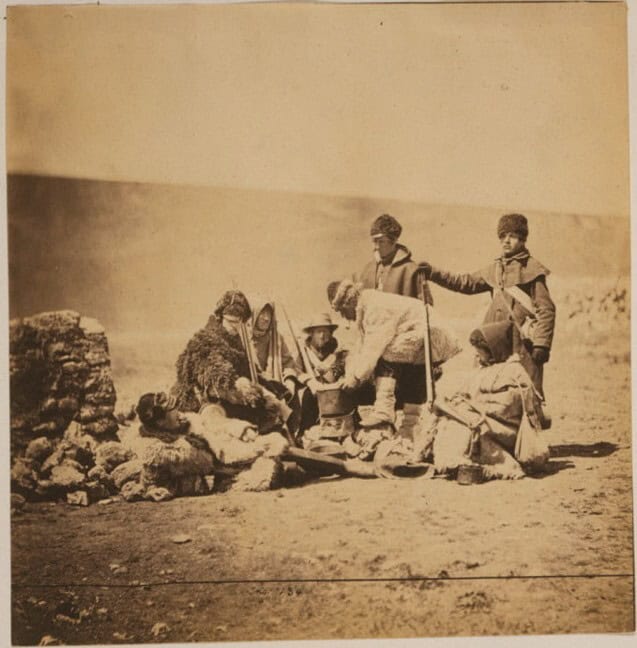
The Pattern 1853 saw its first major combat in the Crimean War. British troops began receiving the rifles in February 1855, by which point the war had been running for nearly two years and several major engagements — Alma in September 1854, Balaclava in October, Inkerman in November — had already been fought with P51 Miniés or smoothbore Pattern 1842s. By the later phases of the siege of Sevastopol in 1855 the P53 was increasingly common in British line regiments.
The British rifled-musket advantage in the Crimea was substantial against Russian infantry, who were overwhelmingly armed with smoothbore muskets. At ranges where Russian volley fire was ineffective, British riflemen could engage with reasonable accuracy. The popular framing that “the Pattern 1853 won Inkerman” overstates the case — the timing doesn’t quite work — but the broader truth that British rifled muskets fundamentally outranged Russian smoothbores in the late stages of the Crimean War is correct.
India 1857 — The Cartridge Crisis
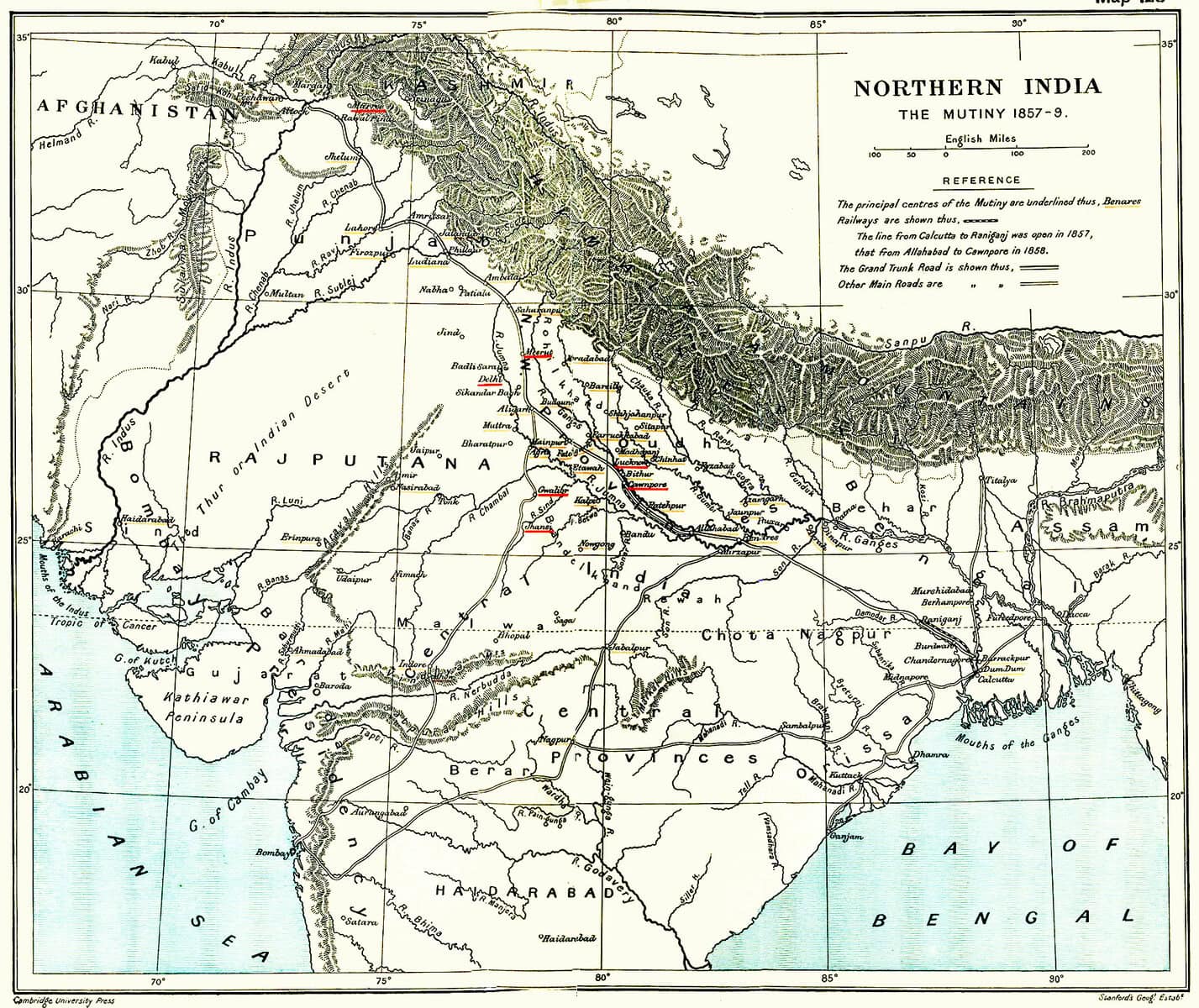
The Pattern 1853’s most-mythologized chapter is the role its paper cartridges played in the 1857 Indian Rebellion — the Sepoy Mutiny in earlier British framings, the First War of Indian Independence in modern Indian historiography.
The rumor that ignited the crisis was specific: the new .577 Enfield cartridges, which had to be torn open during the loading drill, were greased with a mixture of cow tallow and pig lard. Cow fat was a religious offense to Hindus; pig fat to Muslims. Sepoys (Indian soldiers in East India Company service) heard the rumor in early 1857 and refused the cartridges. The 34th Bengal Native Infantry mutinied at Barrackpore in March; the Meerut garrison rose in May; by July the rebellion had spread across northern and central India.
The verified history is more nuanced than the popular telling. The standard British cartridge grease was a beeswax-and-tallow blend. The tallow source could indeed include cow or pig fat — sourcing was inconsistent across contractors — but there is no conclusive documentary evidence that any specific batch known to have been issued in India was greased with verifiably bovine or porcine material. The cartridge mechanics also matter: the grease was applied to the bullet end of the cartridge, opposite the powder end the soldier bit open. A careful soldier would not in practice touch grease with his lips. But sepoys had no reason to trust British assurances on this point, particularly given the broader pattern of British colonial reform that had eroded trust over the preceding decade.
When the British offered to let sepoys hand-tear cartridges or to provide alternative ghee or vegetable-oil grease, the offer was read as tacit admission that the original grease had been beef and pork. The accommodation deepened suspicion rather than resolved it.
The wider context is the part that gets lost in the cartridge-as-cause framing. Pay disputes, the Doctrine of Lapse (under which the East India Company annexed Indian states whose rulers died without direct heirs), missionary activity that sepoys read as Christianizing pressure, and the General Service Enlistment Act of 1856 (which compelled overseas service contrary to caste norms about crossing the kala pani) had all undermined sepoy trust before the cartridge story spread. The Pattern 1853’s grease was the spark; the powder had been laid for years.
The American Civil War — The 900,000 Story

The American Civil War is where the Pattern 1853 Enfield achieved its largest documented impact. Approximately 900,000 P53 Enfields were imported into the United States between 1861 and 1865 — the figure is the upper-bound consensus estimate from Joseph Bilby’s Civil War Firearms and the broader collector and academic literature, with some accounting for re-imports and counting variations.
The Confederate side acquired the larger share by some accounts. Caleb Huse, the principal Confederate purchasing agent in Britain, drove much of the Confederate Enfield procurement, working through commercial Birmingham and London contractors and routing rifles through blockade runners into Charleston, Wilmington, Mobile, and (until its capture in 1862) New Orleans. Confederate import figures commonly cited fall in the 400,000-plus range, though precise accounting is impossible because of how the rifles moved. The Union side purchased approximately 500,000 through commercial contracts and Massachusetts-state purchasing — the earliest London Armoury Company production went to Massachusetts and, later in the war, to the Confederacy.
The Pattern 1853 saw combat in nearly every major engagement of the war from Shiloh in April 1862 through Vicksburg in May 1863 to Appomattox in April 1865. Both armies issued the rifle to line regiments. Confederate sharpshooter units used it. Union state regiments raised on Massachusetts contracts carried London Armoury-marked Enfields throughout the war.
A common misconception is worth correcting: the Pattern 1853 Enfield is not a copy of the Springfield Model 1861. The Pattern 1853 came first by eight years. If anything, the Springfield Model 1855/1861 family was strongly influenced by the British rifled-musket pattern, French Minié work, and the earlier Harpers Ferry Model 1855 lineage. The two arms were nearly identical in concept by 1861 — .58-caliber and .577-caliber three-band rifle muskets with 39 to 40-inch barrels — and the arms could often interchange ammunition in field conditions, with Confederate logistics treating .577 Enfield ball and .58 Springfield ball as substitutable when the barrels were clean. But the lineage runs from Britain to America, not the reverse.
The Pritchett Bullet and the Paper Cartridge
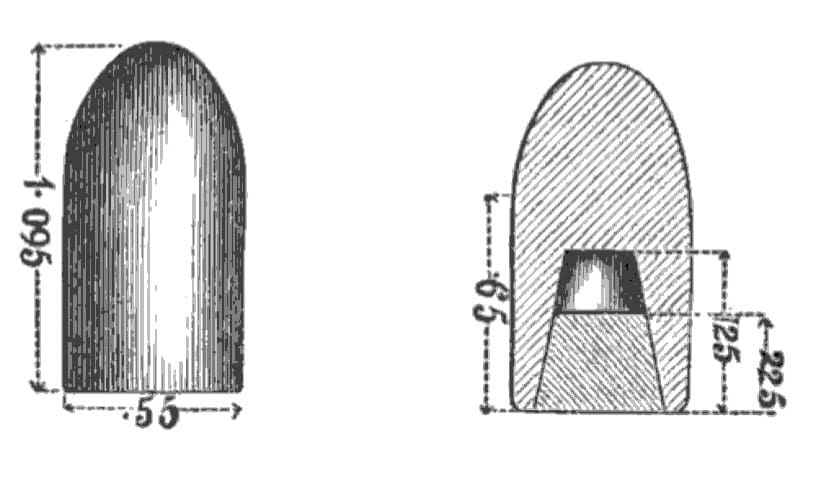
The Pattern 1853 fired a hollow-base, smooth-sided conical bullet of pure lead — the Pritchett bullet, named for its designer R.T. Pritchett who developed it in the early 1850s. The original bullet was .568 inches in diameter, weighed 530 grains, and was reduced to .550 inches in 1858 after troops in India found the original too tight to seat in fouled bores.
Colonel Edward Boxer modified the Pritchett further after 1858 — the same Boxer whose name later appeared on the Snider-Enfield’s drawn-brass centerfire cartridge. Boxer added a tapered baked-clay plug to the hollow base of the Pritchett to ensure positive expansion into the rifling on firing, and changed the cartridge lubricant from beeswax-and-tallow to pure beeswax (this in part to address the residual sensitivity around the 1857 grease controversy, even though by then the rebellion had been suppressed).
Muzzle velocity for the Pattern 1853 with the standard service load — approximately 68 grains of musket-grade black powder behind the 530-grain bullet — was in the range of 900 to 1,000 feet per second based on period field reports and modern chronograph data on reproductions. Some Wikipedia and secondary sources cite 1,250 fps; that figure may reflect later loadings or proof-test conditions and should be treated cautiously against the lower field estimates.
Paper-Wrapped Cartridge Construction
The British paper cartridge of the Pattern 1853 era is a precise piece of nineteenth-century manufacturing that bears more attention than it often receives in popular accounts.
Construction was deliberate. An inner paper wrapper held the bullet and acted as the bullet’s interface with the rifling. An outer paper tube held the powder column, twisted closed at the powder end and crimped at the bullet end. The bullet base sat in the powder column, hollow-base outward. The complete cartridge was lubricated externally — at the bullet end — with a beeswax-and-tallow blend, later (after Boxer’s 1858 modifications) with pure beeswax.
The loading drill was a precise sequence. The soldier tore (or bit) the powder end of the cartridge open. He poured the loose powder down the barrel. He inverted the cartridge so the bullet and its paper wrapper entered the muzzle. He used the ramrod to seat the bullet — paper wrapper and all — onto the powder column. The paper wrapper acted as a gas seal during firing, expanding into the rifling alongside the hollow-base lead bullet, and burned cleanly enough that subsequent shots fired without significant residue from the previous round’s paper.
This loading sequence is what made the paper cartridge a finished product rather than just packaging. The wrapper was not incidental — it was a functional component of the load. The British Pritchett was loaded with this paper wrapper and was smooth-sided; the U.S. .58-caliber Minié (Burton-Minié pattern) was loaded without a paper patch and had grease grooves cut into the bullet sidewall. Both relied on hollow-base expansion — the Minié principle proper. The British paper wrapper and the American grease grooves did similar work — gas seal, lubrication, fouling management — in different configurations.
The transition from paper to drawn brass came with Boxer’s metallic cartridge for the Snider-Enfield in 1867. Boxer’s brass case did everything the paper cartridge did — bullet seating, powder containment, gas seal — in a single self-contained unit, with a primer integrated into the case head. The paper cartridge had served fourteen years of British front-line service. The brass cartridge, in evolved forms, has now served more than 150 years.
For modern shooters, paper cartridges are not just a museum curiosity. Period-correct N-SSA and MLAGB shooters routinely load paper cartridges for competition, with kits and components available from Jefferson Arsenal, Lodgewood Manufacturing, and Track of the Wolf. The kits include paper of the correct weight, bullet molds for the .577 Pritchett, and loading templates for cutting the paper to original dimensions. A practiced loader can produce twenty or thirty period-correct paper cartridges in an evening. The result is a load that fires, performs, and even fouls the bore similarly to the original 1860s configuration.
This continuity — the same paper cartridge, the same Pritchett bullet, the same beeswax-tallow lubricant, fired through the same rifle pattern — is what makes the Pattern 1853 unusual among historical military rifles. The full original loading is not lost knowledge; it remains an active practice in two competitive shooting communities.
Modern shooters of Enfield reproductions can also use original-spec Pritchett bullets cast from molds offered by Eras Gone, Lyman, NEI, and several custom mold makers. Many casual shooters use a modern .58 Minié in their .577 reproduction Enfields — the .58 will seat in a clean .577 bore — but for period-correct competition under N-SSA or MLAGB rules, a sized .577 Pritchett with paper wrapper is the right choice.
Paper-Patched Bullets in the Metallic-Cartridge Era
The paper-patch tradition did not end with the muzzle-loader. It carried forward into the metallic-cartridge era and remains active today in long-range competition.
A paper-patched bullet is a lead bullet whose body is wrapped tightly with one or two layers of thin paper, sized so the patched diameter matches the chamber throat or bore dimension. The patch performs three functions: it provides a gas seal in the bore, it prevents direct lead-to-rifling contact (which keeps the bore from leading), and it engages the rifling cleanly on firing. The paper burns or sheds in the first few feet of barrel travel, leaving the bullet to spin on the rifling without metal-to-metal fouling.
The continuity from the Pattern 1853 era is direct. The British paper wrapper of the Pritchett cartridge — wrapped around the bullet during muzzle-loading and entering the bore alongside it — was the immediate ancestor of the paper patch wrapped around bullets seated in the brass cartridges that followed. When the Snider-Enfield’s drawn-brass .577 cartridge replaced the paper Pritchett in 1867, the paper patch persisted as a separate component, now wrapped around the bullet before the bullet was seated into the brass case. The same was true of the .577/450 Martini-Henry, of the .45-70 Government, and of the long family of large-bore black-powder cartridges that defined the late-nineteenth-century target rifle.
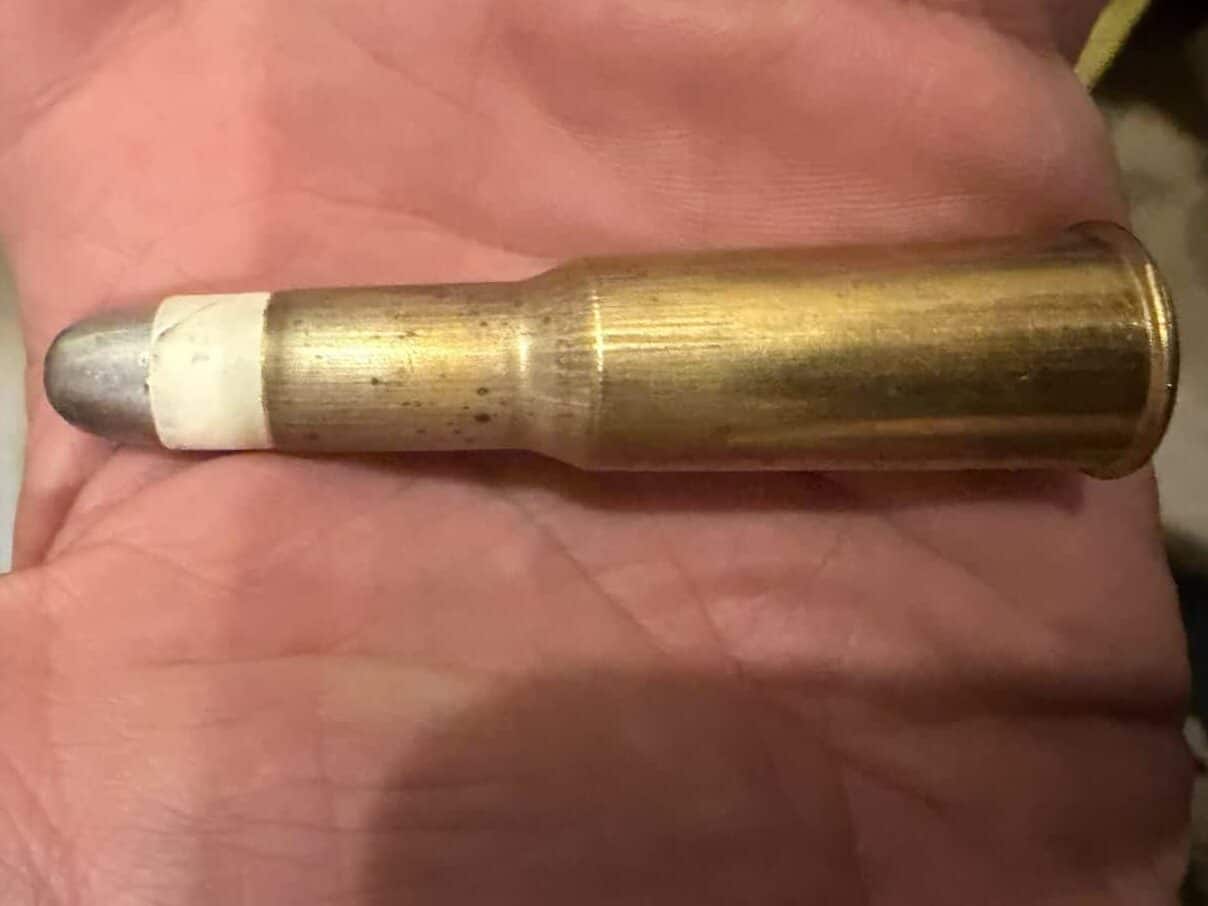
For modern shooters, paper-patched bullets are an active practice in Black Powder Cartridge Rifle (BPCR) competition — the long-range Creedmoor and silhouette disciplines that grew out of the Sharps and Martini-Henry traditions. BPCR shooters cast bullets undersized to bore diameter, then wrap them with sized paper patches to bring the patched bullet up to chamber-throat dimensions. The patched bullet seats in the brass case, fires through the bore without leading, and reproduces the ballistic behavior of the original 1860s-1880s loadings with substantially more consistency than a modern smokeless cartridge using a jacketed bullet.
The paper-patch tradition therefore stretches from the Pattern 1853 Enfield’s paper-wrapped Pritchett bullet of 1853 through the Snider, Martini-Henry, Sharps, and other large-bore black-powder cartridges of the second half of the nineteenth century, and forward to the BPCR competitive shooter loading paper-patched bullets in 2026. Few firearms practices have remained continuously in active use for so long.
End of the Muzzle-Loading Enfield: Snider and Martini-Henry

The Pattern 1853’s first-line career as a muzzle-loader ended in 1866 when Britain officially adopted the Snider-Enfield: a conversion of existing P53 muzzle-loaders to a side-hinged breech mechanism designed by Jacob Snider, paired with Boxer’s drawn-brass .577 centerfire metallic cartridge. Rather than scrap the existing P53 stock — hundreds of thousands of rifles — the British Army converted them en masse. The barrel was cut, a breech section with the Snider hinge mechanism was installed, and the original lock was retained. Snider conversions extended the P53 platform’s useful life by another fourteen years across the British Empire.
The Martini-Henry falling-block rifle in .577/450 began superseding the Snider from 1871. The Martini-Henry was the rifle of the British Empire at its high tide — Rorke’s Drift, the Anglo-Zulu War, the campaigns on the Northwest Frontier — but the older Snider-Enfields remained in second-line and colonial service into the 1880s.
The total span of Enfield Pattern 1853 service across all forms — original muzzle-loader from 1853 to 1867, Snider conversion from 1866 to roughly 1880 — is nearly three decades of front-line British service. Few rifles of any era can claim that kind of operational longevity.
A Note on the Cartridges: .577 Snider vs. .577/450 Martini-Henry
The cartridge transition from paper to brass is worth getting clean, because the names of the British centerfire cartridges that succeeded the paper Pritchett are misleading.
The Snider-Enfield fired the .577 Snider — Boxer’s drawn-brass centerfire cartridge in straight-walled .577 caliber, essentially the original Pritchett bore reconfigured for self-contained ignition. The Snider was the same .577 bore as the original Pattern 1853, just with a different way of getting the cartridge into the chamber. A Snider rifle and a Pattern 1853 muzzle-loader fire bullets of the same diameter through barrels of the same caliber.
The Martini-Henry that began replacing the Snider in 1871 fired the .577/450 Martini-Henry — a fundamentally different cartridge despite the misleading “577” in its name. The .577/450 was a bottlenecked round: the case head and body retained the .577 dimensions of the parent Snider cartridge (which simplified some manufacturing tooling and chamber dimensions), but the case necked down sharply to a .450-caliber bullet at the mouth. The smaller, lighter, faster .450 projectile delivered higher velocity and flatter trajectory than the Snider’s heavier .577 ball — a generational improvement in ballistics.
This is why the popular framing that “the British went from .577 to .303” understates the engineering progression. The actual sequence:
| Period | Rifle | Cartridge | Bore | Loading |
|---|---|---|---|---|
| 1853-1867 | Pattern 1853 Enfield | .577 paper Pritchett | .577 | Muzzle, paper-wrapped |
| 1867-1880s | Snider-Enfield | .577 Snider | .577 | Breech, drawn brass |
| 1871-1888 | Martini-Henry | .577/450 Martini-Henry | .450 (necked from .577 case) | Breech, drawn brass |
| 1888 onward | Lee-Metford / Lee-Enfield | .303 British smokeless | .303 | Breech, magazine-fed |
Three intermediate cartridge designs across roughly thirty-five years, each addressing a specific limitation of its predecessor — the Snider giving the British Empire a breech-loader without scrapping its existing rifle stock, the Martini-Henry trading the Snider’s heavy .577 ball for a faster .450, and the .303 smokeless launching the modern era. The Pattern 1853’s paper cartridge was the first link in that chain, and the bore that started it all — .577 — survived in two of the four cartridges that followed.
Modern Reproductions: The Manufacturers
The original Pattern 1853 has been out of production for more than 150 years, but the rifle has not been off the market for any significant span. From the 1970s onward, a steady stream of Italian and British makers have produced reproductions for the reenactor, competitive, and collector markets. Today three names define the current production landscape, plus one historically important maker whose rifles trade actively on the secondary market.
Davide Pedersoli (Gardone V.T., Italy)
Pedersoli is currently the leading Italian producer of Enfield reproductions, with a multi-model catalog covering the Pattern 1853 three-band, Pattern 1858 Naval Rifle, and Pattern 1861 Musketoon. Build quality is generally regarded as the highest among current production reproductions, with period-correct 1:78 twist three-groove barrels on the standard P53 and the heavier 5-groove progressive-depth barrel on the P58 and P60 patterns. Imported into the U.S. through Italian Firearms Group (Amarillo, TX) and stocked at Dixie Gun Works, Track of the Wolf, Taylor’s & Co., and Cimarron Firearms.
Pedersoli reportedly acquired the tooling and pattern rights of the now-defunct Italian maker Euroarms (formerly Armi San Paolo), consolidating much of the Italian Enfield production into a single line. The acquisition is widely reported in the muzzle-loading community though documentary verification is thin; treat it as the consensus understanding rather than the firmly attested record.
Pedersoli sits in the upper tier of current production — substantially more than Armi Sport, less than original Parker-Hale rifles on the secondary market.
Armi Sport / Chiappa (Italy)
Armi Sport, the Italian factory now operating under the Chiappa Firearms group, produces Pattern 1853 three-band rifles that have long been the volume seller in the U.S. reenactor market. The rifles are distributed through Taylor’s & Co., Cimarron Firearms, and Dixie Gun Works, and are also rebadged as Traditions for the broader U.S. retail market. Build quality is competent and the price point is meaningfully below Pedersoli — making the Armi Sport / Traditions Enfield the most accessible entry point for new Civil War reenactors and recreational shooters.
A note on rifling: Armi Sport’s three-band Enfield uses a 1:48 twist rather than the period-correct 1:78. This is a manufacturing-economy decision (the same tooling produces twist for several other Italian-made replica muzzle-loaders) and matters for serious competitive shooters who want period-correct ballistic behavior, but is invisible to most recreational users.
Parker-Hale (UK) — Discontinued, Premium Secondary Market
Parker-Hale produced what most serious students of the Enfield consider the gold-standard reproduction Pattern 1853 from approximately 1972 through the early 1990s. The rifles were built in Birmingham — symbolically apt, given the city’s role in the original 1860s Confederate Enfield trade — using gauges taken from original rifles in the Royal Armoury. The Parker-Hale catalog included the Pattern 1853 three-band (1974), Pattern 1858 Naval Rifle (1975), Pattern 1861 Musketoon (1972), and a separate .451 Whitworth target rifle.
Parker-Hale closed its muzzle-loading operation in the early 1990s — sources cite a window between 1990 and 1992 — and the original Parker-Hale rifles have traded at premium on the secondary market ever since. The “Parker-Hale” brand has been revived by a different company for modern firearms; that revival is unrelated to the muzzle-loader business and does not produce Enfields.
For competitive long-range shooters under MLAGB rules, the Parker-Hale Pattern 1858 Volunteer remains the reference rifle even three decades after production ended. Original Parker-Hale rifles in good condition trade at substantial premiums over current Pedersoli equivalents.
Euroarms / Armi San Paolo — Defunct, Common on Used Market
Euroarms, the successor brand to Armi San Paolo, produced N-SSA-approved Enfield reproductions through the 2010s. The company’s Enfield rifles still circulate widely on the secondary market and remain N-SSA-eligible under “London Armory” branding. Build quality was below Pedersoli and Armi Sport per the consensus of N-SSA competitors. Euroarms was reportedly absorbed by Pedersoli in the 2010s.
Investarm
Investarm, founded 1975 in Marcheno (Brescia), is an active Italian muzzle-loader maker but does not currently produce a Pattern 1853 reproduction. The company’s catalog focuses on Hawken-pattern and small-game muzzle-loaders. Investarm is included here only because some sources confuse Italian replica houses, and the absence of an Investarm Enfield is itself a fact worth knowing.
Where to Buy in the U.S.
Six retail channels handle nearly all U.S. retail volume on Enfield reproductions:
- Dixie Gun Works (Union City, TN) — the encyclopedic source for muzzle-loader supplies. Carries Pedersoli, Armi Sport, parts, accessories, and a substantial used arms inventory.
- Track of the Wolf (Elk River, MN) — traditional muzzle-loader specialist; Pedersoli rifles stocked, plus parts, Pritchett molds, and period-correct accessories.
- Taylor’s & Co. (Winchester, VA) — primary U.S. distributor for the Armi Sport / Chiappa Civil War line, including Enfield three-band variants.
- Cimarron Firearms (Fredericksburg, TX) — distributes Armi Sport and Pedersoli Civil War reproductions; named-variant treatments common.
- Lodgewood Manufacturing (Whitewater, WI) — high-end restoration parts and custom builds; some R.T. Pritchett-marked premium reproductions.
- Muzzle-Loaders.com — large online specialist; broad inventory across multiple makers.
For original Pattern 1853 rifles — period antiques rather than reproductions — the major U.S. specialist auction houses (notably Morphy Auctions) carry Confederate and Federal Enfields with full provenance documentation. A documented Confederate-marked Birmingham Enfield in good condition trades meaningfully higher than a comparable London Armoury contract piece, with the rarest pieces — Confederate-attributed officer’s rifles, regiments with provenance — reaching the upper tier of nineteenth-century Confederate collectibles.
Competitive Shooting: N-SSA and MLAGB
The Enfield’s competitive home in North America is the North-South Skirmish Association (N-SSA), founded in 1950 and headquartered at Fort Shenandoah, Virginia. N-SSA is the largest competitive muzzle-loading organization in the United States, running uniformed team-based events on breakable targets at 50 and 100 yards with timed rapid-fire formats. Targets are clay pigeons, ceramic tiles, clay flowerpots, and wooden blocks. Both Pattern 1853 three-band and Pattern 1858 / Pattern 1860 two-band rifles compete; many serious N-SSA shooters prefer the two-band for its superior balance and the heavier 5-groove barrel’s accuracy.
N-SSA maintains an “Approved Reproduction Arms” list that determines which rifles a competitor may shoot. The current list includes Parker-Hale Ltd., Euroarms (London Armory branding), Armi San Paolo, Armi Sport (Taylor & Co.), and Pedersoli. Dixie Gun Works sells approved arms but is not itself a maker.
In the United Kingdom, the Muzzle Loaders Association of Great Britain (MLAGB), founded 1952, is the governing body for muzzle-loading shooting and the British affiliate of the international MLAIC for world-championship events. MLAGB long-range military rifle competition shoots classic British Bisley-style courses at 200, 300, 500, and 600 yards prone with two-point military sling — three sighters plus 10 record shots (15 at 600). The Pattern 1858 / Pattern 1860 short rifles, particularly the original Parker-Hale rifles, dominate MLAGB military-class shooting because of their 33-inch heavy 5-groove barrel and 1:48 twist.
For both organizations, the choice between three-band P1853 and two-band P1858/P1860 reflects the use case: the three-band is the iconic Civil War rifle and the right choice for reenactor and short-range N-SSA competition; the two-band is the long-range competitor’s rifle and the right choice for serious MLAGB or long-range N-SSA work.
Don’t-Confuse: Whitworth, Springfield, and the Snider
A few rifles share era and silhouette with the Pattern 1853 enough to cause regular confusion in popular accounts. Worth getting the distinctions clean.
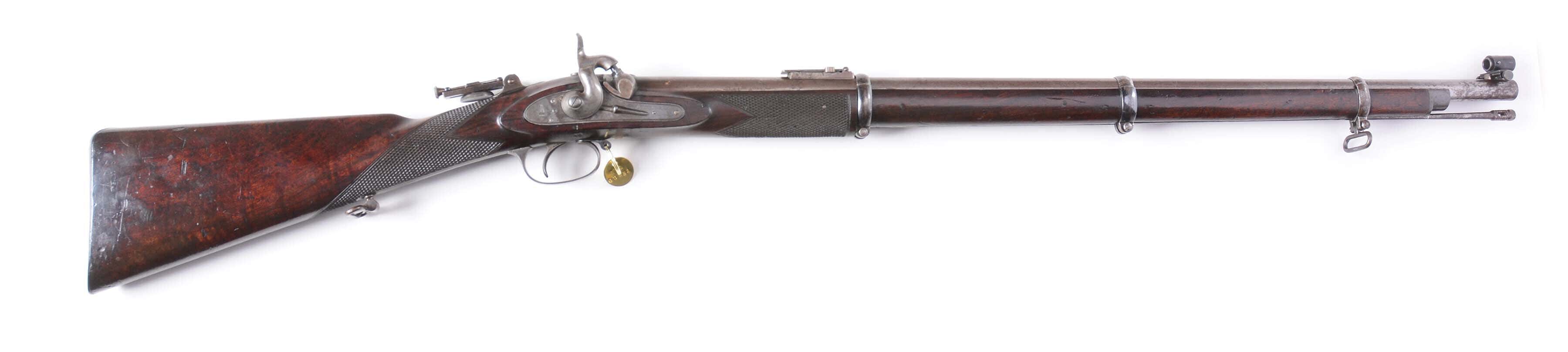
The Whitworth Rifle is not an Enfield. Joseph Whitworth’s hexagonal-bored .451-caliber rifle with 1:20 twist was a different gun designed for a different purpose: long-range precision shooting, what would later be called sniping. Whitworth rifles were used by specially selected Confederate sharpshooters during the American Civil War — but the total Whitworth shipment to the Confederacy is estimated at only 200 to 300 rifles, restricted to a small number of designated marksmen. By contrast, Enfields in Confederate hands numbered in the hundreds of thousands. Confederate Whitworths are rare and famous; Confederate Enfields are common and consequential. They are not the same rifle, and conflating them is a frequent mistake in popular Civil War accounts.
The Springfield Model 1861 is the American counterpart to the Pattern 1853 — a .58-caliber three-band rifle musket with a 40-inch barrel, U.S.-pattern lock, and eagle-on-lockplate markings. The two arms were used together throughout the Civil War. Springfield production exceeded one million Model 1861 rifles plus another quarter-million Model 1863s. The Pattern 1853 came first by eight years; calling the Enfield “a copy of the Springfield” reverses the lineage. American rifle-musket development drew on French Minié work and the British pattern, not the other way around.
The Pattern 1851 Minié rifle is the predecessor — superficially similar in silhouette to the Pattern 1853 but distinguishable by its barrel-band wedges (rather than three iron bands) and its much larger .702 caliber. Limited production; saw brief service before the P53 displaced it.
The Snider-Enfield is the successor — a side-hinged breech conversion of the original muzzle-loaders, firing a .577 centerfire cartridge rather than a paper cartridge. Many original Pattern 1853 rifles were converted to Snider configuration in 1866 and after; a Snider-Enfield is an Enfield, but it is a breech-loader, not a muzzle-loader.
Practical Loading: The Modern Pritchett
For modern shooters loading the Pattern 1853 reproduction for N-SSA or recreational shooting, the practical recipe is well-established.
Powder. The standard service load was approximately 68 grains of musket-grade black powder. Modern N-SSA and MLAGB shooters typically run between 55 and 70 grains of FFg-grade black powder depending on the rifle and the target distance. Goex, Olde Eynsford, and Swiss are the major modern producers. Real black powder is required for sanctioned N-SSA and MLAGB competition; smokeless substitutes (Pyrodex, Triple Seven) work in modern reproductions but produce different velocity and pressure curves and are typically excluded from sanctioned events.
Bullet. A .577 Pritchett-pattern hollow-base bullet weighing approximately 530 grains is the period-correct projectile. Cast molds are available from Eras Gone, Lyman, NEI, and several specialty makers. Many recreational shooters substitute a modern .58 Minié — the .58 will seat in a clean .577 bore and produces good accuracy — but for period-correct competition the sized .577 Pritchett is preferred. Paper-patched original-spec Pritchetts from Jefferson Arsenal, Lodgewood, and Track of the Wolf reproduce the historical loading directly.
Lubricant. A beeswax-and-tallow blend or a pure beeswax dip is appropriate. Modern bullet lubricants (SPG, BAC, T/C Bore Butter) work well for casual shooting; period-correct shooters tend toward beeswax-tallow or pure beeswax in keeping with the post-1858 Boxer specification.
Cleaning. Black-powder fouling is corrosive and water-soluble. The standard practice — swab the barrel with hot water immediately after shooting, dry thoroughly, then oil — applies to any black-powder rifle and especially to the Pattern 1853 with its deep three-groove (or Pattern 1860’s five-groove progressive-depth) rifling that retains fouling readily. A neglected Enfield rusts quickly; a clean-after-shooting routine keeps it serviceable indefinitely.
Recommended Reading


The standard reference works for the Pattern 1853 Enfield divide into two streams: American Civil War-focused works that treat the Enfield as one of the principal rifles of the war, and British military arms scholarship that treats the Enfield within the broader history of the Royal Small Arms Factory.
**Joseph G. Bilby, *Civil War Firearms: Their Historical Background and Tactical Use*** (Combined Publications 1996, reprinted Da Capo) is the single best general-audience reference on Civil War small arms, with substantial Enfield treatment alongside the Springfield, Lorenz, Mississippi Rifle, and other contemporaries. Bilby is the standard citation for Confederate import figures, Caleb Huse’s procurement work, and tactical use across the major battles. (Note: Bilby’s later A Revolution in Arms covers the Henry and Spencer repeating rifles — not the Enfield. Cite Civil War Firearms for Enfield context.)
**Joseph G. Bilby, *Small Arms at Gettysburg: Infantry and Cavalry Weapons in America’s Greatest Battle*** (Westholme 2008) extends Bilby’s analysis to a single battle in granular detail, with regiment-by-regiment ordnance return material that documents which Enfield variants were carried where.
**De Witt Bailey, *British Military Longarms 1815-1865*** (Arms & Armour Press, multiple editions) is the canonical UK manufacturing-side reference. Bailey, longtime Royal Armouries authority, traces the development from the Brown Bess transition through the Pattern 1853 and into the early Snider conversions. The book is the standard for collectors of British military arms.
**Howard L. Blackmore, *British Military Firearms 1650-1850*** (Greenhill Books) provides earlier context — the pre-Enfield British arms tradition that shaped Pattern 1853 design decisions.
**Craig L. Barry’s writing in *Civil War News*** on the Parker-Hale Enfield reproductions is the standard reference on the modern reproduction market.
Frequently Asked Questions
What caliber is the Enfield Pattern 1853? The Pattern 1853 is .577 caliber, not .58. The .577 Pritchett bullet is the period-correct projectile. The rifle will accept a modern .58 Minié in a clean bore (and many modern shooters use them) but the original specification is .577.
Is the Enfield Pattern 1853 a copy of the Springfield Model 1861? No — the lineage runs the other direction. The Pattern 1853 came first by eight years. American rifle-musket development drew on French Minié principles and the British pattern. The Springfield Model 1855 / 1861 family was strongly influenced by the British rifled-musket tradition.
Did the Enfield’s grease really cause the 1857 Indian Rebellion? The grease rumor was a flashpoint, not the underlying cause. Pay disputes, the Doctrine of Lapse, missionary pressure, and the General Service Enlistment Act of 1856 had eroded sepoy trust for years. The cartridge story crystallized accumulated grievances. The actual grease composition per any specific issued cartridge batch is undocumented; the standard British grease was beeswax-and-tallow, but the tallow source was inconsistent.
Pedersoli vs. Armi Sport — which is better? Different propositions. Pedersoli is upper-tier, available, with period-correct rifling twist and strong international support. Armi Sport is mid-tier, lower-priced, the volume seller in the U.S. reenactor market, with a non-period 1:48 twist that is invisible to most recreational users but matters to serious competitive shooters. For N-SSA short-range competition either works. For MLAGB long-range military-class shooting, Pedersoli or original Parker-Hale is the right answer.
Are original Parker-Hale Enfields worth the premium? For competitive long-range shooters, generally yes — the original Parker-Hale rifles are the reference standard for MLAGB military-class shooting and trade at meaningful premiums over current production. For casual reenactment or short-range recreational shooting, Pedersoli or Armi Sport is sufficient and substantially less expensive.
Can I shoot modern .58 Minié bullets in my .577 Enfield reproduction? In a clean bore, yes — the .58 will seat and produces good accuracy. For period-correct competition under N-SSA or MLAGB rules, a sized .577 Pritchett is the right choice. For casual shooting, a modern .58 Minié from Lyman or Lee is workable.
What’s the difference between the three-band and two-band Enfield? The three-band is the standard infantry rifle with 39-inch barrel and three iron barrel bands — the iconic Civil War Enfield. The two-band Pattern 1858 Naval Rifle and Pattern 1860 Short Rifle have 33-inch barrels with two iron bands and a heavier 5-groove progressive-depth barrel with 1:48 twist. The two-band is the long-range and target shooter’s rifle; the three-band is the line infantry rifle.
Was the original Pattern 1853 in service after the Snider-Enfield was adopted in 1866? Yes — many Pattern 1853 rifles were converted to the Snider breech-loading configuration rather than being scrapped. Converted Sniders served across the British Empire into the 1880s, though the Martini-Henry replaced the Snider as the front-line British rifle from 1871. The Pattern 1853 platform — in original muzzle-loader and converted Snider forms — totaled nearly three decades of British service.
The Pattern 1853 as a Living Rifle
The Royal Small Arms Factory at Enfield closed for good in 1988. The Pattern 1853 ended its first-line British service in 1866 and its converted-Snider service in roughly 1880. The original makers who supplied the Birmingham gun trade are mostly gone; London Armoury Company closed in 1866. By any reasonable measure the rifle should be a museum piece.
It is not. The Pattern 1853 is among the most actively shot historical rifles in the world. N-SSA fields hundreds of competitors at major skirmishes every year, the majority shooting Enfields. MLAGB long-range military-class events in Britain are dominated by two-band Enfield reproductions, with original Parker-Hale rifles still setting the competitive standard three decades after production ended. Civil War reenactors numbering in the tens of thousands carry Armi Sport and Pedersoli Enfields at events from Antietam to Gettysburg to Appomattox. And the original 1860s Confederate-marked Birmingham Enfields trade at meaningful premiums whenever they surface at auction.
The rifle that armed Berdan’s opponents at Petersburg, Lee’s regiments at Gettysburg, the Confederate sharpshooters at Vicksburg, and the British line at Sevastopol is the same rifle a competitive long-range shooter pulls from her case at a Bisley match in 2026. The buyer’s framework above will get you to the right model for your use case. The history is what makes the choice mean something.
If you know of any forums or sites that should be referenced on this listing, please let us know here.