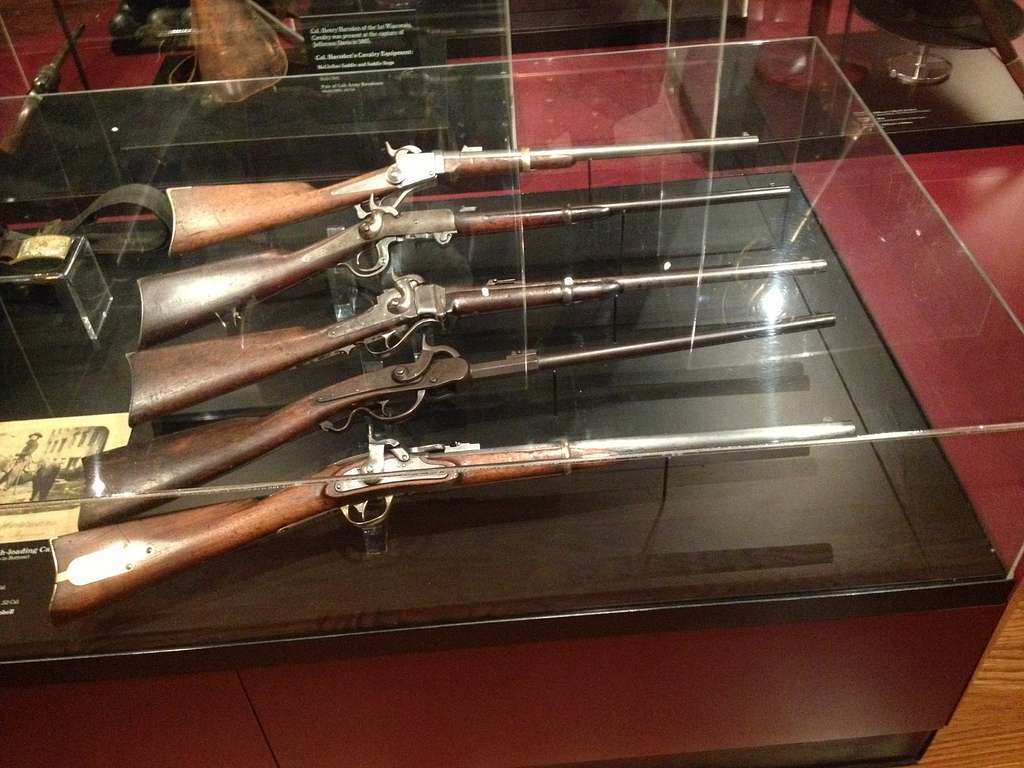
Introduction: A War on Horseback, A Revolution in Steel: Carbines
When the American Civil War erupted in 1861, the U.S. Army’s standard-issue firearm remained the ponderous muzzle-loading rifled musket. But for the Union cavalry (the fast-moving eyes, ears, and strike force of the army) a different kind of weapon was needed. One that could be reloaded quickly, even from the saddle. One that could keep pace with mounted combat. One that hinted at the battlefield of the future.
The answer was the breech-loading carbine. Compact, rugged, and faster to reload than any muzzleloader, these weapons transformed cavalry tactics and served as crucibles of industrial ingenuity. From the dependable Sharps, to the revolutionary Spencer, to a half-dozen lesser-known contenders like the Joslyn, Gallagher, Ballard, and Starr, the Civil War became a proving ground for a staggering variety of breech-loaders. Each weapon told a story, of invention, adaptation, and the relentless pursuit of battlefield superiority.
This article offers a definitive overview of those weapons, the reasons behind their diversity, and the legacy they left behind. Individual models are explored more deeply in separate articles, but here we pull back for the full sweep of this technological revolution.
The Call for Change: Why Breech-Loaders Emerged
The slow reload of a muzzleloader was tolerable for infantry in fixed positions, but utterly impractical for mounted troops. Cavalrymen needed speed: hit, disengage, reposition, hit again. Reloading a muzzleloader on horseback was not just clumsy; it was dangerous and borderline useless.
Several key forces drove the sudden demand for breech-loaders:
- Mounted warfare demanded mobility and speed.
- The industrial capacity of the North allowed for rapid experimentation and manufacturing.
- A flood of patents from inventive minds sought to solve the same set of problems: better sealing, faster reloads, and more reliable ignition.
As a result, the U.S. government, especially early in the war, adopted an unusually flexible procurement strategy, purchasing carbines from dozens of competing inventors and manufacturers. States and regiments often placed independent orders. By 1863, Union cavalry units wielded a bewildering assortment of breech-loaders, each with strengths, flaws, and battlefield lessons to offer.
What Made Breech-Loaders Revolutionary?
Several technological breakthroughs converged to make breech-loading practical:
1. Self-Contained Cartridges
Rather than pouring loose powder and ramming a bullet down the barrel, most breech-loaders used pre-packaged cartridges. These ranged from linen or foil (e.g., Sharps, Gallagher) to rubber (e.g., Smith) to full metallic cartridges (Spencer, Joslyn Model 1864).
2. Improved Ignition Systems
Most used percussion caps. Some, like the Maynard, used tape primers, clever but unreliable. The Spencer used rimfire metallic cartridges, with the primer built in.
3. Mechanical Breech Systems
Falling blocks, pivoting breechblocks, break-action levers, and even bolt-like systems were employed. Each sought to seal the chamber effectively while offering speed and ease of use.
Major Carbines of the Civil War: A Snapshot of Innovation
| Carbine | Type | Cartridge | Issued | Action Type |
|---|---|---|---|---|
| Sharps | Single-shot | Paper | 80,512 | Falling block |
| Spencer | Repeater | Rimfire (.56-56) | 94,196 | Lever-action, tubular magazine |
| Burnside | Single-shot | Tapered brass | 55,567 | Pivoting block |
| Joslyn | Single-shot | Rimfire (.54/.56) | ~16,500 | Pivoting breechblock |
| Gallagher | Single-shot | Foil + percussion cap | ~22,000 | Toggle breech |
| Ballard | Single-shot | .44 rimfire | ~3,000–5,000 | Falling block |
| Starr | Single-shot | Paper | 20,601 | Tilting block |
| Smith | Single-shot | India-rubber | 30,362 | Break-open |
| Maynard | Single-shot | Brass | ~20,000 | Break-open, tape primer |
The Titans of the Battlefield
Sharps Carbine
With a linen cartridge and a robust falling block action, the Sharps was the most respected single-shot carbine of the war. Used by both Union cavalry and some Confederate sharpshooters (who captured or copied it), it combined accuracy, reliability, and rate of fire. Read our full article on the Sharps Carbine.
Spencer Carbine
The first widely successful repeating rifle, the Spencer packed seven rounds in a tubular magazine within the buttstock. Rimfire cartridges made ignition seamless. Although initially resisted due to fears of rapid ammunition expenditure, the Spencer’s battlefield success proved the power of repeaters. Lincoln himself test-fired and endorsed it. Read our full article on the Spencer Carbine.
Burnside Carbine
General Ambrose Burnside’s greatest contribution to the war wasn’t tactical; it was technical. His carbine’s unique tapered brass cartridge and rotating breechblock made it clean-firing and durable, though slightly more complex to manufacture. Read our full article on the Burnside Carbine.
Prolific Contenders and Field-Tested Oddities
Joslyn Carbine
Joslyn’s early models used percussion ignition and paper cartridges; later versions (Model 1864) fired .54 or .56 rimfire metallic cartridges. The swing-out breechblock was strong and simple, giving it post-war appeal. They were used by Union cavalry and some coastal artillery. Read our full article on the Joslyn Carbine.
Gallagher Carbine
The Gallagher used a brass cartridge with no primer, relying on external percussion caps. This hybrid design, while innovative, often suffered from weak extraction and awkward handling. Still, over 20,000 were issued, particularly early in the war.
Ballard Carbine
Ball & Williams built a solid, reliable, falling-block carbine in limited numbers. The Ballard’s primary impact came after the war, but it earned a loyal following among those who carried it in combat.
Starr Carbine
An economical and straightforward design with a tilting breechblock. Starr also made revolvers for the Union. The carbine, while never glamorous, functioned well enough to see over 20,000 units fielded.
Experimental and Transitional Designs
Smith Carbine
Using a break-action design and India-rubber cartridges, the Smith fired cleanly and was waterproof, but extraction could be troublesome. Its simplicity and waterproof design gave it an edge in certain theaters.
Maynard Carbine
Edward Maynard’s tape primer was supposed to speed ignition, automatically feeding percussion charges like a child’s cap gun. The brass cartridge was reloadable, making it popular with Confederates who struggled to manufacture new ammunition.
Lindner Carbine
Rare and experimental, the Lindner carbine used a unique rotating breech. It never gained wide traction but represents the relentless experimentation of the period. Similarly rare was the Gibbs Carbine, produced at the Phoenix Armory in New York until the 1863 Draft Riots destroyed the factory.
Why So Many Different Carbines?
The sheer number of carbine types in Union hands during the war has puzzled collectors and historians alike. But it made sense given the context:
- Procurement Chaos: Early in the war, the U.S. Ordnance Department allowed states and regiments to purchase independently.
- Industrial Diversity: Dozens of Northern manufacturers sought government contracts; the war was a gold rush for arms makers.
- Rapid Innovation: No single design had yet emerged as the obvious standard. Each new contract helped refine the future of firearms.
- Diverse Tactical Needs: Scouting, skirmishing, raiding, and line-holding all required different tactical advantages: some carbines offered rate of fire, others precision or ease of manufacture.
A Legacy That Outlived the War
When the smoke cleared in 1865, one thing was clear: breech-loaders were the future. The infantry quickly followed the cavalry into the metallic cartridge age with weapons like the Springfield “Trapdoor” series. Many of the principles pioneered in these carbines (sealed breechblocks, metallic ammunition, and repeat-fire capability) found their way into:
- The Winchester 1866, a direct descendant of the Henry rifle.
- The Martini-Henry, a British falling-block inspired by American designs.
- The Remington Rolling Block and Peabody rifles, whose simplicity and strength took global markets by storm.
Some Civil War carbines remained in service for decades in frontier and militia units, while others were sold off, sporterized, or forgotten.
Conclusion: Where Innovation Took the Saddle
The Civil War’s breech-loading carbines were more than just tools of war. They were experiments in progress, forged under fire and refined in blood. They turned cavalry from saber-wielding relics into modern, mobile shooters. And they offered a glimpse of the industrialized future of warfare.
Each design (whether a widespread success like the Spencer, or a niche innovation like the Gallagher) contributed to a battlefield renaissance. Their story is one of American ingenuity at its most daring, and their legacy gallops forward into every lever-action and bolt-gun that followed.




If you know of any forums or sites that should be referenced on this listing, please let us know here.