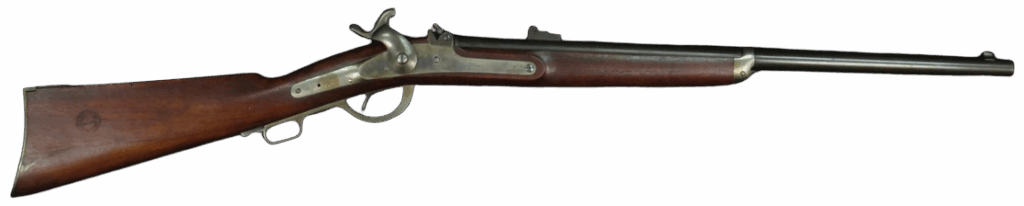
The American Civil War, fought from 1861 to 1865, witnessed a rapid evolution in military technology, particularly in the development and deployment of small arms. Among the more obscure yet technically interesting weapons fielded during the conflict is the Gibbs Carbine. Produced in limited numbers and briefly adopted by Union cavalry units, the Gibbs Carbine occupies a unique niche in Civil War firearms history. This article offers a definitive and in-depth examination of the Gibbs Carbine, detailing its origin, design, performance, deployment, and legacy.
Origins and Development
The Gibbs Carbine was named after its primary inventor, Lucius H. Gibbs, a gunsmith and firearms innovator from Rochester, New York. Gibbs patented his carbine design in 1856, and it reached production in the early 1860s, a period when the United States was urgently seeking effective breech-loading carbines for its mounted forces. Breechloaders offered a significant tactical advantage over traditional muzzleloaders: they could be loaded and fired from a prone or mounted position, improving both the speed and safety of reloading under fire.
The carbine was manufactured at the Phoenix Armory in New York City, operated by William F. Brooks and William W. Marston. The U.S. government ordered 10,000 Gibbs carbines, but only about 1,052 were completed and delivered before the Phoenix Armory was burned during the New York Draft Riots in 1863. These limited numbers make the Gibbs Carbine a rare and highly collectible artifact today.
Lucius H. Gibbs and the Men Who Built the Carbine
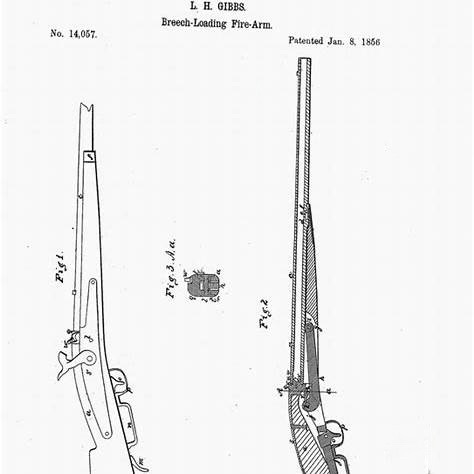
The carbine took its name from its inventor, Lucius H. Gibbs, who patented the breech-loading design on January 8, 1856. Gibbs, a gunsmith who had lived in Oberlin, Ohio before establishing himself in New York, was the sole patentee of the mechanism. The design used a lever, formed by the trigger guard, to tip the barrel upward at the breech so a combustible cartridge could be loaded, then locked it into a tight seal that reduced the gas escape common to competing breechloaders such as the Burnside and the Cosmopolitan.
From Patent to Production
Gibbs held the patent, but turning it into a deliverable military arm took financing and a working shop. He was joined by the financier William F. Brooks and the New York gunsmith William W. Marston, who together produced the carbine at the Phoenix Armory in New York City. Marston, a well-known maker in his own right, first built a small number of hand-made examples in the late 1850s, one of which was used in a successful demonstration at West Point.
The federal government contracted for 10,000 carbines, but production was cut short. On July 13, 1863, during the New York Draft Riots, the Phoenix Armory was set ablaze and destroyed. Only about 1,052 carbines had been completed and delivered, and no more were ever produced. That abrupt end is what makes surviving Gibbs carbines so scarce and collectible today. Most examples are marked simply with the maker and serial numbers, and the carbine stands as a well-engineered design whose service life was ended not by any mechanical failing but by the fire that consumed the shop that built it.
Technical Specifications
The Gibbs Carbine was a .52 caliber single-shot breech-loading rifle, designed primarily for cavalry use. Here are its key technical specifications:
- Caliber: .52
- Barrel Length: 22 inches
- Overall Length: Approximately 39 inches
- Weight: Around 7.5 pounds
- Action: Lever-operated, sliding and tipping barrel
- Stock: Walnut
- Sights: Iron front and adjustable rear sights
- Finish: Blued barrel and case-hardened receiver
The Gibbs Carbine’s lever slid the barrel forward and tipped its breech upward, so a cartridge could be inserted directly into the chamber. This design was innovative for its time and offered a quicker rate of fire than muzzle-loading counterparts.
The carbine was intended to use paper cartridges, a common ammunition format during the Civil War that combined a bullet and powder charge in a combustible or partially combustible paper wrapper. Soldiers would insert the combustible cartridge whole, close the breech, cap the nipple, and cock and fire.
Mechanical Design and Innovation
Lucius H. Gibbs’ design stood out for its mechanical ingenuity. The carbine utilized a simple lever mechanism connected to the trigger guard, which the shooter would pull downward to slide the barrel forward and tip it up. This allowed the soldier to open the breech, insert a cartridge, and then close it with a swift upward motion. The lock was a conventional percussion system, fired by a hammer striking a percussion cap seated on a nipple located at the rear of the chamber.
The weapon featured a rear sight with multiple leaf elevations, allowing for engagement at various ranges. While not as widely refined as later repeating rifles, the Gibbs Carbine represented a significant step forward in battlefield ergonomics and rapidity of fire.
One of the carbine’s distinguishing features was its robust and clean design. The mechanism, while mechanically complex, was well-sealed and relatively protected from fouling, a major issue with black powder arms. Its wooden stock was well-shaped for horseback firing, and its metal parts were engineered to tight tolerances, reflecting high manufacturing standards.
Military Adoption and Use
The Union Army, particularly its cavalry, experimented with a wide variety of carbines during the Civil War. The necessity of arming thousands of mounted troops led to the adoption of numerous designs, many of which were procured in limited numbers for field testing.
The Gibbs Carbine was accepted for service following trials conducted by the Ordnance Department. Of the 10,000 contracted, 1,052 were delivered and distributed to several Union cavalry regiments, with 500 going to the 10th Missouri Cavalry.
Field reports were mixed but generally positive. Soldiers appreciated the ease of loading and the carbine’s relative reliability under combat conditions. However, by the time it entered service in 1863–1864, the market was already dominated by more prolific and logistically supported weapons like the Sharps Carbine, the Burnside Carbine, and eventually, the Spencer Repeating Carbine, which offered a seven-shot magazine fed by a metallic rimfire cartridge.
As a result, the Gibbs Carbine saw only limited deployment before the war ended in 1865, and it was never produced in sufficient quantities to make a major tactical impact. Nevertheless, its design was a proof of concept for breech-loading efficiency in cavalry firearms.
Comparison With Contemporary Carbines
In evaluating the Gibbs Carbine, it is essential to compare it with its contemporaries:
Sharps Carbine
- Caliber: .52
- Loading: Breech-loading with paper cartridges
- Action: Falling block
- Widely used with tens of thousands issued
- Known for durability and accuracy
Burnside Carbine
- Caliber: .54
- Used a unique brass cartridge
- Breech opened by a trigger-guard lever
- Saw significant service, though with ammunition supply complications
Spencer Carbine
- Caliber: .56-56 Spencer rimfire
- Seven-round tubular magazine
- Lever-action, repeating rifle
- Revolutionary firepower advantage
Compared to these, the Gibbs Carbine was mechanically reliable and accurate but lacked the production numbers and logistical support to become a widespread favorite. It was also a single-shot weapon, which by 1864 made it increasingly obsolete compared to repeaters like the Spencer.
Post-War Fate and Collectibility
After the Civil War, many surplus carbines were sold at auction or stored. The Gibbs Carbine, being rare even during the war, became almost nonexistent in subsequent U.S. military inventories. Its limited numbers ensured it did not appear in post-war conflicts, unlike the Sharps and Spencer models, which continued to see use in the Indian Wars and other frontier engagements.
Today, the Gibbs Carbine is a highly valued collectible, both because of its scarcity and its innovative design. Collectors prize specimens in good condition, especially those with matching serial numbers, intact markings, and original finish. Prices vary widely depending on condition, provenance, and completeness, with authentic specimens often commanding several thousand dollars at auction.
Markings on the carbine typically include the manufacturer’s name and patent date, along with a serial number. Some examples also bear inspector’s cartouches, which further authenticate their military use and add to their historical value.
Legacy and Historical Significance
While the Gibbs Carbine did not achieve the fame or widespread adoption of its contemporaries, it remains an important artifact for several reasons:
- Engineering Milestone: Its lever-operated, tip-up breech-loading mechanism was a precursor to later developments in single-shot and repeating firearms.
- Innovation in Design: Gibbs’ approach to simplifying the loading process and enhancing battlefield usability was aligned with the tactical needs of the evolving Civil War battlefield.
- Historical Rarity: Its limited production run ensures that each surviving unit is a valuable physical link to the Union cavalry’s efforts to modernize during one of the most technologically transformative conflicts in American history.
- Collector’s Interest: Among arms collectors and historians, the Gibbs Carbine holds a place of fascination not just for its rarity, but for the quality of its design and manufacture.
Conclusion
The Gibbs Carbine represents the ingenuity and industrial fervor of the American Civil War era. Though it did not become a standard-issue weapon, its thoughtful design and respectable battlefield performance placed it among the notable experiments in mid-19th-century military firearms. For historians, collectors, and enthusiasts of Civil War weaponry, the Gibbs Carbine offers a unique study in innovation, ambition, and the complex arms procurement processes of wartime America.
Its story enriches our understanding of the technological race that defined the Civil War and illustrates how even lesser-known firearms contributed to the broader evolution of modern small arms. As such, the Gibbs Carbine remains not just a rare collectible, but a crucial chapter in the narrative of American military history.
Read more here: For a broader look at how it fit among its contemporaries, see our overview of Civil War breech-loading carbines.


If you know of any forums or sites that should be referenced on this listing, please let us know here.