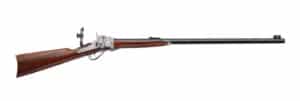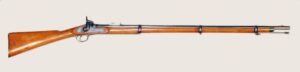
A rifle that fires several shots before it needs a full reload broke a limit that had governed infantry tactics and hunting for centuries. That is what the repeating rifle did, and the effects reached well past the battlefield: into westward expansion, into the meat pole, into law enforcement and into the hands of the people law enforcement chased. Interest in these guns has not faded. Lever-action repeaters are selling again, in the old chamberings and in new ones.
Early Development and Predecessors
The idea is older than most people assume. Gunmakers were building multi-shot arms in the 16th century, but the first repeaters that worked well enough to matter came in the 17th. The Kalthoff system, designed by the Kalthoff family of gunmakers around 1630, fed powder and ball from magazines built into the gun and went to war with Danish troops in 1659. The Lorenzoni system, named for the Florentine gunmaker Michele Lorenzoni, improved on the Kalthoff mechanism later in the same century. All of them were intricate, costly, and fragile. A gunsmith could build one for a prince. Nobody could arm a regiment with them.
The 19th century attacked the problem at the breech. The Hall Rifle (1819), issued in limited numbers to the U.S. military, loaded at the breech rather than the muzzle, which was a real step forward. Samuel Colt’s revolving rifles of the 1830s and 1840s went further still, using the revolving cylinder from his revolvers to put several shots under one hammer. They carried a flaw that killed the idea. Chain fire, where the flash from one chamber set off the others, made them dangerous, and the design never earned trust.
The Birth of the Modern Repeating Rifle
True repeating rifles arrived in the middle of the 19th century, once cartridge design and metallurgy caught up with the mechanism. The Volcanic Repeating Arms Company, formed in 1855, built lever-action arms with a magazine under the barrel, but its caseless rocket ball ammunition held too little powder to be worth much. Volcanic’s successor, the New Haven Arms Company, brought in Benjamin Tyler Henry, and it was Henry who produced the first lever-action repeater that worked. The Henry Rifle (1860), chambered for the .44 Henry rimfire, was fast and reliable in a way nothing before it had been.
The American Civil War tested the idea in the field. Christopher Spencer patented his repeater on 6 March 1860. The first Spencer carbines were delivered to the government on 31 December 1862, and the guns were in soldiers’ hands from January 1863. The Spencer held seven rounds in a tube through the buttstock and cycled by a lever, so a trooper could empty it in about half a minute while a man with a muzzleloader got off two or three shots. More than 144,000 Spencer rifles and carbines were built by the end of the war, over two thirds of them bought by the U.S. government, and Union cavalry got the most out of them. Soldiers who bought Henry rifles with their own money had the same advantage over enemy troops still working single-shot muskets.
Winchester’s Dominance and the Expansion of Repeaters
After the war repeaters spread quickly, and Winchester Repeating Arms Company became the name attached to them. Oliver Winchester had taken over New Haven Arms and renamed it, and the Winchester Model 1866 followed: the Henry action with a loading gate on the side of the frame and a wooden forearm, which made the rifle easier to load and easier to hold.
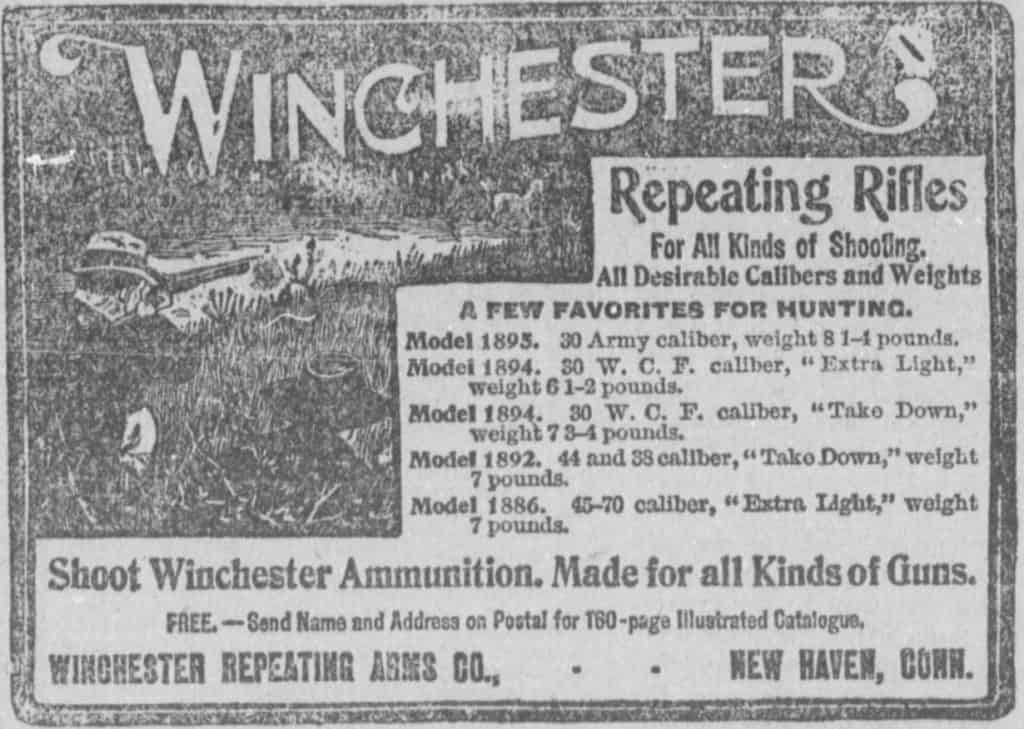
The Winchester Model 1873 came next, chambered for the .44-40 Winchester. The same cartridge fit Colt’s revolvers, so a rider could carry one kind of ammunition for both guns. That, a steel frame in place of the older brass alloy, and an action that held up to hard use sold the rifle: more than 720,000 were built, and production ran to 1919. The tag that follows the Model 1873, “The Gun That Won the West,” came later, out of Winchester’s own advertising in the early 20th century, and it belongs to that model rather than to the 1866.
Most of the work these rifles did was civilian. Homesteaders carried them for meat and for defense, and so did lawmen and outlaws. Annie Oakley shot Winchesters in front of paying audiences, and Buffalo Bill’s Wild West show put repeaters in front of crowds who would never handle one.
The Winchester Model 1894, chambered in .30-30 Winchester, sold in numbers no sporting rifle had reached before it. More than seven million were built between 1894 and 2006.
The Role of Repeating Rifles in Global Conflicts
The Battle of the Little Bighorn (1876) is the fight people reach for, and it needs care. Custer’s 7th Cavalry carried single-shot Springfield carbines. The Lakota and Cheyenne carried a mix: bows, old muzzleloaders, single-shot rifles, and repeaters, mostly Henrys and Winchester 1866s and 1873s. Metal-detector survey of the battlefield in the 1980s recovered more than 2,300 cartridges, cases and bullets tied to at least 371 individual guns of 45 types. Charles Windolph of Company H, who survived the battle, put repeaters in roughly a quarter of warrior hands, and reconstructions from the recovered cases land near 200 repeating rifles on the field. They counted for a great deal at close range. So did numbers and ground, and the rifles by themselves do not explain the outcome.
Repeaters also went abroad. Russia ordered Winchester Model 1895 rifles in 7.62x54R, the cartridge of its own Mosin rifles, and roughly 300,000 were delivered between 1915 and 1917, fitted with stripper clip guides. Winchester chambered the same model in .303 British, the British service cartridge. In Japan, troops from Tosa Province fought the Boshin War (1868-1869) with American Spencer repeaters bought off the surplus market after the Civil War.
By the early 20th century the military standard was the bolt-action repeater, which was stronger, more accurate, and better suited to long-range fire. The Mauser Model 1898, Springfield Model 1903, and Lee-Enfield rifles armed the major powers through both world wars. Lever-action and pump-action rifles kept the civilian market.
Modern Evolution and Resurgence of the Lever-Action Rifle
Semi-automatic and fully automatic rifles took over the military work, and lever guns stayed with hunters and sport shooters. The Marlin Model 336 and the Winchester Model 94 carried that load for most of a century. Chamberings run from .22 rimfire for small game and targets, through .30-30 Winchester and .45-70 Government for big game, to .308 Winchester and 7.62x51mm NATO in the stronger box-magazine actions, which reach farther and hit harder than a tube-fed gun was ever meant to.
Hornady’s LEVERevolution ammunition, loaded with a soft polymer-tipped bullet that is safe to stack in a tube magazine, gave these old cartridges a flatter trajectory and more usable range.
The lever gun has also come back in a harder-edged form. Marlin (now owned by Ruger), Henry Repeating Arms, and Winchester sell models with M-LOK rails, threaded barrels for suppressors, and receivers set up for optics. Some buyers pick them for home defense, where a short rifle, a fast follow-up shot, and a manual action that anyone can learn suit the job.
The bolt-action repeater has not gone anywhere either. It is still the basis for sniper and designated marksman rifles, for the same reasons it took the arsenals a century ago: accuracy and reliability.
The Lasting Legacy of Repeating Rifles
The repeating rifle was a step, not a refinement. It cut the gap between shots, and that one change rewrote infantry tactics, altered what a hunter could expect from a day in the field, and changed what one person could hold off alone. Semi-automatic and automatic firearms run the arsenals now. The lever-action and the bolt-action are still bought, still carried, and still collected.
A hunter today can buy a lever gun a rider in 1890 would recognize on sight, load it with ammunition that shoots flatter than anything he had, and put it to the same work. Very few designs last long enough to make that possible.
Here are a number of forums where you can join the conversation about these weapons:
If you know of any forums or sites that should be referenced on this listing, please let us know here.