In the chronicles of American history, certain figures shine brightly, their contributions shaping the course of the nation’s path. Colonel Hiram C. Berdan is undoubtedly one of these figures, a man whose life encompassed both the arena of mechanical innovation and the battlefield, reflecting the drive of an era deeply entrenched in progression and the struggle for unity.
Who Was Hiram C. Berdan?
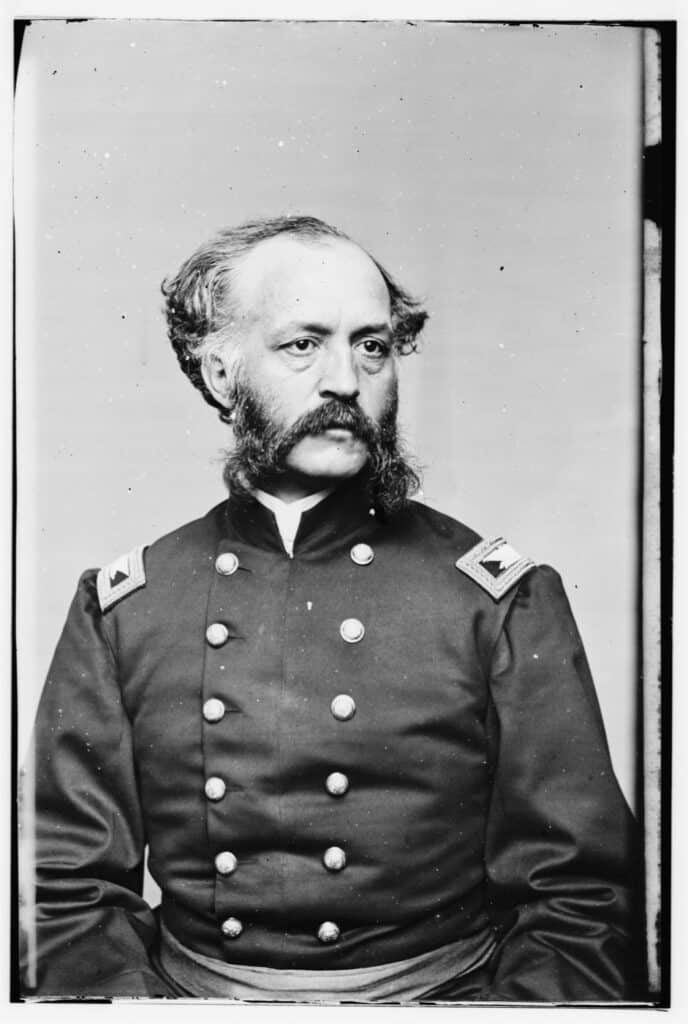
Berdan was born on September 6, 1824, in Phelps, New York. From an early age, he demonstrated an aptitude for understanding the intricate workings of machinery, a trait that would prove influential in his later pursuits and impact not only the Civil War’s landscape but also the framework of American industry.
Before the war he worked as a mechanical engineer in New York City, and he was widely held to be the finest rifle shot in the country, a reputation he carried for some fifteen years. Firearms were only part of his output. He built the first commercial gold amalgamation machine for processing ore, along with a reaper and a mechanical bakery.
Raising the United States Sharpshooters
As the Civil War cast a dark shadow over America in 1861, Berdan emerged as a significant military figure. With his sharp understanding of the need for precision and a tactical advantage in warfare, he created the 1st and 2nd United States Sharpshooters, units comprising the most skilled marksmen in the country.
Berdan set rigorous standards for these regiments, requiring each recruit to place ten consecutive shots within a 10-inch circle from 200 yards. The published standard understates it. The shots also had to average within five inches of center, and measured on a string the whole group could total no more than fifty inches.
The regiments drew eighteen companies from eight states, and Berdan was commissioned colonel of the 1st United States Sharpshooters on November 30, 1861.
The Sharpshooters’ uniforms distinguished them from their comrades. Clad in forest green, they stood out against the traditional Union blue. This departure from the norm was a calculated decision by Berdan, who recognized the tactical advantage that effective camouflage could provide. The green wool ran to both frock coat and trousers, the buttons carried no brass, and the men drew Prussian-style fur knapsacks. The green did not last the war. By the Gettysburg campaign most of them had gone over to modified blue.
The Berdan Rifle and What His Sharpshooters Actually Carried
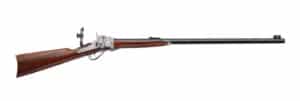
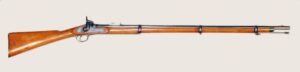
Berdan designed a rifle known as the Berdan Rifle, a .58 Caliber breech loader. Contrary to popular belief, the Berdan rifle was not used by his regiment. The Sharpshooters primarily used the Sharps Rifle, a .52 caliber breech-loading firearm that offered a significant advantage in terms of rate of fire and reliability over traditional muzzle-loading weapons.
For the first months the men carried whatever they owned, a mix of Sharps rifles, heavy Whitworth target rifles and privately owned sporting arms. The regiment was not issued Sharps rifles until May 8, 1862. The wait bought them a great deal: the Sharps fired eight to ten times a minute, weighed around twelve pounds, and held its accuracy to 600 yards.
Despite the delay, the skill of the Sharpshooters coupled with their effective weaponry made them a crucial part of the Union’s strategy.
Berdan’s Sharpshooters played crucial roles throughout the Civil War. At the Battle of Gettysburg, they contributed significantly by targeting key Confederate officers. During the Siege of Yorktown, they successfully disrupted Confederate defenses, paving the way for Union advancements. These contributions underscore the value of Berdan’s strategic vision and his ability to apply his understanding of precision to the battlefield.
The Berdan Primer, and the One America Actually Uses
Away from the battlefield, Berdan’s inventiveness revolutionized American industry. He developed the Berdan Primer, a central component of modern centerfire primers, marking a significant stride in firearms technology. Moreover, his work on mining and crushing machinery significantly advanced the American industrial sector.
He patented the design on March 20, 1866, as US patent 53,388, and on September 29, 1868, received US patent 82,587, which covered a reinforcing cup for the case head and the use of patched bullets in brass cases rather than the primer itself. Seven months after that first patent, on October 13, 1866, Colonel Edward Mounier Boxer of the Royal Arsenal at Woolwich patented a rival design in England. Boxer took out a US patent of his own on June 29, 1869, numbered 91,818.
The Difference Is Where the Anvil Sits
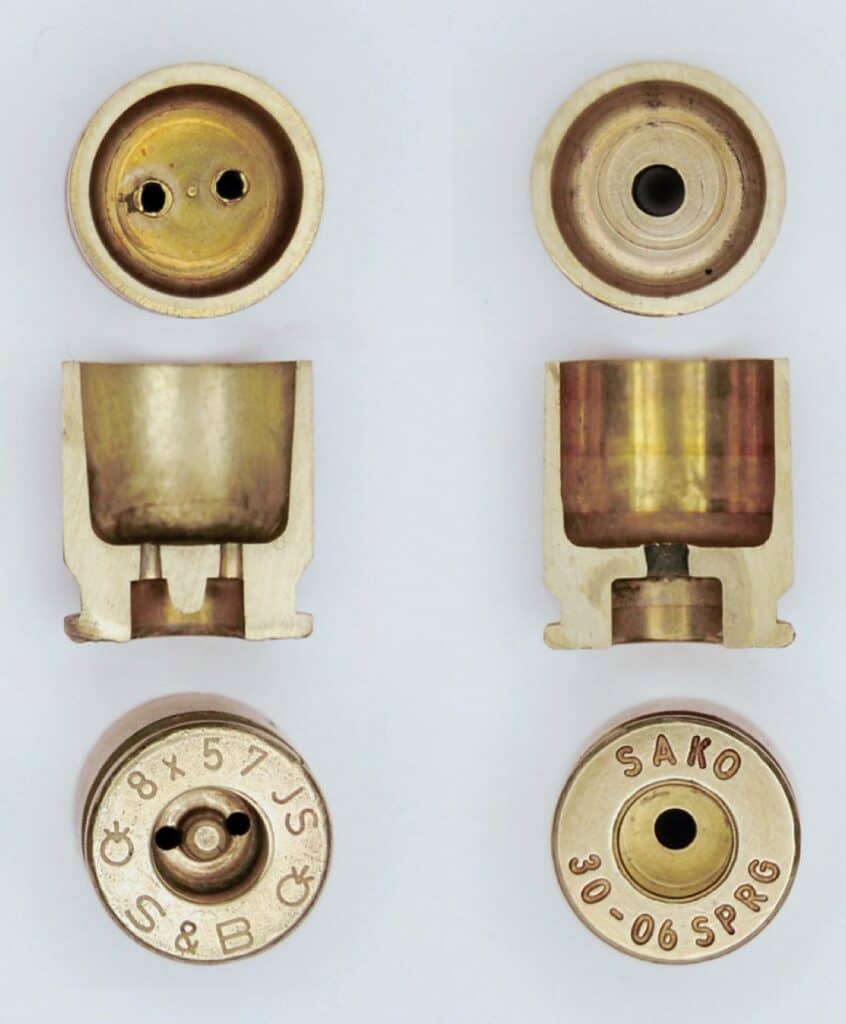
Both designs solve the same problem and differ in one decision. In a Berdan case the anvil is part of the case head itself, a small raised bump in the floor of the primer pocket, with two or more flash holes set off to either side of it. In a Boxer case the anvil is a separate stirrup-shaped piece that sits inverted inside the primer cup, and the case head carries a single flash hole dead center.
That single central hole is the whole story for anyone who reloads. A Boxer case deprimes with one rod pushed down through the neck: the pin passes through the flash hole and pops the spent primer straight out. A Berdan case has no clear path for a pin, because the anvil is in the way and the flash holes are off to the sides. Removing a Berdan primer takes hydraulic pressure, a pincer, or a hooked lever that reaches under the rim of the cup and levers it out. It is slower, it is fiddlier, and it is why a range pickup of Berdan-primed brass tends to go in the scrap bucket.
The Irony
Berdan was American and Boxer was English, and each man’s design ended up in the other’s part of the world. Berdan priming is cheaper to manufacture and became the norm across Europe and in military surplus ammunition made outside the United States. Boxer priming became universal for American civilian factory ammunition. An American reloader working with US commercial brass is using the Englishman’s primer, and the surplus tin that will not deprime carries the American’s.
What the Regiment Paid
Being specialists did not spare them. The 1st United States Sharpshooters lost ten officers and 143 enlisted men killed in action or mortally wounded, and another officer and 128 enlisted men to disease. 282 dead in all.
After the War
Berdan resigned his commission on January 2, 1864. Formal recognition came slowly. He was brevetted brigadier general to rank from March 13, 1865, though the Senate did not confirm it until February 16, 1869, and a nomination to brevet major general was never confirmed at all.
His rifle found its market abroad rather than at home. Working with two Russian officers, Colonel A. P. Gorlov and Lieutenant K. I. Gunius, Berdan produced a design that Russia took up when the United States would not.
The first version, the Berdan I or Model 1868, used a hammerless trapdoor breechblock and was built in small numbers against a contract for 30,000. The Berdan II of 1870 was the one that mattered: a single-shot bolt action with a short, pear-shaped bolt handle, chambered for the 10.75x58mmR, a round of roughly .42 caliber.

Russia adopted the Berdan II in 1870 in place of the Krnka and kept it as the standard infantry rifle until the Mosin-Nagant replaced it in 1891. More than three million were built between 1868 and 1891, the first of them at Birmingham Small Arms in England and the bulk afterwards at the Russian arsenals at Tula, Izhevsk and Sestroretsk.
It had a long tail. The Berdan II fought the Russo-Turkish War of 1877 and 1878, was still in Russian hands during the Russo-Japanese War, and turned up again in the First World War arming second-line, training and service units more than forty years after its adoption.
He kept patenting: a trapdoor action, a hammerless straight-line striker, then a run of naval and artillery work that took in a steam-powered torpedo boat, a torpedo meant to slip past defensive netting, a long-distance rangefinder and a distance fuse for shrapnel shells.
He died on March 31, 1893, in Washington, D.C., and is buried at Arlington National Cemetery.
Berdan’s life stands as a testament to American ingenuity and the relentless pursuit of progress. His contributions in both the military and industrial arenas demonstrate a remarkable adaptability and a deep understanding of his crafts, hallmarks of the American spirit. As we continue to strive for an even better Union, we look back at figures like Hiram C. Berdan, a symbol of precision, patriotism, and innovation, for inspiration.
If you know of any forums or sites that should be referenced on this listing, please let us know here.