Remington Arms began in 1816 with a single rifle barrel, forged by a 22-year-old blacksmith at his father’s forge in upstate New York. Over the next two centuries the company armed the Union Army, sold rolling block rifles to militaries in Europe and South America, and built the best-selling shotgun ever made. It also filed for bankruptcy twice in three years and was broken up and sold off in 2020.
Origins and Early Years (1816–1856)
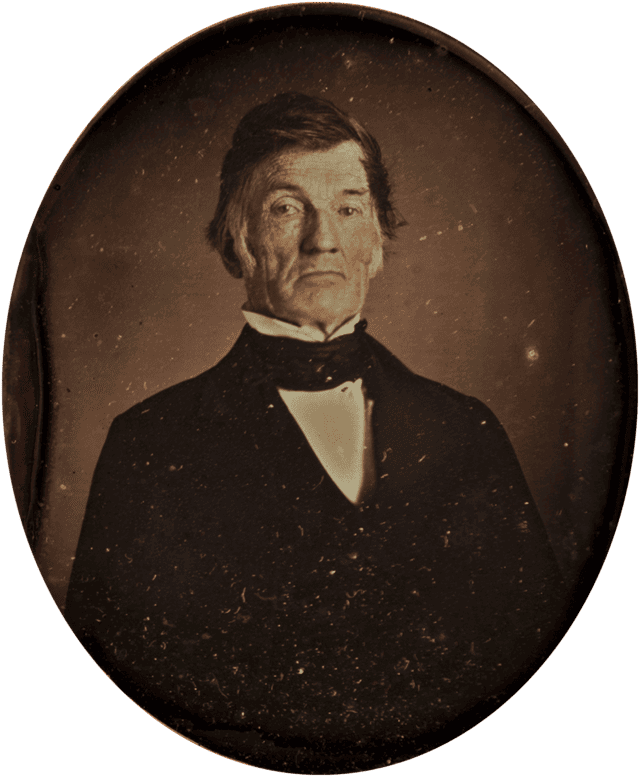
Eliphalet Remington II forged his first rifle barrel in 1816, at the age of 22, in his father’s blacksmith shop in Ilion Gulch in the township of Litchfield, Herkimer County, New York. Water from Steele’s Creek drove the forge wheel. He walked the finished barrel to a gunsmith in Utica to have it reamed and rifled, then had it fitted with a lock and stock. The rifle shot well enough at a local match that other men began ordering barrels from him.
Through the 1820s Remington moved from building whole guns to order toward making barrels in quantity for other gunsmiths. The Erie Canal opened in 1825 and ran along the Mohawk River a few miles north of the forge. In 1828 the family bought 100 acres on the canal at Morgan’s Landing, later renamed Ilion, and moved the forge and foundry there. By 1845 the works had gone beyond barrels to complete firearms, including the Remington percussion rifles that made the company’s name for reliable, accurate work.
Civil War and Post-War Expansion (1856–1888)
In 1856 Eliphalet’s three sons, Philo, Samuel and Eliphalet III, became partners in the firm, and it took the name E. Remington & Sons.
During the American Civil War, Remington was a major arms supplier to the Union Army. Its most important product was the New Model Army revolver, a .44 caliber, six-shot, single-action percussion revolver. It was a cap-and-ball gun, loaded with loose powder, ball and percussion caps, not a cartridge arm. The design descended from Fordyce Beals’s patent of September 1858 by way of the earlier Remington Beals revolver. Remington built roughly 132,000 New Model Armies between 1863 and 1875. The U.S. government was the largest buyer during the war, which made Remington the second largest revolver supplier to the Union after Colt (Flayderman, 2007, Flayderman’s Guide to Antique American Firearms).
After the war the company’s reputation rested on the Rolling Block. The action grew out of the split-breech carbine that Leonard Geiger and Joseph Rider developed during the war, and Rider’s patents of 15 November 1864 (No. 45,123) and 1865 fixed it in close to its final form. Production rifles followed in the later 1860s, and the first large military orders came from 1867. The Rolling Block was a single-shot breech-loader, simple and strong, and it sold to armies across Europe and South America. Chamberings ran from .22 rimfire up through .50-70 Government (Houze, 2011, Remington: America’s Oldest Gunmaker).
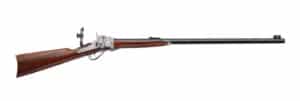
In 1873 Remington added the No. 1 Long Range Creedmoor, a target rifle built on the rolling block action for the new sport of long-range competition. It was chambered first for the .44-77 Remington-Sharps and soon after for the longer .44-90 Remington. At the international long-range match at Creedmoor on Long Island in 1874, the American team, half of them shooting Remington Creedmoors and half of them Sharps Model 1874 rifles, beat the Irish team.
Turn of the Century and World War I (1888–1918)
Financial trouble put E. Remington & Sons up for sale in 1888. Marcellus Hartley, who owned the Union Metallic Cartridge Company (UMC), bought it with his partners and reorganized it as the Remington Arms Company. That put ammunition and firearms production under one owner, which mattered a great deal when the war orders arrived.
The Model 8 followed in 1906. John Browning designed it, patented it in 1900, and sold the design to Remington. It was one of the first semi-automatic rifles in America that worked reliably with full-power centerfire ammunition, and it was offered in .25, .30, .32 and .35 Remington. Police bought it during the Depression-era crime wave. Texas Ranger Frank Hamer carried a Model 8 in .35 Remington at the 1934 ambush of Bonnie Parker and Clyde Barrow (Ball, 2012, Winchester and Remington: Pioneers of American Firearms).
Remington also built the Model 1911 pistol in this period. Remington-UMC held a wartime contract for Browning’s .45 ACP design and delivered 21,677 of them, the last in early 1919.
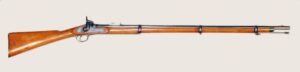
The company’s largest contribution to the First World War was the Model 1917, adapted from the British Pattern 1914 rifle and chambered in .30-06 Springfield. It became the rifle most American soldiers actually carried. By the Armistice, about three quarters of the American Expeditionary Force in France was armed with it. Total Model 1917 production came to 2,193,429 rifles from three plants: 545,541 at Remington’s Ilion works, 1,181,908 at Eddystone, a Remington subsidiary, and the balance at Winchester (Hatcher, 1947, Hatcher’s Notebook).
Interwar Years and World War II (1918–1945)
After the war Remington turned back to civilian guns. Two models stand out:
- Model 31 pump-action shotgun (1931). A high-quality competitor to the Winchester Model 12.
- Model 720 bolt-action rifle (1941). A sporting rifle derived from the military Model 1917 and chambered for .30-06 Springfield.
In the Second World War, Remington’s main military contract was the M1903A3, a wartime variant of the Springfield Model 1903 bolt-action rifle with simplified production features, chambered for .30-06 Springfield.
Postwar Era and Rise of Iconic Firearms (1945–2000)
The Model 870 Wingmaster arrived in 1950 and became the best-selling shotgun ever made. Remington built the ten millionth in April 2009, and the total has since passed 11 million. Hunters, police departments and home owners all bought it, on the strength of its price, its durability and the number of configurations it came in.
The Model 700 followed in 1962. Mike Walker engineered it, and its trigger and its chamber tolerances made it a favorite with hunters and with police marksmen. The U.S. Army built its M24 Sniper Weapon System on the Model 700 action (Poyer, 2007, The Model 700 Handbook). Chambered across a wide range of cartridges and priced within reach, it became one of the most popular hunting rifles in America.
Modern Era and Challenges (2000 onward)
Remington moved into the modern sporting rifle market in the 2000s:
- Remington R-15 (2008). A semi-automatic rifle on the AR-15 pattern, offered in chamberings including .223 Remington and .450 Bushmaster.
- Remington Versa Max (2010). A gas-operated semi-automatic shotgun.
The finances did not hold. Remington filed for bankruptcy in 2018 and again in 2020, and it also faced litigation over the criminal use of its rifles. The second filing ended with the company broken up and its assets sold separately:
- Ruger bought Marlin Firearms.
- Vista Outdoor bought Remington Ammunition.
- Roundhill Group bought the Remington firearms division.
Remington firearms remain in wide use in hunting, police work and military service.
Conclusion
Remington ran for more than two centuries, from one forge in Litchfield to a firearms and ammunition business with customers on several continents. The Rolling Block, the Model 8, the Model 700 and the Model 870 are the designs that carried it. Bankruptcy broke the company into pieces in 2020 and those pieces now trade under separate owners, but the guns and the name are still in service.
References:
Poyer, Joe. The Model 700 Handbook. North Cape Publications, 2007.
Ball, Robert. Winchester and Remington: Pioneers of American Firearms. Gun Digest, 2012.
Flayderman, Norm. Flayderman’s Guide to Antique American Firearms. 9th ed., Krause Publications, 2007.
Hatcher, Julian. Hatcher’s Notebook. Stackpole Books, 1947.
Houze, Herbert. Remington: America’s Oldest Gunmaker. Chartwell Books, 2011.
Check out their company website here.
If you know of any forums or sites that should be referenced on this listing, please let us know here.