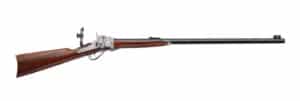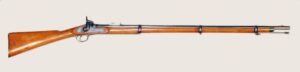

Introduction: The Remington M1867 Rolling Block Rifle
The Remington M1867 rolling block rifle was one of the most widely exported military rifles of the 1860s and 1870s. It never had the public profile of the Winchester lever guns or the Springfield Trapdoor, but it was exported to armies across Europe, the Americas and North Africa, and it is a clear marker of the point where infantry moved off the muzzleloader for good.
The rifle is named for its action. A separate breechblock and hammer each rotate on their own pin in the receiver, and when the hammer falls it slides in behind the block and locks it shut. Few parts, none of them delicate, and enough strength to take a full black powder charge.
Armies that issued rolling blocks include Sweden, Norway, Denmark, Spain, France, Argentina and Egypt. The United States bought them for the Navy and Marine Corps, but not for the Army.
Origins and Development of the Remington M1867
The Genesis of the Rolling Block Action
The action did not arrive complete. It grew out of the split-breech carbine designed by Leonard Geiger and then reworked by Joseph Rider, an engineer at E. Remington & Sons. Accounts often compress the whole sequence into a single 1863 patent. The patent record has more than one step:
- U.S. Patent No. 37,501, issued to Leonard Geiger on 27 January 1863, covering the early split-breech mechanism.
- U.S. Patent No. 45,123, issued to Joseph Rider on 15 November 1864, which added the lock that stops the hammer falling while the breech is open.
- U.S. Patent No. 45,797, issued to Rider on 3 January 1865, the patent usually cited as the first for the action Remington went on to sell as its own system.
Rider’s first mechanism was close enough to Geiger’s that Remington bought the rights to the Geiger patent rather than argue about the overlap. Rider then kept refining the design across his 1864 and 1865 patents until it reached the form the company put into production.
Working the rifle is four motions. The shooter cocks the hammer, which frees the breechblock, rolls the block back with the thumb to expose the chamber, drops in a metallic cartridge, and rolls the block forward again. Pulling the trigger drops the hammer, which fires the round and locks the block at the same moment. That was quick next to a muzzleloader and simpler than most of the early breechloaders it was tested against.
Key Advantages of the Rolling Block Action
- Strength. The breechblock is solid and the cocked hammer sits directly behind it, so the breech carried heavy black powder loads without working loose.
- Simplicity. Fewer moving parts than the Springfield Trapdoor or the Martini-Henry, which made it cheaper to build and easier for a soldier to keep running.
- Ease of training. One shot, one loading motion, and little for a recruit to get wrong under stress.
Other armies were solving the same problem in the same year by other means. Austria-Hungary adopted the M1867 Werndl-Holub with its rotating drum breech, and Britain went to the Martini-Henry a few years later. What set the rolling block apart in that company was how cheap it was to build and how little it asked of the soldier carrying it.
How the M1867 Was Made
Production at Remington
The originating maker was E. Remington & Sons of Ilion, New York, the firm Eliphalet Remington II founded in 1816. It did not take the Remington Arms Company name until 1888, when the family sold the business, so the M1867 is properly an E. Remington & Sons product.
Production mixed machine work with hand fitting. Barrels, receivers and breech parts were machined in stages, with workers kept on single operations so they got fast at them. Gunsmiths then assembled each rifle by hand, checking that the block closed square and the parts lined up. Finished rifles were proof tested before they left the plant.
Licensed Production Abroad
Remington was not the only maker, and after the first few years it was not the main one. Sweden and Norway bought manufacturing licences and built the rifles at their own state arsenals:
- Carl Gustafs Stads Gevärsfaktori and Husqvarna Vapenfabriks Aktiebolag, Sweden
- Kongsberg Våpenfabrikk, Norway
Remington’s own share of the Scandinavian programme was the first run of about 10,000 rifles. Swedish output alone then came to somewhere between 237,000 and 257,000 rifles and carbines. In the United States the Navy’s rolling blocks were built at Springfield Armory under a royalty agreement with Remington, which is where the Model 1870 Remington-Navy rifle comes from.
Military Adoption and Global Success
Limited U.S. Military Use
The U.S. Army tested the rolling block and did not take it up for infantry service. Cost decided it, along with an arsenal system already geared to converting muzzleloaders. The Springfield Trapdoor became the standard Army rifle in .45-70 Government in 1873 and stayed there until the Krag-Jorgensen replaced it in 1893.
The Navy and Marine Corps did buy rolling blocks, chambered for .50-70 Government, for shipboard and landing party use, and the Navy also took a few thousand carbines on a reduced .50-70 load. The .45-70 belongs to the Springfield, not to the American rolling blocks of this period.
Widespread European Adoption: Sweden & Norway
In 1867 both kingdoms were looking for a breechloader to replace aging muzzleloaders. They trialled several designs and settled on the rolling block, each adopting it as the standard infantry rifle in 12.17x42mm rimfire. Later work converted much of the inventory to centrefire.
The rifles outlasted their front line careers by a long way. Reserve and second line units still held them into the early twentieth century, some as late as the First World War, and large numbers went to civilian target shooters as surplus.
Other Nations Using the Rolling Block
- Spain. Standard issue as the Fusil Remington Modelo 1871 in 11.15×58mmR Spanish Remington, used heavily in Cuba and the Philippines.
- Denmark. Issued to the Danish army in 11.7×51mmR Danish Remington.
- France. Put in the hands of the Garde Nationale during the Franco-Prussian War of 1870 and 1871.
- Argentina. Bought in quantity for military use in the late nineteenth century.
- Egypt. Carried through the Russo-Turkish War of 1877 and 1878 and other campaigns of the period.
Technical Specifications and Performance
| Feature | Specification |
|---|---|
| Action | Rolling block, single-shot |
| Barrel Length | 951 mm (37.4 in) on the Scandinavian infantry rifle; carbines much shorter, down to 460 mm (18.1 in) |
| Weight | About 4.3 kg (9.5 lb) for the infantry rifle |
| Stock Material | Walnut, oil-finished |
| Sights | Adjustable ladder rear sight |
Calibers & Ballistics
Chambering followed the country of adoption:
| Country | Cartridge | Bullet Weight | Muzzle Velocity | Effective Range |
|---|---|---|---|---|
| USA (Navy Model) | .50-70 Govt | 450-grain | ~1,250 fps | 300-500 yards |
| Sweden/Norway | 12.17x42mm RF | ~350-360-grain | ~1,200 fps | 600 yards |
| Spain | 11.15×58mmR | 370-400 grain | ~1,350 fps | 500 yards |
Performance & Reliability
- Accuracy. Good work at 200 to 400 yards with issue sights and issue ammunition, which is the range band the rifle was built for.
- Recoil. Heavy with full black powder loads, but manageable from the shoulder.
- Durability. It held up in hard service and in extreme climates, which is much of why so many armies bought it.
Collector Value & Modern-Day Interest
Surviving rifles have a steady following among collectors, and among shooters who use them in black powder cartridge matches. Value tracks rarity, condition and documented provenance more than anything else.
Estimated Collector Prices (2024)
- Standard models: $1,500 to $2,500
- U.S. Navy variants: $3,500 to $5,000
- Scandinavian rifles with rare markings: $4,000 and up
Those are 2024 figures. Check recent auction results before you buy or sell.
Conclusion
The M1867 mattered because it was cheap to make, hard to break and easy to teach. That combination sold it to one army after another, and it kept the rifles in reserve service for decades after better weapons existed.
Repeating bolt actions ended its front line career. The action itself outlived the military contracts, turning up in single-shot sporting and target rifles well into the twentieth century.
Discussions on this and other Remington firearms can be found on the Remington Society.
If you know of any forums or sites that should be referenced on this listing, please let us know here.