The Ruger Bearcat is one of those little revolvers that looks almost too pretty to be useful until it starts punching tidy clusters in the target and riding unnoticed on a belt all afternoon. Small, light, and elegant, it has been a favorite trail gun and plinker for generations. To understand why such a tiny single action .22 has such a devoted following, it helps to look at the company that built it, the history behind it, and the place it holds among rimfire revolvers old and new.
Sturm, Ruger & Co. and the rimfire tradition
Sturm, Ruger & Co. was founded in 1949 by William B. Ruger and Alexander McCormick Sturm in Southport, Connecticut, starting with a single product: the .22 Long Rifle Ruger Standard semi automatic pistol. That pistol, introduced in 1949, quickly became a runaway success and established Ruger as a serious firearms manufacturer.
From the beginning, Ruger built its name on affordable, reliable rimfire guns. The Standard pistol and its Mark series descendants, followed by the 10/22 rifle and later rimfire models, turned the brand into one of the dominant names in .22 firearms.
By the early 1950s, Ruger had realized that fans of Western movies and classic sixguns wanted a .22 caliber single action that looked and handled like a scaled down Colt Single Action Army. In 1953 the company introduced the Ruger Single Six, a .22 revolver that mimicked the big Colt in profile but used modern manufacturing techniques to keep costs down.
The Single Six was a hit and effectively rescued the traditional single action concept for the postwar market. That success gave Ruger the confidence to go even smaller and build a truly compact .22 trail gun. The result was the Bearcat.
Birth of the Bearcat
The Ruger Bearcat was introduced in 1958 as a miniature, single action .22 revolver intended as a lightweight companion for hikers, campers, and outdoorsmen.
Designed by William B. Ruger, the Bearcat drew aesthetic inspiration from 19th century Remington pocket single action revolvers, rather than the Colt pattern that informed the Single Six. The idea was to build a rimfire kit gun that was smaller and lighter than the Single Six while still feeling like a real sixgun, not a toy.
Ruger announced the new revolver in 1958 with a suggested retail price of $49.50, right in the same general price neighborhood as Colt’s then new Frontier Scout .22 single action. The name “Bearcat” referenced a nimble, quick little animal, and the revolver lived up to that image. It had a short 4 inch barrel, a scaled down grip frame, and a six shot cylinder in .22 Long Rifle that would also accept .22 Long and .22 Short.
From the start the Bearcat was marketed as a trail gun or kit gun, something that could live in a tackle box, on a belt, or in a backpack without adding much weight. Ruger’s advertising highlighted its value as a plinker and small game gun for outdoorsmen who wanted a quality revolver in a compact package.
Generations of Bearcat: from alloy frame to New Bearcat
Over its long life the Bearcat has appeared in several distinct versions, each building on the same core concept.
First issue Bearcat, 1958 to 1970
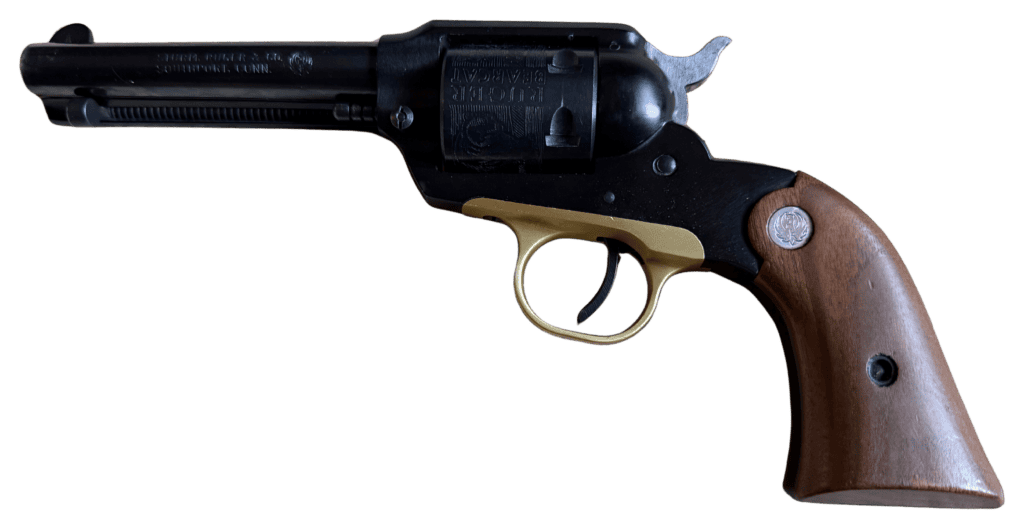
The original Bearcat, often called the first issue, used an aluminum alloy frame to keep weight down to about 17 ounces, with a 4 inch barrel and compact, one piece grip frame. Early guns wore black plastic grips, later replaced by walnut.
The cylinder was fluted, with roll engraved scenes that gave the little gun much of its visual charm. Sights consisted of a fixed front blade and a simple rear notch, regulated for typical .22 Long Rifle loads of the period. Like other Ruger single actions of the era, the early Bearcat did not include a transfer bar safety, so safe practice was to carry it with an empty chamber under the hammer.
Super Bearcat, 1971 to 1974
In 1971 Ruger upgraded the design with the Super Bearcat, the second issue. The main change was a switch from an aluminum frame to all steel, boosting weight to about 22.5 ounces and increasing durability. The Super Bearcat also used an unfluted, engraved cylinder and coil springs.
The Super Bearcat remained a compact, fixed sight sixgun with the same basic lines and purpose. Production of the Bearcat and Super Bearcat together totaled well over 140,000 revolvers before Ruger discontinued the line in the mid 1970s.
Hiatus and reintroduction: the New Bearcat
After 1974 the Bearcat disappeared from Ruger’s catalog for nearly two decades. Interest in rimfire single actions never really went away, however, and in 1993 Ruger reintroduced the model as the New Bearcat, sometimes considered the third issue.
The New Bearcat kept the steel frame and 4.2 inch barrel, with weight around 24 ounces. It wore smooth hardwood (often rosewood) grips with Ruger medallions and retained the engraved, unfluted cylinder that made the little sixgun so visually distinctive.
The biggest mechanical change was the addition of Ruger’s transfer bar safety system, which allows the revolver to be safely carried with all six chambers loaded.
For a time Ruger offered an extra .22 Magnum cylinder, but those cylinders were recalled in 1994 due to timing concerns and the Bearcat has effectively remained a .22 Long Rifle only revolver since then.
In 2002 Ruger added a stainless steel version of the New Bearcat, which quickly became popular with outdoorsmen who liked a weather resistant finish. A 50th Anniversary Bearcat, announced in late 2007 and produced in 2008, featured special markings, gold accents, cocobolo grips, and a unique serial number prefix, with a limited run of 2,539 guns.
In 2015 Ruger answered long standing customer requests with an adjustable sight Bearcat, giving shooters the ability to dial in elevation and windage for specific loads without altering the revolver.
Technical details and handling
The Bearcat is a small frame, single action rimfire revolver with a six shot cylinder. Current New Bearcat production is chambered for .22 Long Rifle, although the original design accepted .22 Short and .22 Long as well.
Typical specifications for a New Bearcat:
- Action: Single action
- Caliber: .22 Long Rifle
- Capacity: 6 rounds in a fixed cylinder
- Barrel length: Approximately 4.2 inches in modern production
- Overall length: About 9 inches
- Weight: Around 24 ounces in standard blued or stainless steel versions
The grip frame is integral to the main frame, which keeps the revolver compact. The grip itself is small and rounded, yet reviewers consistently note that the gun remains comfortable and controllable even for shooters with larger hands, thanks to the shape of the grip and the hammer spur placement.
Sights on the classic Bearcat are fixed: a small blade front sight and a square notch rear cut into the top strap. The later adjustable sight model substitutes a fully adjustable rear unit and a higher front blade, which makes it easier to zero with modern high velocity .22 ammunition.
The Bearcat loads through a right side loading gate. Cartridges are inserted one at a time with the hammer at half cock on older guns, or following the loading instructions specific to the transfer bar system on newer guns. Extraction is by the traditional ejector rod on the right side of the barrel.
The Bearcat among Ruger rimfire revolvers
Within Ruger’s own catalog, the Bearcat has always occupied a unique niche.
Single Six and New Model Single Six
The Single Six, introduced in 1953, predates the Bearcat and remains one of Ruger’s signature rimfire revolvers. It is essentially a full size .22 single action patterned on the Colt Single Action Army. Over time the Single Six line evolved into the New Model Single Six and various spin offs such as the Single Ten and Single Nine, often with convertible cylinders and adjustable sights.
Compared with the Single Six family, the Bearcat is noticeably smaller and lighter, with a scaled down frame and shorter barrel. The Single Six is more of a general purpose .22 single action, while the Bearcat is focused on being a compact trail companion.
Wrangler and Super Wrangler
In 2019 Ruger launched the Wrangler, a budget priced .22 Long Rifle single action built on an aluminum alloy frame with an unfluted cylinder. It was designed to offer a lower cost alternative to the Single Six while preserving the classic single action layout.
The Wrangler line was expanded in 2023 with the Super Wrangler, which uses a steel frame and ships with two cylinders, one for .22 Long Rifle and one for .22 Magnum. It has adjustable sights and a 5.5 inch barrel.
Both Wrangler variants are excellent plinking and training revolvers, but they are larger and heavier than the Bearcat. The Bearcat remains Ruger’s smallest single action .22, aimed at shooters who prioritize compactness and traditional aesthetics over maximum value pricing or multi caliber flexibility.
Double action .22 Rugers
Ruger also offers several double action .22 revolvers, such as the SP101 in .22 Long Rifle, the LCR .22, and the GP100 .22.
- The SP101 .22 is an 8 shot, stainless steel, 4.2 inch barreled revolver that weighs about 30 ounces and uses adjustable sights.
- The LCR .22 is a lightweight double action revolver with a polymer and aluminum frame, 8 round capacity, and a weight under 15 ounces.
- The GP100 .22 is a large frame, 10 shot stainless revolver with a 5.5 inch barrel and about 42 ounce weight, set up as a full size training or field revolver.
These double action guns offer higher capacity, different triggers, and in some cases adjustable sights and heavier frames suited to extended practice. None of them duplicate the Bearcat’s combination of tiny size, single action mechanism, and ornate styling.
Predecessors and competitors from other makers
The Bearcat did not appear in a vacuum. Other companies were building small rimfire revolvers for similar roles.
Ruger predecessors
Ruger’s own Standard .22 pistol, introduced in 1949, created the company’s foothold in the rimfire market and taught it how to build inexpensive, accurate .22 firearms in volume.
The Single Six of 1953 can be seen as the Bearcat’s older brother. That full size .22 single action established the pattern of affordable, rugged sixguns that the Bearcat would later miniaturize for the trail gun role.
Colt Frontier Scout
Colt’s Frontier Scout, introduced in 1957, was a scaled down Single Action Army in .22 Long Rifle and .22 Magnum, with an aluminum alloy frame and a price around $50 at launch. It remained in production into the 1970s with several variations.
The Frontier Scout and Bearcat appealed to much the same audience, but the Colt was essentially a miniature Peacemaker while the Bearcat had its own Remington inspired lines and a more compact frame. The Ruger was even smaller and lighter, better suited to ride unnoticed in a kit bag or on a narrow belt.
Smith & Wesson Kit Guns
Smith & Wesson’s Kit Gun family, which eventually included the Model 34 and later Model 63 and 317, represented the double action side of the same concept. These were small framed, six or eight shot .22 revolvers with 2 or 4 inch barrels and adjustable sights, meant to live in a fishing or hunting kit.
Compared with the Bearcat, the S&W Kit Guns offered double action capability and typically more refined adjustable sights, but at the cost of a different trigger feel and, in many cases, a slightly bulkier profile.
Modern budget and pocket competitors
In today’s market, the Heritage Rough Rider .22 single action, introduced in the 1990s, fills much of the entry level Old West style niche at very low prices. North American Arms builds tiny .22 rimfire mini revolvers that are far smaller than the Bearcat but occupy more of a deep concealment or novelty role.
The Bearcat sits between these extremes. It is smaller and more elegant than full size single actions, more substantial and easier to shoot than mini revolvers, and built to higher fit and finish standards than the least expensive imports. That balance is one of the keys to its enduring appeal.
Shooting the Ruger Bearcat
On the range, the Bearcat has a distinct personality that matches its looks.
The single action trigger is typically light and crisp, with a short, clean break that rewards good fundamentals. Cocking the wide spur hammer produces the familiar series of clicks common to traditional single actions, and the short cylinder rotation combined with the compact frame makes the gun feel quick and lively in the hand. Reviewers consistently report that the Bearcat is surprisingly easy to handle despite its size, even for shooters with larger hands.
Recoil with .22 Long Rifle is almost nonexistent in a 24 ounce steel revolver, which makes the Bearcat an inviting gun for new shooters and a relaxing plinker for experienced hands. The light weight and short barrel also mean that the muzzle moves easily, so smooth trigger control and follow through matter if accurate groups are the goal. Once a shooter settles into a rhythm, the little revolver can deliver impressive precision, especially with loads that match the sight regulation.
The fixed sight Bearcat models are usually regulated at typical small game ranges with high velocity .22 ammunition. Shooters who prefer heavy subsonic or hyper velocity loads sometimes see elevation changes relative to point of aim, which is one of the reasons Ruger eventually offered an adjustable sight version.
Loading and unloading follow the traditional single action pattern. The shooter opens the loading gate, indexes the cylinder to each chamber, inserts or extracts rounds, and then returns the hammer to the down position. It is a slower process than using a swing out double action revolver, but part of the charm of the Bearcat is that deliberate pace. It encourages careful shooting rather than rapid fire spray.
As a field revolver, the Bearcat excels as a kit gun. Its compact size and modest weight mean it disappears in a hip holster or small belt rig. The engraved cylinder and classic lines do not hurt its appeal when it comes out for an impromptu plinking session on a fallen log or a quick check of zero during a hike.
The Bearcat’s unique place in the rimfire world
Across decades of production, discontinuation, and revival, the Ruger Bearcat has held on to a very specific role that no other revolver quite duplicates.
Within Ruger’s lineup it is the smallest and most traditionally styled .22 single action, more compact than the Single Six or Wrangler and more refined in line and detailing than most budget competitors. It inherits Ruger’s long experience with rimfire firearms and investment casting, while using modern materials and the transfer bar safety on current models.
Among all .22 revolvers, it stands at an intersection of traits:
- Truly compact, yet still a full size sixgun in feel and operation
- Strong steel construction on modern versions, with a long track record of durability
- Classic pocket Remington styling that sets it apart from Colt patterned clones
- A long continuous production history across three main generations, punctuated by popular special editions
For hikers, campers, trappers, and anyone who likes a small revolver that looks at home on a leather belt and feels alive in the hand, the Bearcat remains one of the most distinctive choices available. It is not the cheapest rimfire revolver, nor the highest capacity, nor the most heavily accessorized. Instead it offers something simpler and more enduring: a compact, beautifully made six shot .22 that invites regular use and, very often, ends up being passed down to the next generation with the blue worn a little thin and the memories attached to it worn in very deep.
Ruger's website can be found here.
You can read about specific Bearcat models on Ruger's site here.
Buy a Ruger Bearcat here.
If you know of any forums or sites that should be referenced on this listing, please let us know here.