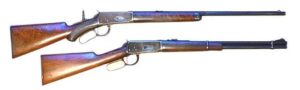
For more than a century, two lever-action rifles have dominated American deer camps, gun shop counters, and heated campfire debates: the Winchester Model 94 and the Marlin 336. Both chamber the legendary .30-30 Winchester. Both have put venison on countless tables. And both inspire fierce brand loyalty that borders on the religious.
But these rifles are not the same gun wearing different nameplates. They differ meaningfully in action design, loading method, accuracy potential, scope mounting, ergonomics, and collectibility. This head-to-head comparison breaks down every dimension that matters so you can decide which lever gun earns a spot in your safe.
Looking for a deep dive on the Winchester 94's history, design, and specificationsSee our comprehensive guide: The Winchester Model 94: A Legacy of Innovation and Versatility.
Origins: Two Different Design Philosophies
The Winchester Model 1894, designed by John Moses Browning, entered production in New Haven, Connecticut in 1894. It was the first commercially successful sporting rifle built for smokeless powder cartridges, and its twin vertical locking lugs represented a clean break from Winchester's earlier toggle-link actions. Over seven million units have been produced, making it the best-selling centerfire sporting rifle in history.
The Marlin Model 336 arrived in 1948, but its lineage traces back to the Marlin Model 1893 designed by Lewis Hepburn. The 336 was an evolution of the earlier Model 36 (1936) and introduced a stronger, round-bolt action with a two-piece firing pin for improved safety. Marlin built the 336 in North Haven, Connecticut — just a few miles from Winchester's factory — until production moved to Ilion, New York under Remington ownership, and later to Ruger's facility in Mayodan, North Carolina after Ruger acquired the Marlin brand in 2020.
Action Design and Strength
Winchester 94: Uses twin vertical locking lugs that engage recesses in the receiver when the lever is closed. The bolt locks at the rear. This design handles standard .30-30 pressures (approximately 42,000 PSI) with a comfortable margin but was not designed for higher-pressure cartridges. The action is notably slim and lightweight.
Marlin 336: Features a round bolt with a locking lug that cams into a recess in the receiver. The squared-off receiver is machined from a solid steel forging. Marlin's action is generally considered slightly stronger and more rigid than the Winchester's, which is one reason Marlin was able to offer the 336 in .35 Remington — a cartridge that generates somewhat higher pressures and more recoil than the .30-30.
Edge: Marlin, slightly, on raw action strength. In practical terms, both are more than adequate for their intended cartridges.
Loading: Side Gate vs Top Eject
This is where the two designs diverge most visibly.
Winchester 94 (pre-1982): Loads through a loading gate on the right side of the receiver and ejects spent cases from the top. Top ejection makes scope mounting problematic — you either need an offset mount or a long eye-relief scout scope. This single issue drove more buyers to Marlin than perhaps any other factor.
Winchester 94 Angle Eject (1982–present): Winchester addressed the scope problem by redesigning the ejection to throw cases forward and to the right at roughly a 35-degree angle. This allowed conventional scope mounting on post-1982 rifles. However, collectors often prefer the classic top-eject models, and some shooters feel the angle-eject modification changed the rifle's handling character.
Marlin 336: Loads through a side loading gate and ejects from the right side of a solid-top receiver. The flat-top receiver with factory-drilled and tapped scope mounting holes has been a Marlin selling point since 1948. Mounting a scope on a 336 is straightforward and requires no special hardware.
Edge: Marlin, decisively, for scope mounting. Winchester closed the gap with angle eject, but Marlin had it right from the start.
Accuracy Potential
Both rifles are hunting-accurate out of the box, and the .30-30 cartridge itself is the practical accuracy limiter at ranges beyond 200 yards. That said, there are design differences that affect precision.
Winchester 94: The traditional top-eject models have no practical way to mount a scope directly over the bore, which limits precision shooting. The micro-groove or button-rifled barrels on later models shoot well, and the trigger on a good Winchester 94 can be surprisingly crisp. Many hunters report consistent 2–3 MOA groups at 100 yards with iron sights.
Marlin 336: The solid-top receiver and easy scope mounting give the 336 a meaningful accuracy advantage in practice. Marlin's Micro-Groove rifling (shallow, multi-groove) was introduced in 1953 and produces excellent accuracy with jacketed bullets. With a decent scope and quality ammunition, many 336 rifles will produce 1.5–2.5 MOA groups at 100 yards.
Edge: Marlin, primarily because the scope-friendly receiver lets shooters realize the rifle's full mechanical accuracy. With iron sights only, they are very close.
Ergonomics, Handling, and Weight
Winchester 94: The classic Winchester is slightly slimmer and lighter, typically weighing 6.5–6.8 pounds. The action cycles with a shorter lever throw and a distinctly smooth, almost silky feel. Many shooters consider the Winchester's lever action the gold standard for speed and fluidity. The slim profile carries beautifully in one hand or in a saddle scabbard.
Marlin 336: The 336 typically weighs 7.0–7.5 pounds depending on configuration. The lever stroke is slightly longer and the action feel is more mechanical — solid and precise rather than fluid. The pistol-grip stock (standard on most 336 variants) provides better recoil control and a more natural shooting position for scope use. Winchester's traditional straight-grip stock is elegant but less ideal for scoped shooting.
Edge: Winchester for carrying and fast iron-sight work. Marlin for scoped shooting comfort. This one comes down to personal preference.
Caliber Options
Winchester 94 has been chambered in a wide range of calibers over its production life, including .30-30 Winchester, .32 Winchester Special, .32-40 Winchester, .38-55 Winchester, .25-35 Winchester, .44 Remington Magnum, .45 Colt, .357 Magnum, .44 Special, .307 Winchester, and .356 Winchester. The pistol-caliber variants (particularly .44 Magnum and .357 Magnum) are popular for cowboy action shooting and as companion rifles to revolvers.
Marlin 336 has been offered in fewer chamberings: .30-30 Winchester, .35 Remington, .32 Winchester Special (discontinued), and .219 Zipper (briefly). The .35 Remington option is significant — it hits substantially harder than the .30-30 at woods ranges and makes the 336 a serious contender for larger game like black bear and elk in thick timber.
Edge: Winchester for variety. Marlin for the .35 Remington option specifically.
Aftermarket Support and Upgrades
Both rifles enjoy enormous aftermarket support, but the landscape differs.
Winchester 94: Replacement parts are widely available for both pre-64 and post-64 models. Aftermarket triggers, sights, and stocks are offered by multiple manufacturers. However, the top-eject receiver limits scope and rail options on pre-1982 models. Wild West Guns, Skinner Sights, and XS Sights all offer popular upgrades.
Marlin 336: The solid-top receiver makes the 336 the preferred platform for modern upgrades. Midwest Industries, XS Sights, and Ranger Point Precision offer M-LOK handguards, Picatinny rails, threaded muzzle adapters, oversized lever loops, and complete chassis systems that transform the 336 into a surprisingly modern tactical lever gun. The "Marlin Dark" series from Ruger leans into this trend from the factory.
Edge: Marlin, significantly. The flat-top receiver makes it far more adaptable to modern accessories.
Collectibility and Value
Winchester 94: Pre-1964 Winchester 94s command serious collector premiums. Standard rifles in good condition typically sell for $1,200–$2,500, while rare variants, commemoratives, and exceptional-condition early production guns can bring substantially more. The Winchester name and Browning design pedigree carry enormous cachet. Post-64 models are more affordable ($500–$900 for good examples), and current Miroku-produced Winchesters ($1,100–$1,500 new) are well-made but lack the collector magic of the originals.
Marlin 336: Vintage Marlins have historically been more affordable, with pre-Remington (pre-2007) models in the $400–$800 range and JM-stamped barrels preferred by knowledgeable buyers. The Remington-era Marlins (2007–2020) suffered well-documented quality control problems and are generally avoided. New Ruger-manufactured Marlins ($1,000–$1,300) have been well received and represent a genuine return to quality, though they lack the collectibility premium of vintage JM-marked guns.
Edge: Winchester for collectibility and investment value. Marlin for bang-for-the-buck as a working gun.
Current Production and Availability (2025)
Winchester (Miroku): Currently produces several Model 94 variants including the Short Rifle, Sporter, Trails End Takedown, and Deluxe models. Prices range from approximately $1,100 to $1,800. Quality is excellent — Miroku's fit and finish often surpasses later-era American-made Winchesters.
Marlin (Ruger): Ruger has been steadily reintroducing Marlin models. The 336 Classic, 336 Dark Series, and 1895 variants are currently in production. Initial supply was constrained, but availability has improved. Street prices run $900–$1,400 depending on model. Ruger's manufacturing quality has been consistently praised by reviewers and owners.
Edge: Roughly even. Both are available, well-made, and competitively priced.
Head-to-Head Comparison Table
| Feature | Winchester Model 94 | Marlin 336 |
|---|---|---|
| Designer | John Moses Browning | Lewis Hepburn (original 1893) |
| Year Introduced | 1894 | 1948 (lineage to 1893) |
| Action Type | Lever, twin vertical locking lugs | Lever, round bolt with locking lug |
| Ejection | Top (pre-82) / Angle (post-82) | Side, solid-top receiver |
| Weight (typical) | 6.5–6.8 lbs | 7.0–7.5 lbs |
| Primary Caliber | .30-30 Winchester | .30-30 Winchester |
| Notable Alt Caliber | .44 Mag, .45 Colt, .357 Mag | .35 Remington |
| Scope Mounting | Difficult (pre-82) / Good (post-82) | Excellent (factory drilled/tapped) |
| Stock Style | Straight grip (traditional) | Pistol grip (standard) |
| Current Manufacturer | Miroku (Japan) | Ruger (USA) |
| New Price Range | $1,100–$1,800 | $900–$1,400 |
| Total Produced | 7+ million | 6+ million (estimated, all variants) |
| Collector Premium | High (especially pre-64) | Moderate (JM-marked preferred) |
| Aftermarket Support | Good | Excellent |
So Which One Should You Buy?
Buy the Winchester 94 if:
- You value history, collectibility, and the Browning design legacy
- You prefer iron sights and traditional aesthetics
- You want the lightest, slimmest lever gun for all-day carrying
- You want pistol-caliber options (.44 Mag, .357 Mag, .45 Colt)
- You appreciate the smoothest lever action in the business
Buy the Marlin 336 if:
- You plan to mount a scope and want the easiest path to get there
- You want the .35 Remington for larger game
- You are interested in modern tactical upgrades (rails, M-LOK, threaded barrels)
- You want maximum accuracy potential at a competitive price
- You prefer a pistol-grip stock for better recoil management
Buy both if: You are honest with yourself about how this hobby works.
Frequently Asked Questions
Is the Winchester 94 more accurate than the Marlin 336?
Mechanically, they are very similar. The Marlin's solid-top receiver makes scope mounting easier, which gives it a practical accuracy advantage for most shooters. With iron sights, the difference is negligible.
Can I mount a scope on a pre-1982 Winchester 94?
Yes, but it requires a side mount or a long eye-relief scout scope on a barrel-mounted rail. It works, but it is not as clean or as rigid as the Marlin's receiver-mounted setup.
What happened to Marlin quality under Remington?
When Remington moved Marlin production from North Haven, CT to Ilion, NY around 2007–2010, quality suffered significantly. Common complaints included rough actions, poorly fitted wood, and finish problems. These issues persisted until Remington's 2020 bankruptcy. Ruger acquired the Marlin brand and has restored quality to levels that meet or exceed the original JM-era standards.
Which holds its value better?
The Winchester 94, particularly pre-1964 models, appreciates more consistently. That said, clean JM-marked Marlin 336 rifles have been climbing in value as collectors recognize the Remington-era quality dip made pre-2007 guns more desirable.
Are lever-action rifles good for home defense?
While lever actions are primarily designed as hunting rifles, pistol-caliber variants (particularly in .357 Magnum or .44 Magnum) have found a following among shooters in jurisdictions with restrictions on semi-automatic firearms. They are not optimal for the role compared to purpose-built defensive firearms, but they are far from ineffective.
Can I use LEVERevolution ammunition in both rifles?
Yes. Hornady's LEVERevolution line, with its flex-tip polymer spitzer bullets, is safe to use in both the Winchester 94 and Marlin 336 tubular magazines. This ammunition significantly extends the effective range of the .30-30 by improving the ballistic coefficient while remaining safe in tube-fed lever actions.
At the end of the day, there is no wrong answer here. The Winchester 94 and Marlin 336 are both outstanding lever-action rifles with proven track records measured in decades and millions of units. The best lever gun is the one that fits your hands, your eyes, and your hunting style. And the second-best lever gun is the other one — which you will probably end up buying eventually anyway.
If you know of any forums or sites that should be referenced on this listing, please let us know here.