Challenge of the mouse gun rivals
Introduction to the 25 ACP vs 32 ACP
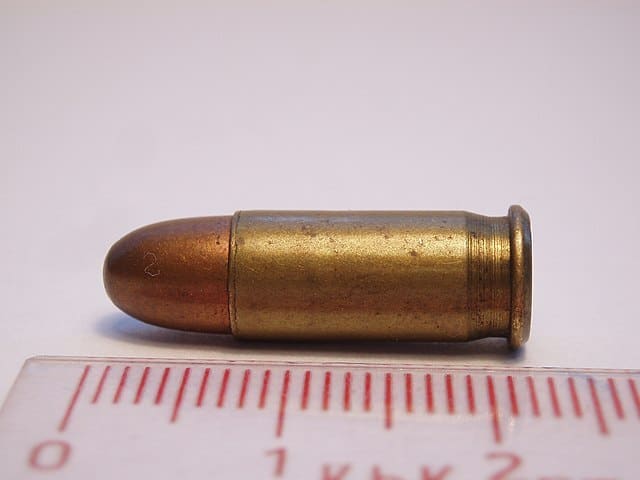
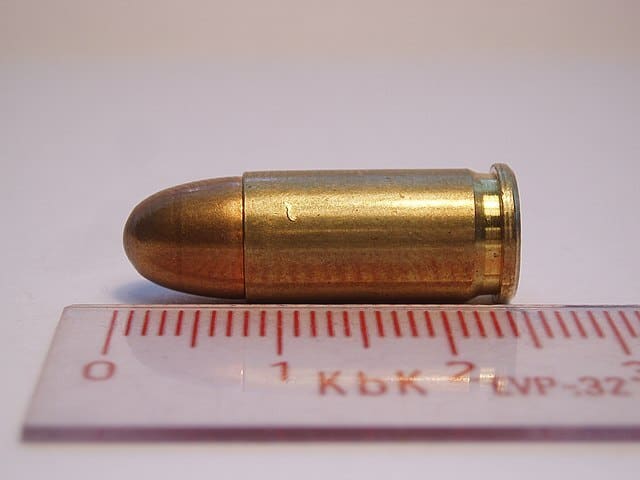
The .25 ACP (Automatic Colt Pistol) and .32 ACP are both small-caliber cartridges primarily used in semi-automatic pistols. While they share some similarities, there are notable differences between them in terms of power, size, and historical significance.
Cartridge Specifications: 25 ACP vs 32 ACP
| Specification | .25 ACP | .32 ACP |
|---|---|---|
| Designer | John Moses Browning | John Moses Browning |
| Year Introduced | 1905 | 1899 |
| Parent Case | None (original design) | None (original design) |
| Bullet Diameter | .251 in (6.4 mm) | .312 in (7.9 mm) |
| Case Length | .615 in (15.6 mm) | .680 in (17.3 mm) |
| Overall Length | .910 in (23.0 mm) | .984 in (25.0 mm) |
| Max Pressure (SAAMI) | 25,000 psi | 20,500 psi |
| Typical Bullet Weight | 35–50 gr | 60–73 gr |
| Typical Muzzle Velocity | 750–900 fps | 900–1,050 fps |
| Typical Muzzle Energy | 63–73 ft-lbs | 110–160 ft-lbs |
Both cartridges are semi-rimmed, straight-walled designs — classic Browning. The .32 ACP arrived first in 1899 for the FN M1900 pistol. The .25 ACP followed six years later for the FN M1905. Browning designed both from scratch rather than necking down or trimming an existing case.
One number jumps off the table: muzzle energy. The .32 ACP roughly doubles the .25 ACP’s energy output. That gap matters more than the velocity difference alone suggests, because the heavier .32 bullet retains momentum better downrange and penetrates deeper in tissue.
Powder and Ballistics 25 ACP vs 32 ACP
- .25 ACP: The .25 ACP is a very low-powered cartridge, often considered to be one of the weakest commonly available pistol cartridges. It typically fires a 50-grain bullet at a velocity of around 760 feet per second (fps). Its energy output is relatively low, making it suitable for short-range self-defense but not recommended for stopping power.
- .32 ACP: The .32 ACP, also known as 7.65mm Browning, is more powerful compared to the .25 ACP. It typically fires a 71 to 73-grain bullet at a velocity ranging from 900 to 1,000 fps. While still not considered a high-powered round, the .32 ACP offers better performance in terms of energy and penetration compared to the .25 ACP.
Size and Magazine Capacity 25 ACP vs 32 ACP
- .25 ACP: The .25 ACP is a smaller cartridge in terms of both overall length and diameter. The smaller size of the cartridge allows for compact and lightweight pistols. These pistols tend to have smaller magazine capacities, usually ranging from 6 to 9 rounds.
- .32 ACP: The .32 ACP cartridges are slightly larger than the .25 ACP. This means that firearms chambered in .32 ACP are generally larger and heavier compared to those chambered in .25 ACP. The magazine capacity of .32 ACP pistols is typically around 7 to 9 rounds.
Self-Defense and Terminal Performance: 25 ACP vs 32 ACP
Straight talk: neither of these cartridges is a first choice for self-defense by modern standards. The FBI’s ammunition testing protocol calls for 12 to 18 inches of penetration in calibrated ballistic gelatin. The .25 ACP consistently falls short of that minimum. Standard .25 ACP defensive loads typically penetrate 8 to 10 inches in gel — not enough to reliably reach vital structures through clothing, tissue, and bone.
The .32 ACP does better. Quality FMJ loads reach 10 to 14 inches in gel, and certain loads with flat-nose or hollow-point bullets can land squarely in the FBI’s window. It is not a powerhouse, but it meets the minimum threshold that the .25 ACP cannot.
Modern ammunition has narrowed the gap slightly. Hornady makes an XTP hollow point load in .25 ACP (35 grain) that is designed to expand at low velocities. Federal and Speer have offered similar low-velocity JHP options in .32 ACP. These loads represent genuine engineering efforts to maximize terminal performance from small cartridges. But physics is physics — you cannot cheat a 50-grain bullet traveling at 760 fps into doing the work of a 9mm.
The practical philosophy around these calibers comes down to one idea: any gun you actually carry beats the full-size pistol sitting in your safe. A .32 ACP pocket pistol that rides in your front pocket every single day provides a level of armed readiness that a Glock 19 left at home does not. That is the real argument for mouse guns — not ballistic superiority, but consistent presence.
Between the two, the .32 ACP holds a clear edge for defensive use. It penetrates deeper, carries more energy, and offers better ammunition selection. If self-defense is even a secondary consideration, .32 ACP is the better pick.
Historical Significance
- .25 ACP: The .25 ACP cartridge has a long history and was popularized by the Belgian firearm designer John Browning. It gained popularity in the early 20th century and was widely used in small, easily concealable pocket pistols.
- .32 ACP: The .32 ACP cartridge, also designed by John Browning, gained popularity around the same time as the .25 ACP. It was also used in pocket pistols and gained further recognition through various firearm models, such as the well-known Walther PP and PPK.
Notable Firearms: 25 ACP vs 32 ACP
Both calibers have appeared in some genuinely iconic firearms. Here is a look at the most significant pistols chambered in each.
.25 ACP Pistols
- Colt 1908 Vest Pocket — The pistol that put .25 ACP on the map in America. Designed by Browning and produced by Colt from 1908 to 1948, it was the definitive gentleman’s pocket pistol of the early 20th century. Over 409,000 were manufactured.
- FN Baby Browning — Smaller than the Colt 1908, this tiny Belgian pistol became one of the most widely copied firearms designs in history. Production ran from 1931 to 1983. At barely four inches long, it defined the concept of a true pocket pistol.
- Beretta 950 Jetfire — A tip-up barrel design that made chambering a round simple and safe. Produced from 1952 to 2003, the Jetfire was a practical and well-made .25 ACP option that saw wide commercial success.
- Raven Arms MP-25 — The most produced .25 ACP pistol in American history. Cheap, zinc-alloy construction earned it the “Saturday Night Special” label, but millions were sold from 1970 until Raven closed in 1991. A cultural artifact as much as a firearm.
.32 ACP Pistols
- Colt 1903 Pocket Hammerless — Another Browning design. Elegant, reliable, and slim. General officers in the U.S. military carried them. Production ran from 1903 to 1945, and original examples are prized by collectors today.
- Walther PP and PPK — The PP arrived in 1929 and the PPK in 1931. Both were designed for European police use and became two of the most recognized pistols in the world. James Bond carried a PPK in .32 ACP in Ian Fleming’s novels — and yes, that specific detail mattered to Fleming, who was corrected by a firearms expert into upgrading Bond from a .25 ACP Beretta.
- Beretta 3032 Tomcat — The .32 ACP counterpart to the Jetfire, featuring the same tip-up barrel. Still in production as the Tomcat Inox. A genuinely practical modern .32 ACP carry option.
- CZ 83 — A double-action, double-stack .32 ACP with a 15-round magazine capacity. Produced in Czechoslovakia starting in 1983, it offers a level of firepower unusual for the caliber. Surplus examples have become popular on the American market.
- Seecamp LWS 32 — A tiny, American-made double-action-only pocket pistol. No sights, no external safety — pure point-and-shoot design built for extreme close range. Handmade quality with long wait times for new production.
- Kel-Tec P-32 — At 6.6 ounces unloaded, one of the lightest .32 ACP pistols ever made. Introduced in 1999, it proved that modern materials and engineering could shrink the .32 ACP platform to .25 ACP dimensions — which undercut the .25 ACP’s main advantage.
The firearms list tells its own story. The .32 ACP has attracted more serious designs from more manufacturers across a longer span of history. The .25 ACP peaked as a platform in the mid-20th century and has seen limited new development since.
Ammunition Availability and Cost: 25 ACP vs 32 ACP
Neither caliber sits on the shelf at every sporting goods store the way 9mm or .45 ACP does. Both are niche rounds, and you should expect to order online or visit a well-stocked shop to find them reliably.
That said, .32 ACP is easier to find. The caliber still has enough of a following — particularly in Europe — that major manufacturers keep it in production. Fiocchi, Sellier & Bellot, and Winchester all offer .32 ACP FMJ loads at reasonable prices. Federal and Hornady produce defensive loads in .32 ACP. Supply dried up during the 2020-2022 ammunition shortage like everything else, but it has recovered reasonably well.
The .25 ACP is tougher. Fewer manufacturers produce it, and production runs are smaller. Fiocchi and Sellier & Bellot are the most reliable sources for affordable .25 ACP range ammunition. Hornady offers the Custom .25 ACP XTP load for defensive use. CCI produces a Blazer .25 ACP load. Beyond those options, pickings get thin.
Expect to pay more per round for either caliber compared to 9mm. As of this writing, .32 ACP FMJ runs roughly $0.35-0.45 per round, and .25 ACP runs roughly the same or slightly higher. By contrast, bulk 9mm FMJ can be found for under $0.25 per round. Prices fluctuate, but the gap between these calibers and mainstream ammunition is consistent. That is a meaningful difference for regular range practice, and another reason many shooters have moved on to more mainstream calibers.
The Mouse Gun Debate
Every few years, someone declares the mouse gun dead. And every few years, people keep buying them.
The reason is simple: size and weight still matter. A pistol that weighs under 12 ounces and disappears in a front pocket gets carried places that a subcompact 9mm does not. Board shorts, gym clothes, formal wear, a quick run to the store — these are the situations where a deep concealment gun earns its place.
The .32 ACP has found a second life in this role. The Kel-Tec P-32 and Seecamp LWS proved that modern .32 ACP pistols could be built as small and light as .25 ACP guns. That eliminated the .25 ACP’s only real advantage — smaller size — while retaining the .32’s ballistic edge. Beretta’s continued production of the Tomcat and the recent interest in the CZ 83 on the surplus market show that the .32 ACP still has a market.
The .25 ACP’s role has narrowed considerably. Most current .25 ACP buyers fall into two camps: collectors maintaining classic firearms, and owners of inherited pistols who want ammunition to shoot them. As a practical carry choice, the .25 ACP has been eclipsed by .32 ACP from above and by the sheer availability of micro 9mm and .380 ACP pistols from below.
The counterargument to all mouse guns is obvious: the SIG P365, Springfield Hellcat, and similar micro-compact 9mm pistols pack 10 to 13 rounds of a vastly more effective cartridge into a package that, while larger than a Seecamp, is still highly concealable. For most people, a micro 9mm is the better answer. But “most people” is not “all people,” and the mouse gun fills a niche that micro 9mms physically cannot — true pocket carry with zero printing, in the smallest possible package.
Final Verdict: 25 ACP vs 32 ACP
The .32 ACP wins this comparison on nearly every metric. More energy. Better penetration. Superior ammunition selection. A deeper roster of quality firearms past and present. Easier to find on the shelf. If you are choosing between the two calibers for any practical purpose — self-defense, a range gun, a carry piece — the .32 ACP is the clear pick.
The .25 ACP is not without its place. If you own a Colt 1908 Vest Pocket, a Baby Browning, or a Beretta Jetfire and want to shoot it, the .25 ACP is a fun, mild-recoiling range cartridge with genuine historical character. These are firearms worth owning and shooting. But choosing a .25 ACP as a primary defensive tool in an era of micro 9mm pistols and modern .32 ACP loads is hard to justify on the merits.
For a deeper look at the .32 ACP on its own terms — including its European history, its military service, and its modern revival — read our full article on the .32 ACP cartridge.
Read more about this and other cartridges here:
-
Sale!

Cartridges of the World, 16th Edition: A Complete and Illustrated Reference for Over 1,500 Cartridges
Original price was: $37.99.$34.09Current price is: $34.09. Purchase on Amazon -
Sale!
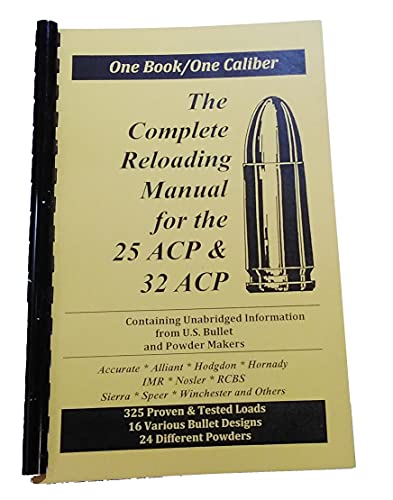
The Complete Reloading Manual for the 25 & 32 ACP
Original price was: $24.99.$12.95Current price is: $12.95. Purchase on Amazon
If you know of any forums or sites that should be referenced on this listing, please let us know here.