
The Rifle That Armed the World
Ask a firearms enthusiast to name the most widely produced military rifle of the 19th century, and you will hear answers ranging from the Springfield Trapdoor to the Mauser 71 to the Martini-Henry. Almost nobody names the Remington Rolling Block — and yet it is the correct answer. Between 1867 and the early 1900s, Remington Arms produced an estimated 1.5 million Rolling Block rifles and carbines, and licensed manufacturers in at least a dozen countries produced hundreds of thousands more. At its peak, the Rolling Block was the standard-issue military rifle of more than 40 nations on five continents. No other single-shot military rifle in history can match that record.
Yet the Rolling Block has been largely overshadowed in American popular memory by the Sharps rifle, the Springfield Trapdoor, and the Winchester lever actions.
Joseph Rider’s Elegant Mechanism
The genius of the Rolling Block lies in its breathtaking mechanical simplicity. The entire action consists of just two major moving parts: the breechblock and the hammer. The breechblock pivots (or “rolls”) backward on a pin to expose the chamber for loading. When the hammer is cocked, its face cams forward to lock behind the breechblock, creating an interlocking support that becomes stronger under the pressure of firing — the harder the cartridge pushes against the breechblock, the more firmly the hammer locks it in place.
This design was the work of Joseph Rider, a prolific inventor who had been working at Remington’s Ilion, New York, factory since the 1850s. Rider received his key patent in 1864 (U.S. Patent No. 45,123), and Remington began full-scale production in 1867. The timing was perfect: the U.S. Civil War had ended, European powers were rearming with metallic-cartridge breechloaders, and the demand for a simple, strong, affordable military rifle was enormous.
Global Military Adoption: A Country-by-Country Survey
What made the Rolling Block unique among 19th-century firearms was its extraordinary breadth of international adoption. No other rifle of any era has served as the primary military arm of so many different nations. A partial list illustrates the scope:
- Scandinavia: Sweden, Norway, and Denmark all adopted the Rolling Block as their standard military rifle in the late 1860s. Sweden alone ordered approximately 100,000 rifles and 30,000 carbines. The Swedish Model 1867 in 12.17x42mm rimfire was manufactured both by Remington and under license at the Carl Gustafs Stads Gevarsfaktori in Eskilstuna. Norwegian Rolling Blocks were produced at the Kongsberg Vapenfabrikk. These Scandinavian rifles remained in front-line service into the 1890s and in reserve arsenals for decades after.
- Spain: The Spanish military adopted the Rolling Block in .43 Spanish (11.15x58mmR), and it became the standard infantry rifle of the Spanish Army. Spanish Rolling Blocks saw combat in the Third Carlist War (1872-1876), colonial campaigns in Cuba and the Philippines, and were still in the hands of some Spanish troops during the Spanish-American War of 1898, where they faced Americans armed with Krag-Jorgensen bolt actions.
- Egypt and the Ottoman Empire: Both adopted Rolling Blocks in the 1870s. Egyptian models, chambered in .43 Egyptian (11x50mmR), saw service in the Anglo-Egyptian War and the campaigns in the Sudan.
- Latin America: Argentina, Brazil, Colombia, Cuba, the Dominican Republic, Ecuador, Mexico, Peru, Uruguay, and Venezuela all purchased Rolling Blocks. Argentina’s forces carried them during border conflicts with Paraguay and Chile. Mexican Rolling Blocks in .43 Spanish remained in use through the Mexican Revolution (1910-1920) — a reflection of the action’s durability.
- United States: The U.S. Navy and some Army units adopted the Rolling Block in .50-70 Government, though the Army eventually standardized on the Springfield Trapdoor. The New York State National Guard also issued Rolling Blocks.
- France: France purchased 210,000 Rolling Blocks from Remington during the Franco-Prussian War (1870-1871) in a desperate emergency procurement after the Prussian Army’s Dreyse needle guns proved devastating. This single order, delivered in months, demonstrated Remington’s manufacturing capacity and established the Rolling Block’s combat reputation in Europe.
Why So Many Countries Chose the Rolling Block
The Rolling Block’s dominance was not accidental. Several factors made it the default choice for nations modernizing their armies in the 1860s-1880s:
- Extreme simplicity: With only two major moving parts in the action, the Rolling Block could be manufactured by nations with limited industrial capacity and maintained by soldiers with minimal training. Field-stripping required no tools.
- exceptional strength: The interlocking breechblock-and-hammer design could withstand pressures that would destroy a trapdoor or hinge-block action. In formal government trials, Rolling Blocks were tested with double and triple powder charges without failure.
- Low cost: Remington’s mass-production capabilities at its Ilion factory allowed it to undercut European competitors on price while delivering reliable quality.
- Caliber flexibility: The same basic action could be chambered in virtually any cartridge of the era, from .22 rimfire to .50-70 Government. This allowed each purchasing nation to specify its preferred caliber.
- Proven combat record: After the French emergency purchase during the Franco-Prussian War, every potential buyer knew the Rolling Block had been tested in major combat and found satisfactory.
Models and Variations
The Rolling Block was produced in a staggering number of configurations. The major models include:
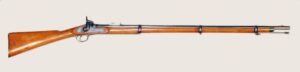
- No. 1 Military Rifle: The full-size infantry rifle, typically with a 35-36 inch barrel, chambered in the purchasing nation’s standard caliber. This was the backbone of the line.
- No. 1 Carbine: A shortened version with a 20-22 inch barrel, issued to cavalry and artillery troops. The carbine was lighter and handier but generated more recoil with the same cartridge.
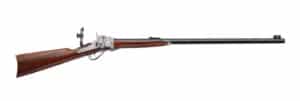
- No. 1 Sporting Rifle: Built on the same action but with finer finish, better sights, and a wider selection of calibers including .45-70, .44-77, and .38-55. Popular among American hunters and sportsmen.
- No. 2 Sporting Rifle: A lighter, smaller-frame version intended for smaller cartridges like .32-20, .32-40, and .22 Long Rifle. Often used for target shooting and small game.
- No. 4 and No. 5 “Boy’s” and Cadet models: Scaled-down rifles in .22 and .32 rimfire for youth training and military cadets.
- No. 7 Target Rifle: A heavy-barrel precision model with vernier tang sights, used in Creedmoor-style long-range competitions. These are among the most prized Rolling Block variants for collectors.
The Rolling Block at Adobe Walls and on the Frontier
While the Sharps rifle gets most of the attention in accounts of the Second Battle of Adobe Walls (1874), several of the defenders carried Rolling Blocks. On the American frontier, the Rolling Block competed directly with the Sharps for the buffalo-hunting market. It was less expensive than a Sharps, equally strong, and available in all the popular heavy calibers. Some hunters preferred it precisely because of its simplicity — there was less to break or malfunction in the dust and heat of the Texas Panhandle.
The “Adobe Walls Rifle” has become a specific term among collectors and reproduction shooters, referring to the heavy-barreled No. 1 Sporting model in .45-70 that typifies the frontier-era Rolling Block. Modern reproductions by Pedersoli and imported by Cimarron Firearms keep this tradition alive.
The Creedmoor Matches: Rolling Block vs. Rigby
One of the Rolling Block’s finest hours came not on a battlefield but on a firing range. In the 1874 Creedmoor international long-range rifle match, an American team shooting Remington Rolling Blocks and Sharps rifles defeated a heavily favored Irish team shooting Rigby muzzle-loading match rifles. The match, held at the Creedmoor range on Long Island, New York, was fired at ranges from 800 to 1,000 yards. The American victory was a sensation, proving that American-made breechloaders could outshoot the finest European muzzle-loading target rifles. It was an enormous boost for both Remington and Sharps, and it accelerated the global transition from muzzle-loading to breech-loading firearms.
On the morning of June 27, 1874, a group of Comanche, Kiowa, and Cheyenne warriors launched an assault on Adobe Walls. Their objective was to drive out the buffalo hunters whose activities were drastically depleting buffalo populations, a vital resource for the tribes. Despite being greatly outnumbered, the small group of 28 men and one woman at Adobe Walls faced the challenge head-on.
Decline and Legacy
By the late 1880s, the single-shot Rolling Block was being supplanted by bolt-action repeaters — the Mauser 71/84, the Lebel, and eventually the Mauser 98. The ability to carry multiple rounds in an integral magazine proved decisive, and armies worldwide replaced their Rolling Blocks through the 1890s and 1900s.
But the Rolling Block refused to die. Its simplicity meant that it could be rechambered for smokeless-powder cartridges like the 7mm Mauser, extending its service life in Latin American armies well into the 20th century. Rolling Blocks were reported in use as late as the Mexican Revolution, various South American border conflicts, and even in isolated pockets during World War I. A rifle designed in 1864 was still functional and effective more than 50 years later — a reflection of the soundness of Joseph Rider’s original engineering.
Today, original Rolling Blocks are among the most affordable collectible military rifles of the 19th century. Because so many were produced, specimens in good condition can still be found at reasonable prices. Reproductions by Pedersoli allow modern shooters to experience the action firsthand. For anyone interested in the firearms that shaped the world between the Civil War and the First World War, the Remington Rolling Block is essential knowledge — and a deeply rewarding rifle to shoot.
Related articles: The Adobe Walls Rolling Block Rifle | Billy Dixon’s Famous Shot at Adobe Walls | The Evolution of Sharps Rifles | .50-70 Government Cartridge
If you know of any forums or sites that should be referenced on this listing, please let us know here.