The AR-15 is the most modular firearm platform in existence, and finding the best AR-15 upgrades can transform a good rifle into a great one. That’s a blessing and a curse. The aftermarket is so vast — thousands of parts from hundreds of manufacturers — that new AR owners can spend more time (and money) swapping parts than actually shooting. The internet doesn’t help: every forum thread produces fifteen different opinions on which trigger or handguard or BCG is “the best,” and the answer changes depending on who’s typing.
AR upgrades are endless. There are more options than anyone could ever write about, and many of them are genuinely good. It’s not hard to spend more on upgrades than you paid for the rifle itself. This guide is aimed at the person customizing their first AR — the upgrades that make the biggest difference for the least complexity. If you’re a seasoned builder who’s already on your third barrel and hand-fitting your trigger group, this isn’t for you. But everyone needs to start somewhere.
Quick Picks: Best AR-15 Upgrades by Category
| Upgrade | Category | Best Pick | Price Range |
|---|---|---|---|
| Trigger | Accuracy & Feel | LaRue Tactical MBT-2S | ~$100 |
| Optic (Red Dot) | Accuracy & Target Acquisition | Holosun 510C | ~$260-300 |
| Optic (LPVO) | Accuracy & Versatility | Vortex Strike Eagle 1-8×24 | ~$350-400 |
| Free-Float Handguard | Accuracy & Ergonomics | Midwest Industries Combat Rail | ~$160-200 |
| Charging Handle | Ergonomics | Radian Raptor | ~$70-85 |
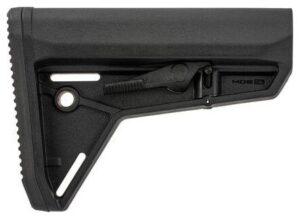
| Stock | Ergonomics & Comfort | Magpul SL-S | ~$55-65 |
| Muzzle Device | Recoil & Flash | VG6 Gamma 556 | ~$50-65 |
| BCG (Bolt Carrier Group) | Reliability | Toolcraft Nitride | ~$75-95 |
| Grip | Ergonomics | Magpul MOE K2+ | ~$20-25 |
| Sling | Utility | Blue Force Gear Vickers Sling | ~$45-55 |
Best AR-15 Upgrades: Priority Order
Not every AR-15 needs every upgrade. The right modification depends on your rifle’s current configuration, your shooting discipline, and what’s actually limiting your performance. Here’s the priority order we recommend for most shooters.
Priority 1: Optics (If You’re Still on Iron Sights or a Cheap Red Dot)
The single most impactful upgrade for most AR-15 owners is a quality optic. A $300 red dot on a $500 rifle will outperform a $1,500 rifle with no optic at practical shooting distances. Your eyes are the bottleneck, not the barrel.
Red dot sights are the default for general-purpose use: home defense, carbine courses, recreational shooting, and engagements inside 200 yards. They’re fast, simple, and work with both eyes open.
Low-power variable optics (LPVOs) at 1-6x or 1-8x bridge the gap between red dots and magnified scopes. At 1x, they function like a red dot. At 6-8x, they allow precision shots at 300-600 yards. They’re heavier and more expensive than red dots, but they’re the most versatile AR-15 optic available.
Priority 2: Trigger
A quality trigger is the second most impactful upgrade. Most factory AR-15 triggers break at 6-8 lbs with significant creep, grit, and overtravel. A good aftermarket trigger breaks at 3-4.5 lbs with a clean, predictable break and a short reset. The improvement in practical accuracy is immediate and dramatic.
Priority 3: Free-Float Handguard
If your rifle has a standard two-piece, drop-in handguard with a delta ring and barrel nut, replacing it with a free-float handguard will improve accuracy. A free-float handguard doesn’t contact the barrel, which means pressure from your support hand, a sling, or a barricade doesn’t affect barrel harmonics. The accuracy improvement is typically 0.5-1 MOA — meaningful for a practical rifle.
Priority 4: Everything Else
After optics, trigger, and handguard, the remaining upgrades are about ergonomics, comfort, and personal preference. They’re worthwhile, but they don’t deliver the same step-change improvement as the top three.
Best AR-15 Upgrades: Detailed Reviews
1. LaRue Tactical MBT-2S Trigger — Best Overall AR-15 Trigger
The best value in AR-15 triggers. Full stop.
The LaRue MBT-2S (Meticulously Built Trigger, 2-Stage) has been the value champion of the AR trigger market since its introduction. At ~$100, it delivers a two-stage trigger with a clean, glass-rod break that competitors charge $200-250 to match. The first stage takes up at roughly 2 lbs, and the second stage breaks at approximately 4.5 lbs total. Reset is short and tactile.
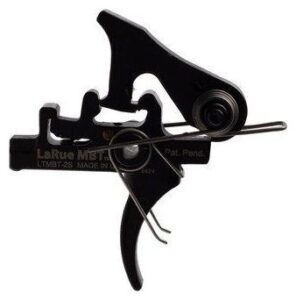
Mark LaRue essentially decided to sell a premium trigger at a price that undercuts the competition by 50% — and the shooting community noticed. The MBT-2S consistently appears in “best trigger” lists because it genuinely outperforms its price bracket. It belongs in the conversation with the Geissele SSA-E, which costs twice as much.
Key Specs:
– Two-stage design: ~2 lb first stage, ~4.5 lb total
– Drop-in installation (no gunsmithing required)
– Full-auto rated carrier compatible
– Comes with both straight and curved trigger shoe options
– KNS anti-walk pins included
What we like: The value proposition is absurd — this is a $200 trigger at a $100 price. Both trigger shoe options included is a thoughtful touch. The two-stage pull is predictable enough for precision work yet fast enough for rapid fire. KNS pins included saves an additional $15-20 purchase.
What we don’t: Lead times from LaRue can be unpredictable. The 4.5 lb break weight is slightly heavier than the Geissele SSA-E (3.5 lb). Availability fluctuates.
Who should buy this: Every AR-15 owner with a factory trigger. This is the single most recommended AR trigger in online firearms communities for a reason.
Check price at LaRue.com | Check price at Brownells
2. Holosun 510C — Best Red Dot Sight for AR-15
The Holosun 510C has become the default recommendation for AR-15 red dots in the “do you want to spend $300 or $600?” conversation. For ~$260-300, you get a large open-lens red dot with solar power backup, shake-awake auto-on, and a choice between a 2 MOA dot, 65 MOA ring, or both simultaneously.
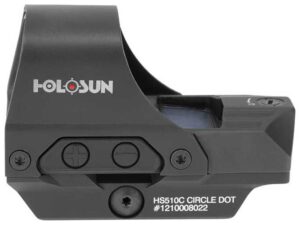
The 510C’s party trick is the solar panel on top of the sight. In any lighting condition above dim indoor, the solar cell powers the dot independently of the battery. Combined with shake-awake (the dot activates when it detects movement and sleeps when it doesn’t), battery life measured in years becomes realistic rather than theoretical.
Key Specs:
– Open reflex sight with large viewing window
– Multiple reticle options: 2 MOA dot, 65 MOA ring, or both
– Solar failsafe + CR2032 battery (up to 50,000 hours battery life)
– Shake Awake auto-on/off
– QD mount compatible with standard Picatinny
– IP67 waterproof
What we like: The viewing window is significantly larger than tube-style red dots — target acquisition is faster with both eyes open. Solar + shake awake means the dot is always on when you need it. The circle-dot reticle option provides both speed (ring for close range) and precision (dot for distance). Outstanding value.
What we don’t: Open emitter design means debris can potentially block the emitter (tube-style sights like the Aimpoint T-2 don’t have this vulnerability). Not as proven in extreme military/duty conditions as Aimpoint or EOTech. Some shooters find the housing too large for a streamlined setup.
Who should buy this: AR-15 owners who want a quality red dot without paying Aimpoint prices. Home defense, recreational shooting, carbine courses, and competition. Anyone who wants the versatility of the circle-dot reticle.
Check price on Amazon | Find at Brownells | Check price at Primary Arms
3. Vortex Strike Eagle 1-8×24 — Best LPVO for AR-15
If you want your AR-15 to reach out past 200 yards while maintaining close-range speed, a low-power variable optic is the answer. The Vortex Strike Eagle 1-8×24 delivers true 1x (no magnification, both eyes open, functions like a red dot) to 8x magnification in a package that weighs 17.6 oz and costs roughly $350-400.
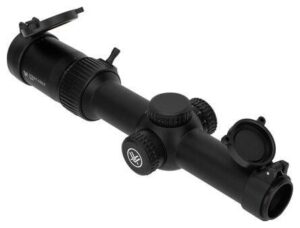
The current model represents a significant improvement over earlier versions: better glass clarity, a more forgiving eye box, and a daylight-visible illuminated reticle. At 1x, it’s fast enough for CQB-distance shooting. At 8x, you can identify and engage targets at 400-600 yards with the BDC3 reticle’s holdover markings.
Key Specs:
– 1-8x magnification, 24mm objective
– BDC3 illuminated reticle (calibrated for 5.56 NATO)
– Second focal plane
– 30mm tube
– Weight: 17.6 oz
– Vortex VIP Lifetime Warranty
What we like: The versatility — one optic covers 0 to 600 yards. The glass is a meaningful improvement (earlier Strike Eagles were criticized for glass quality). The Vortex VIP warranty is unconditional and transferable. The BDC3 reticle makes holdover estimation simple for 5.56.
What we don’t: Second focal plane means the BDC markings are only accurate at 8x — at lower magnifications, holdover values change. At 17.6 oz, it’s noticeably heavier than a red dot (adds weight to the top of the rifle). The eye box at 8x is tighter than premium LPVOs. If you are still building out your setup, check out our guide to the best AR-15 slings.
Who should buy this: AR-15 owners who shoot at varying distances and want one optic to cover everything. 3-gun competitors. Ranch/property rifles that need CQB-to-distance capability. Anyone who finds a red dot limiting at longer ranges.
Check price at Primary Arms | Check price on Amazon | Find at Brownells
4. Midwest Industries Combat Rail — Best Free-Float Handguard
Midwest Industries has built their reputation on handguards that fit well, hold zero on mounted accessories, and don’t cost as much as the rifle they go on. The Combat Rail continues that tradition with a lightweight, slim M-LOK handguard that’s available in lengths from 7″ to 15″ to fit any AR-15 barrel profile.
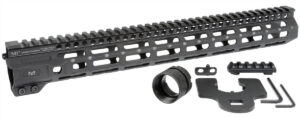
Installation requires removing your existing handguard, barrel nut, and delta ring (if applicable), installing the MI barrel nut, and securing the handguard. It’s a 30-minute job with basic tools and a barrel nut wrench.
Key Specs:
– 6061 aluminum construction, Type III anodized
– M-LOK slots at 3, 6, and 9 o’clock
– Full-length Picatinny top rail
– Anti-rotation tabs for secure mounting
– Available in 7″, 9″, 10.5″, 12.625″, 15″ lengths
– Weight: 8.5-13.3 oz depending on length
What we like: The slim profile is noticeably thinner than most competitors — it’s comfortable for extended shooting sessions and works well with smaller hands. MI’s fit and finish is excellent, with no slop between the handguard and barrel nut. The anti-rotation tabs prevent any movement under hard use.
What we don’t: Installation requires removing the existing barrel nut — if you don’t have an AR armorer’s wrench and vise block, budget an additional $30-50 for tools. The slim profile means limited internal clearance for some suppressor configurations.
Who should buy this: AR-15 owners upgrading from a drop-in handguard to a free-float. Anyone who wants a slim, lightweight handguard without paying $300+. Builders looking for reliable M-LOK mounting.
Check price at MidwestIndustries.com | Check price on Amazon | Find at Brownells
5. Radian Raptor Charging Handle — Best Ambidextrous Charging Handle
The factory AR-15 charging handle is a design from 1957 that nobody has improved upon fundamentally — they’ve just made it ambidextrous and added better grip texture. The Radian Raptor is the standard by which aftermarket charging handles are measured: it’s ambidextrous (matching latches on both sides), aggressively textured for gloved operation, and machined from 7075 aluminum.
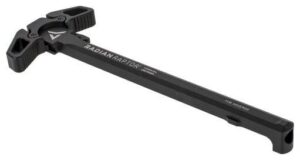
This is one of those upgrades that seems unnecessary until you’ve used one. Running the charging handle under stress, with gloves, in the rain, or from the non-dominant side becomes effortless. The Raptor also eliminates the “gas to the face” problem on suppressed ARs better than the standard handle, thanks to its tighter fit.
Key Specs:
– 7075-T6 aluminum, Type III anodized
– Ambidextrous latches with aggressive texturing
– Drop-in installation (10 seconds, no tools)
– Available in multiple colors
– Also available: Raptor-LT (polymer latches, lighter, ~$55)
What we like: The ambidextrous operation is genuinely useful regardless of which hand is dominant. Texture is aggressive enough for wet or gloved hands without being painful. The Raptor-LT variant offers 80% of the performance at 65% of the price. Install takes seconds.
What we don’t: At $70-85, it’s expensive for a charging handle. The latches protrude slightly more than the standard handle — possible snag point on gear. Cosmetic more than functional for shooters who don’t regularly use the charging handle under stress. For additional reading, see ATF’s guidance on firearm modifications.
Who should buy this: Anyone who runs their AR in competition, training courses, or defensive use. Left-handed shooters (the factory handle is essentially right-hand only). Suppressed AR owners. If you’ve never been annoyed by the factory charging handle, this should be lower on your priority list.
Check price on Amazon | Find at Brownells | Check price at Primary Arms
6. Magpul SL-S Stock — Best Buttstock Upgrade
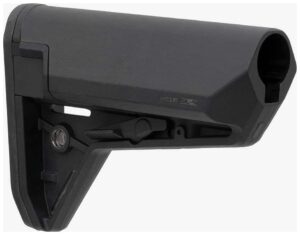
Magpul dominates the AR-15 furniture market because they deliver consistently good products at fair prices with excellent QC. The SL-S (Slim Line – Storage) improves on the standard M4 stock with a streamlined profile, improved cheek weld, anti-rattle friction lock, and two battery storage compartments.
The SL-S sits between the basic Magpul SL (no storage) and the premium Magpul ACS-L (which adds a friction lock lever). For most shooters, the SL-S is the sweet spot.
Key Specs:
– Reinforced polymer construction
– Slim, streamlined profile
– Anti-rattle friction lock
– QD sling swivel socket (both sides)
– Two battery storage tubes
– Fits standard mil-spec buffer tubes
– Weight: 10.4 oz
What we like: The friction lock eliminates the rattle that plagues cheaper stocks. The cheek weld is more comfortable and consistent than the standard M4 stock. Battery storage is surprisingly practical — CR123As for your weapon light, always within reach. QD sling mounts on both sides.
What we don’t: It’s a stock — the improvement is ergonomic, not performance-altering. Shooters who are happy with their current stock won’t see a dramatic difference.
Who should buy this: Anyone upgrading from the basic M4 waffle stock. Shooters who carry their AR with a sling and want QD mount points. Anyone annoyed by stock rattle.
Check price on Amazon | Check price at Brownells | Check price at Palmetto State Armory
7. VG6 Gamma 556 Muzzle Brake — Best Muzzle Device
The VG6 Gamma 556 is a hybrid muzzle brake and compensator that reduces both felt recoil and muzzle rise. In independent testing, the Gamma 556 consistently ranks among the most effective 5.56 muzzle devices at any price — including devices costing 2-3x as much.
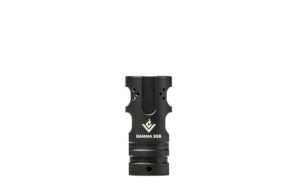
The design uses a series of precisely angled ports to redirect propellant gas upward and to the sides, counteracting the recoil impulse and the barrel’s tendency to rise during firing. The result is noticeably flatter shooting and faster follow-up shots.
Key Specs:
– 17-4 PH stainless steel, QPQ coated
– 1/2×28 thread (standard AR-15)
– Length: 2.18″
– Weight: 2.62 oz
– Three chambers with directional ports
What we like: The recoil reduction is genuinely noticeable — rapid-fire strings are measurably flatter. The stainless steel construction is durable. Price-to-performance ratio is excellent. Compatible with the VG6 CAGE device (an optional blast shield that redirects concussion forward, making the brake range-neighbor-friendly).
What we don’t: Like all muzzle brakes, it’s concussive. Shooters next to you at the range will notice. Flash signature is larger than a flash hider. Louder than an A2 birdcage. If you are still building out your setup, check out our picks for the best tactical flashlights.
Who should buy this: Competition shooters who need flat and fast follow-ups. Anyone who finds 5.56 recoil distracting (new shooters, smaller-framed shooters). Shooters who want brake performance without brake pricing.
Check price on Amazon | Check price at Brownells | Check price at Primary Arms
8. Toolcraft Nitride Bolt Carrier Group — Best Replacement BCG
The bolt carrier group is the heart of the AR-15. If yours is of questionable origin (or came in a budget rifle), upgrading to a Toolcraft Nitride BCG is cheap insurance. Toolcraft is the OEM manufacturer for many name-brand BCGs — when you buy a BCG from a popular AR brand, there’s a good chance Toolcraft made it.
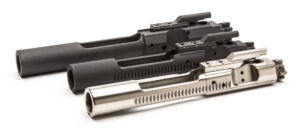
The nitride finish (also called Melonite or QPQ) is harder and more corrosion-resistant than standard phosphate coating, and it’s smoother for easier cleaning. At $75-95, a Toolcraft BCG is the best value in the market. For additional reading, see the National Shooting Sports Foundation.
Key Specs:
– 9310 steel bolt, Carpenter 158 optional
– MPI tested (Magnetic Particle Inspected) and HPT (High Pressure Tested)
– Nitride finish inside and out
– Properly staked gas key
– Standard M16 full-auto profile carrier
What we like: MPI and HPT testing means every bolt is individually inspected — this isn’t quality sampling, it’s quality assurance. Nitride finish cleans easily and resists corrosion. Toolcraft’s reputation as an OEM manufacturer means consistent quality at a fair price.
What we don’t: Not a premium BCG with enhanced features (no improved cam pin, no enhanced extractor spring). If your factory BCG is functional and from a quality manufacturer, this is a lateral move, not an upgrade.
Who should buy this: Anyone with a BCG of unknown origin or quality. Budget rifle owners who want peace of mind. Shooters building a new AR who need a reliable, well-tested BCG without paying $200+.
Check price on Amazon | Find at Brownells | Check price at Palmetto State Armory
9. Magpul MOE K2+ Grip — Best Pistol Grip
The factory A2 pistol grip that ships on most ARs is a design from the 1960s. It’s too narrow, too steep, and has finger grooves that fit nobody’s hand. The Magpul MOE K2+ replaces it with a steeper grip angle (closer to 1911-style, which most shooters find more natural for a rifle), a rubberized overmold for better texture, and a storage compartment in the grip bottom.
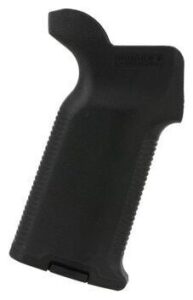
This is a $20-25 upgrade that takes 60 seconds to install and immediately makes the rifle feel better in hand.
Key Specs:
– Reinforced polymer core with rubber overmold
– Steeper grip angle than A2 (more vertical)
– Storage core with trap door
– Fits all AR-15/M4 pattern receivers
– Weight: 3.2 oz
What we like: The rubber overmold provides genuine grip improvement in wet or sweaty conditions. The steeper angle reduces wrist strain during extended sessions. The storage compartment fits batteries or a spare bolt. Twenty bucks.
What we don’t: The steeper angle is a preference, not a universal improvement — some shooters prefer the standard A2 angle. The rubber overmold may wear over time with heavy use.
Who should buy this: Anyone still using the factory A2 grip. It’s $20 and 60 seconds of effort for a noticeable ergonomic improvement. Hard to justify not upgrading.
Check price at Palmetto State Armory | Check price at Brownells
10. Blue Force Gear Vickers Sling — Best Rifle Sling
A sling is the most underappreciated AR-15 accessory. It’s how you carry the rifle when your hands need to do other things, how you stabilize shots from barricades and unusual positions, and how you retain the rifle in a struggle. Larry Vickers (Delta Force veteran, firearms instructor) designed this sling to be simple, adjustable, and bomb-proof.
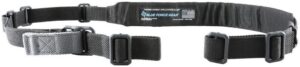
Key Specs:
– 1.25″ nylon webbing
– Quick-adjust pull tab (tighten/loosen with one hand)
– Acetal hardware (won’t scratch your rifle, won’t rust)
– Multiple attachment options (QD, HK hooks, push-button)
– Weight: 3.5 oz
What we like: The quick-adjust system is intuitive — pull to tighten, push buckle to loosen. Hardware is deliberately plastic (acetal) to prevent scratching the rifle and to be silent. Multiple attachment configurations. Larry Vickers’ design credibility is earned, not marketed.
What we don’t: No padding — extended carry of a heavy rifle can be uncomfortable. The thin webbing can dig into the shoulder under load.
Who should buy this: Every AR-15 owner. A sling is not optional for a rifle you might need to carry or shoot from unconventional positions. At $45-55, it’s one of the most practical accessories you can own.
AR-15 Upgrade FAQ
What’s the first upgrade I should make to my AR-15?
An optic, if you don’t have one (or have a cheap one). Then a trigger. Then a free-float handguard. This order gives you the most performance improvement per dollar in sequence.
Should I upgrade or build a new AR-15?
If your current rifle has a quality barrel and receiver, upgrade it. If the foundation is questionable (very cheap manufacturer, keyholing rounds, feeding issues), you’re better off building or buying a quality base rifle and then upgrading from there.
Are mil-spec parts actually good?
“Mil-spec” means the part meets the minimum specification required by the military contract. It doesn’t mean the part is the best available — it means it meets a defined standard. Mil-spec triggers, stocks, and grips are functional but uninspiring. Mil-spec barrels, bolts, and receivers are generally good. Quality aftermarket parts often exceed mil-spec where it matters.
How much should I spend on AR-15 upgrades?
A practical, well-upgraded AR-15 can be built for $1,200-1,800 total (base rifle + optic + trigger + handguard + furniture). Beyond that, you’re in the territory of diminishing returns — a $400 trigger is perhaps 5% better than a $100 trigger.
Final Recommendation
If you have $100 to spend on one AR-15 upgrade, buy the LaRue MBT-2S trigger. Nothing else at this price delivers as much practical improvement.
If you have $300, buy the Holosun 510C and save for the trigger next.
If you have $500, buy the trigger, the optic, and the Magpul MOE K2+ grip — and you’ll have a rifle that shoots dramatically better than it did yesterday.
The AR-15 platform rewards smart upgrades. Prioritize optics, trigger, and handguard before worrying about anything cosmetic, and your rifle will reward you at the range.
If you know of any forums or sites that should be referenced on this listing, please let us know here.