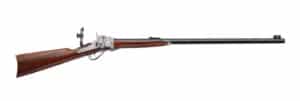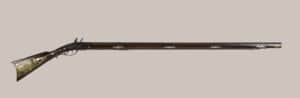
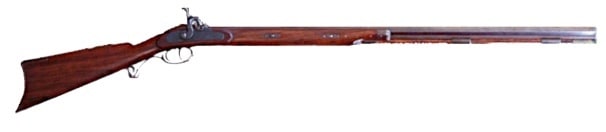
The Hawken rifle is one of the most consequential American firearms ever made — and one of the few historical guns whose modern reproductions are still actively manufactured, hunted with, and collected today. This guide covers both halves: the history of the original plains rifle, and the seven current Hawken-style reproductions worth knowing in 2026.
If you’re here to buy one, jump straight to Modern Hawken Reproductions. If you’re here for the story of why this rifle mattered, read on.
Introduction to the Hawken Rifle
Born from the skilled hands of the Hawken brothers, Jacob and Samuel, the Hawken rifle emerged as a groundbreaking example of firearms engineering during the early 19th century. The brothers were natives of Hagerstown, Maryland, where they apprenticed in the gunsmith trade. Jacob arrived in St. Louis first, opening a shop there in 1815. Samuel joined him in 1822, and the brothers formalized their partnership around 1825 — after the death of Jacob’s earlier business partner, James Lakenan. St. Louis itself was the launching point for the fur trade and westward expansion, the perfect setting for the rifle they would build.
Development and Production
The earliest documented Hawken rifle dates to 1823 — a commission for fur-trade financier William Henry Ashley — though regular production didn’t begin in earnest until around 1831. Over the next several decades the Hawken would become an iconic symbol of the American frontier. The brothers sought to improve upon the long, cumbersome Kentucky rifles of the day, optimizing for greater performance in the rugged landscapes of the West.
Renowned for its unique construction, the Hawken rifle — sometimes referred to as a “plains” or “mountain” rifle — boasted a shorter, more substantial barrel than its contemporaries. Measuring around 30 to 36 inches long, the rifle weighed approximately 10 to 12 pounds (about 10.5 lb on average) — manageable yet robust. The Hawken was primarily a percussion cap muzzleloader, loaded from the front end of the barrel. While the very earliest examples may have used flintlock ignition, the vast majority of Hawken rifles were built as percussion cap rifles.
The caliber of a typical Hawken rifle was .50 or .53, with some larger bores ranging up to .68 crafted for bear and other large game. Such calibers handled heavier rounds, particularly desirable when hunting the larger game prevalent in the western territories. The rifles fired patched round balls or conical bullets, delivering commendable accuracy at a reasonable distance and earning the favor of mountain men and trappers across the era.
The production process was a meticulous affair, a testament to the artistry and precision of its creators. Each rifle was hand-crafted — from a block of curly maple carved into the stock, to the careful forging and rifling of the barrel. The result was a rifle that was not only functional but distinctive, brass and steel fixtures gleaming against polished maple.
The shop’s pace was modest by industrial standards. Primary research (Hanson) puts annual output at roughly 100 rifles per year early in the brothers’ partnership, peaking near 200 per year during the gold-rush era of the late 1840s. Estimated total production across the J&S Hawken era (1825–1860) is approximately 3,000 to 5,000 rifles — a small number by modern manufacturing measure, but the brothers chose quality over quantity. That principle earned them the patronage of legendary figures including Kit Carson and Jim Bridger.
Usage
The Hawken rifle found widespread use in the American West, particularly in the Rocky Mountains. Its association with the fur trade was pivotal. Trappers, needing a robust and accurate firearm to defend themselves and hunt game, found the Hawken an excellent companion. As westward expansion progressed, the rifle became popular among settlers and gold seekers traveling the Oregon and California trails, serving as a crucial tool for survival.
But the Hawken was more than a simple tool. It was a symbol of a nation on the move — a testament to the pioneering spirit that defined an era. The combination of craftsmanship, durability, and reliability produced a firearm that not only served its purpose but left an indelible mark on the history of American firearms and the broader narrative of the American West.
Legacy
Jacob Hawken died of cholera in St. Louis on May 8, 1849. The brothers’ golden era was already winding down by the mid-1850s — Samuel retired around 1855 and his son William briefly continued the business before selling. J.P. Gemmer purchased the shop around 1860–1862 and continued trading on the Hawken name until his own retirement in 1915, which is the date often cited for the shop’s “closure.” The J&S Hawken brothers’ direct involvement effectively ended a half-century earlier.
By any measure, the Hawken rifle had cemented its status as a legend of American gunsmithing. Today, it is prized among collectors and history enthusiasts — a tangible piece of the nation’s intrepid past. The Hawken’s impact on the frontier’s narrative and the course of firearms technology cannot be overstated. It was the steel and maple embodiment of a particular moment in American history, marking the era of westward expansion and the daring spirit of those who blazed the trail.
But the Hawken’s story didn’t end with Gemmer in 1915. The 1970s muzzleloader revival — sparked in part by Thompson Center’s reintroduction of a Hawken-style rifle — brought the design roaring back. Today, several manufacturers produce Hawken-pattern rifles for collectors, traditional shooters, and modern muzzleloader hunters. Here’s the current landscape.
Modern Hawken Reproductions: A Buyer’s Guide
The seven Hawken-style rifles below cover every reasonable buying scenario — from the entry-level shooter who wants a working percussion gun under $700, to the serious collector spending $2,000+ on a museum-grade Pedersoli, to the muzzleloader hunter looking for a fast-twist barrel that handles modern conicals. None of them are exact copies of an original Sam Hawken rifle (no current maker reproduces the precise architecture of an 1840s J&S Hawken), but each captures the silhouette, the action, and the spirit.
Quick comparison
| Rifle | Caliber | Barrel | Twist | Weight | Price (2026) | Best For |
|---|---|---|---|---|---|---|
| Lyman Great Plains | .50 / .54 | 32″ | 1:48 (.50) / 1:65 (.54) | 8.8 lb | $949–959 | Authentic look at a working price |
| Lyman Great Plains Hunter | .50 / .54 | 30″ | 1:24 (fast) | 8.9 lb | $929 | Elk / large-game hunting with conicals |
| Investarm Bridger Hawken | .45 / .50 | 28″ | 1:48 | 8.6 lb | $710 (.45) / $789 (.50) | Entry-level full-size Hawken |
| Pedersoli Rocky Mountain | .54 | 34⅝” | 1:65 | 9.9 lb | $2,027 direct from Pedersoli US | Museum-grade fur-trade reproduction |
| Pedersoli Missouri River | .45 / .50 | 30″ | 1:47 / 1:24 | 9.3 lb | $1,829 walnut .50 | Pedersoli for hunters |
| Traditions Hawken Woodsman | .50 | 28″ | 1:48 | 7.9 lb | $629–720 | Best price-to-feature ratio |
| Thompson Center Hawken | .45 / .50 / .54 | 28″ | 1:48 | varies | used market only | Vintage / collector path |
1. Lyman Great Plains Rifle (Signature Series)
The Lyman Great Plains is the rifle most American shooters associate with “I want a real Hawken-style gun without paying Pedersoli money.” Made in Italy by Davide Pedersoli for Lyman, the Signature Series carries Pedersoli build quality with Lyman branding and a working-shooter price.
What you get: a 32-inch blued octagonal barrel, oil-finished European walnut stock, double-set adjustable trigger, semi-buckhorn rear sight with blade front, and the right twist rate for what you actually want to shoot — 1:48 in .50 caliber for general-purpose patched round ball, 1:65 in .54 for the dedicated round-ball traditionalist. Both percussion and flintlock variants are produced.
Drilled and tapped for the Lyman 57 GPR peep sight, which is the standard accuracy upgrade for serious target shooters.
Best for: the buyer who wants a traditional-appearance Hawken at a working-shooter price. Sub-$1,000 with Pedersoli build quality is hard to beat.
Where to buy:
- Muzzle-Loaders.com — Lyman Great Plains .54 percussion (SKU 6034001)
- Muzzle-Loaders.com — .50 percussion (SKU 6034000)
- Muzzle-Loaders.com — .50 flintlock (SKU 6034002)
- Search Amazon for current availability
2. Lyman Great Plains Hunter Rifle
The Hunter is what the Great Plains becomes when you tune it for modern muzzleloader hunting season instead of fur-trade reenactment. Same Pedersoli-Lyman partnership, but the barrel drops to 30 inches and the twist rate accelerates to 1:24 — the pairing that handles heavier conicals, sabots, and the hunting projectiles preferred for elk and other large game.
The trade-off is purely aesthetic: where the standard Great Plains has traditional iron sights, the Hunter ships with adjustable fiber-optic rear and front bead — fast on target in low light, less period-correct, and the right call if you actually intend to put meat on the wall with this rifle.
Best for: elk, large-game hunting, anyone whose primary use case is a muzzleloader-season tag rather than range traditionalism.
Where to buy:
- Muzzle-Loaders.com — .50 percussion (SKU 6034006)
- Muzzle-Loaders.com — .54 percussion (SKU 6034007)
- MidwayUSA listing
- Search Amazon for current availability
3. Investarm Bridger Hawken (formerly the Cabela’s Hawken)
This is the rifle most American hunters under 50 actually own when they say “my Hawken.” For decades Cabela’s sold an Investarm-made Bridger Hawken under their house brand, and tens of thousands ended up in deer camps and gun safes across the country. Cabela’s no longer sells new Investarm Hawkens, but the same OEM rifle is still produced and now sold under the Investarm brand directly through specialty retailers — Muzzle-Loaders.com being the primary US channel.
What that means for buyers: the used “Cabela’s Hawken” market on GunBroker and at gun shows is robust and inexpensive (sub-$400 for clean examples is realistic), and clean used guns are mechanically identical to currently-produced new Bridgers. If you want full-size Hawken handling without the new-rifle premium, this is your path.
The Bridger ships with a 28-inch blued octagonal barrel in .45 or .50 (a .54 was historically produced as well), 1:48 twist, sidelock percussion, double-set trigger, and traditional Hawken-style furniture. There’s also a 24-inch carbine variant — same 1:48 twist, lighter at 7.1 lb — for the hunter who wants something handier. A small-bore .36 Santa Fe Hawken is also produced for plinking and small-game work.
Current pricing at Muzzle-Loaders.com (verified 2026-05-05): Bridger .50 percussion at $789, Bridger .45 percussion reduced to $710, Hawken Carbine .50 percussion reduced to $602.
Best for: entry-level full-size Hawken; budget-conscious buyers who don’t mind the used market.
Where to buy:
- Muzzle-Loaders.com — Bridger .50 percussion (IA2110)
- Muzzle-Loaders.com — Bridger .45 percussion (IA2115)
- Muzzle-Loaders.com — Hawken Carbine .50 percussion
- Muzzle-Loaders.com — Gemmer Hawken kit
- Used “Cabela’s Hawken” inventory on GunBroker
4. Pedersoli Rocky Mountain Hawken
When budget is no object and the goal is a museum-grade fur-trade reproduction, this is the rifle. The Rocky Mountain is Davide Pedersoli’s serious collector piece — a one-piece European walnut or maple stock, 34⅝-inch browned octagonal barrel with seven-groove rifling, hardened steel furniture, color case-hardened lockplate, and the slow 1:65 twist that’s the right pairing for patched round ball at fur-trade-era loads.
This is .54 caliber only, percussion only. Pedersoli’s own US shop sells the Maple-stocked version direct at $2,027.15 (shop.davidepedersoli.com) — typically the cheapest path to this rifle. Muzzle-Loaders.com lists the same configuration at $2,349 (currently sold out at the time of writing).
Best for: the collector or traditionalist who wants the most authentic mountain-man rifle currently in production. Also a remarkable shooter — these rifles deliver the kind of accuracy that rewards careful loading.
Where to buy:
- Davide Pedersoli — Rocky Mountain Hawken Maple (S.295)
- Davide Pedersoli — Rocky Mountain Hawken Walnut (S.283)
- Pedersoli US shop — Maple
- Muzzle-Loaders.com — Maple .54
- Cabela’s listing
- Bass Pro listing
- Dixie Gun Works listing
5. Pedersoli Missouri River Hawken
Pedersoli’s hunting-oriented Hawken. Same Pedersoli build quality as the Rocky Mountain, but configured for modern muzzleloader hunters: a shorter 30-inch barrel, a fast 1:24 twist in the .50 caliber variant (1:47 in the .45), in walnut or maple. Available in .45 or .50 — and per some retailer listings, .54 as well, though Pedersoli’s primary catalog focuses on the .45 and .50 configurations.
What makes this rifle interesting: it’s the Pedersoli option for someone who wants museum-grade build quality but doesn’t want to fight a slow-twist barrel during deer-and-elk season. The 1:24 twist eats conicals, sabots, and modern muzzleloader projectiles without the patched-round-ball compromise.
Current Muzzle-Loaders.com pricing (verified 2026-05-05): Walnut .50 at $1,829, Maple .50 at $2,349 (currently sold out).
Best for: the serious-budget hunter who wants Pedersoli quality with hunting-tuned ballistics.
Where to buy:
- Davide Pedersoli — Missouri River Hawken Maple
- Muzzle-Loaders.com — Walnut .50
- Muzzle-Loaders.com — Maple .50
- Muzzle-Loaders.com — Walnut .45
- MidwayUSA listing
6. Traditions Hawken Woodsman
The Woodsman is the entry-level Hawken in current new production. Traditions Performance Firearms imports the rifle (barrels and locks made in Spain by Ardesa) and assembles in the US. What you get for the money: a 28-inch blued octagonal barrel in .50, 1:48 twist, select hardwood stock with walnut finish, solid brass furniture including an inletted brass patch box, hooked breech (drops out of the stock for easy cleaning), and click-adjustable rear hunting sight.
Available in percussion or flintlock, the percussion model lists at $639.95 MSRP and Muzzle-Loaders.com prices it at $629. The flintlock variant lists at $719.95.
Best for: the buyer’s first Hawken, a percussion gun that delivers feature-for-feature parity with rifles costing twice as much. The hooked breech alone — letting you drop the barrel from the stock for cleaning — is a comfort feature most reproductions in this price range omit.
Where to buy:
- Traditions — Hawken Woodsman .50 Percussion (R24008)
- Traditions — Hawken Woodsman .50 Flintlock (R2390801)
- Cabela’s listing
- Bass Pro listing
- MidwayUSA listing
- Scheels listing
7. Thompson Center Hawken (Discontinued — Used Market Only)
You can’t buy a new Thompson Center Hawken. Smith & Wesson now owns the Thompson/Center brand and discontinued the sidelock Hawken line years ago. But the original TC Hawken — produced from approximately 1970 through the early 2010s — was the rifle that single-handedly revived modern American black-powder shooting, and clean examples remain plentiful on the used market.
What made the TC Hawken historically important: when serious blackpowder shooting was a niche-of-niches activity in 1970, Thompson Center mass-produced a Hawken-pattern rifle in .45, .50, and .54, in percussion or flintlock, with American walnut stocks and brass furniture. The 28-inch barrel and 1:48 twist made it equally workable with patched round ball and TC’s own Maxi-Ball conical (one of the first commercially successful muzzleloader hunting projectiles). The double-set trigger, the engraved color case-hardened lockplate, the inletted brass patch box with cleaning jag inside — these features defined what an “American factory Hawken” looked like for two generations of shooters.
A clean used TC Hawken is the most authentically American Hawken-pattern rifle on this list, even though it’s no longer produced. If the historical-revival angle matters to you, this is the path.
Where to buy (used):
- GunBroker — Thompson Center Hawken search
- Guns International — Thompson Center muzzleloaders
- Cabela’s Gun Library and used-rack listings periodically carry TC Hawkens — search Cabela’s for current inventory
Hunting With a Modern Hawken
If you’re buying a Hawken-style rifle for muzzleloader season, three rules cover most of what you need to know.
Rule 1: Twist rate dictates projectile. Slow twist (1:48 to 1:65) stabilizes patched round balls and round-ball-only loads — this is the traditional fur-trade configuration. Fast twist (1:24 to 1:32) handles conicals, sabots, and the heavier hunting projectiles that drop large game cleanly. The Lyman Great Plains Hunter and Pedersoli Missouri River are fast-twist hunting rifles. The Rocky Mountain and standard Great Plains are slow-twist round-ball rifles. Pick deliberately.
Rule 2: Caliber matches game.
- .45 — small to medium deer, target shooting. Light-recoiling, accurate at moderate range.
- .50 — the universal answer for North American whitetail and mule deer hunting, and the dominant caliber in modern muzzleloader season regulations.
- .54 — elk, moose, large bear. The traditional fur-trade caliber for serious western game.
Rule 3: Verify your state’s muzzleloader regulations before you buy. Most states with muzzleloader-only seasons have specific requirements — minimum caliber (often .40 or .45), open or fiber-optic sights only (no scopes in some states), and rules about whether sabots and pelletized propellants are permitted. The DNR or wildlife agency website for your state is the authoritative source. Don’t trust forum advice; rules change.
Accessories You Need to Shoot a Hawken
Buying the rifle is half the battle. Here’s the complete kit a Hawken shooter needs.
Percussion caps
If you bought a percussion rifle, you’ll need #11 caps. The standard options:
- CCI #11 — the everyday workhorse, copper and ribbed, fits standard #11 nipples. Search Amazon | Muzzle-Loaders.com
- RWS #11 No.1075 — hotter, preferred by competitive shooters who want consistent ignition. Muzzle-Loaders.com | Graf & Sons
- Remington #11 — backup brand when CCI/RWS are out of stock. Muzzle-Loaders.com
Patches
For patched round ball shooters: Traditions Wonderlube 1000 Plus Patches in .50–.54, 100-count, .015 thickness. Pre-saturated with biodegradable Wonderlube — the right answer for nearly any factory rifle in this caliber range. Search Amazon | OpticsPlanet | Muzzle-Loaders.com
Round balls
- Hornady .490 Lead Round Ball (177–178 grain) for .50 caliber — cold-swaged pure lead, the de facto standard. Search Amazon | Hornady direct | MidwayUSA
- Hornady .530 Lead Round Ball (224 grain) for .54 caliber. Search Amazon | Cheaper Than Dirt
- Speer .490 Lead Round Ball as an alternative when Hornady’s out of stock. Speer direct | Muzzle-Loaders.com
Powder
True black powder (Goex FFG) is the historically authentic option but ships HazMat and supply has been intermittent since 2024. For the vast majority of shooters, Pyrodex RS or Triple Seven FFG is the right answer:
- Pyrodex RS — FFg-equivalent, volume-equivalent 1:1 with FFg, ships safely. Muzzle-Loaders.com | MidwayUSA
- Hodgdon Triple Seven FFG — sulfur-free, cleaner-burning, slightly higher velocities. Hodgdon direct | Muzzle-Loaders.com | MidwayUSA
- Goex FFG — true black powder for purists; HazMat shipping required. Goex direct | Powder Inc. | MidwayUSA
Powder flask and measure
- CVA Cylinder Flask in brass — entry-level, 2.5 oz capacity, interchangeable spouts at 30/75/100 grain. Amazon
- Pedersoli Tubular Adjustable Brass Powder Flask for the period-correct premium option. RMC Ox-Yoke
- Pedersoli Brass Powder Measure with Funnel (0–50 grain) for accurate volumetric loads. RMC Ox-Yoke
Cleaning kit
Black powder fouling demands more thorough cleaning than smokeless residue. Two paths:
- Hoppe’s No. 9 Deluxe Gun Cleaning Kit (62-piece) — universal kit, pair with a black-powder-specific solvent. Real black-powder cleanup also wants hot soapy water. Amazon
- Otis Technology Muzzleloader Cleaning Kit in .50 caliber — purpose-built, includes breech-plug tool. Otis direct
Bore brushes and jags
- CVA Brush & Swab Set in .50 caliber, 10/32 thread (the standard ramrod thread). Muzzle-Loaders.com | MidwayUSA
- Traditions .50 Cal Cleaning/Loading Jag in brass — bore-friendly, 10/32 thread. 3 Rivers Archery
Capper
- Traditions Straight-Line Capper for #11 caps (A1203) — solid brass, holds up to 15 caps, dispensed one at a time. Amazon | Muzzle-Loaders.com
Short starter
Round balls don’t seat by hand. You need a short starter:
- Traditions Round-Handle Ball Starter (A1207) — brass tips on a hardwood handle, $11.95 MSRP. Amazon | Muzzle-Loaders.com
- October Country Solid Brass & Hardwood Short Starter for the period-correct premium option. October Country
Possibles bag
A possibles bag holds caps, patches, balls, short starter, and other essentials at the range or in the field:
- Crazy Crow Beavertail Hunter’s Bag Kit (DIY, oil-tanned leather, 7.5 inch) — Crazy Crow is the canonical maker of period-correct possibles bags. Crazy Crow
- Generic black-powder leather possibles bag as a lower-priced ready-made option. Amazon
Bullet molds (for shooters who cast their own)
If you shoot enough Hawken to make casting your own balls economical:
- Lee Precision .490 Double Cavity Round Ball Mold for .50 caliber — aluminum block, produces 176.61 grain round balls. Amazon | Lee direct
- Lee 50CAL-320 Double Cavity Combo Mold — round ball + 320-grain REAL conical in one mold. Lee direct | Graf & Sons
- Lee Precision .530 Double Cavity Round Ball Mold for .54 caliber. Amazon | Track of the Wolf 6-cavity option
Reference Books
If the historical side of the Hawken is what drew you here, these are the references serious students of the rifle keep on the shelf — Charles E. Hanson Jr.’s seminal The Plains Rifle (1960) and his focused The Hawken Rifle: Its Place in History (Fur Press, 1979), plus John D. Baird’s classic Hawken Rifles: The Mountain Man’s Choice (1968).


Hanson’s books cover Hawken production history, the Ashley contract, and a careful debunking of common Hawken myths. Baird’s monograph mainstreamed the modern Hawken legend, originating as a 1967 Muzzle Blasts magazine series.
Frequently Asked Questions
Are Hawken rifles still made today?
Original Hawken rifles haven’t been made since the J&S Hawken shop closed in 1915. But Hawken-style reproductions are produced by Lyman (Pedersoli-built), Davide Pedersoli, Investarm, and Traditions, and they’re widely available — see the buyer’s guide above.
What caliber Hawken is best for elk?
.54 caliber, with a fast-twist barrel (1:24 or thereabouts) shooting heavy conicals or saboted hunting projectiles. The Lyman Great Plains Hunter in .54 percussion is the most direct fit. Pedersoli’s Missouri River Hawken in .50 with the 1:24 twist is another strong option.
How accurate is a Hawken rifle?
A well-made modern Hawken-pattern rifle, properly loaded with a matched ball-and-patch combination or a quality conical, is capable of 2-3 inch groups at 100 yards from a rest. Slow-twist rifles do best with patched round ball; fast-twist with conicals. Original 19th-century Hawkens were renowned for accuracy at distances that surprised contemporaries.
What’s the difference between a Hawken rifle and a Kentucky rifle?
Kentucky (or Pennsylvania) rifles are long, slim, and small-caliber — typically 40-44 inches of barrel in .32 to .45 caliber, designed for the eastern woods and squirrel-to-deer game. Hawken rifles are shorter and substantially heavier — 30-36 inches of stout barrel in .50 to .58 caliber — designed for the western plains, harder service, and larger game. The Hawken’s design represents a deliberate evolution beyond the Kentucky pattern.
How much is an original Hawken rifle worth?
Genuine 19th-century J&S Hawken rifles are extraordinarily rare; documented examples have sold at major auction houses (Rock Island, Morphy’s, Heritage) for sums ranging from $25,000 for less-distinguished examples to well over $250,000 for documented historical rifles with named provenance. Most surviving Hawkens are in museum collections. Modern reproductions are not original Hawkens and should not be confused with them.
Have a question about Hawken rifles, modern reproductions, or muzzleloader hunting? Email the editor at [[email protected]] or join the discussion at the Muzzleloading Forum.
You may also be interested in our coverage of the Pennsylvania Rifle and the Lamson, Goodnow & Yale Special Model 1861.
If you know of any forums or sites that should be referenced on this listing, please let us know here.