If you wanted law and order in the desolate stretch of West Texas along the Rio Grande in the 1880s, you got Judge Roy Bean. You also got his saloon, his pet bear, and whatever brand of justice he felt like dispensing that afternoon. Bean was a saloon-keeper, a justice of the peace, and one of the most colorful characters in the history of the American frontier. He called himself “The Only Law West of the Pecos,” and for roughly two decades, nobody successfully argued the point.
From Kentucky to the Border
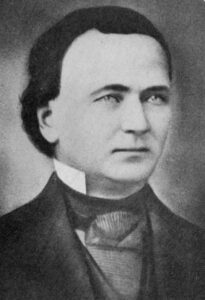
Phantly Roy Bean Jr. was born around 1825 in Mason County, Kentucky. The exact date is uncertain — Bean himself was never particularly interested in pinning it down, and frontier records from rural Kentucky in the 1820s were spotty at best. His parents, Phantly Roy Bean Sr. and Anna Bean, had several children. Roy’s older brothers, Joshua and Sam, would head west ahead of him, and their adventures pulled Roy along like a current.
Joshua Bean left Kentucky first and made his way to Mexico, then to California. Sam followed. By the late 1840s, both brothers had established themselves out west. Joshua, in fact, became the first mayor of San Diego in 1850 — a genuine civic accomplishment that probably mystified anyone who knew the Bean family personally.
Roy, still a teenager, headed west around 1847. He landed in Mexico first, where accounts suggest he got into enough trouble to wear out his welcome. He moved north into what is now New Mexico, settling briefly in Chihuahua and then the area around Mesilla. The details are murky — Bean was not a diary-keeper, and most of what we know about his early years comes from later retellings that are generous with the embellishment.
What we do know is that Roy wound up in San Diego with his brother Joshua by the early 1850s. The brothers ran a saloon together, and Roy got into a scrape that resulted in a shooting — a duel of some kind with a man over a woman, depending on which version you believe. Roy reportedly shot the man, spent time in jail, and escaped. He then moved north to San Gabriel, near Los Angeles, where his brother Sam had a saloon and billiard hall.
In San Gabriel, Roy continued his talent for finding trouble. A romantic entanglement led to another confrontation — this time, according to the most widely repeated account, a group of men ambushed Roy and left him with a rope around his neck, dangling from an oak tree. A woman (possibly the very one who sparked the confrontation) cut him down before it killed him. Bean reportedly carried stiffness in his neck for the rest of his life as a souvenir.
By late 1852, Joshua Bean had been murdered in San Gabriel — shot at his own home under circumstances that were never fully resolved. With both California and his brother’s legacy behind him, Roy Bean headed for Texas.
San Antonio and the Civil War Years
Roy Bean arrived in San Antonio by the late 1850s and set about doing what he did best: selling things to people, bending rules, and getting by. He married Virginia Chavez around 1866, and the couple eventually had four children — Roy Jr., Laura, Zulema, and Sam (named after Roy’s brother).
During the Civil War, San Antonio was a Confederate city, and Bean operated as a freelance supplier — a polite way of saying he was a blockade runner and smuggler. The Union naval blockade of Southern ports made basic goods scarce and expensive, which created opportunity for anyone willing to cross the Rio Grande into Mexico, buy cotton or other goods, and haul them back across. Bean was exactly that kind of willing.
He ran cotton through Mexico and reportedly dealt in whatever commodities could turn a profit. He was not a soldier in any conventional sense. He was an entrepreneur operating in the gray market that war creates. Whether he had any Confederate sympathies beyond the financial kind is debatable — Bean’s loyalties generally followed the money.
After the war, Bean stayed in San Antonio for another fifteen-plus years. He worked as a teamster, a butcher, a dairy operator, and a wood dealer, among other ventures. His business ethics were, to be charitable, flexible. He was hauled into court more than once on charges ranging from assault to larceny. He watered his milk. He sold firewood by the cord but delivered short stacks. He was, by most accounts, a hustler and a cheat — but a resourceful one who managed to stay just this side of serious consequences.
His marriage to Virginia deteriorated. By the early 1880s, they had effectively separated, with Virginia and the children remaining in San Antonio while Roy looked for his next angle. He found it along the Southern Pacific Railroad.
How Judge Roy Bean Became the Law
In 1882, the Southern Pacific Railroad was pushing its line westward through the desert stretches of Southwest Texas, connecting San Antonio to El Paso across some of the most desolate country on the continent. Where the railroad went, construction crews followed — and where construction crews gathered, somebody was going to sell them whiskey.
Roy Bean, now in his late fifties, set up a tent saloon near the Pecos River at a railroad camp called Vinegarroon (sometimes spelled Vinegaroon). The camp was a rough place — railroad workers, drifters, gamblers, and thieves, all packed into a temporary settlement with no law enforcement of any kind. The nearest courthouse was over a hundred miles away. Getting a lawman out to the camps was a logistical impossibility, and the Texas Rangers had bigger problems than settling bar fights among railroad graders.
The situation was bad enough that the Texas Rangers and local authorities needed someone — anyone — to serve as a justice of the peace. In August 1882, Roy Bean was appointed Justice of the Peace for Precinct 6 of Pecos County by the Pecos County Commissioners Court. The appointment was pragmatic rather than meritorious. Bean happened to be there, he was willing, and he had a building (such as it was) where court could be held.
Bean took to the role like he had been waiting for it his entire life. He may have been. Here was a man who had spent decades on the fringes, running low-grade schemes and dodging consequences, and now he had actual authority — official, state-recognized authority — to hold court, levy fines, and pass judgment on his fellow man. He was never going to use that power with restraint.
When the railroad construction moved west, Bean moved with it. He eventually settled at a small railroad stop called Eagle’s Nest, which became known as Langtry. He built a wooden shack that served simultaneously as his saloon, his courtroom, his billiard hall, and his home. He named it “The Jersey Lilly” — after the famous British actress Lillie Langtry, who was also known as the “Jersey Lily” (she was from the island of Jersey). Bean misspelled her nickname with two L’s, and nobody ever corrected him.
The naming of the town itself is contested. The Southern Pacific Railroad claimed the stop was named after a railroad construction foreman named George Langtry. Bean insisted he named it after Lillie. The railroad’s explanation has better documentation behind it — the name appeared on railroad maps before Bean arrived — but Bean’s version is the one that stuck in popular memory.
Judge Roy Bean’s Brand of Justice
Judge Roy Bean’s courtroom was his saloon. The bar was the bench. His law library consisted of a single volume: the 1879 Revised Statutes of Texas, which he consulted with creative interpretation. Jury members were selected from whoever happened to be drinking at the bar, and they were expected to buy a round during recess. Court was called to order when Bean felt like calling it to order, and adjourned when he got bored or thirsty.
The fines Bean levied had a funny way of equaling the exact amount of cash the defendant was carrying. He pocketed the fines himself — there is scant evidence that any of his collections ever made it to the county treasury. He charged fees for every service a justice of the peace could perform: marriages, inquests, legal filings. He married couples and then charged them for the privilege, sometimes adding a fee for the divorce he told them they would inevitably need.
One of the most famous stories — and one that appears in multiple contemporary accounts — involves Bean holding an inquest over the body of a dead man who had fallen from the railroad bridge over the Pecos River. The deceased was found with a pistol and forty dollars in his pocket. Bean fined the dead man forty dollars for carrying a concealed weapon and confiscated both the money and the gun. When someone pointed out that you could not fine a dead man, Bean reportedly replied that he could find no law against it.
Bean had a bear — a black bear that he kept chained in front of the saloon as a sort of living advertisement. The bear drank beer. Customers were encouraged to buy the bear a round. Bean also kept a pet mountain lion at one point, because apparently a beer-drinking bear was not sufficient atmosphere for his establishment.
His legal reasoning was, to put it mildly, original. In one widely reported case, an Irish railroad worker was charged with killing a Chinese laborer. A mob of two hundred armed men — the dead man’s coworkers and friends — showed up at the saloon threatening to lynch the defendant or tear the place apart. Bean consulted his statute book, declared that he could find no law against killing a Chinese man, and dismissed the case. The ruling was legally absurd, morally reprehensible, and almost certainly saved Bean’s saloon from destruction. It tells you everything you need to know about how Bean operated: self-interest first, justice as a distant afterthought.
Bean was not the folksy, lovable rogue that later Hollywood portrayals suggested. He was a racist who reflected the ugliest attitudes of his time and place. He cheated his customers, exploited his authority, and ran his court as a personal revenue operation. But he was also genuinely the only legal authority for hundreds of miles in any direction, and most of the people who came before his court had nowhere else to go. In that vacuum, even bad law was better than no law — or at least, that was the argument his continued appointment rested on.
The Fitzsimmons-Maher Prize Fight
If one event cemented Roy Bean’s national fame during his lifetime, it was the Fitzsimmons-Maher prize fight of February 21, 1896.
Here is the setup: Bob Fitzsimmons and Peter Maher were scheduled for a heavyweight championship bout. Prize fighting was illegal in Texas, as it was in most states at the time. The fight had already been chased out of several other jurisdictions. Dan Stuart, the promoter, was desperate for a location. The Texas Rangers, under the direction of Adjutant General W.H. Mabry, were deployed specifically to prevent the fight from happening on Texas soil. The governor had made his position clear — no prize fight in his state.
Roy Bean saw opportunity. He invited the fight to Langtry, and when the Rangers arrived to shut it down, Bean had a solution. He arranged for a temporary platform and ring to be built on a sandbar on the Mexican side of the Rio Grande, just across from Langtry. A pontoon bridge was constructed to get spectators across the river. Technically, the fight would take place in Mexico — in the state of Coahuila — where Texas law had no jurisdiction.
On the day of the fight, a special train brought hundreds of spectators from El Paso to Langtry. The crowd crossed the pontoon bridge, watched Fitzsimmons knock out Maher in the first round (the fight lasted about ninety-five seconds), and then crossed back to Texas to spend their money in Bean’s saloon. The Texas Rangers stood on the American side of the river, legally unable to do a thing. Mexican authorities, who had reportedly been told about the fight too late to prevent it, were similarly powerless.
Bean sold beer and liquor to the crowd throughout the event. He charged admission to cross his bridge. He was, by every measure, the only winner of the day — Fitzsimmons got the belt, but Bean got the gate and the bar revenue.
The stunt made national headlines. Newspapers across the country covered the fight and the colorful judge who had outwitted the Texas Rangers and the governor to make it happen. Bean’s reputation as a character — already well-established in West Texas — went national overnight. He loved every minute of it.
The Legend vs. the Man
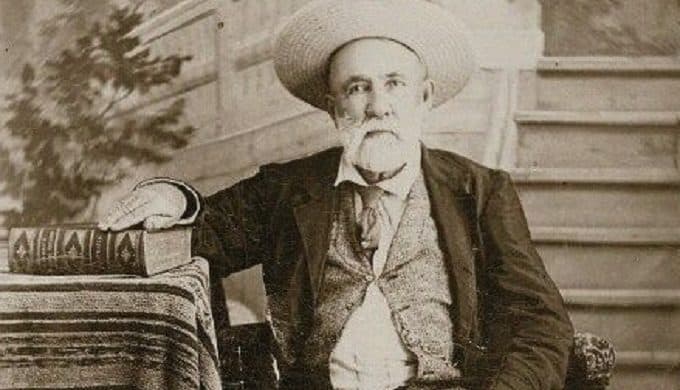
Even during his lifetime, the stories about Roy Bean were growing faster than the facts could support. Newspaper reporters made the trip to Langtry and wrote colorful dispatches about the eccentric judge, and Bean — who understood publicity the way a coyote understands chickens — played up to every one of them. He posed for photographs with his law book and his bear. He told outrageous stories about his own rulings. He was, in modern terms, curating his personal brand, and he was very good at it.
The problem is that it became difficult to separate what Bean actually did from what Bean said he did, and from what reporters and later writers decided he must have done. The dead-man inquest story has multiple versions with different details. Some accounts have the dead man carrying $40, others say $45. Some say he fell from the bridge, others say he was found below the railroad trestle. The core facts appear to be real — Bean did hold an inquest and did fine the corpse — but the specifics shift depending on who is telling it.
Other stories are harder to verify. Did Bean really sentence a man to hang and then pardon him because the defendant’s wife came in and bought drinks for the whole bar? Maybe. Did he really force a lawyer to buy a round before he could argue a case? Probably — that one sounds exactly like Bean. Did every jury he empaneled really have to purchase drinks during deliberation? Almost certainly, yes.
Bean was voted out of office in 1896, replaced by a man named Jesus Torres in the election that November. He won the office back in 1900, running on what amounted to name recognition and stubbornness. He served as justice of the peace until his death, though by his final years, the position was more ceremonial than functional. Newer courts and actual law enforcement had arrived in the region. Bean was increasingly a tourist attraction more than a court officer — and, characteristically, he was fine with that arrangement as long as it kept people buying drinks.
The real Roy Bean was not a good man in any conventional sense. He was a petty grifter, a corrupt official, and a bully who used his office to enrich himself. He was also undeniably resourceful, stubbornly self-reliant, and genuinely entertaining — qualities the frontier rewarded more than fairness or honesty. The West did not produce Roy Bean. Roy Bean was exactly what the lawless stretches of West Texas deserved and, for better or worse, got.
Lillie Langtry and the Final Chapter
Roy Bean’s infatuation with Lillie Langtry was the one constant thread running through his years in West Texas. He named his saloon after her. He plastered her picture on the walls of his courtroom. He wrote her letters — whether any of them reached her is debatable, though at least one piece of correspondence appears to have gotten through, since Langtry reportedly knew of Bean’s existence.
Lillie Langtry was a genuine celebrity of the Victorian era — a British actress and socialite, born Emilie Charlotte Le Breton on the island of Jersey in 1853. She was famous for her beauty, her stage career, and her widely rumored relationship with the Prince of Wales (later King Edward VII). She toured the United States extensively in the 1880s and 1890s, performing to sold-out theaters across the country. Bean was utterly smitten.
He invited her to Langtry repeatedly. She never came while he was alive. Whether she was aware of his invitations, amused by them, or simply too busy performing in actual cities to make a detour to a railroad stop in the middle of the Chihuahuan Desert is a fair question.
Roy Bean died on March 16, 1903, in his saloon in Langtry. He was approximately 78 years old. The cause of death was reportedly complications following a drinking binge in San Antonio — he had traveled there, gotten drunk, come home ill, and never recovered. He was buried in the Del Rio cemetery, about sixty miles east of Langtry, in Val Verde County.
Lillie Langtry finally visited Langtry in 1904 — roughly ten months after Bean’s death. The town presented her with Bean’s pistol and one of his pet bears (a different bear from the original) as gifts. She was reportedly charmed by the whole affair. The visit received significant press coverage, which is probably what Lillie Langtry was actually there for. She was a performer to the bone.
There is a melancholy irony in the timing. Bean spent twenty years inviting a woman to a town named (maybe) after her, to a saloon named (definitely) after her, and she arrived just late enough to miss him entirely. Whether that is tragic or simply fitting depends on how generous you feel toward Roy Bean on any given day.
Further Reading
If you want to dig deeper into Judge Roy Bean’s life and times, these are the books to start with:

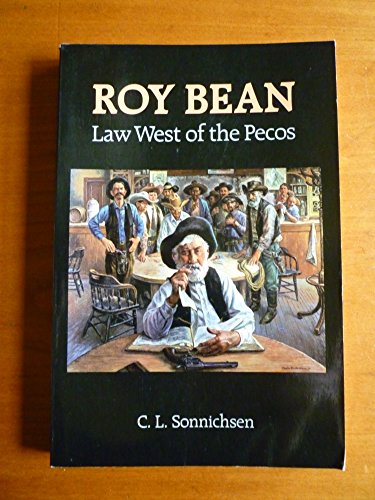
Roy Bean: Law West of the Pecos by C.L. Sonnichsen
The definitive biography. Sonnichsen was a serious historian who spent years separating fact from legend, and this book remains the single best source on Bean’s actual life. Originally published in 1943, it has been reprinted multiple times and is still in print. If you read one book about Roy Bean, make it this one. Find it on Amazon.
Law West of the Pecos by Everett Lloyd
An earlier account (originally 1931) that collects many of the Bean stories and anecdotes. Less rigorously sourced than Sonnichsen, but valuable for its proximity to living memory — some of Lloyd’s sources personally knew Bean. Copies can be hard to find, but it is worth tracking down for serious students of the subject. Find it on Amazon.
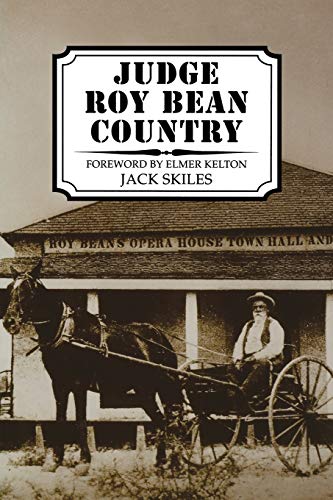
Judge Roy Bean Country by Jack Skiles
Skiles grew up in the Langtry area and brings a local perspective that the other books lack. Excellent for understanding the geography and the land itself — the landscape that shaped Bean’s world. Also includes good material on the Pecos River region’s broader history. Find it on Amazon.
Visiting Langtry Today
The Judge Roy Bean Visitor Center in Langtry, Texas, is operated by the Texas Department of Transportation and is free to the public. It sits on the site of Bean’s original saloon and courthouse, and includes a replica of the Jersey Lilly and a small museum with artifacts and exhibits about Bean’s life and the history of the Lower Pecos region. The cactus garden on the grounds is also worth a walk-through.
Langtry itself is tiny — a handful of residents, no gas station, no restaurant. It sits on US Route 90 between Del Rio and Sanderson, roughly 330 miles west of San Antonio. If you are making the drive along the southern route across Texas, it is an easy stop and well worth the twenty minutes. The landscape alone — stark, vast, achingly empty — tells you everything about why a man like Roy Bean could declare himself the law and make it stick.
The Pecos River High Bridge, a short drive east, offers one of the most dramatic views in Texas. The original railroad bridge where Bean’s famous inquest took place has been replaced, but the canyon is unchanged — a deep, sheer gash in the limestone plateau that reminds you how isolated this country was, and still is.
If you know of any forums or sites that should be referenced on this listing, please let us know here.