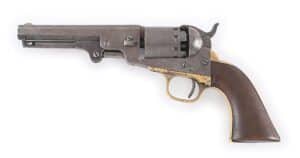
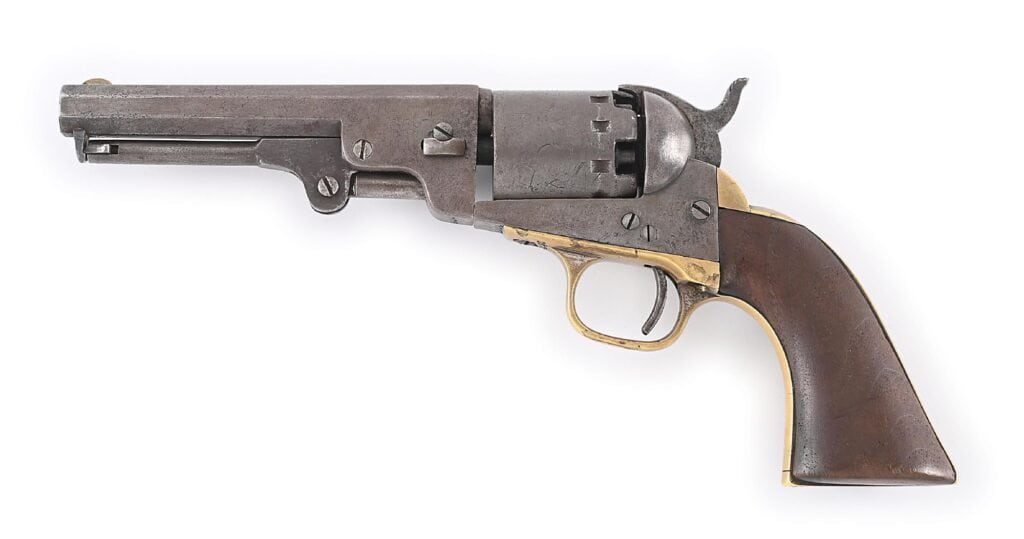
An outlaw’s name did the heavy lifting at Morphy’s Old West & Native American Art Auction on June 20, where a Manhattan Arms Navy Series IV Single Action Percussion Revolver attributed to Jesse James crossed the block at $100,860 to take top-lot honors. The 515-lot sale, staged at the Santa Fe Community Convention Center in Santa Fe, New Mexico, rang up more than $900,000 including the buyer’s premium, and dovetailed with the 36th Annual Old West Show held at the same venue over June 19–21.
The provenance is the kind collectors argue about and buyers still chase. The revolver was, according to the consignment, used by James at the robbery of the Southern Bank of Kentucky in Russellville on March 20, 1868, and it came with a letter signed by James’s son, Jesse Edward James, and daughter-in-law Stella James attesting to the story. The hammer price landed within estimate. “It was a strong finish to our time in Santa Fe,” said Dan Morphy, president of Morphy Auctions, who noted the traveling event moves to Mesa, Arizona in May 2027.
Remington’s “Rattlesnake,” rendered in silver
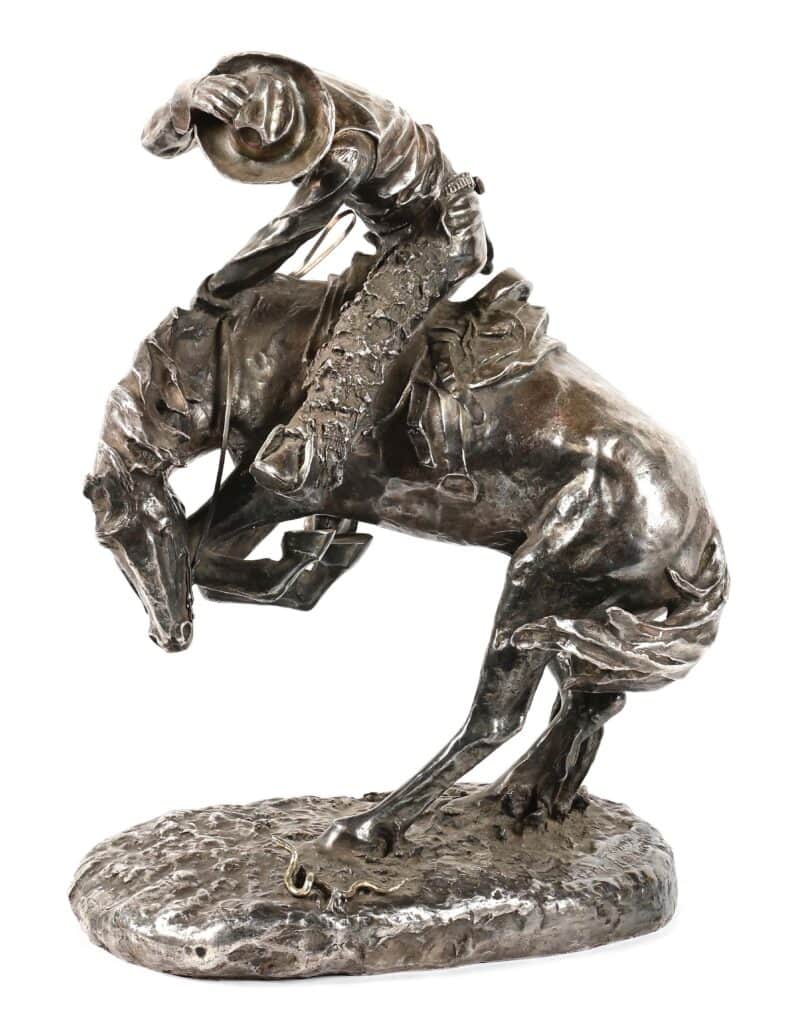
The sale’s second-highest lot married Western art to precious metal. A wonderfully detailed sculpture of Frederic Remington’s The Rattlesnake, cast in more than 1,000 troy ounces of .999 silver, sold within estimate at $86,100. The 17-inch-tall casting was number 3 from an edition of 100, produced at the Maiden Foundry in Oregon in 1989. With silver at record highs, the piece was as much bullion as bronze-tradition Western art — a displayable investment that a buyer could weigh as well as admire.
The first Nolte-Olsen parade saddle
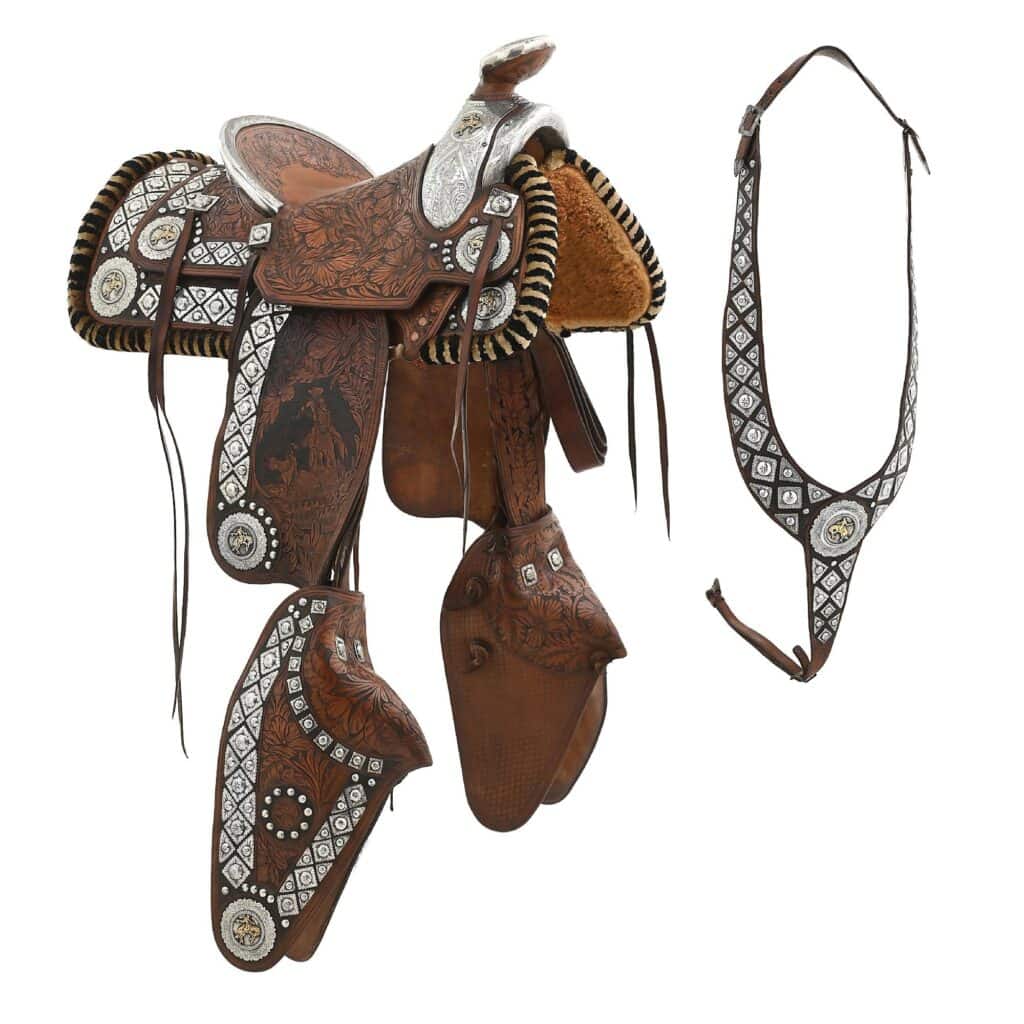
Parade saddles were the rolling billboards of Western showmanship, and this was the first of a landmark run. The first silver parade saddle built by Nolte-Olsen of San Francisco, representing the pinnacle of the high-end saddles Al Nolte produced circa 1937, realized $46,750, within estimate. The silver decoration was the work of San Francisco silversmith Robert Schaezlein; the leather tooling was by Gene Sisco. Remarkably, the saddle had been mounted on a horse only twice since 1937, and it came with an original 1930s photograph of the Nolte-Olsen storefront.
A California gold-quartz Waltham
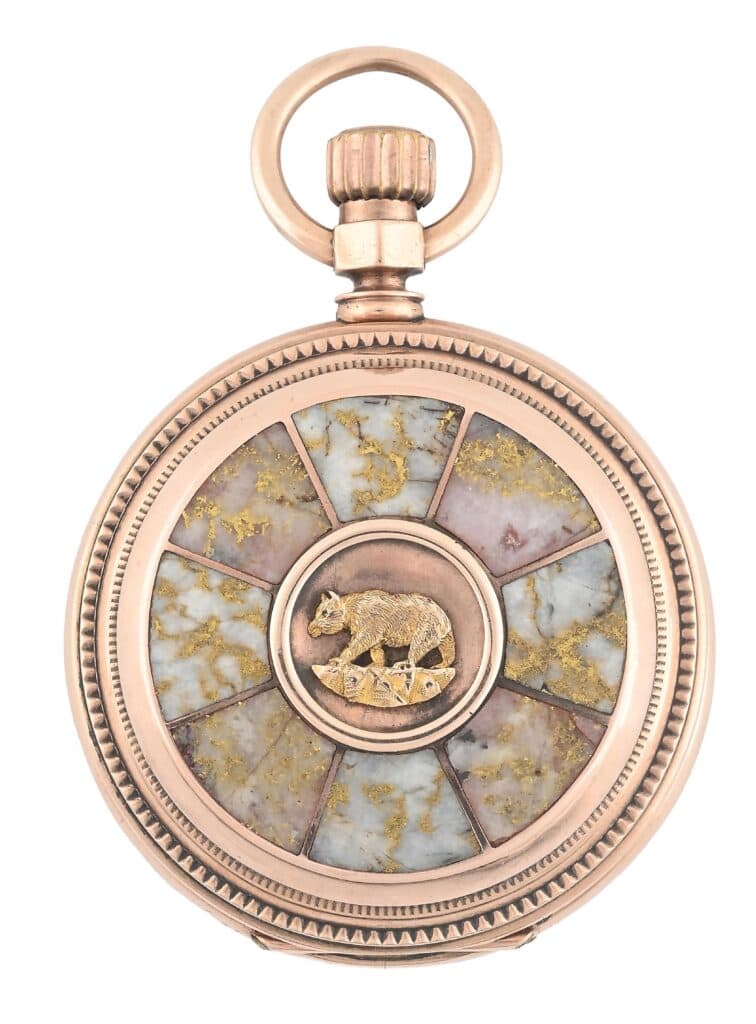
Gold-rush craftsmanship carried a rare 18K pink gold Waltham hunting cased pocket watch to $27,060, just below its high estimate. The case, 54mm across, was set with alternating inlaid panels of pink and white gold-quartz surrounding a central yellow gold California grizzly bear. Inside was a size-18, 21-jewel, circa-1889 Vanguard-grade lever-set movement; outside, a white porcelain Roman-numeral dial with blued steel spade hands. At 138.7 grams gross, it was still running and in good condition.
A buffalo hunter’s Sharps “Old Reliable” belt
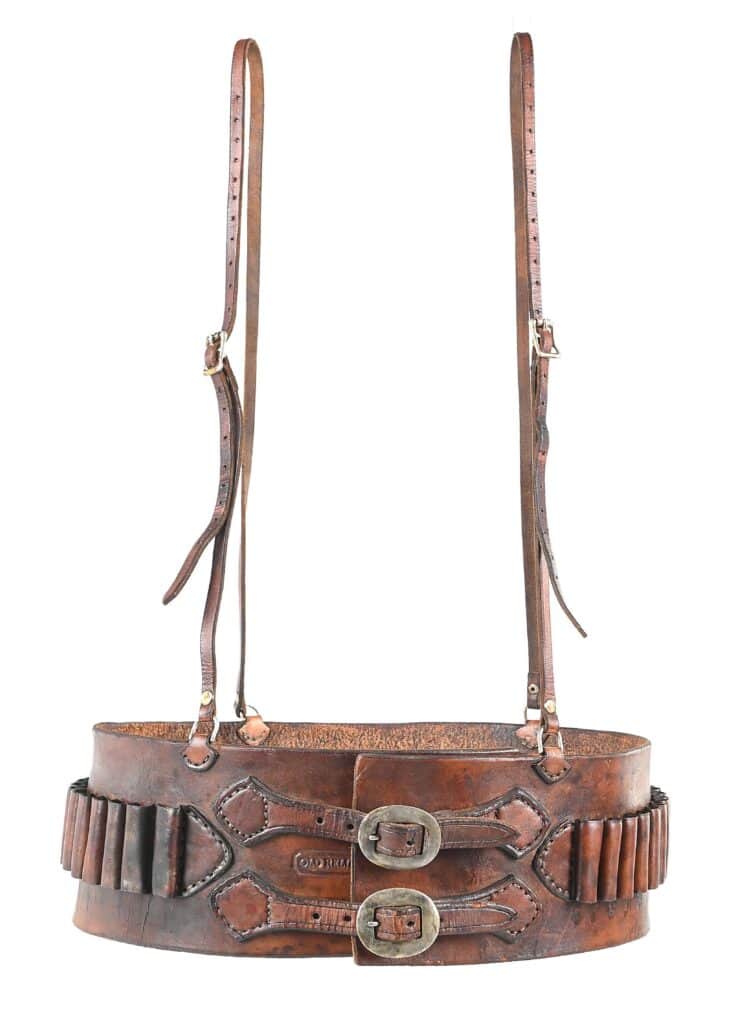
Some lots sell on the story of where they were found. A Sharps “Old Reliable” cartridge belt, similar to the belt worn by famed buffalo hunter Jesse Hendricks, blew past its $6,500 high estimate to settle at $24,600. The belt ran 43½ inches long by 4 inches wide, with 2-inch cartridge loops, twin buckles, and two thin leather shoulder straps with roller buckles for adjustment. It had turned up in an old hunting camp in Northern Ontario, Canada — the frontier equivalent of finding it in an attic.
A Montana-prison horsehair bridle
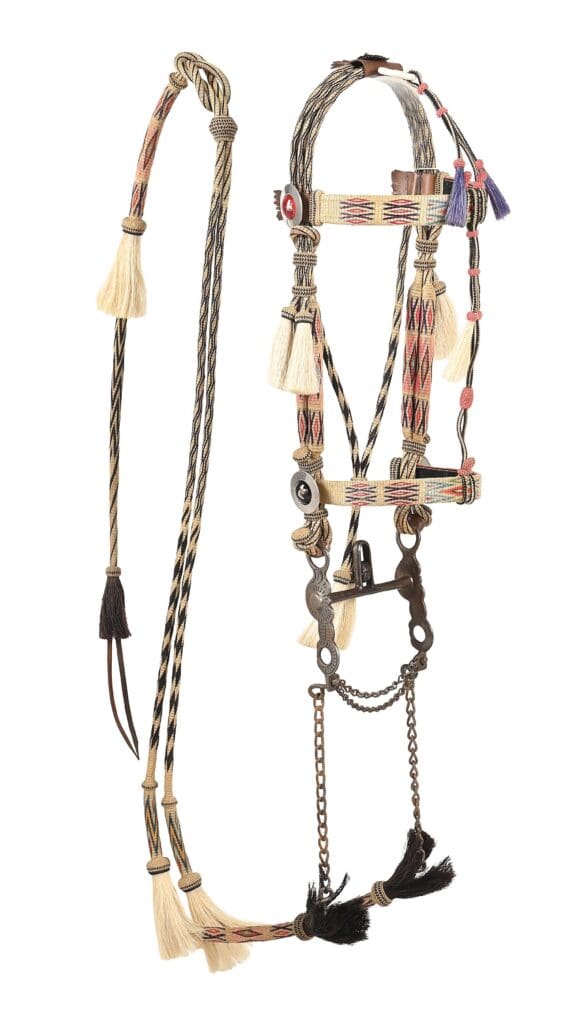
Prison-made horsehair work is a genuine folk-art category, and a strong example doubled expectations here. A hitched horsehair bridle with its original kissing-bird-style half-breed bit, crafted in a Montana prison, was bid to $17,220, well above its $10,000 high estimate. It was executed on a black-on-cream ground with bright combinations of turquoise, pink, orange, green, purple, red, and blue, and its domed rosette conchos, edged in nickel, carried images of horse heads and running horses.
Mexican colonial silver spurs
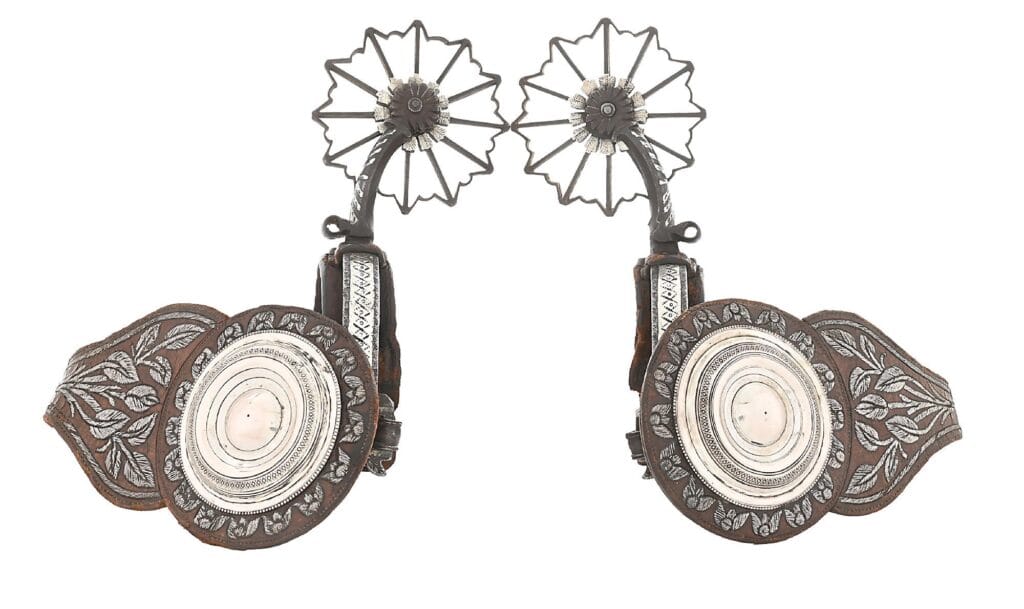
A pair of Mexican colonial silver-mounted spurs, rarely seen in such fine condition and still together as a set, climbed to $14,760, more than double the $6,000 high estimate. They were finished in the best traditions of the Spanish-influenced master craftsmen of colonial Mexico and Alta California: hand-forged iron, double-mounted with inlaid silver bands in stamped dot-and-diamond designs, with straps lined in fine maroon Moroccan leather.
Two lots, one number: $9,840
Two very different pieces of Western Americana tied at exactly $9,840, and both far outran their estimates.
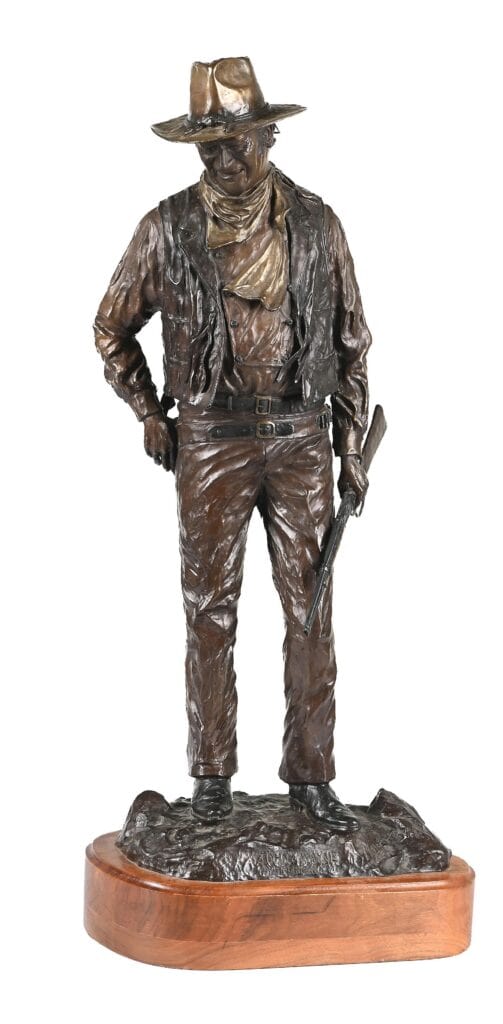
The first was a bronze statue of “The Duke” — John Wayne in Old West garb, carrying a rifle — by sculptor David Manuel (b. 1940). At 28½ inches tall, signed, titled, dated 1979, and editioned 26 of 250, it more than tripled its high estimate. It bore the publisher’s mark of the Bianchi Frontier Museum and the foundry mark of the Maiden Bronze Foundry in Walla Walla, Washington, and came with a Certificate of Authenticity from the Frontier Museum Historical Center.
Matching it dollar for dollar was a large-format Buffalo Bill “Rough Riders” poster, produced by Wieners lithography of London and Paris to advertise shows in Belgium. Measuring 44 by 68¼ inches and mounted in a contemporary frame, it graded a strong 8.9 for condition, its bucking bronco and woolie-chapped cowboy rendered in a mix of French and English text. An original postcard from the event came with it.
Hamley & Company woolly chaps
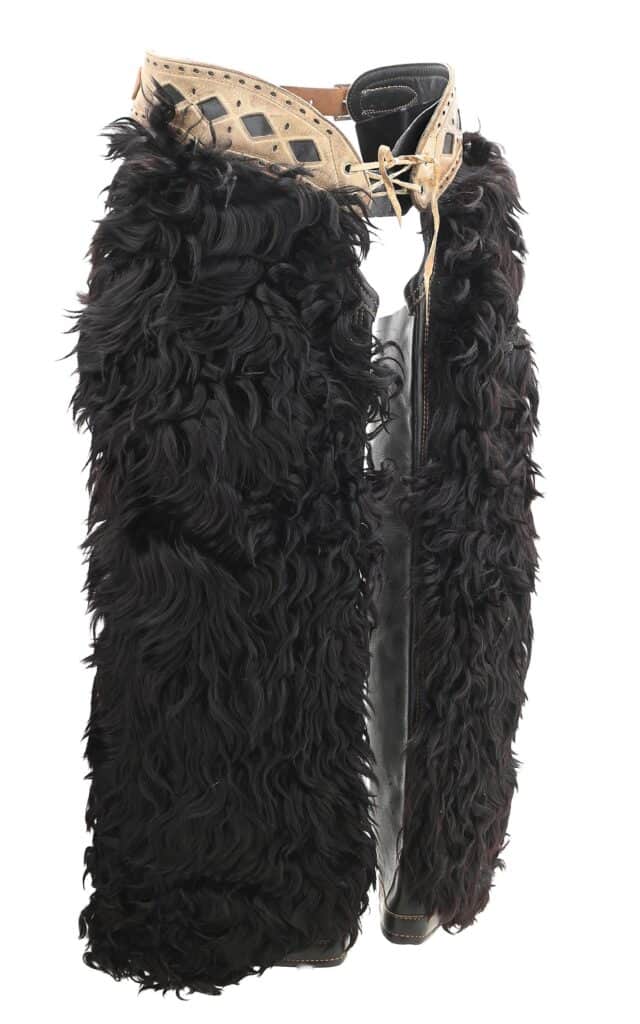
Working cowboy gear from a marquee maker rounded out the highlights. A pair of black woolly chaps by the renowned Hamley & Company of Pendleton, Oregon, fetched $9,225, easily besting its $6,000 high estimate. The 37-inch chaps were in excellent, supple condition with no shedding or hair loss, their tops worked in a striking incised black-diamond pattern under ivory. The maker’s stamp — HAMLEY & CO / PENDLETON / ORE — was struck to one end of the belt.
The takeaway from Morphy’s Old West auction
Morphy’s June Old West auction was a reminder that in Western Americana, the market pays twice: once for the object and once for the story behind it. The blue-chip lots — the Jesse James revolver, the silver Remington, the Nolte-Olsen saddle — sold squarely within estimate, priced by buyers who already knew exactly what they were bidding on. The surprises came from the pieces where provenance and rarity outran the catalog: a buffalo hunter’s belt from an Ontario camp, a prison-made bridle, a matched set of colonial spurs, all of which doubled or better. Condition and a documented past did the rest.
The full results catalog, with high-resolution photography of every lot, is available at Morphy Auctions. To discuss consigning to a future Old West & Native American Art Auction, contact Dan Morphy at 877-968-8880 or [email protected].
All photography in this article is courtesy of Morphy Auctions.
If you know of any forums or sites that should be referenced on this listing, please let us know here.