A technical and historical exploration of one of America’s most perfectly balanced field revolvers
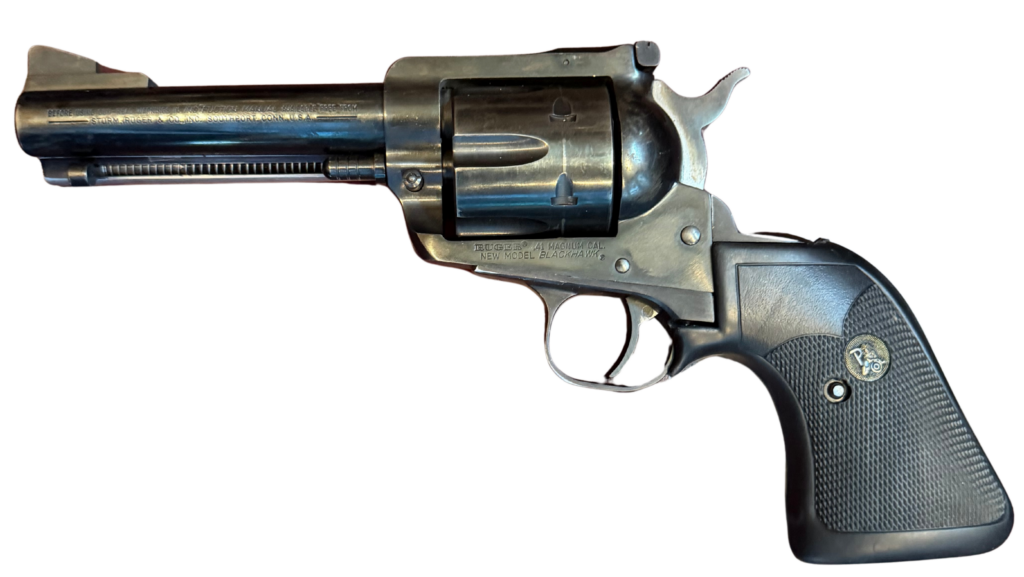
The Ruger Blackhawk chambered in .41 Remington Magnum has earned a place in American firearms culture that few revolvers ever achieve. It is a tool of the field, a piece of engineering philosophy, and a cartridge platform shaped by the hands and minds of some of the most influential figures in handgun history. Collectors value it for its lineage. Shooters value it for its power to weight ratio. Historians value it for its role in the Magnum revolver evolution that defined the twentieth century.
It sits at the intersection of classic single action styling, mid century American craftsmanship, and Magnum era ballistic innovation. The result is a revolver that offers strength, precision, and packability in a combination almost no other handgun replicates.
Ruger’s forging of the modern single action era
Sturm, Ruger & Co. entered the market in 1949 with the now Ruger Standard .22 pistol. The company was young, but Bill Ruger’s vision was expansive. By 1953 Ruger launched the Single Six, a rimfire single action revolver that rekindled public passion for frontier style handguns. Colt had discontinued production of the Single Action Army in 1941. Television westerns of the early fifties created enormous demand for the look and feel of the Old West. Ruger recognized this shift in American culture and moved to fill the gap with a new generation of single action revolvers.
In 1955 Ruger released the first Blackhawk, chambered in .357 Magnum. This revolver retained the external silhouette of the classic Colt Peacemaker but adopted modern internal design features. Ruger’s use of coil springs, heat treated investment cast frames, and fully adjustable rear sights represented a major leap from nineteenth century engineering. For the first time shooters could purchase a single action revolver capable of digesting continuous high pressure loads without fear of stretching frames or loosening timing.
The .44 Magnum arrived next. By 1956 Ruger launched the .44 Blackhawk to meet the rising demand for heavy hunting revolvers. It entered the market only months after the .44 Magnum cartridge itself appeared and provided a far more affordable alternative to the premium priced Smith and Wesson Model 29.
By 1965 Ruger expanded the Blackhawk line yet again with a dedicated .41 Remington Magnum model. This earlier variant is now known as the Old Model or Three Screw Blackhawk. In 1973 Ruger introduced the New Model Blackhawk with the transfer bar safety system, permitting safe carry with all six chambers loaded. For collectors the transition marks one of the most significant milestones in modern Ruger history. For shooters it represents an important step in functional refinement.
Across decades of continuous production the Blackhawk family has included a wide list of chamberings. Ruger has offered the revolver in .30 Carbine, .327 Federal Magnum, .357 Magnum, .41 Remington Magnum, .44 Special, .44 Magnum, .45 Colt, and others. Barrel lengths have ranged from 4.62 inches through 7.5 and beyond. The Blackhawk has become one of the most enduring and respected single action platforms of the twentieth and twenty first centuries.
The 4.62 inch .41 Magnum variant stands out as a near perfect balance between portability and ballistic capability. It is short enough to ride comfortably on the hip through an entire season in the backwoods and strong enough to deliver Magnum class authority against medium game.
The invention of the .41 Remington Magnum
A cartridge designed for real performance rather than marketing
No discussion of the 4.62 inch Ruger Blackhawk can begin without understanding the story of the .41 Remington Magnum itself. Few handgun cartridges carry such a rich and simultaneously tragic history.
The visionaries behind the cartridge
Three influential men shaped the concept.
- Elmer Keith, the father of the .44 Magnum, believed the .357 Magnum lacked the penetration and wound channel needed for reliable performance in the field.
- Bill Jordan, Border Patrol shooter, wanted a cartridge that lawmen could handle with confidence under stress.
- Skeeter Skelton, one of the most respected gun writers of the century, sought a Magnum that hit with authority but remained pleasant enough to shoot without inducing flinch or fatigue.
Together the trio designed a cartridge that would occupy the middle ground between the sharp, flat shooting .357 and the thunderous .44 Magnum. Their idea was deceptively simple. A straight walled case that fired a .410 inch bullet with high sectional density, moderate recoil, and excellent penetration.
The proposed loads versus the released loads
The team envisioned two loads.
- A full power 210 grain hunting load around 1400 feet per second from a long test barrel.
- A mild 200 grain police load around 900 feet per second for service use.
Remington adopted the hunting load nearly as proposed. The police load, however, entered production hotter than intended. Instead of the controllable round Jordan imagined, Remington’s police load produced elevated velocities and harsher recoil than many officers expected. As a result major departments declined to adopt the caliber.
This decision shaped the fate of the .41 Magnum. It became a cartridge beloved by shooters who understood ballistics rather than a cartridge issued en masse by law enforcement.
Technical characteristics
The .41 Magnum case measures 1.290 inches. Overall length is about 1.590 inches. SAAMI pressures sit near 36,000 psi. Standard bullets weigh 170, 195, 200, 210, 220, and 250 grains. The most historically common weight is 210 grains.
From a 4.62 inch Ruger Blackhawk practical velocities generally run:
- 210 grains at 1150 to 1250 feet per second
- 170 grains at 1250 to 1350 feet per second
- Heavy hard cast 220 to 265 grains in the 1100 to 1250 range depending on powder type
These are real world chronograph numbers rather than textbook figures. They produce muzzle energies in the 600 to 800 foot pound neighborhood, which places the .41 squarely in the medium game category.
Why the .41 Magnum became a cult cartridge
Hunters and shooters quickly realized that the .41 Magnum shot flatter than many .44 Magnum loads and maintained higher sectional density for a given bullet weight. It also recoiled less violently while still offering deep penetration and reliable expansion with modern bullets.
Collectors later recognized that the .41 Magnum represents the final chapter of the classic Magnum era that began in the 1930s with the .357 and peaked in the 1950s with the .44. It was the last major American big bore revolver cartridge created for police and field work rather than silhouette shooting or marketing spectacle.
The Ruger Blackhawk 4.62 inch .41 Magnum
Specifications and engineering details
The New Model Ruger Blackhawk in .41 Remington Magnum with the 4.62 inch barrel has long been favored by outdoorsmen and handgun hunters for its blend of size, weight, and strength. Its specifications speak to a revolver engineered for durability and precision.
- Caliber: .41 Remington Magnum
- Capacity: six rounds
- Barrel length: 4.62 inches
- Overall length: approximately 10.5 inches
- Weight: about 38 ounces
- Material: blued alloy steel
- Sights: ramp front with fully adjustable rear
- Action: single action with transfer bar safety
- Rifling: typically six groove with a twist around 1 turn in 20 inches
The 4.62 inch barrel length deserves special mention. This length, often rounded to 4.5 inches in conversation, preserves a traditional single action silhouette while allowing rapid holster clearance. It also maintains enough bore length to generate impressive velocities from the .41 Magnum without demanding the extra weight of a 6.5 or 7.5 inch barrel.
The grip frame follows Ruger’s classic XR3 or XR3-RED pattern depending on generation. This shape allows the revolver to roll upward in recoil rather than striking the web of the hand. This roll is central to how the Blackhawk manages Magnum pressure rounds without punishing the shooter.
The fully adjustable rear sight defines the Blackhawk’s role as a true field revolver rather than a cowboy action replica. It permits fine elevation and windage adjustments for different bullet weights, something especially important with a cartridge like the .41 Magnum where 170 grain, 200 grain, and 210 grain loads often strike at noticeably different heights.
The cylinder walls of the .41 Magnum Blackhawk are famously thick. Ruger’s investment casting process produces frames that are not only robust but dimensionally consistent. This contributes directly to long term durability and consistency in chamber alignment.
Ruger .41 Magnum Barrel Lengths, Bisley Variants, Redhawk Models, and Distributor Exclusives
A Detailed historical and technical overview
Ruger’s history with the .41 Remington Magnum spans far more than the well known 4.62 inch Blackhawk. Over the decades the company has produced multiple barrel lengths, distinct frame and grip shapes, double action models, and numerous limited or distributor exclusive variants. Each configuration fills a particular niche and attracts a different segment of shooters and collectors. Understanding them provides a clearer picture of the depth of Ruger’s commitment to the .41 Magnum and the cartridge’s enduring place in the American firearms landscape.
Ruger .41 Magnum barrel lengths
How barrel length shaped performance, handling, and purpose
Ruger has produced .41 Magnum revolvers in 4.62, 5.5, 6.5, and 7.5 inch configurations across various models, and each length reflects a distinct design purpose.
4.62 inch
The 4.62 inch barrel is the quintessential field length. It offers a fast draw, reduced overall weight, and excellent holster mobility, particularly in thick brush or mountainous terrain. It still provides enough bore length to generate impressive velocities with 170 to 210 grain bullets, typically within 100 to 150 feet per second of longer barrels. Many experienced revolver hunters prefer this length because it balances power with portability and pairs naturally with the Blackhawk’s single action ergonomics.
5.5 inch
Ruger’s 5.5 inch .41 Magnum revolvers appeared primarily in Bisley and limited run Blackhawk models. This length adds stability while preserving reasonable holster convenience. Velocity gains over the 4.62 inch tube are usually modest, but the extended sight radius and forward weight shift contribute to improved precision under field or silhouette conditions. Collectors prize this length because it often appears in short production windows.
6.5 inch
The 6.5 inch barrel was one of Ruger’s earliest .41 Magnum offerings and remains a favorite among traditional handgun hunters. The longer bore provides meaningful velocity increases, often 100 to 200 feet per second more than the 4.62 inch barrel depending on bullet weight and powder selection. It also lengthens the sight radius, improving precision for deliberate shooting. Many silhouette competitors and outdoorsmen relied on 6.5 inch .41 Blackhawks during the height of handgun hunting in the 1970s and 1980s.
7.5 inch
Although less common, the 7.5 inch length appears in certain Ruger .41 Magnum offerings, particularly in the double action Redhawk line. This length optimizes the cartridge’s ballistic capability, producing velocities very close to published factory test barrel data. The configuration appeals to hunters who treat their revolver as a primary weapon rather than a backup. The added mass tames recoil and stabilizes sight alignment during slow, precise shots.
Across all these lengths, the .41 Magnum’s performance demonstrates remarkable consistency. The cartridge responds predictably to increased dwell time, and Ruger’s robust cylinder walls maintain uniform chamber pressure behavior even under maximum published loads.
The Ruger Bisley .41 Magnum
A specialized platform for precision, heavy loads, and silhouette shooting
Ruger adapted its Bisley grip frame to the .41 Magnum to serve a very specific purpose. The Bisley grip was developed to improve control under recoil and to provide a higher, straighter grip geometry suited for precision shooting.
Grip geometry and recoil characteristics
Unlike the traditional plow handle grip, the Bisley grip keeps the hand positioned lower and more vertically. This geometry reduces upward roll and delivers a more linear recoil impulse. For the .41 Magnum, this greatly enhances controllability, especially with heavy 220 to 265 grain hard cast loads frequently used by hog and deer hunters.
Trigger reach and hammer contour
The Bisley hammer sits lower and broader, allowing faster, more consistent cocking during slow fire or silhouette shooting. The trigger shape encourages a clean break, which benefits precision work.
Typical Bisley barrel lengths
Most .41 Magnum Bisleys were produced in 5.5 or 6.5 inch configurations. These lengths complement the Bisley’s stability, promote tight grouping, and fully exploit the cartridge’s flat shooting characteristics.
Collector interest
.41 Magnum Bisleys are highly regarded on the secondary market. Production numbers were never large, and many shooters bought them to use rather than preserve, making high-condition examples increasingly desirable. Their combination of ergonomics and ballistic efficiency makes them favorites among seasoned handgun hunters.
Ruger Redhawk .41 Magnum
The double action powerhouse built for heavy loads and harsh conditions
Ruger’s Redhawk platform introduced the .41 Magnum to a double action frame designed from the ground up for sustained fire with high pressure cartridges.
Engineering and strength
The Redhawk frame is a one piece design that integrates the frame and barrel shroud into a single forging. This eliminates the need for a separate sideplate, dramatically increasing rigidity. Combined with Ruger’s triple lock style cylinder retention and heat treated investment cast construction, the Redhawk in .41 Magnum offers exceptional durability.
Barrel lengths
Most Redhawk .41 Magnum revolvers appeared in 5.5 and 7.5 inch configurations.
- The 5.5 inch Redhawk offers a blend of compactness and controllability, performing well as a field gun and for defensive backcountry use.
- The 7.5 inch Redhawk is a full hunting platform designed for deliberate shooting and maximum ballistic output.
Trigger characteristics
The Redhawk’s single spring mechanism powers both hammer and trigger functions. While heavier than the GP100 or Smith and Wesson N frame triggers, it is extremely durable and settles into a smooth pull with extensive use.
Field role
The Redhawk .41 Magnum is often carried by hunters, ranchers, and trappers who require rapid follow up shots on game or defensive targets. It also serves as a rugged primary hunting handgun where heavy 220 to 265 grain loads may be necessary.
Distributor exclusives and limited production runs
A collector’s guide to the rarest Ruger .41 Magnum revolvers
Ruger has a long tradition of producing limited edition models for major distributors such as Lipsey’s, Davidson’s, and others. These special runs add unique configurations to the .41 Magnum catalog and are of significant interest to collectors.
Typical exclusive features
Distributor exclusives often include:
- Unique barrel lengths not found in standard catalogs
- Rare finish combinations such as stainless with special grips
- Bisley conversions in .41 Magnum with short production windows
- Uncommon sight packages or rollmark variations
- Special serial number prefixes or limited number ranges
Notable examples
Some of the most desirable .41 Magnum exclusives include:
- Lipsey’s limited Bisley Blackhawks in 5.5 inch .41 Magnum
- Rare short run stainless Blackhawks with unique grip frame combinations
- Distributor run 4.62 inch Bisley hybrids that combine short barrels with Bisley grip frames
- Uncataloged Redhawk variants chambered in .41 Magnum with limited regional availability
These exclusives tend to hold their value well and are frequently pursued by Ruger specialists who assemble detailed examples of the brand’s Magnum era production.
Collectibility
Condition, originality, and barrel length rarity strongly influence value. Models that combine the Bisley grip with mid length barrels or stainless finishes typically command the highest premiums. As production numbers were often extremely small, many exclusives are far scarcer than comparable standard catalog items.
Shooting experience
How the revolver feels in the hand and performs on the range and in the field
The 4.62 inch Ruger Blackhawk in .41 Magnum has a shooting personality that has endeared it to generations of revolver enthusiasts.
Recoil character
Recoil is substantial but smooth. The revolver rises in a straight arc, rotates through the plow handle grip, and settles back on target with a rhythm that becomes instinctive. Unlike many double action revolvers with enclosed backstraps, the Blackhawk does not hammer the web of the hand. Instead the energy is spread through the rotation of the frame.
This recoil impulse is one of the reasons the .41 Magnum Blackhawk feels less punishing than a .44 Magnum Super Blackhawk of similar length, despite delivering hunting class energy.
Accuracy
Accuracy is excellent. The Blackhawk’s lockwork provides a consistent single action trigger pull, the frame geometry provides rigidity, and the barrel quality ensures good bullet stabilization. Many examples will place quality ammunition into two inch groups at twenty five yards with iron sights. Handloaders often squeeze even more performance from the platform.
Field performance
The revolver is at home in rough country. Its combination of size, weight, and authority makes it ideal as a backcountry belt gun for deer, hogs, black bear, and general defense in remote terrain. The 4.62 inch barrel clears the holster quickly. It does not snag clothing or brush. It distributes weight comfortably for long days outdoors.
Cartridge comparisons
A technical look at where the .41 Magnum stands among classic revolver calibers
.38 Special
A standard 158 grain .38 Special produces roughly 750 to 850 feet per second. The energy levels seldom exceed 250 foot pounds. The .38 remains a fine defensive cartridge but it is not a field cartridge in the Magnum sense.
.357 Magnum
A 158 grain .357 Magnum typically generates 1200 to 1400 feet per second with energies in the 500 to 700 foot pound range. It penetrates deeply and shoots flat. The .41 Magnum surpasses it in bullet weight, frontal area, and momentum.
.32 H&R Magnum and .327 Federal Magnum
The .32 H&R Magnum offers performance similar to the classic .32-20 Winchester. The .327 Federal Magnum expands the concept dramatically with pressures near 45,000 psi and velocities rivaling or surpassing many .357 loads. These cartridges excel in compact defensive revolvers, but they are not designed for medium game in the way the .41 Magnum is.
.44 Magnum
The .44 Magnum is the heavyweight of the revolver world. A typical 240 grain load produces 1200 to 1400 feet per second and approaches or exceeds 1000 foot pounds of energy. It remains the benchmark for hard recoiling revolvers.
The .41 Magnum sits just behind it in raw power but often surpasses it in trajectory flatness for common bullet weights. The .41 also delivers a smoother recoil impulse in many revolvers, particularly in medium frame single actions like the Blackhawk.
The .41 Magnum among Ruger’s revolver families
Ruger has produced several revolver families that define its brand.
- The Single Six serves as a rimfire training and small game revolver.
- The Blackhawk is the company’s cornerstone single action platform.
- The Super Blackhawk sits atop the big bore hunting category.
- The Vaquero and New Vaquero cater to traditionalists and cowboy action shooters.
- The GP100 and SP101 represent rugged double action revolvers in .357 and .327 Federal Magnum.
- The Redhawk and Super Redhawk deliver heavy double action performance for serious hunting cartridges.
The .41 Magnum Blackhawk occupies a unique place within this lineup. It carries more easily than the Super Blackhawk. It hits harder than the .357 Blackhawk. It offers finer control than many .44 Magnum revolvers. It serves as the quintessential medium game field revolver.
Other manufacturers and the .41 Magnum legacy
The .41 Magnum ecosystem extends beyond Ruger.
Smith and Wesson entered the caliber with the Model 57 and Model 58. The Model 57 offered high polish elegance with adjustable sights. The Model 58 represented a more utilitarian fixed sight police revolver. Later stainless models such as the 657 expanded the line.
Taurus developed compact .41 Magnum Trackers that emphasized portability. Freedom Arms built extremely strong and accurate single action revolvers in .41 Magnum, such as the Model 83, which many consider one of the most precise revolvers ever produced.
These manufacturers highlight how versatile the .41 Magnum can be when applied to different platforms. The Ruger Blackhawk distinguishes itself through ruggedness, affordability, and field ready ergonomics.
The unique place of the Ruger Blackhawk 4.62" .41 Magnum
Why collectors, shooters, and historians hold it in such high regard
The 4.62 inch .41 Magnum Blackhawk represents one of the best power to weight ratios in the revolver world. It remains for its balance on the belt, its strength under pressure, and its ability to transform the potential of the .41 Magnum into real world performance.
Its significance lies in several factors.
- It is strong enough to fire the heaviest published .41 Magnum loads without strain.
- It is compact enough to be carried daily on long hunts or in backcountry settings.
- It is accurate enough to serve as a primary hunting weapon.
- It remains part of an uninterrupted revolver lineage stretching from the 1950s to the present.
- It expresses the original design philosophy of Bill Ruger more faithfully than almost any other handgun.
Collectors admire it for its place in the Magnum era’s final chapter. Shooters admire it because it simply works and works well. Historians admire it for how completely it represents the convergence of mid century ballistic innovation and modern manufacturing.
The Ruger Blackhawk 4.62 inch .41 Remington Magnum is more than a revolver. It is a bridge between eras, a tool perfected by tradition, and one of the finest expressions of the American single action concept.
Ruger's website can be found here.
A direct link to the current New Model Blackhawks can be found here.
Buy a Ruger in .41 Remington Magnum here!
If you know of any forums or sites that should be referenced on this listing, please let us know here.