When Accuracy Became a Weapon of War
In the summer of 1861, a flamboyant New York inventor and marksman named Hiram Berdan placed an advertisement in newspapers across the Northern states. He was recruiting the finest rifle shots in the Union for a new kind of military unit -- one in which every soldier would be a trained marksman, equipped with the best available firearm, and deployed not in massed battle lines but as precision shooters targeting enemy officers, artillerists, and scouts at ranges that ordinary infantry could not reach. The unit would become the 1st and 2nd United States Sharpshooters, and the rifle they eventually carried -- the Sharps New Model 1859 -- would help birth a significant concept: the deliberate use of aimed, long-range rifle fire as a tactical weapon independent of conventional infantry formations.
This is the story of how the Sharps rifle and the men who carried it changed the American Civil War -- and, in doing so, laid the groundwork for modern military sniping and precision infantry doctrine.
Hiram Berdan: Showman, Inventor, and Controversial Commander
Hiram Berdan (1824-1893) was already one of the most famous rifle shots in America before the war. He had won multiple national shooting championships and was renowned for demonstrations in which he shot at targets 600 yards away while lying on his back, using his feet to support the rifle. He was also a mechanical engineer who held patents on various inventions, including a repeating rifle mechanism and -- most significantly for history -- the Berdan primer, still used in most centerfire ammunition manufactured outside the United States today.
When the Civil War broke out, Berdan proposed forming two regiments of sharpshooters drawn from across the Union states. Recruits had to pass a shooting test: ten consecutive shots placed within a 10-inch circle at 200 yards. Many applicants could do this with their eyes half-closed. The best could group their shots into a space the size of a man's fist.
The men who passed these tests were farmers, hunters, target shooters, and woodsmen -- men who had grown up with rifles in their hands. They were not parade-ground soldiers. They were practical marksmen who understood wind, range estimation, and the behavior of bullets in flight. What they needed was a firearm worthy of their skills.
The Sharps vs. the Springfield: A Bureaucratic Battle
Berdan originally wanted his men armed with target rifles of their own choosing -- heavy-barreled muzzle-loaders with precision sights. The Army's Ordnance Department, led by the notoriously conservative Brigadier General James W. Ripley, initially issued the Sharpshooters standard Springfield Model 1861 rifled muskets -- the same muzzle-loading .58-caliber rifle carried by every Union infantryman.
Berdan was furious. The Springfield was a fine infantry weapon, but for precision shooting at extended range, it was inadequate. He lobbied relentlessly for the Sharps New Model 1859 breechloader, arguing that its faster loading, superior accuracy, and more reliable ignition made it the only acceptable arm for his specialized unit.
The bureaucratic fight lasted months. Ripley distrusted breechloaders in general, believing they encouraged soldiers to waste ammunition. He also resented Berdan's celebrity and political connections. But Berdan went over Ripley's head, securing support from President Lincoln himself -- Lincoln was personally fascinated by firearms technology and had test-fired several breechloaders on the White House grounds. By early 1862, the Sharpshooters finally received their Sharps rifles.
The Sharps New Model 1859: Technical Superiority
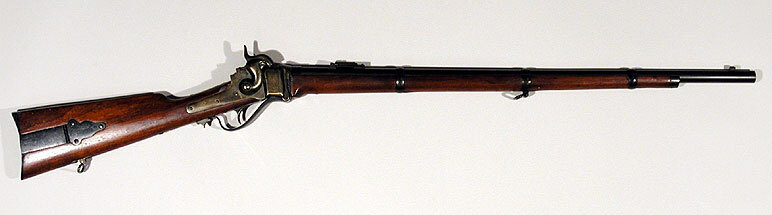
The Sharps New Model 1859 that Berdan's men carried was a .52-caliber, single-shot breechloader with a falling-block action operated by the trigger guard lever. It fired a paper or linen cartridge containing a .52-caliber bullet and a measured charge of black powder. Ignition was provided by a Maynard tape primer or standard percussion cap.
Compared to the Springfield muzzle-loader, the Sharps offered decisive advantages:
- Rate of fire: A trained soldier could fire 8-10 aimed shots per minute with the Sharps, compared to 2-3 with a muzzle-loader. The breech-loading system allowed the shooter to reload while lying prone or behind cover -- impossible with a muzzle-loader that required the soldier to stand to ram the charge.
- Accuracy: The Sharps' tight-fitting breechblock and consistent ignition produced more uniform velocities and tighter groups than the Springfield. At 300-500 yards, the difference was pronounced.
- Reliability in weather: Paper cartridges loaded from the breech were better protected from rain and damp than those rammed down a muzzle. The Sharps could fire reliably in conditions that would render a muzzle-loader useless.
- Tactical flexibility: Because the Sharps could be loaded and fired from any position -- prone, kneeling, behind a tree, or from a rooftop -- it allowed the Sharpshooters to exploit cover and concealment in ways that conventional infantry could not.
Berdan's Sharpshooters in Combat
The 1st and 2nd U.S. Sharpshooters served in the Army of the Potomac throughout the war's major Eastern Theater campaigns. Their tactics were unlike anything the Army had previously employed. Rather than standing in line of battle, they operated in small teams of two to four men, occupying advanced positions ahead of the main line and targeting high-value individuals:
- Officers: Confederate officers were distinguished by their uniforms, swords, and positions on horseback. The Sharpshooters systematically targeted them, knowing that removing an officer from command could paralyze an entire regiment. At Gettysburg, Berdan's men were credited with killing several Confederate officers during the fighting on the second day.
- Artillerists: A well-served cannon was one of the deadliest weapons on the Civil War battlefield. The Sharpshooters learned to identify the section chief, gunner, and No. 1 man on each piece and pick them off at ranges of 400-600 yards. A battery that lost its key men became temporarily impotent.
- Scouts and signalmen: Confederate signal officers using flags to communicate between units were vulnerable to a Sharps bullet at long range. Disrupting communications could blind an entire division.
Key Battles: Gettysburg and the Wilderness
Gettysburg, July 2, 1863
On the second day at Gettysburg, Berdan's Sharpshooters was central to the fighting around the Peach Orchard, Devil's Den, and the Wheatfield. Berdan personally led a reconnaissance in force toward the Emmitsburg Road, where his men clashed with elements of Cadmus Wilcox's and Ambrose Wright's brigades. The Sharpshooters' rapid, accurate fire created the impression of a much larger force, delaying the Confederate advance and providing crucial intelligence about the direction of Longstreet's assault.
During the fighting around Devil's Den, individual Sharpshooters took positions among the massive boulders and engaged Confederate soldiers at ranges beyond 400 yards. The rocky terrain was ideal for their style of warfare -- natural cover, clear fields of fire, and elevated positions from which they could observe and shoot. Confederate accounts from this sector repeatedly mention the devastating effect of accurate long-range fire that seemed to come from invisible marksmen.
The Wilderness and Spotsylvania, May 1864
By the spring of 1864, the Sharpshooters were seasoned veterans. During the Battle of the Wilderness, they fought in the dense Virginia forest where visibility was often less than 50 yards -- an environment where their individual marksmanship was less important than their ability to operate independently in small teams. At Spotsylvania Court House, the Sharpshooters occupied advanced positions around the infamous "Bloody Angle" and engaged Confederate defenders at close range for nearly 24 hours of continuous fighting.
The Sharps Carbine: Cavalry's Breechloader
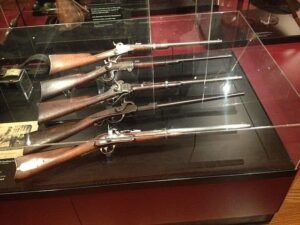
While Berdan's men carried the full-length Sharps rifle, an even larger number of Sharps firearms served in the Civil War as carbines -- shortened versions with 22-inch barrels, issued primarily to Union cavalry. The Sharps Carbine in .52 caliber was the most widely issued single-shot carbine of the war, with approximately 80,000 produced.
Union cavalry troopers armed with Sharps carbines could reload on horseback -- something impossible with a muzzle-loader. This capability transformed cavalry tactics. Instead of fighting primarily with sabers and pistols, Union horsemen could dismount and deliver rapid, accurate fire as mounted infantry, then remount and reposition. The Spencer repeating carbine eventually supplanted the Sharps in cavalry service, but the Sharps carbine was the weapon that first proved the concept of breech-loading cavalry arms.
Confederate Responses and Counter-Sniping
The Confederacy recognized the threat posed by Berdan's Sharpshooters and attempted to respond in kind. Confederate sharpshooter units were formed, most notably the Whitworth Sharpshooters, who used imported British Whitworth rifles -- muzzle-loading .45-caliber hexagonal-bore rifles equipped with Davidson telescopic sights. The Whitworth was arguably more accurate at extreme range than the Sharps, and Confederate Whitworth shooters scored some of the war's most notable long-range kills, including the death of Union General John Sedgwick at Spotsylvania in May 1864, struck at approximately 800 yards.
However, the Whitworth was a muzzle-loader, which meant its rate of fire was much lower than the Sharps. The Confederacy also lacked the industrial capacity to produce them in quantity -- most were imported through the blockade. As a result, the Union maintained a significant advantage in the number and deployment of sharpshooter units throughout the war.
Throughout its production history, the Sharps Rifle Manufacturing Company manufactured various models to cater to different needs. The Sharps Model 1851 featured a distinctive falling-block design and became popular among soldiers and civilians alike. The Model 1859, known as the "New Model," introduced refinements to enhance durability and reliability. The Sharps Model 1863 Carbine, a shortened version of the rifle, gained popularity among Union cavalry units due to its maneuverability and potent firepower.
Legacy: From Civil War Sharpshooters to Modern Snipers
The tactics developed by Berdan's Sharpshooters -- small-team deployment, target prioritization, concealment, range estimation, and patient aimed fire -- are the direct ancestors of modern military sniping doctrine. The U.S. Army did not formally establish sniper training programs until World War I, but the principles were all present in the Civil War Sharpshooter units.
The Sharps rifle itself continued to evolve after the war. The Model 1874, chambered in massive black-powder cartridges like the .50-90 Sharps and .45-110, became the well-known buffalo rifle of the American West and achieved well-known status at the Battle of Adobe Walls in 1874. But it was in the Civil War that the Sharps first proved what a precision firearm in the hands of a skilled marksman could accomplish -- and in doing so, changed the nature of warfare forever.
For more on the Sharps rifle family, see our comprehensive article on The Evolution of Sharps Rifles: From Christian Sharps to The Sharps Rifle Company. For the Sharps' role at Adobe Walls, see Billy Dixon's Famous Shot at Adobe Walls.
Read more about Berdan's Sharpshooters and Civil War Sharps rifles:

If you know of any forums or sites that should be referenced on this listing, please let us know here.