A classic cowboy rifle that eats modern pistol ammo
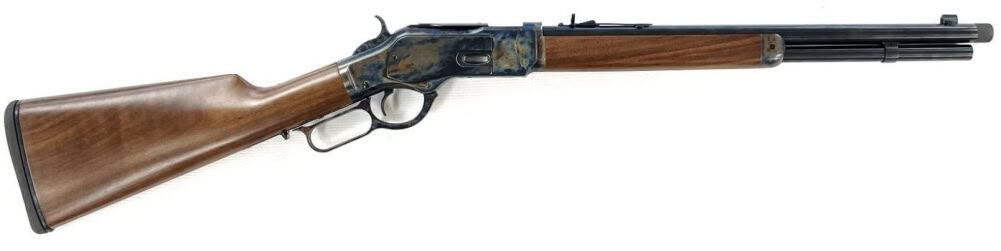
Lever guns are having a real moment again, and in the middle of all the tactical rails and space age stock designs sits something delightfully unexpected. The Taylor & Company TC73 takes the classic 1873 rifle profile that shaped the Old West and marries it to the most common handgun cartridge on the planet today, the 9mm Luger. The result is a rifle that feels like stepping back into 1875, yet runs on the same boxes of ammo that feed modern carry pistols and pistol caliber carbines.
What makes the TC73 special is not only its unusual chambering. It is also the first 100 percent American made firearm to wear the Taylor’s name, a significant milestone for a company that built its reputation importing Italian made reproductions.
Taylor’s & Company: Old West specialists take the next step
Taylor’s & Company was founded in 1988 in Winchester, Virginia, a fitting hometown for a firm dedicated to classic Winchester era firearms. The company began supplying parts and accessories for Civil War reenactors, then moved into importing full firearms that recreated 19th century designs with modern machining and steels.
Most Taylor’s branded guns have been manufactured by partners such as Uberti, Pietta and Armscor, built to Taylor’s specifications, then tuned and refinished stateside. These include a wide range of 1873 pattern rifles and carbines, 1892s, single action revolvers, and percussion arms that are popular with cowboy action shooters and history minded shooters.
The TC73 marks a break from that model. For this rifle Taylor’s committed to an all American production path. Every part is made in the United States, the rifle is assembled and finished here, and Taylor’s brought its long experience tuning imported 1873s directly into the design from the ground up.
That decision matters for buyers who want a classic pattern lever gun that is not only historically styled but domestically produced. It also allowed Taylor’s to incorporate internal refinements that would be difficult to bolt onto an existing third party design.
The 1873 pattern: “The gun that won the West” in a new suit
Winchester introduced the Model 1873 as an evolution of the earlier 1866, strengthening the action and moving from a rimfire cartridge to the new centerfire 44-40. After its initial introduction, the Model 1873 was eventually offered in 38-40 and 32-20 as well, which quickly became popular revolver cartridges. That rifle and carbine combination let a frontiersman carry one type of ammunition for both long gun and sidearm, a major selling point in an era when logistics meant saddle bags, not shipping pallets.
The 1873 pattern combined a tubular magazine, a toggle link action, a side loading gate and a dust cover over the ejection port. It offered respectable capacity, relatively quick follow up shots, and reasonable reliability with black powder ammunition. More than 700,000 original Winchesters were produced, and modern reproductions from Italy and Japan remain strong sellers.
The TC73 retains the soul of that design but with a chambering that never existed in the 19th century. It is, functionally, an 1873 pattern rifle reengineered around 9mm Luger.
TC73 specifications and features
The TC73 is built as a handy rifle length lever gun with proportions intentionally close to classic 1873 sporting rifles.
Key specifications
- Caliber: 9mm Luger
- Barrel length: 18 inches
- Overall length: 37.5 inches
- Magazine: 10 round tubular magazine, side loading gate
- Barrel: Blued steel, threaded 5/8x24 at the muzzle with a knurled thread protector
- Receiver: Case colored steel, traditional dust cover on top
- Stock and forearm: American walnut, straight grip
- Butt: Rubber recoil pad rather than a steel crescent plate
- Sights: Dovetailed white bead front, semi buckhorn rear with reversible notch plate, drift adjustable
- Trigger: Taylor Tuned action, approximately 3 to 4 pound pull
- Capacity: Ten rounds of 9mm in the tube, plus one in the chamber if desired
- MSRP: Around 1,999 USD at launch
Internally, Taylor’s highlights an improved carrier block design, fully machined internal parts, hardened screws, and a lightened trigger. This is not a parts bin rifle with metal injection molded components; all major parts are machined from steel.
Externally, the rifle offers genuine bone charcoal style case coloring on the frame and lever, with a deep blue on the barrel and magazine tube. The walnut furniture has straight classic lines and tasteful figure rather than wild grain.
The threaded barrel sets the TC73 apart from most traditional lever guns. The 5/8x24 pattern accepts a wide range of centerfire rifle suppressors and muzzle devices. Suppressor use requires attention to alignment and manufacturer approval, but the provision is there from the factory.
A note on appearance and craftsmanship
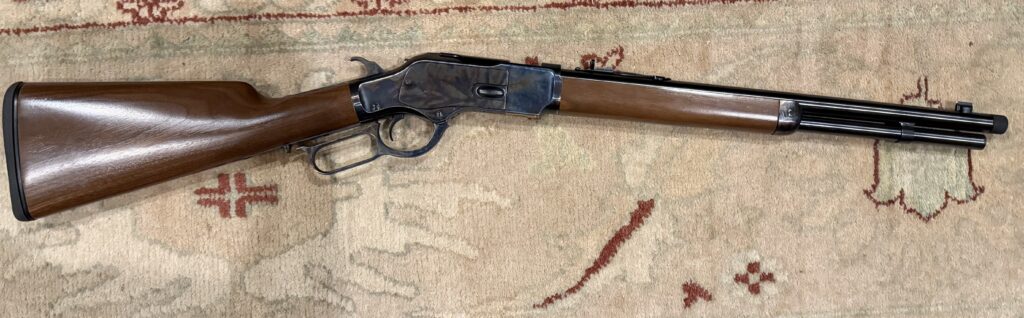
The TC73 is more than a mechanical achievement. It is also a visually striking rifle that displays the same attention to finish that made nineteenth century Winchesters admired as much for their beauty as their function. The case hardening on the receiver and lever shows deep, swirling color patterns that reflect the classic bone and charcoal process. Under natural light these blues, purples, and subtle amber tones create a richness normally seen on high grade custom guns. Paired with well fitted American walnut, smooth lines, and a traditional profile, the TC73 presents itself as a rifle that invites admiration even before the first round is chambered.
Engineering a tube fed 9mm lever gun
Chambering a toggle link 1873 pattern rifle in 9mm is not as simple as cutting a different chamber. The original cartridges were long, gently tapered and featured protruding rims, which are friendly to tubular magazines and carrier blocks. The 9mm Luger is shorter, more abrupt in shape, and rimless.
To make the TC73 work, Taylor’s redesigned the carrier block, timing and internal geometry so that rimless cartridges feed smoothly from a straight tube, lift to the chamber and extract without case head slippage.
Our experiences at the range confirm that this is more than marketing language. Extended shooting with a mix of bullet weights and profiles, from 70 grain lightweight loads through 147 grain subsonics, has shown the TC73 offers reliable feeding and ejection without chronic nose dives or stovepipes.
The magazine holds ten rounds, which is generous for a rifle of this length. Shorter cartridges generally mean shorter stroke, and the TC73 lever throw feels quick and compact compared to a full length rifle in a longer 19th century cartridge. That shorter stroke, combined with the tuned internals, gives the action a very smooth feel deserving of high praise.
Shooting experience: soft recoil, fast follow ups, and real accuracy
When you step up to the line to shoot with a TC73, you tend to notice three things almost immediately: the smoothness of the action, how mild the recoil feels, and how easy it is to ring steel or print tight groups at typical pistol caliber distances.
Recoil and handling
Out of an 18 inch barrel, 9mm loads burn most of their powder well before the muzzle, which keeps blast and recoil modest. Felt recoil is minimal, even with full power 115 grain and 124 grain range loads, and positively gentle with 147 grain subsonic ammunition.
The rifle balances just ahead of the receiver, with enough forward weight to stay on target between shots but not so much that it feels nose heavy. At roughly 37.5 inches overall, it remains compact enough for truck gun, farm, or home property use while still offering a full sight radius and comfortable shoulder weld.
The rubber butt pad is a quiet modern concession, replacing the traditional curved steel plate. It anchors the rifle in the shoulder and takes the already mild recoil down another notch.
Trigger and cycling
The Taylor Tuned trigger typically breaks between three and four pounds with a clean, predictable release and little overtravel. Coupled with the short lever throw and slick carrier, cycling the action feels effortless. Several independent tests remark that running the gun rapidly is surprisingly easy, even for shooters new to lever rifles.
Accuracy
With iron sights and factory range ammunition, five shot groups around two inches at fifty yards are common, and many testers have seen better. For a light lever rifle with a semi buckhorn rear sight, that is perfectly respectable performance.
The white bead front sight and semi buckhorn rear are old friends to cowboy shooters. Once the eye remembers how to center that bead in the notch, rapid hits on steel plates or reactive targets out to 100 yards are straightforward.
Suppressed shooting
The threaded 5/8x24 muzzle invites a suppressor. With subsonic 147 grain loads, an 18 inch barrel and a quality can, reviewers describe the TC73 as one of the quietest manually operated centerfire rifles they have shot, especially in outdoor settings.
The combination of low powder charge, no gas system, and no action noise beyond the lever stroke makes this rifle particularly friendly for recoil sensitive shooters, new shooters, and anyone who values a subdued signature on the back forty.
The TC73 in context: 1873 lineage and 9mm lever gun competitors
Among the 1873 family
To place the TC73 in its proper historical setting, it helps to return to the origins of the lever action rifle in America. The story begins with Benjamin Tyler Henry, whose 1860 Henry rifle introduced the concept of a reliable lever operated repeater with a tubular magazine. Henry’s toggle link action allowed for fast follow up shots at a time when most rifles still relied on single shot mechanisms. It also established the mechanical foundation that would carry forward into the next generation.
Nelson King, Winchester’s plant superintendent, took Henry’s work and improved it significantly. King created the side loading gate and redesigned the magazine system for the Winchester 1866, which solved several drawbacks of the Henry. The new loading method allowed the shooter to top off the rifle without removing a magazine follower, and the improved magazine tube resisted damage far better in rugged conditions. These innovations propelled Winchester into a position of dominance and paved the way for the next evolutionary step.
When the Model 1873 arrived, it represented the most refined form of the Henry and King lineage. The toggle link action was strengthened. The rifle switched to centerfire ammunition. The 44 40 cartridge became the standard chambering and quickly proved itself as one of the most useful frontier rounds ever introduced. Winchester followed with versions in 38 40 and 32 20, giving buyers a range of power levels that suited everything from small game to personal defense.
The 1873 also popularized the matched rifle and revolver concept. A cowboy could carry a Colt revolver and a Winchester rifle that both fired 44 40, which simplified ammunition supply in an era when a saddle bag served as the entire logistical system. This pairing was one of the most important reasons for the rifle’s lasting success across the American West.
It is important to note that John Moses Browning had no involvement in the creation of the 1873. Browning would not begin his work with Winchester until the early 1880s, well after the 1873 had already become one of the most iconic rifles in American history. His later contributions shaped the 1886, 1892, 1894, and 1895, all of which used entirely different locking systems and abandoned the Henry style toggle link. The 1873 belongs to the earlier Henry and King lineage, not to the Browning era.
Modern reproductions of the 1873 by Uberti, Miroku, and American makers remain faithful to the historic pattern. They maintain the familiar slab sided receiver, the dust cover, the toggle link system, and the classic chamberings rooted in black powder design. The TC73 echoes these features externally, yet departs from the traditional configuration in several important ways. It chambers a modern rimless cartridge. It includes a threaded barrel. It features a rubber recoil pad in place of the old steel crescent. Most notably, it is manufactured entirely in the United States.
In spirit, the TC73 carries forward the original goal of the 1873. It lets a shooter pair a common handgun cartridge with a lever rifle for practical, efficient use. Where nineteenth century shooters matched a Colt revolver to a Winchester in 44-40, modern shooters can now match their 9mm pistol to a lever action that retains the charm of a classic frontier rifle.
Among other 9mm lever actions
Once set against the small group of modern 9mm lever rifles, the TC73 becomes even more distinctive. The Patriot Ordnance Factory Tombstone is the most visible competitor, but it occupies a very different space. The Tombstone uses detachable box magazines, ghost ring sights, and a tactical furniture layout that speaks to defensive and sporting roles rather than historical appeal. It behaves like a lever operated pistol caliber carbine with an emphasis on capacity and modern ergonomics.
The TC73 moves in the opposite direction. It preserves the lines and handling of a nineteenth century rifle while integrating modern ammunition and quiet shooting potential through its threaded muzzle. With a tubular magazine, color case style finish, walnut furniture, and traditional sights, it stands alone as the only 9mm lever action that truly looks, feels, and operates like a classic 1873.
Its uniqueness comes from this blend. It gives shooters the romance and mechanical personality of the Old West. It offers the economy and convenience of the most widespread pistol round in the world. It remains visually faithful to its ancestors while functioning in a way that Henry and King could only have dreamed of if they had access to modern steels, modern machining, and modern ballistics.
The TC73 is not trying to compete with magazine fed carbines. It is not a tactical lever rifle in disguise. It is a traditional rifle that has been reimagined to meet the needs of modern shooters who want authentic handling along with accessible ammunition. It bridges two centuries of design thought in a way no other rifle presently does.
Practical roles: from plinking to property defense
The TC73 is not a budget rifle, but it was never intended to be. With an MSRP around 1,999 dollars, it targets buyers who appreciate craftsmanship and plan to keep the gun for the long haul.
Within that space, the rifle fills several roles very well.
- Range plinker and trainer
Cheap, available 9mm ammunition and the mild recoil make it an excellent rifle for long afternoons on steel targets or paper. New shooters can focus on sight alignment and lever manipulation without being punished by blast or recoil. - Cowboy action and historical style shooting
While match rulebooks vary, many organizations allow pistol caliber lever guns that visually match 19th century patterns, and Taylor’s offers a smooth thread protector to maintain a traditional profile when a suppressor is not attached. - Property, ranch, or home defense
Ten rounds of 9mm in a handy, reliable rifle with simple manual of arms is a perfectly credible option for close range defensive needs in jurisdictions where semiauto rifles are restricted or where the owner prefers a manually operated gun. Commenters in cowboy action circles have already pointed to the TC73 as a logical choice for shooters who are more comfortable with a lever than a semi auto. - Suppressor host
With its combination of subsonic ammunition compatibility and threaded barrel, the TC73 makes a strong candidate for those who want to enjoy very quiet shooting without the mechanical noise of a gas operated semi automatic.
A unique place in the lever gun universe
The Taylor & Company TC73 9mm 1873 rifle is not just a curiosity, although it is certainly eye catching. It represents a serious effort to merge the charm and heritage of the 1873 pattern with the logistical realities of the 21st century.
- It keeps the look and feel of a classic Winchester style lever rifle.
- It chambers a ubiquitous, affordable pistol cartridge.
- It brings 100 percent US manufacture to a brand known for imported replicas.
- It offers modern touches like a threaded muzzle and tuned internals without losing the spirit of the original design.
For shooters who love the idea of a cowboy rifle that drinks from the same ammo stash as their carry pistol, and who appreciate smooth machining, true case coloring and walnut, the TC73 occupies a very special niche. Among 1873 pattern rifles the TC73 stands out as the practical modernist. Among 9mm carbines it stands out as the polished traditionalist.
That dual identity, combined with its strong performance on the range, is exactly what gives the TC73 its unique place in today’s lever gun landscape.
Taylor & Co can be found here.
You can buy a TC73 here or here.
If you know of any forums or sites that should be referenced on this listing, please let us know here.