
America’s First Military Rifle
Origins of the Model 1803 Rifle
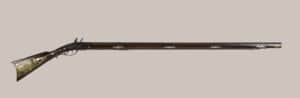
The early 19th century marked a turning point in American firearm manufacturing. With the establishment of the Harpers Ferry Armory in 1799, the United States took a significant step toward self-sufficiency in arms production. Recognizing the need for a standardized rifle to supplement smoothbore muskets, the U.S. military commissioned the development of what became known as the Model 1803 Rifle—the first standardized military rifle produced in the country.
Prior to the Model 1803, American troops primarily relied on imported firearms or the long-barreled Kentucky Rifle (also called the Pennsylvania Rifle), which, though highly accurate, was not standardized for mass military use. The adoption of the Model 1803 reflected a shift toward domestically produced, rifled firearms, designed for both improved accuracy and logistical efficiency.
Built at Harpers Ferry
Manufacture and Design
The Model 1803 Rifle was manufactured exclusively at Harpers Ferry Armory, located in present-day West Virginia. The first production run took place from 1803 to 1807, during which approximately 4,000 rifles were built. A second production run occurred between 1814 and 1820, producing an additional 15,000 rifles, bringing total production to approximately 19,000 units.
Unlike smoothbore muskets, which were the primary infantry weapons of the time, the Model 1803 featured rifling, which imparted spin to the projectile, dramatically improving accuracy. The rifle was chambered in .54 caliber and fired a round lead ball, making it compatible with existing U.S. military ammunition. Early versions had a 33-inch barrel, while the later 1814 production models featured a 36-inch barrel, improving velocity and effective range.
Interchangeable Parts and the Myth of John Hall’s Involvement
While Harpers Ferry Armory was instrumental in pioneering the American System of Manufacturing, the Model 1803 Rifle was not fully interchangeable. Each rifle required significant hand-fitting, particularly in its lock mechanism and stock. The claim that John Hall, a key figure in the development of true interchangeability, was responsible for this rifle’s production is incorrect. Hall’s innovations came later, with his Model 1819 Hall Rifle, the first true breech-loading U.S. military rifle.
Under Fire in the War of 1812
Use in Combat and Historical Significance
The Model 1803 was primarily issued to U.S. rifle regiments and select militia units, rather than line infantry, which continued to rely on smoothbore muskets like the Springfield Model 1795.
War of 1812 and U.S. Riflemen
During the War of 1812 (1812-1815), the Model 1803 was central to the hands of specialized rifle regiments such as the U.S. Regiment of Riflemen. These troops were trained in precision shooting and skirmishing tactics, using their rifles to harass and disrupt enemy formations.
At battles such as the Siege of Fort Meigs (1813) and the Battle of the Thames (1813), riflemen armed with the Model 1803 provided long-range, accurate fire against British forces and Native American allies. Compared to the Brown Bess musket, which had an effective range of 50-75 yards, the Model 1803 could hit targets with precision at distances of 100-150 yards, with exceptional shooters pushing out to 200 yards.
Comparison to Contemporary Firearms
At the time of its introduction, the Model 1803 was among the most advanced rifles in American military service, but it was not the only rifled firearm in the world. Other nations had also begun fielding rifles, including:
- British Baker Rifle (1800): Used by British rifle regiments, the Baker had a shorter barrel (30 inches), a larger bore (.625 caliber), and a patch-assisted round ball, making it comparable but slightly heavier than the Model 1803.
- German Jaeger Rifles: Used by Hessian troops and mercenaries, these rifles were highly accurate but less standardized than the Model 1803.
- Kentucky Rifle: Though not a military-issue firearm, the Kentucky Rifle had a longer barrel (up to 42 inches), greater range, and superior accuracy, but was slower to reload and not designed for mass production.
What It Could and Couldn’t Do
Performance and Limitations
The Model 1803 was well-regarded for its accuracy and reliability, but it had limitations. The muzzle-loading design meant that it was slower to reload than a smoothbore musket, especially in combat conditions. Standard riflemen could typically fire two to three rounds per minute, compared to a trained musket-armed soldier who could achieve three to four rounds per minute.
The .54 caliber round ball was effective against enemy troops but lacked the knockdown power of later conical bullets, such as the Minie ball, which revolutionized rifled firearms in the mid-19th century. The rifle’s lack of a bayonet mount also made it less versatile in close combat compared to the standard musket.
Setting the Standard
Legacy and Influence
By the 1820s, the Model 1803 was phased out in favor of the Model 1814 Rifle, an improved version with a longer barrel and heavier stock. The greatest leap in U.S. rifle technology came with John Hall’s Model 1819, which introduced breech-loading capabilities, allowing for faster reloading and greater battlefield effectiveness.
The Model 1803’s greatest impact lay in its standardization of rifled arms for military use. Prior to its adoption, the U.S. military had largely relied on foreign-imported or individually crafted rifles, which were difficult to maintain in large numbers. This rifle set the stage for future American military rifle development, proving that the U.S. could manufacture high-quality firearms domestically.
Conclusion
The Model 1803 Rifle was a milestone in American firearm history, bridging the gap between early long rifles and the mass-produced rifled muskets of the Civil War era. While it was never as widely issued as the Springfield muskets, its accuracy, craftsmanship, and role in U.S. military development ensured its place as a significant chapter in early 19th-century warfare. From the War of 1812 skirmishers to its influence on later American rifle production, the Model 1803 reflects the ingenuity and evolution of U.S. armaments.
For those interested in early American military rifles, the Model 1803 remains a historical cornerstone, a rifle that helped lay the foundation for the rifles that would define the future of U.S. warfare.
Read more here:

If you’d like to join discussion about the Harper’s Ferry Rifle here’s a forum on Muzzleloading:
The Harper’s Ferry Rifle stands as a significant artifact of American history, marking not only the industrial revolution but also the evolution of warfare tactics during the 19th century. This intricate piece of weaponry remains a testament to early American engineering and manufacturing prowess, underscoring the nation’s strategic intent in the international arena.
The flintlock musket, such as the Charleville Musket and the British Brown Bess, were the standard long arms when these armories were established. These were smoothbore firearms, adequate for the linear tactics of the time, but limited in accuracy and range. These limitations drove the development of rifles, which had grooved barrels to impart spin on the projectile, increasing accuracy and effective range.
Harper’s Ferry Armory took the lead in experimenting with rifles. By 1803, they had produced the first standardized U.S. military rifle, aptly named the Model 1803. This flintlock rifle served as a precursor to the Harper’s Ferry Rifle, demonstrating the potential of American-made rifles and setting the stage for the later innovations that the armory would produce.
The Harper’s Ferry Rifle, also known as the Model 1803, went into production in 1803. The rifle was manufactured exclusively by the Harper’s Ferry Armory. While Harpers Ferry was instrumental in pioneering the American System of Manufacturing, true interchangeable parts did not come until John Hall’s Model 1819 rifle. The Model 1803 still required significant hand-fitting of components.
Despite the advancements in manufacturing, production numbers for the Model 1803 were relatively modest due to the costs and complexities of rifle manufacturing at the time. It’s estimated that approximately 20,000 units were produced during its entire production run. There were two production ‘types’ based on the manufacturing period, the Type I (produced from 1803-1807) and Type II (produced from 1814-1820).
Despite being a rifle, the Model 1803 used a .54 caliber round ball, similar to those used by muskets. This made the ammunition relatively easy to produce and procure, but limited the weapon’s range and accuracy compared to later rifles. The rifle had an effective range of approximately 200 yards, which was a significant improvement over the smoothbore muskets but still less than later rifled muskets and rifles.
The Harper’s Ferry Rifle was a muzzle-loading firearm, which meant the ammunition had to be loaded from the front of the barrel. This was a slower and more labor-intensive process compared to the breech-loading mechanisms that would come later. Despite these limitations, the rifle was prized for its accuracy and reliability, and it was highly regarded by those who used it.
.S. forces, the Harper’s Ferry Rifle also saw use by several other nations. Some were purchased directly from the U.S., while others were captured during conflicts. The rifle also influenced the designs of several European firearms, most notably the British Baker Rifle, which borrowed heavily from the design and manufacturing processes of the Model 1803.
Comparison with Other Battle Rifles
At the time of the Model 1803’s production and use, the standard infantry weapon in most armies was still the smoothbore musket. These firearms, such as the British Brown Bess and the French Charleville Musket, were reliable and easy to produce, but they lacked the range and accuracy of the Model 1803.
The U.S. was not the only country experimenting with rifles at the time. In Britain, the aforementioned Baker Rifle was seeing use, especially by light infantry and skirmishers. Similarly, the German states were producing the Jaeger Rifle, a short, rifled firearm that was highly regarded for its accuracy.
As technology advanced, the Harper’s Ferry Rifle, like all muzzle-loaders, eventually became obsolete. The advent of breech-loading firearms and later the development of the metallic cartridge revolutionized warfare, increasing the rate of fire and ease of use. In the U.S., this was demonstrated by the Springfield Model 1861 and the Spencer repeating rifle, which both played significant roles in the American Civil War. You may also be interested in our coverage of Lebel Model 1886: The First Smokeless Powder Rifle.
In retrospect, the Harper’s Ferry Rifle signifies a turning point in American military history, marking the transition from reliance on foreign-made firearms to domestic production and the dawn of advanced manufacturing techniques. While it may not have seen extensive use or had the longevity of some other firearms, its influence on American and international firearm design and manufacturing cannot be overstated.
If you know of any forums or sites that should be referenced on this listing, please let us know here.