Additional Historical Context
The annals of firearms history are teeming with groundbreaking designs, innovators, and remarkable engineering. One of the most iconic creations to emerge from this is the Colt Lightning rifle. Known for its speed and reliability, the Colt Lightning carved out a unique place for itself in the vast firearms landscape.
Introduced in 1884 by the legendary Colt’s Patent Fire Arms Manufacturing Company, the Colt Lightning was an answer to a call for innovation. The Winchester Repeating Arms Company had dominated the market with their lever-action rifles. Still, there was a demand for an alternative – a gun that could be fired and reloaded more swiftly, more accurately, and with fewer mechanical issues.
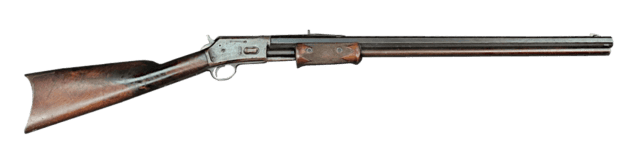
The Lightning was an attempt by Colt to seize a share of the market in slide-action rifles. It was a marked departure from the company’s traditional strongholds of revolvers and single-shot rifles. The Lightning, a pump-action or slide-action rifle, was aptly named – its speedy action was a prominent selling point, and it gained a reputation as one of the fastest shooting rifles of its time.
The Colt Lightning came in three primary models, each designed to fire a different caliber cartridge. This feature was innovative for its time and allowed the gun to appeal to a broad spectrum of users.
The first model, the medium-frame version, also known as the “Rifle, Caliber .44”, was introduced in 1884. It was chambered in .44-40 Winchester, a popular round at the time, and one shared with Colt’s own successful Single Action Army revolver, which was highly appealing for those on the frontier who wanted to carry a single type of ammunition for both their rifle and sidearm.
The small-frame model, which was introduced in 1887, was designed for the .22 caliber, and was a favorite for small game hunting and target shooting.
Lastly, the large-frame model was introduced in 1887 to chamber the more powerful .38-56 Winchester, .40-60 Winchester, .45-60 Winchester, and .50-95 Express. These larger calibers provided the energy necessary for big game hunting, a key consideration for many prospective buyers.
The historical significance of the Colt Lightning cannot be overstated. Beyond being a marvel of mechanical engineering for its time, it also had substantial cultural impact. For one, it was heavily marketed to the police forces of the era. Law enforcement agencies appreciated its quick firing rate and significant firepower, which made it a useful tool for maintaining law and order.
Further, the rifle also saw use in the military, particularly in the hands of the Royal Northwest Mounted Police in Canada. The medium-frame model was used in the Spanish-American War, and the large-frame model found some popularity among big game hunters.
In popular culture, the Lightning was often featured in Western films, upholding the spirit of the American Frontier. It was a tool for lawmen and outlaws alike, and its quick action made it perfect for the dramatic shootouts that so often defined the genre.
The Colt Lightning holds a special place in the history of firearms. Its innovative design, diverse caliber range, and high rate of fire allowed it to stand
out in a crowded market. Associated with various historical events and figures, the Lightning rifle has been etched into the folklore of the American West. While it may not have achieved the commercial success that Colt had hoped for, it nevertheless left an indelible mark on the evolution of firearms, continuing to inspire manufacturers and collectors alike.
Introduction
Few firearms in history have left as unique a mark as the Colt Lightning rifle. Introduced in 1884 by Colt’s Patent Fire Arms Manufacturing Company, this pump-action repeater was a radical departure from Colt’s revolver-dominated lineup. It was designed to compete directly with Winchester’s immensely popular lever-action rifles, offering a faster rate of fire with its innovative slide-action mechanism. While it never supplanted Winchester’s dominance, the Colt Lightning became a favorite among lawmen, hunters, and frontiersmen, earning a reputation as one of the fastest-shooting rifles of its era.
Origins and Development
By the 1880s, Winchester had a firm grip on the repeating rifle market. Their Model 1873, chambered in .44-40 Winchester, had become the rifle synonymous with the American West. But pump-action firearms were gaining traction, and Colt saw an opportunity to enter the market with a repeating rifle that offered faster cycling than a lever-action.
Designed by William Mason, Colt’s Lightning rifle featured a pump-action mechanism that allowed shooters to cycle the action with a quick forward-and-backward motion, eliminating the need for the arcing lever stroke found in Winchesters. This resulted in rapid follow-up shots, making the Lightning a formidable firearm for hunting, self-defense, and even law enforcement.
Unlike Winchester, which had firmly established its reputation in rifles, Colt was primarily known for handguns—especially the Single Action Army revolver. But by chambering the Lightning in the same pistol cartridges used in their revolvers, Colt created an appealing “companion rifle” concept, much like Winchester had done with their lever-guns.
Models and Calibers
Colt produced three distinct models of the Lightning rifle, each designed for different applications and calibers:
1. Medium-Frame Colt Lightning (1884–1904)
The first model introduced, the medium-frame Lightning, was chambered in .32-20, .38-40, and .44-40 Winchester. This was the most widely produced variant, with nearly 90,000 units manufactured. Because .44-40 was also a common chambering for Colt’s Single Action Army revolvers, this rifle found favor among cowboys, lawmen, and ranchers who wanted a single caliber for both their rifle and sidearm.
2. Small-Frame Colt Lightning (1887–1904)
Designed for small game hunting and target shooting, the small-frame Lightning was chambered in .22 Short and .22 Long. These rifles were often used for pest control, recreational shooting, and as trainer rifles for young shooters. Approximately 89,000 small-frame Lightning rifles were produced.
3. Large-Frame Colt Lightning (1887–1894)
Introduced to cater to big-game hunters, the large-frame Lightning was chambered in powerful calibers such as .38-56 Winchester, .40-60 Winchester, .45-60 Winchester, and .50-95 Express. With fewer than 6,500 units produced, this model is highly sought after by collectors today. The .50-95 Express, in particular, was favored by hunters pursuing large and dangerous game.
Advantages and Drawbacks
The Colt Lightning’s fast cycling rate was its greatest advantage. Contemporary reports praised its ability to fire shots in rapid succession, making it a formidable weapon for close-quarters engagements and hunting fast-moving game.
However, the Lightning was not without its flaws:
- Prone to Short-Stroking: Unlike lever-actions, which had a mechanical lock preventing incomplete cycling, the Lightning could be “short-stroked,” causing misfeeds or jams.
- Sensitive to Dirt and Debris: The action was more susceptible to fouling than the enclosed systems found in bolt-action and lever-action rifles.
- Less Robust than Winchester Lever-Actions: While the Lightning was fast, Winchester’s lever-action designs proved more durable over time, especially in the harsh conditions of the frontier.
Despite these issues, shooters who mastered the Lightning’s operation found it to be an incredibly effective firearm.
Use by Law Enforcement and Military
Contrary to some myths, the Colt Lightning was not widely adopted by the military. However, it did find favor among law enforcement agencies. The Royal Northwest Mounted Police (RNWMP) purchased some Lightning rifles, but their standard issue remained Winchester lever-actions and Lee-Metford bolt-action rifles.
Some accounts suggest that the Lightning saw limited use among private security firms, express companies, and police forces, but it never became the dominant law enforcement rifle of its time.
The Colt Lightning in Popular Culture and Collectability
While it may not have achieved the lasting commercial dominance of Winchester’s rifles, the Colt Lightning remains an iconic firearm in American history. Its distinctive design and rapid-fire capability have made it a favorite among gun collectors and Western firearms enthusiasts.
Collectors today seek out original Colt Lightning rifles, especially those in rare configurations. Factory-engraved models, large-frame versions, and well-documented historical examples command high prices in auctions and private sales.
Additionally, the Colt Lightning has appeared in numerous Western films and TV shows, further solidifying its legendary status. It was used in films like “The Quick and the Dead” (1995) and “3:10 to Yuma” (1957 & 2007), often depicted as a rifle of choice for both outlaws and lawmen.
Conclusion: A Rifle Ahead of Its Time
The Colt Lightning rifle was an ambitious attempt to challenge Winchester’s monopoly on repeating rifles. Its lightning-fast pump-action, paired with popular revolver calibers, made it a compelling choice for frontier shooters. However, mechanical quirks and Winchester’s entrenched market position limited its long-term success.
Today, the Colt Lightning remains a cherished collector’s item, valued for its historical significance, innovative design, and association with the American West. Whether in a museum, a private collection, or on the silver screen, this unique pump-action rifle continues to capture the imagination of firearms enthusiasts worldwide.
Read more here:

Discussions on the Colt Lightning can be found on the Colt Forum here.
If you know of any forums or sites that should be referenced on this listing, please let us know here.