The Henry rifle gave one man sixteen shots at a time when almost everyone he faced could fire once and then reload. That is the whole of its advantage, and it was enough to carry the design out of a New Haven workshop in 1860, through the Civil War, onto the frontier, and into every lever gun that came after it. A fair amount of legend has attached itself to the rifle since, and some of it does not survive a look at the record. Learn more about the enduring appeal of lever guns.
The Origins of the Henry Rifle: From Volcanic to Winchester
The Henry began as the fix for a gun that had already failed. In 1855 the partnership of Horace Smith and Daniel B. Wesson was reorganized as the Volcanic Repeating Arms Company, built around a lever action and the hollow-base “Rocket Ball” cartridge that carried its powder charge inside the bullet. The action worked. The ammunition was too weak to be worth much.
Oliver Winchester was one of the investors. When Volcanic ran out of money he forced it into insolvency in late 1856, bought the assets, moved the plant to New Haven, and reorganized the firm in April 1857 as the New Haven Arms Company. He then put the ammunition problem in front of his plant superintendent, Benjamin Tyler Henry.
Henry stopped trying to rescue the Rocket Ball. He designed a self-contained metallic cartridge instead, the .44 Henry Rimfire, and then a rifle built to fire it. Both were ready by 1860.
Technical Features and Innovations
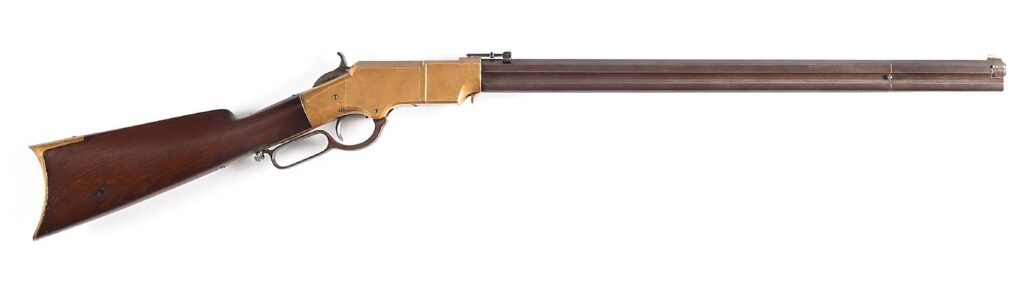
The lever and the magazine were not the new parts. Volcanic already had both. The new part was the cartridge, and a Henry’s magazine tube under the barrel held fifteen of them, with a sixteenth able to ride in the chamber. A man with a rifled musket fired once and then spent most of a minute getting ready to fire again.
Key Specifications:
- Caliber: .44 Henry Rimfire
- Barrel Length: 24 inches, octagonal
- Capacity: 15 rounds in the magazine, 16 with one in the chamber
- Action: Lever-action, breech-loading
- Receiver: Brass
- Muzzle Velocity: about 1,125 feet per second
- Effective Range: about 200 yards
- Production: 1860 to 1866, about 14,000 rifles
The brass receiver gave the Henry its yellow cast, and the reason was practical rather than decorative. Brass was easier to machine than steel with the tooling of the day. The magazine tube ran exposed along the full length of the barrel, with an open slot down the side for the cartridge follower. The slot let in dirt, and the tube grew hot under sustained fire.
The Henry Rifle in the Civil War
The Union Army never adopted the Henry as standard issue, and the reason was cost. A Henry sold for about $40 at a time when a Union private earned $13 a month, so roughly three months’ pay. Officers and enlisted men who wanted one bought it out of their own pockets, and some paid well above list. One soldier is recorded as paying $65.
Union Soldiers and the Henry Rifle
Several Union regiments became known for carrying Henrys, nearly all of them privately bought. The one it is firmly attached to is the 7th Illinois Volunteer Infantry, which had them in the hands of most of its men. Confederate troops are said to have described the rifle this way, a line usually attributed to Colonel John Mosby:
“That damned Yankee rifle that they load on Sunday and shoot all week.”
The clearest demonstration came at the Battle of Allatoona Pass on October 5, 1864. Colonel John E. Tourtellotte held the post with a partial brigade, and Brigadier General John M. Corse arrived with reinforcements the night before the attack and took overall command. Roughly 2,000 Union troops, a good many of them carrying Henrys, held the position against about 3,300 Confederates under Major General Samuel G. French. Being able to keep firing without stopping to reload was a large part of why the line held.
Post-War Adoption and the Evolution into Winchester
Demand rose after the war, particularly on the frontier, but the Henry had a real weakness. There was no loading gate. To fill the magazine the shooter worked the cartridge follower up the slot, pivoted the front of the tube aside, and fed rounds in from the muzzle end. That is awkward standing still and worse under fire.
Winchester renamed the New Haven Arms Company the Winchester Repeating Arms Company in 1866. He had controlled the firm since 1857, so this was a change of name and organization rather than a change of hands.
The Winchester Model 1866 that followed kept the Henry’s action and fixed its loading. Nelson King’s patented side gate let the shooter push cartridges straight into the receiver, and a sealed magazine tube under a wooden forestock kept the dirt out and the heat off his hand. That layout, not the Henry’s, is what the Winchester Model 1873 carried into the West as “The Gun That Won the West.”
The .44 Henry Rimfire Cartridge: Power and Limitations
The .44 Henry Rimfire was a real advance, a self-contained metallic cartridge at a point when most soldiers were still handling loose powder and ball. It was also modest. The load was a 216-grain bullet over about 25 grains of black powder.
- Muzzle Energy: roughly 600 foot-pounds, well under the black powder rifle cartridges of the period.
- Range: useful to about 200 yards, far short of the .58 caliber rifled muskets it was fired alongside.
- Rimfire case: not reloadable, so a Henry was only as good as the supply of factory ammunition behind it.
Inside 200 yards it killed reliably, which is what mattered for cavalry, for skirmishers, and for anyone holding a position. It was the wrong cartridge for a long-range exchange with infantry.
The .44 Henry Rimfire was also the only chambering the original rifle was ever offered in, across the whole 1860 to 1866 run. There were no factory variants in other calibers. That is worth knowing when you pick up a modern reproduction, because the centerfire rounds those are sold in are modern substitutions, not historical options.
Who Actually Carried a Henry
The 7th Illinois at Allatoona is the firmest ground here. Two frontier stories get told about the Henry far more often, and neither holds up as well as the retelling suggests.
Nelson Story and the Montana Cattle Drive (1866)
Nelson Story bought about 1,000 longhorns in Texas in 1866 and drove them north to Montana with a crew of about thirty armed men. He bought repeating rifles for that crew, and the drive is usually retold as a Henry story.
The record points somewhere else. Story bought thirty breech-loading Remington rifles for his men, and most authorities take those to have been early rolling blocks. No source puts Henry rifles on that drive. It is a good story about what repeating firepower did for a small party on the trail. It is not evidence about the Henry.
Was Pat Garrett a Henry Rifle User?
Not on the available evidence. Pat Garrett killed Billy the Kid at Fort Sumner in July 1881 with a Colt Single Action Army revolver in .44-40, a gun he had taken off one of the Kid’s associates and which sold at auction in 2021 for just over $6 million. Nothing documents Garrett owning or carrying a Henry, and by 1881 the original had been out of production for fifteen years. The lever gun of his time and place was the Winchester.
Modern Reproductions and the Henry Rifle’s Legacy
Two makers build the 1860 pattern today. Both keep the front-loading magazine, and both give up capacity to do it, because the centerfire cases they are chambered for are bulkier than the old rimfire. Thirteen rounds is the usual figure rather than fifteen.
- Uberti offers the 1860 Henry with a brass frame in .44-40 WCF and .45 Colt, and with a case-hardened steel frame in .45 Colt. All three carry a 24.5 inch barrel and hold 13+1.
- Henry Repeating Arms builds the New Original Henry in .44-40 WCF and .45 Colt. Its receiver is a hardened brass rather than steel, and the barrel and magazine are made as one octagonal piece, as they were on the original.
Neither is a .357 Magnum rifle. Henry Repeating Arms does chamber that round, but in the Big Boy line, which is a different gun and not a reproduction of anything.
Conclusion: A Firearm That Defined an Era
The Henry was in production for six years and the design was superseded almost as soon as it was proven. It still settled the question that mattered, which was whether a magazine-fed lever action could be made to work with a cartridge worth firing. Once that was answered the Model 1866 and the Model 1873 followed quickly, and the lever gun became a fixture of American shooting for the next hundred years. The Henry is where that line starts.
Read more here:
-
Sale!

The Historic Henry Rifle: Oliver Winchester's Famous Civil War Repeater
Original price was: $29.95.$24.42Current price is: $24.42. Purchase on Amazon -
Sale!

The Story of Benjamin Tyler Henry and His Famed Repeating Rifle
Original price was: $487.50.$150.00Current price is: $150.00. Purchase on Amazon
Henry Rifle Forums has a discussion group about Henry USA’s reproduction of the Henry Rifle. Join the discussion here.
If you know of any forums or sites that should be referenced on this listing, please let us know here.