Introduction
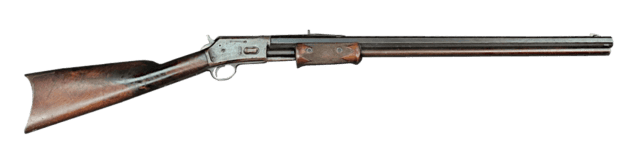
The Colt Lightning was Colt‘s attempt to take a share of the repeating rifle market away from Winchester. Introduced in 1884 by Colt’s Patent Fire Arms Manufacturing Company, it was a slide-action repeater from a firm known for revolvers, and Colt sold it on the speed of its action. It never displaced the Winchester lever gun. It did sell in quantity, and it found buyers among hunters, ranchers, and a few police departments.
Origins and Development
By the 1880s Winchester had a firm grip on the repeating rifle market. The Model 1873, chambered in .44-40 Winchester, had become the rifle most associated with the American West. Slide-action firearms were gaining ground, and Colt saw room for a repeater that cycled faster than a lever-action.
The design came from outside the company. Dr. William H. Elliot, a dentist in Ilion, New York, and a prolific firearms inventor, received patent US 278,324 for an improved magazine firearm on 29 May 1883. Colt bought the design that year, and its own engineers reworked it before the rifle reached the market in late 1884. Further patents on the finished gun went to Colt employees W. B. Franklin, F. F. Knous, F. W. Weatherhead, and C. J. Ehbets.
The slide handle moves straight back and forward under the barrel, so there is no arcing lever stroke to make. A shooter can work the action with the rifle still at the shoulder, which is what made the follow-up shots quick.
Colt was known for handguns, above all the Single Action Army revolver. By chambering the Lightning in the same cartridges as those revolvers, Colt could sell it as a companion rifle, the same pitch Winchester used for its own lever guns.
Models and Calibers
Colt built the Lightning on three frame sizes. Each frame covered more than one chambering, so the range ran from .22 rimfire up to .50-95 Express. Total production across all three came to more than 186,000 rifles by 1904.
1. Medium-Frame Colt Lightning (1884–1904)
The first model out, with 89,777 made. It was chambered in .32-20, .38-40, and .44-40 Winchester. Colt offered it as a rifle with a 26-inch barrel and a 15-round magazine, and as a carbine with a 20-inch barrel and a 12-round magazine. Because .44-40 was also a Single Action Army chambering, the medium frame gave cowboys, lawmen, and ranchers one cartridge for both rifle and sidearm.
2. Small-Frame Colt Lightning (1887–1904)
Chambered in .22 Short and .22 Long, the small frame was built for small game, pest control, target work, and teaching young shooters. Production reached 89,912, slightly more than the medium frame, which makes the small frame the most widely produced of the three.
3. Large-Frame Colt Lightning (1887–1894)
The large frame, sold as the Express, was aimed at big-game hunters. Chamberings included .38-56 Winchester, .40-60 Winchester, .45-60 Winchester, and .50-95 Express. Colt made 6,496 of them over seven years, which is why the large frame is the one collectors chase hardest today. The .50-95 Express drew hunters after large and dangerous game.
Advantages and Drawbacks
Cycling speed was the Lightning’s selling point, and contemporary accounts credited it with putting shots downrange in quick succession. That suited close work and fast-moving game.
The rifle had real weaknesses to go with it:
- Prone to short-stroking: lever-actions had a mechanical lock that prevented incomplete cycling. The Lightning could be short-stroked, which caused misfeeds and jams.
- Sensitive to dirt and debris: the action took in fouling more readily than the enclosed systems on bolt-action and lever-action rifles.
- Stiff out of the box: the action often needed sustained use before it smoothed out.
- Less robust than Winchester lever-actions: the Winchester designs held up better over time, particularly in frontier conditions.
Shooters who learned to run the action properly got good service out of it. That was the catch. The rifle rewarded practice more than the lever gun did.
Use by Law Enforcement and Military
The Lightning was never formally adopted by any military. It is reported to have turned up with American forces in the Spanish-American War, most likely as rifles bought privately by the men carrying them rather than as issued arms.
Police sales were real but limited. The San Francisco Police Department bought about 400 Lightnings in 1898, each one individually numbered and stamped SFP on the lower tang. Departments that bought the rifle wanted a fast repeater with more firepower than a revolver could give them. Scattered accounts put the Lightning in the hands of private security men and express company guards as well, but it never became the standard police rifle of the period.
Canada’s North-West Mounted Police are sometimes named as Lightning buyers. Their records show the Winchester Model 1876 as the issued carbine from 1878 to 1914, followed by the Lee-Metford from 1895 and the Lee-Enfield Magazine Rifle Mark I from 1900.
The Colt Lightning in Popular Culture and Collectability
Collectors want original Lightnings, and the rarer the configuration the better. Large-frame Express rifles, factory-engraved guns, and examples with documented history bring the strongest prices at auction and in private sales.
On screen the Lightning shows up far less often than its reputation suggests. Prop houses settled on Winchester lever-actions, the Model 1892 above all, because they looked right for the period and ran the Winchester 5-in-1 blank. A pump-action rifle in a Western is the exception, not the rule.
Conclusion: A Rifle Ahead of Its Time
The Colt Lightning was a serious run at Winchester’s hold on the repeating rifle. The fast slide action and the revolver chamberings gave frontier buyers a reason to look at it. Mechanical quirks and Winchester’s entrenched position kept it from lasting.
Colt read the mechanism right even if the execution fell short. Slide actions went on to dominate American shotguns and did steady work in rimfire rifles long after the Lightning left the catalog. The gun itself is now a collector’s piece, valued for the design, the production numbers, and the period it came out of.
Read more here:

Discussions on the Colt Lightning can be found on the Colt Forum here.
If you know of any forums or sites that should be referenced on this listing, please let us know here.