Iron sights will always have their place, but when you’re reaching past 200 yards or hunting in low light, a quality scope changes what’s possible for most people who aren’t Marines. You can own the finest barrel, the crispest trigger, and the most consistent handloads on the bench — and none of it matters if your optic can’t put the crosshair where the bullet needs to go. The best rifle scopes under $500 deliver clear glass and reliable tracking without emptying your wallet.
Table of Contents
Best Rifle Scopes Under 500: Table of Contents
Quick Comparison: Best Rifle Scopes Under $500
| Scope | Magnification | Reticle Type | Focal Plane | Weight | Best For | Street Price | Buy |
|---|---|---|---|---|---|---|---|
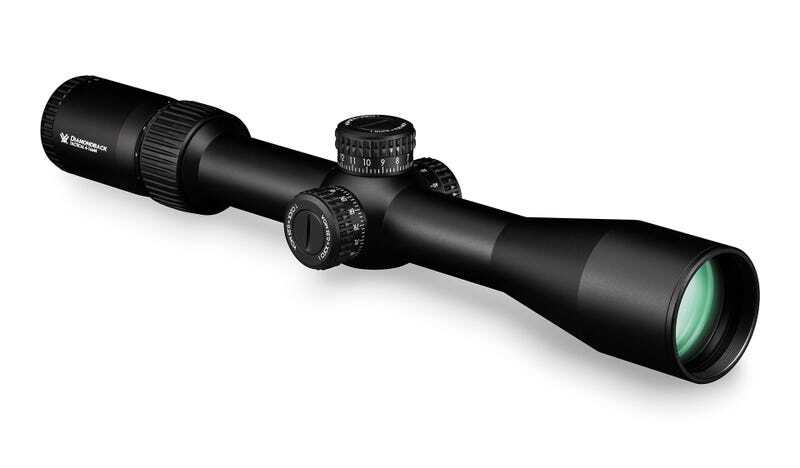
| Vortex Diamondback Tactical 4-16×44 FFP | 4-16x | EBR-2C (MOA/MRAD) | FFP | 23.1 oz | Mid-range precision & hunting | ~$350 | Amazon | Find at Brownells |
| Vortex Strike Eagle 1-8×24 | 1-8x | AR-BDC3 (illuminated) | SFP | 17.6 oz | AR-platform / 3-gun / CQB to mid | ~$300 | Amazon | Find at Brownells |
| Burris Fullfield IV 3-12×42 | 3-12x | Ballistic E3 | SFP | 17.6 oz | Deer & elk hunting | ~$280 | Amazon | Find at Brownells |
| Primary Arms SLx 4-14×44 FFP | 4-14x | ACSS-Orion | FFP | 24.0 oz | Budget precision / long-range beginners | ~$280 | Amazon | Find at Brownells |
| Leupold VX-Freedom 3-9×40 | 3-9x | Duplex | SFP | 12.2 oz | Classic hunting / lightweight builds | ~$250 | Amazon | Find at Brownells |
Prices reflect typical street pricing as of early 2026. Prices fluctuate — check the links below for current deals.
1. Vortex Diamondback Tactical 4-16×44 FFP — Best Mid-Range Precision Scope
This scope sits in a sweet spot: it’s precise enough for steel at 600-800 yards, versatile enough to go on a hunting rifle, and affordable enough that you don’t lose sleep over field use. It’s the scope I recommend most often to shooters who are building their first dedicated precision rig on a budget or stepping up from a basic hunting scope.
Specifications
| Magnification | 4-16x |
| Objective Lens | 44mm |
| Tube Diameter | 30mm |
| Reticle | EBR-2C (MOA or MRAD) |
| Focal Plane | First (FFP) |
| Field of View | 26.9 – 6.7 ft @ 100 yds |
| Eye Relief | 3.8 inches |
| Weight | 23.1 oz |
| Length | 14.06 inches |
| Turret Style | Exposed tactical, resettable |
| Parallax Adjustment | Side focus, 50 yds to infinity |
What Makes It Stand Out
The EBR-2C reticle is a well-designed hashmark pattern that provides windage and elevation holdover references without cluttering your field of view. Because it’s in the first focal plane, the subtensions remain accurate at every magnification — a genuine advantage if you use holdovers instead of dialing turrets for every shot. Available in both MOA and MRAD, so pick whichever system you’re comfortable with.
Glass quality is solid for the price. Vortex uses extra-low dispersion (XD) glass in the Diamondback Tactical, and it shows. Images are sharp with good contrast and minimal chromatic aberration. It won’t match a Viper PST Gen II in a side-by-side comparison — no $350 scope will — but for the price, the clarity is impressive. Low-light performance is adequate for hunting during legal shooting hours, though dedicated hunters may want more.
Pros
- First focal plane with a proven reticle design (EBR-2C)
- Exposed, resettable turrets with reliable tracking
- Side parallax adjustment — essential for precision work
- XD glass delivers impressive clarity for the price
- Available in both MOA and MRAD
- Vortex VIP unconditional lifetime warranty
Cons
- No zero stop — you’ll need to count turret revolutions
- Glass quality, while good, trails the Viper PST Gen II noticeably
- At 23.1 oz and 14+ inches, it’s not lightweight
- Eye relief of 3.8 inches is adequate but not generous
- Magnification ring can be stiff out of the box
Where to Buy
2. Vortex Strike Eagle 1-8×24 — Best LPVO for AR-Platform Rifles
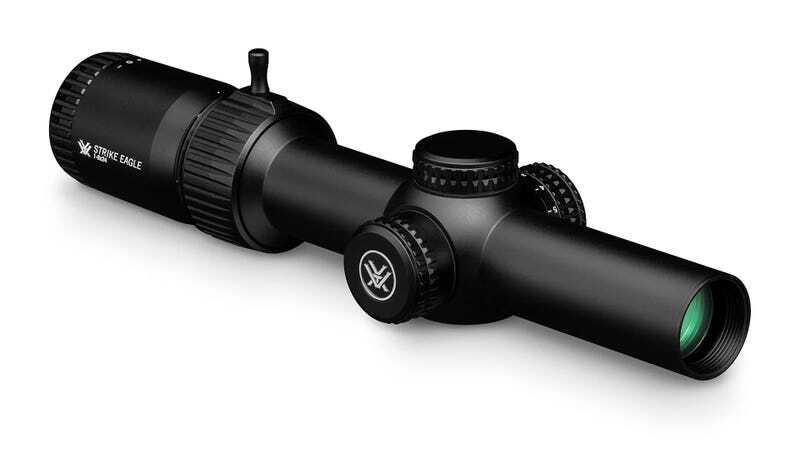
The LPVO (Low Power Variable Optic) has become the modern standard for AR-platform rifles, and the Strike Eagle 1-8×24 is where most shooters should start. At around $300, it delivers true 1x for both-eyes-open shooting at close range and enough magnification at 8x for precise hits at 400+ yards. It’s the most versatile optic type on this list, and Vortex has refined the Strike Eagle into a reliable performer across two generations.
If you own an AR-15 and shoot anything from defensive drills to 3-gun stages to the occasional coyote, this is the scope to buy.
Specifications
| Magnification | 1-8x |
| Objective Lens | 24mm |
| Tube Diameter | 30mm |
| Reticle | AR-BDC3 (illuminated) |
| Focal Plane | Second (SFP) |
| Field of View | 109 – 14.4 ft @ 100 yds |
| Eye Relief | 3.5 inches |
| Weight | 17.6 oz |
| Length | 10.0 inches |
| Illumination | Yes — 11 brightness settings |
| Turret Style | Capped, finger-adjustable |
What Makes It Stand Out
The AR-BDC3 reticle is calibrated for the ballistics of 5.56 NATO / .223 Remington out of a 16-inch barrel. The hashmarks provide holdover references at common distances, so you can use holds instead of dialing for shots from 200 to 600 yards (at max magnification, where SFP subtensions are accurate). The center dot is illuminated for fast acquisition in any lighting condition, and the rest of the reticle remains visible without illumination as a traditional glass-etched design.
Glass quality is acceptable. The Strike Eagle isn’t known for optical brilliance — it’s known for practical performance at a practical price. Images are clear enough for positive target identification, but side-by-side with a Razor or even a PST, you’ll notice the difference in edge clarity and chromatic aberration. For the intended use case (action shooting, defensive applications, hunting), it’s more than adequate.
Pros
- True 1x with forgiving eye box for both-eyes-open shooting
- Illuminated AR-BDC3 reticle with practical holdover references
- Lightweight at 17.6 oz — won’t front-load your AR
- Extremely versatile 1-8x range covers CQB to 400+ yards
- Affordable entry into the LPVO category
- Vortex VIP unconditional lifetime warranty
Cons
- Glass quality is not its strongest selling point — adequate, not exceptional
- SFP reticle subtensions only accurate at max (8x) magnification
- Illumination is not daylight-bright in direct sunlight
- Eye relief of 3.5 inches is tight — mount position matters
- Not a precision scope — 8x max limits long-range work
Where to Buy
3. Burris Fullfield IV 3-12×42 — Best Traditional Hunting Scope
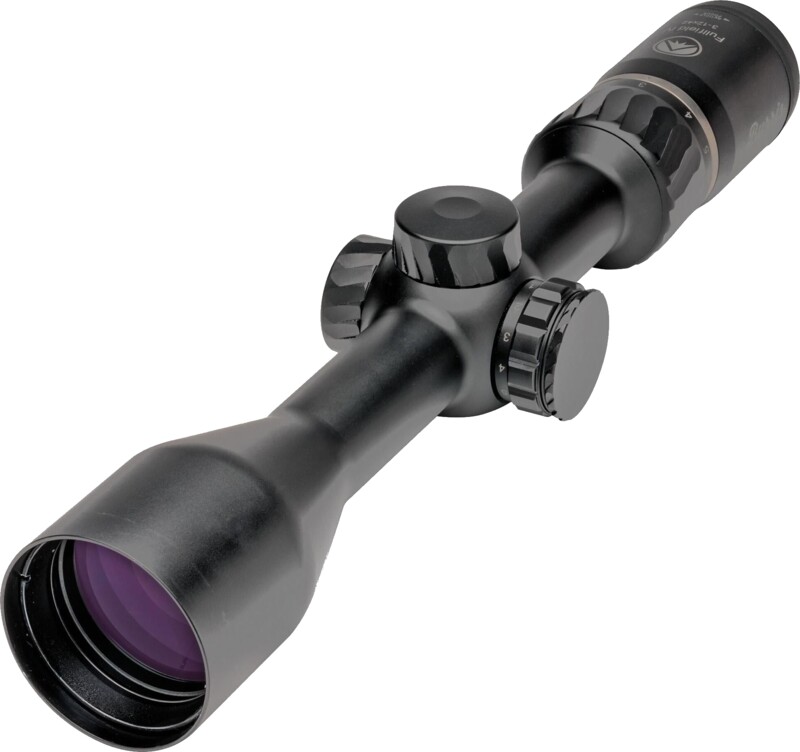
Not every scope needs exposed turrets, a Christmas tree reticle, and a 30mm tube. Sometimes you just need clear glass, a reliable zero, and a scope that disappears on your rifle and lets you focus on the hunt. That’s the Burris Fullfield IV.
Specifications
| Magnification | 3-12x |
| Objective Lens | 42mm |
| Tube Diameter | 1 inch |
| Reticle | Ballistic E3 |
| Focal Plane | Second (SFP) |
| Field of View | 38 – 9 ft @ 100 yds |
| Eye Relief | 3.5 – 3.8 inches |
| Weight | 17.6 oz |
| Length | 12.0 inches |
| Turret Style | Finger-adjustable, low-profile |
| Coatings | Hi-Lume multi-coated |
What Makes It Stand Out
The Ballistic E3 reticle provides holdover marks below the center crosshair that correspond to common hunting cartridge trajectories at extended ranges. It’s a simple, practical design that gives you the ability to hold for a longer shot without touching your turrets. The reticle is clean and uncluttered at low magnification, which matters when you’re swinging on a running whitetail at 3x.
The 1-inch tube and 42mm objective keep this scope low-profile. You can run low or medium rings on most bolt actions, which preserves a consistent cheek weld and keeps the rifle’s overall profile compact. This matters more than most shooters realize — a scope that sits too high forces an unnatural head position that slows down target acquisition and fatigues your neck during long sits in the stand. If you are still building out your setup, check out our guide to the best pistol red dot sights.
The 3-12x magnification range is ideal for most North American hunting. Three power provides the field of view you need for close encounters, and 12x gives you enough magnification for confident shot placement at 300-400 yards on big game. For many hunters, this is all the scope they’ll ever need.
Pros
- Excellent glass quality with Hi-Lume multi-coated lenses
- Lightweight at 17.6 oz — good for walking rifles
- Low-profile 1-inch tube works with low/medium rings
- Ballistic E3 reticle provides practical holdover capability
- Clean, simple design — nothing to fiddle with in the field
- Burris Forever Warranty
Cons
- SFP only — reticle subtensions accurate only at max magnification
- No side parallax adjustment (fixed at the factory)
- 1-inch tube limits total elevation/windage adjustment range
- Not suited for precision or tactical applications
- Turrets are low-profile — functional but not designed for frequent dialing
Where to Buy
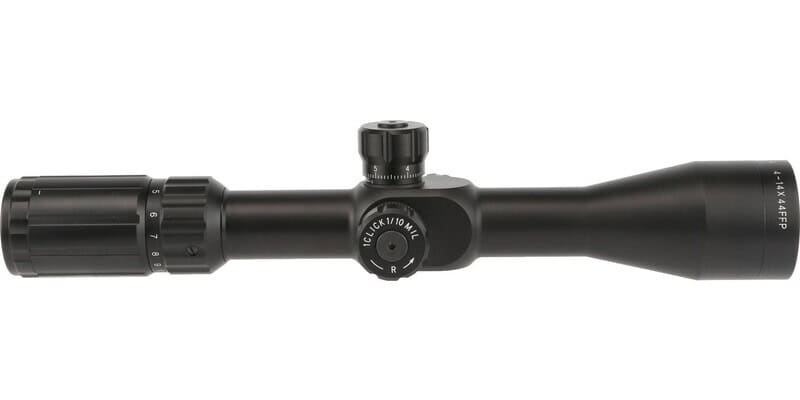
4. Primary Arms SLx 4-14×44 FFP — Best Value Precision Scope
Specifications
| Magnification | 4-14x |
| Objective Lens | 44mm |
| Tube Diameter | 30mm |
| Reticle | ACSS-Orion (MOA-based) |
| Focal Plane | First (FFP) |
| Field of View | 27.2 – 7.85 ft @ 100 yds |
| Eye Relief | 3.14 – 3.22 inches |
| Weight | 24.0 oz |
| Length | 13.0 inches |
| Turret Style | Exposed, finger-adjustable |
| Parallax Adjustment | Side focus |
| Construction | 6063 aircraft-grade aluminum |
What Makes It Stand Out
The ACSS-Orion reticle is the reason to buy this scope. Primary Arms’ Advanced Combined Sighting System is one of the most practical reticle designs available at any price. The Orion variant provides a horseshoe-dot center for fast acquisition, BDC holdover marks calibrated for common rifle cartridges (including .308, 6.5 Creedmoor, and .223/5.56), wind holds, and moving target leads — all integrated into a single, intuitive design. New shooters pick it up quickly, and experienced shooters appreciate the speed it offers compared to dialing turrets for every shot.
Being first focal plane means the ACSS-Orion subtensions remain accurate at every magnification. This is critical for a holdover-oriented reticle system — if the subtensions only work at one magnification (as with SFP), you lose the primary advantage of the ACSS design. At $280, an FFP scope with a reticle this capable is exceptional value.
Build quality is solid. The 6063 aircraft-grade aluminum body is waterproof, shockproof, and fog-resistant. It’s not as polished as the Vortex in terms of fit and finish — the magnification ring can be slightly stiff, and the parallax knob isn’t the smoothest — but mechanically, it’s built to handle real-world use. These are cosmetic compromises, not functional ones.
Pros
- ACSS-Orion reticle is brilliant — one of the best reticle systems at any price
- First focal plane at under $300 is exceptional value
- Side parallax adjustment for precision shooting
- 30mm tube with exposed turrets and reliable tracking
- Versatile 4-14x range for 100-800 yard shooting
- Primary Arms lifetime warranty
Cons
- No zero stop on turrets
- Heavier than competitors at 24.0 oz
- Eye relief (3.14-3.22 inches) is tighter than most — mount position is critical
- Glass quality trails the Vortex Diamondback Tactical, especially in low light
- Ergonomics (mag ring, parallax knob) feel budget
Where to Buy
5. Leupold VX-Freedom 3-9×40 — Best Classic Hunting Scope
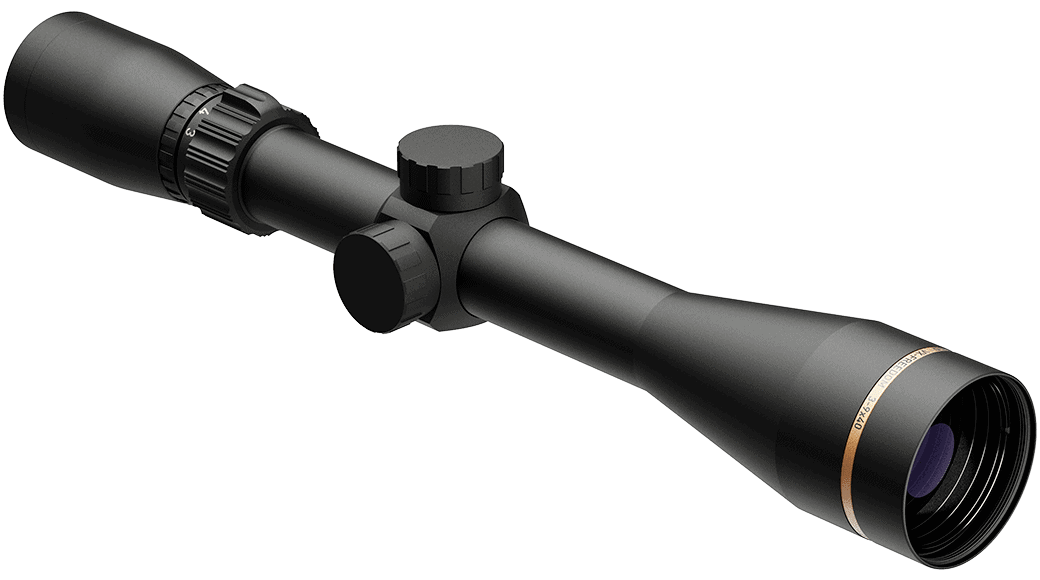
Some things don’t need to be reinvented. The 3-9×40 configuration has been the standard American hunting scope for more than half a century, and Leupold has been building them longer and better than almost anyone. The VX-Freedom is the entry point to Leupold’s lineup, and at a street price around $250, it delivers the core qualities that have made the brand legendary: light weight, clear glass, rock-solid reliability, and American-made construction. For additional reading, see National Shooting Sports Foundation.
This isn’t a scope that will impress you with features. It will impress you by working flawlessly, every time, in every condition, for decades.
Specifications
| Magnification | 3-9x |
| Objective Lens | 40mm |
| Tube Diameter | 1 inch |
| Reticle | Duplex |
| Focal Plane | Second (SFP) |
| Field of View | 33.1 – 13.6 ft @ 100 yds |
| Eye Relief | 4.2 – 3.7 inches |
| Weight | 12.2 oz |
| Length | 12.39 inches |
| Turret Style | Capped, finger-adjustable |
| Construction | 6061 T6 aluminum |
| Light Management | Twilight Light Management System |
What Makes It Stand Out
Twelve point two ounces. Read that again. The VX-Freedom is the lightest scope on this list by a wide margin — five full ounces lighter than the next lightest option. On a mountain rifle or a timber gun that you carry all day and shoot for five seconds, that weight savings is real. Pair it with a lightweight bolt action in .308 or .270 Winchester, and you’ve got a hunting rifle that won’t punish your shoulders on a long stalk.
Leupold’s Twilight Light Management System is what separates the VX-Freedom from generic 3-9×40 scopes. This proprietary lens coating system optimizes light transmission across the visible spectrum, with particular emphasis on the blue and red wavelengths that dominate during dawn and dusk — exactly when most game animals are active. The practical result: you can identify and shoot in the last few minutes of legal light when cheaper scopes are showing you nothing but shadow. For a hunting scope, this capability is worth the entire price of admission.
The Duplex reticle is the most proven crosshair design in hunting history. Four posts that taper to thin wires at the center, drawing your eye naturally to the aiming point. It’s fast, it’s intuitive, and it works. Leupold also offers the VX-Freedom with other reticle options (Tri-MOA, CDS-ZL2 dial system), but the classic Duplex remains the best seller for good reason.
Eye relief ranges from 4.2 to 3.7 inches, which is the most generous on this list. On a magnum rifle or a lightweight gun with significant felt recoil, that extra eye relief prevents scope bite — the painful cut you get when recoil drives the scope into your brow. Leupold understands that hunting scopes end up on everything from .243 Win to .300 Win Mag, and they’ve designed accordingly.
Made in Beaverton, Oregon. Leupold is one of the few optics manufacturers that still builds scopes in the United States. Every VX-Freedom is assembled, tested, and waterproofed at their Oregon facility. For shooters who prioritize American manufacturing, this matters.
Pros
- Incredibly lightweight at 12.2 oz — lightest scope on this list by far
- Twilight Light Management System delivers excellent low-light performance
- Generous eye relief (4.2 – 3.7 inches) — best on this list
- Made in the USA with Leupold’s lifetime guarantee
- Proven 3-9×40 configuration with classic Duplex reticle
- Low-profile 1-inch tube sits low on the rifle
Cons
- 3-9x range is limited for long-range or precision applications
- SFP with basic Duplex reticle — no holdover capability
- Capped turrets not designed for frequent adjustment
- No side parallax adjustment (fixed at factory)
- 1-inch tube limits total adjustment range
- No illuminated reticle in the base model
Where to Buy
Buyer’s Guide: What to Look for in a Rifle Scope Under $500
Choosing a scope comes down to understanding your intended use and matching the features to it. Here’s what actually matters.
Magnification: How Much Do You Need?
More magnification is not always better. Higher power amplifies mirage, hand tremor, and breathing movement — making it harder to shoot well without a solid rest. Match your magnification to your shooting application:
- Close-range / defensive / 3-gun: 1-6x or 1-8x (LPVO)
- Hunting (woods, brush, eastern whitetail): 3-9x or 2-10x
- Hunting (open country, western big game): 3-12x or 4-16x
- Precision target / long-range steel: 4-16x, 5-25x, or 6-24x
- All-around versatility: 4-16x is the sweet spot
For most hunters, 9-12x is plenty. For most precision shooters, 16-25x covers the practical range. The 4-16x magnification range is the most versatile single configuration — it’s why the Vortex Diamondback Tactical in that configuration is so popular. For a complete walkthrough of rifle selection, caliber choice, and the skills progression from zeroing to 1,000 yards, see our Long Range Rifle Shooting for Beginners guide.
First Focal Plane (FFP) vs. Second Focal Plane (SFP)
This is the most misunderstood specification in rifle scopes, and it’s one of the most important decisions you’ll make.
First Focal Plane (FFP): The reticle is placed in front of the magnification erector lenses. As you change magnification, the reticle appears to grow and shrink with the image. The critical advantage: reticle subtensions (the spacing between hashmarks, holdover points, and windage references) remain accurate at every magnification setting. If a holdover mark represents 2 MOA at 10x, it represents 2 MOA at 4x, 8x, and 16x. This is essential for shooters who use reticle holdovers at varied magnifications.
Second Focal Plane (SFP): The reticle is placed behind the erector lenses. It stays the same apparent size regardless of magnification. The advantage: cleaner sight picture at low power (the reticle doesn’t become microscopic) and at high power (it doesn’t become thick). The trade-off: reticle subtensions are only accurate at one magnification, typically maximum power.
The practical guidance: If you use holdovers for elevation or windage corrections, choose FFP. If you primarily dial turrets for corrections and want a clean sight picture at all magnification levels, SFP works fine. For pure hunting where you set your zero and hold center, SFP with a simple Duplex reticle is perfectly adequate.
Glass Quality: What to Evaluate
Glass quality determines what you see through the scope, and it’s the hardest specification to evaluate from a spec sheet. Here’s what to look for:
- Fully multi-coated lenses: Every air-to-glass surface should have multiple layers of anti-reflective coating. This maximizes light transmission and reduces glare. All five scopes on this list meet this standard.
- ED (Extra-Low Dispersion) glass: Reduces chromatic aberration — the color fringing you see around high-contrast edges. The Vortex Diamondback Tactical uses XD glass; the Leupold uses their proprietary Twilight Light Management System. Both noticeably reduce color fringing.
- Low-light performance: This is where you’ll notice the biggest difference between scopes in the $250-350 range. Leupold traditionally excels here. Test scopes side-by-side at dusk if you can.
- Edge-to-edge sharpness: Look through the scope at maximum magnification. Is the center sharp? How far toward the edges does that sharpness extend? Better glass maintains sharpness across more of the field of view.
Turrets: Capped vs. Exposed
Capped turrets are covered by threaded caps that protect against accidental adjustment. You set your zero and leave it alone. This is the right choice for hunting scopes where you don’t want to risk your zero getting bumped during a pack-in or while climbing into a tree stand. The Burris Fullfield IV and Leupold VX-Freedom both use capped turrets.
Exposed turrets are always accessible for quick dialing. Essential if you shoot at varied distances and dial elevation corrections rather than using holdovers. Look for turrets with clear markings, tactile clicks, and a resettable zero indicator. A zero stop — which prevents you from dialing below your zero point — is a valuable feature that makes it easy to return to your battlesight zero after a long-range engagement. The Vortex Diamondback Tactical and Primary Arms SLx both feature exposed turrets, though neither includes a zero stop at this price point.
Eye Relief: Why It Matters
Eye relief is the distance between your eye and the rear lens at which you see a full, clear image through the scope. It matters for two reasons:
- Recoil protection: On rifles with significant recoil (.300 Win Mag, .338 Lapua, even .30-06 in a lightweight rifle), short eye relief can result in the scope hitting your brow or orbital bone during recoil — a painful experience known as “scope bite.” The Leupold VX-Freedom’s 4.2 inches of eye relief at low power is the most forgiving on this list.
- Shooting position flexibility: Longer eye relief gives you more tolerance for head position on the stock. This matters when shooting from field positions (kneeling, sitting, off a pack) where your cheek weld isn’t as consistent as on a bench.
As a general rule, 3.5 inches or more is comfortable. Below 3.5 inches, mount position becomes critical.
Tube Diameter: 1 Inch vs. 30mm vs. 34mm
The main tube diameter affects two things: the total amount of internal adjustment range (elevation and windage travel) and the rings/mounts you need.
- 1-inch tubes (Burris Fullfield IV, Leupold VX-Freedom) are lighter, lower-profile, and compatible with widely available, affordable ring sets. They have less total internal adjustment range, which can matter for long-range shooting but is rarely an issue for hunting at typical distances.
- 30mm tubes (Vortex Diamondback Tactical, Strike Eagle, Primary Arms SLx) provide more internal adjustment range and slightly more room for the erector assembly, which can improve optical quality. They require 30mm rings or mounts, which are also widely available.
- 34mm tubes are found on higher-end optics above this price range (Vortex Razor, Nightforce, Kahles). The larger diameter provides even more internal adjustment range and a stiffer tube, which matters for long-range precision and repeated hard recoil. If you move up to a premium scope later, you will likely encounter 34mm — just know that 34mm rings and mounts are less common and more expensive than 30mm options.
For hunting, 1-inch is fine. For precision shooting where you may need to dial 20+ MOA of elevation, 30mm gives you more room.
Reticle Types: A Quick Primer
- Duplex: The classic four-post crosshair. Fast, clean, proven. No holdover capability. Best for hunters who shoot at known distances. (Leupold VX-Freedom)
- BDC (Bullet Drop Compensator): Includes holdover marks below the center crosshair calibrated for specific cartridge trajectories. Practical for quick shots at varied distances without dialing. (Burris Ballistic E3, Vortex AR-BDC3)
- Christmas Tree / Hashmark: Detailed grid of elevation and windage references for precise holdovers. Common in precision and tactical scopes. (Vortex EBR-2C)
- ACSS (Advanced Combined Sighting System): Primary Arms’ proprietary design combining BDC, wind holds, moving target leads, and ranging capabilities. Arguably the most information-dense reticle available at this price. (Primary Arms ACSS-Orion)
Frequently Asked Questions
Is a scope under $500 good enough for hunting?
Absolutely. All five scopes in this guide are more than capable of reliable, accurate performance for hunting at typical distances (inside 400 yards). The Leupold VX-Freedom and Burris Fullfield IV, in particular, are purpose-built hunting scopes that will serve you for decades. Modern manufacturing and lens coating technology has made sub-$500 scopes dramatically better than they were even ten years ago. Your scope will not be the limiting factor — your marksmanship and your knowledge of the animal’s behavior will.
Should I buy FFP or SFP for hunting?
For most hunters, SFP is the practical choice. The cleaner sight picture at low magnification, simpler reticle options, and lower price point all favor SFP for a dedicated hunting scope. FFP becomes advantageous when you regularly use reticle holdovers at varied magnifications — more common in precision shooting and competition than in hunting. If you want one scope for both hunting and precision practice, an FFP scope like the Vortex Diamondback Tactical or Primary Arms SLx gives you more versatility.
What’s the best scope on this list for an AR-15?
The Vortex Strike Eagle 1-8×24 is designed specifically for AR-platform rifles. Its 1x true magnification, illuminated reticle, and compact size make it the natural choice. If you’re building an AR-15 for longer-range work (200-600 yards), the Vortex Diamondback Tactical 4-16×44 or Primary Arms SLx 4-14×44 are strong alternatives — just make sure you use a quality cantilever mount designed for AR-15 upper receivers. See our AR-15 Upgrades Guide for mount recommendations.
Do I need an illuminated reticle?
It depends on your use case. For close-range shooting with an LPVO (like the Strike Eagle), illumination is nearly essential — it allows the center dot to function like a red dot sight at 1x. For hunting, illumination helps the reticle stand out against dark backgrounds at dawn and dusk, but it’s a convenience, not a necessity. For dedicated precision shooting in good light, illumination adds cost and complexity without significant benefit. Of the five scopes here, only the Strike Eagle offers illumination, and it’s the scope that benefits most from it.
How important is the warranty?
Very. Rifle scopes endure significant forces — recoil, temperature swings, moisture, drops, and general field abuse. A strong warranty protects your investment. Vortex’s VIP warranty is unconditional and unlimited — they’ll repair or replace your scope regardless of how the damage occurred, no receipt required. Leupold’s lifetime guarantee covers the original owner for the life of the product. Burris’s Forever Warranty is also lifetime and transferable. Primary Arms offers a lifetime warranty as well. All four manufacturers on this list stand behind their products, which is part of why they made the list.
What rings or mount do I need?
Match your ring diameter to your scope’s tube diameter (1 inch or 30mm) and choose a ring height that provides clearance between the objective bell and the barrel or rail. For bolt-action rifles, two-piece rings (like Vortex Pro Rings, Leupold STD, or Burris Signature Zee rings) are standard. For AR-15s, a one-piece cantilever mount (like the Aero Precision Ultralight or Vortex Sport Cantilever) is preferred because it provides the forward offset needed for proper eye relief on an AR upper receiver. Budget $40-80 for quality mounting hardware — don’t put a $350 scope in $12 rings.
Can I use these scopes for long-range shooting (600+ yards)?
The Vortex Diamondback Tactical 4-16×44 and Primary Arms SLx 4-14×44 are both capable of reliable performance at 600-800 yards with appropriate ammunition and shooter skill. Their FFP reticles, exposed turrets, and side parallax adjustment give you the tools needed for extended range work. That said, if long-range precision is your primary goal and you can stretch your budget, moving up to a Vortex Viper PST Gen II or similar scope in the $450-600 range will give you better glass, a zero stop, and more refined turrets. For a deeper look at getting started — including rifle selection, caliber choice, and the skills progression from 100 to 1,000 yards — read our Long Range Rifle Shooting for Beginners guide.
Final Recommendations: Which Scope Should You Buy?
Here’s the bottom line, by use case:
- Best all-around precision scope: Vortex Diamondback Tactical 4-16×44 FFP — Amazon | Brownells | MidwayUSA | OpticsPlanet. The most versatile scope on this list. FFP reticle, exposed turrets, side parallax, and XD glass in a package that handles precision shooting and hunting equally well. If you can only own one scope, this is a strong choice.
- Best scope for AR-15 / 3-gun / home defense: Vortex Strike Eagle 1-8×24 — Amazon | Brownells | MidwayUSA | OpticsPlanet. No other scope type matches the versatility of a good LPVO on an AR-platform rifle. True 1x to 8x, illuminated reticle, lightweight. The modern standard for a reason.
- Best dedicated hunting scope (more magnification): Burris Fullfield IV 3-12×42 — Amazon | Brownells | MidwayUSA | OpticsPlanet. Excellent glass, capable BDC reticle, and a practical magnification range for hunting at any distance inside 500 yards.
- Best dedicated hunting scope (lightweight classic): Leupold VX-Freedom 3-9×40 — Amazon | Brownells | MidwayUSA | OpticsPlanet. Light weight, legendary reliability, and the best low-light performance in this price range. The scope your grandfather would have bought — and that’s a compliment.
- Best value for long-range beginners: Primary Arms SLx 4-14×44 FFP — Amazon | Brownells | MidwayUSA | Primary Arms. The ACSS-Orion reticle alone is worth the price. An FFP scope with this level of reticle capability for under $300 is one of the best deals in the optics market. Start here, learn the fundamentals, and upgrade when your skills demand it.
No matter which scope you choose from this list, you’re getting a capable optic backed by a manufacturer that stands behind its products. The sub-$500 market is deeper in quality than it’s ever been, and the real limiting factor isn’t the glass — it’s the shooter behind it.
Invest in good ammunition. Invest in trigger time. And invest in a quality set of rings or a mount to hold your new scope in place. Those three things, combined with any scope on this list, will take you further than an expensive optic sitting on a rifle that never leaves the safe.
Good shooting.
Last updated: March 2026. Prices and availability are subject to change. We update this article regularly to reflect current market conditions and product availability.
If you know of any forums or sites that should be referenced on this listing, please let us know here.