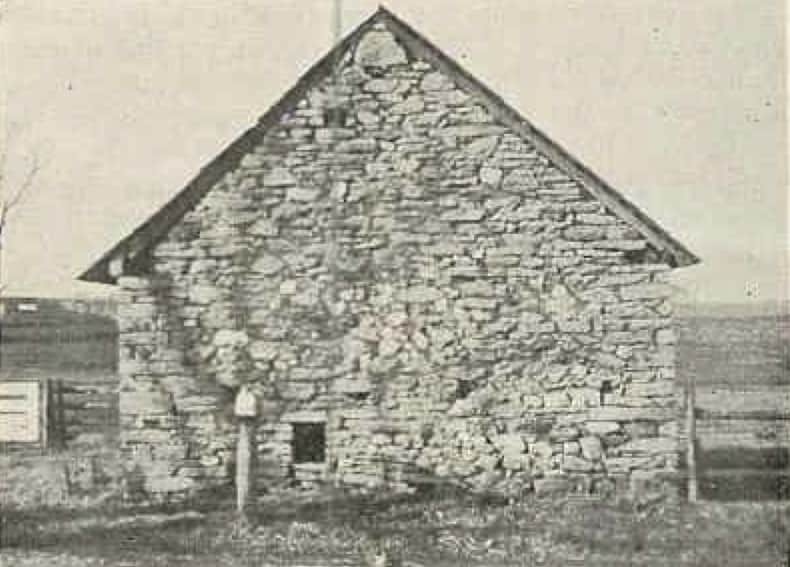
In Willow Street, Pennsylvania, a small stone building has stood for three centuries under a celebrated name: Martin Meylin’s Gun Shop, said to be the birthplace of the American longrifle and the workshop of one of the first gunsmiths in the New World. It is one of the most cherished origin stories in American firearms history. It is also one that rests far more on tradition than on proof.
The Tradition
Martin Meylin (the name is also written Mylin and Meyly) was a Swiss Mennonite who emigrated to Lancaster County around 1710 and was, by long tradition, a gunsmith. The story holds that about 1719 he built a stone shop and began turning out rifles that reworked the heavy German Jaeger into the slender, long-barreled, accurate Pennsylvania rifle — the gun that became an icon of the frontier and the Revolution. The building still stands, marked and honored as a landmark, and generations of writers, Henry Kauffman among them, have credited Meylin as the man who made the first longrifles.
It is a good story. The difficulty is the proof.
What the Record Shows
No rifle signed by Martin Meylin is known to exist. Two have been attributed to him over the years, and neither holds up: one long displayed locally proved to be a European musket of a later date, and the other, bearing a date of 1705, is a forgery — the Meylin family did not arrive in America until 1710.
The building itself has been examined directly. In 2005, archaeologists from Millersville University excavated it, and the result was inconclusive. The dig produced no proof that rifles were ever made there, but its director, Timothy Trussell, was careful to say the team had “disproved several significant claims against the building being used as a gunshop” while stopping short of proving that it was one. The archaeology neither confirms the legend nor kills it.
The building’s architecture has been argued over, too. Skeptics point to the absence of windows and of an end chimney as proof that no smith, black- or gun-, could have worked there. But the Millersville team put that objection to practicing blacksmiths, who judged the available light no real hindrance. Like the dig, the architecture cuts both ways.
The documents are ambiguous as well. The elder Meylin’s estate names no gunsmithing tools or stock, while his son’s inventory is full of them — which some historians read as evidence that the gunsmith in the family was the son, a generation after the legend places the trade with the father.
So Where Did the Longrifle Come From?
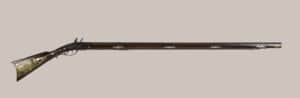
The right answer is probably that the Pennsylvania longrifle had no single father and no single birthplace. It evolved gradually through the first half of the 18th century in the hands of many German and Swiss immigrant gunsmiths across Lancaster, Berks, and Lehigh counties, who reshaped the Jaeger toward longer barrels, smaller calibers, and finer rifling. The first firmly documented makers of high-quality longrifles belong to the middle of the century — men such as Jacob Dickert, who settled in Pennsylvania around 1740, along with later masters like Andreas Albrecht and Christian Oerter.
Distinct regional traditions emerged: the Lancaster school, which produced sleek, accurate rifles and became the most influential; the Berks County school, known for ornate carving and brass inlay; and the Lehigh Valley school, recognized for slim stocks and fine wood. By the French and Indian War and the Revolution, Pennsylvania gunsmiths were arming the colonies. But that flowering came decades after 1719, and not from one shop.
Why the Legend Endures
The Meylin story took hold for the reasons many origin stories do: it is tidy, it is local, and it had champions. Meylin descendants owned the property for generations, local pride did the rest, and a roadside historical marker fixed the date and the claim in place. Once a story attaches to a building that is still standing, it is hard to dislodge — especially one you can still photograph.
None of this diminishes the site. A three-hundred-year-old stone workshop in early Lancaster County is a real window into colonial craft, whatever was made inside it. Honoring the building does not require treating the legend attached to it as settled fact.
The Takeaway
Martin Meylin may well have been a gunsmith; his son very likely was. What has never been proven is that he was America’s first, or that the longrifle was born in his shop. That rifle was the work of many hands over many decades, and the documented credit belongs to the makers who came after. The legend is worth knowing. So is the line between a legend and a fact.
Read more about the Pennsylvania Rifle here:

Millersville University excavated the site of Martin Meylin’s Gunshop. Read more about it here.
If you know of any forums or sites that should be referenced on this listing, please let us know here.