Muskets of the American Revolutionary War: Tools of Freedom
The American Revolutionary War (1775–1783), also known as the War of Independence, was a period that marked the birth of a nation: the United States of America. It was a war waged on different fronts and with various weapons. Among them, muskets were the most commonly used firearms on both sides. These weapons of war, despite their technological limitations, played a pivotal role in the American quest for independence.
The Flintlock Musket
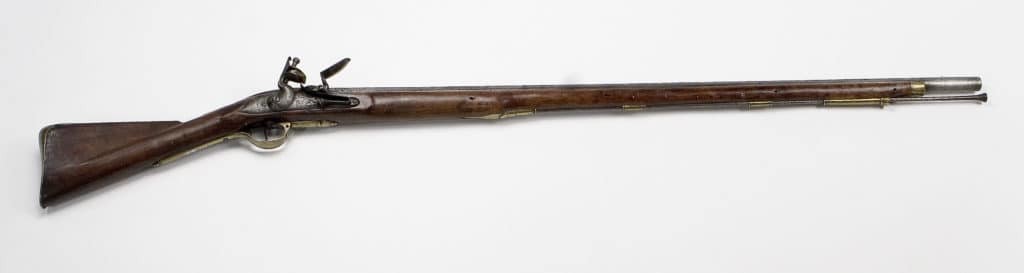
The dominant type of firearm used during the Revolutionary War was the flintlock musket, which had a spark-based firing mechanism. As the user pulled the trigger, the flintlock’s hammer, holding a piece of flint, would strike a steel frizzen, creating a spark. This would ignite the powder in the pan, and the ensuing flame would enter the barrel, igniting the main powder charge and propelling the lead ball down the barrel and towards the target.
British Brown Bess
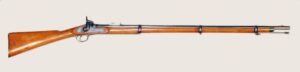
On the British side, the most common musket was the “Brown Bess.” This was a smoothbore flintlock musket, which had been the standard long gun of the British Empire since the early 1700s. The name ‘Brown Bess’ is of uncertain origin, but it became a widely used nickname for the weapon. Despite its relatively large caliber and notable inaccuracy over long distances, the Brown Bess was highly effective in volleys and close-quarters combat, which were typical of the warfare style of the era.
The Charleville and American-Made Muskets
The American Continental Army used a variety of muskets, including captured British Brown Besses and domestically produced firearms. However, the most famous and widely-used firearm on the American side was the Charleville Musket, supplied in large numbers by France, a key ally during the war. The Charleville was a .69 caliber, smoothbore flintlock musket, with design roots from the French Charleville Armory.
In addition to the Charleville, American gunsmiths produced muskets of their own. The earliest American-made martial arms were the Committee of Safety muskets, close copies of the British Brown Bess turned out by colonial contractors in 1775–1776 to arm the militia and the newly formed Continental Army. A national armory musket did not appear until after the war: the Springfield Model 1795, the first musket produced by a United States armory, was patterned not on the Brown Bess but on the French Charleville. Though never made in the quantities of the imported Charlevilles or captured Brown Besses, these American arms hold a significant place in the nation’s history.
Performance and Tactics
Despite their widespread use, muskets of the Revolutionary War were notorious for their lack of accuracy over long distances. This was primarily due to their smoothbore design, which did not spin the projectile for stability as in later rifled weapons. They were most effective within a range of 50 to 100 yards, with their accuracy decreasing sharply at longer ranges.
The typical warfare tactic at the time was to have infantry line up in ranks and fire volleys at the enemy. After each volley, soldiers would have to reload, a process that could take up to 20 seconds for a trained soldier. Given their limited range and accuracy, the idea was to concentrate as much fire as possible, creating a lethal wall of lead.
The musket’s limitations led to the development of guerrilla warfare tactics by the American militias. These groups, like the minutemen, utilized cover and ambush tactics to disrupt and harass British forces, offsetting the musket’s limitations with increased strategic flexibility.
Conclusion
The muskets of the American Revolutionary War, despite their technological simplicity by today’s standards, were instrumental in the formation of the United States. These firearms, although inaccurate over long distances, played a vital role in both traditional and guerrilla warfare tactics. They are a testament to the tenacity and adaptability of the soldiers who wielded them, echoing the spirit of a people determined to achieve their independence. You may also be interested in our coverage of The Muskets of the American Civil War.
-

Muskets of the Revolution and the French and Indian Wars
Purchase on Amazon -
Sale!

The Flintlock Musket: Brown Bess and Charleville 1715–1865 (Weapon, 44)
Original price was: $23.00.$21.44Current price is: $21.44. Purchase on Amazon -

The History of Weapons of the American Revolution
Purchase on Amazon -

Weapons of the American Revolution … and Accoutrements.
Purchase on Amazon
If you wish to participate in discussions about Muskets, the Muzzleloading Forum can be found here.
If you know of any forums or sites that should be referenced on this listing, please let us know here.