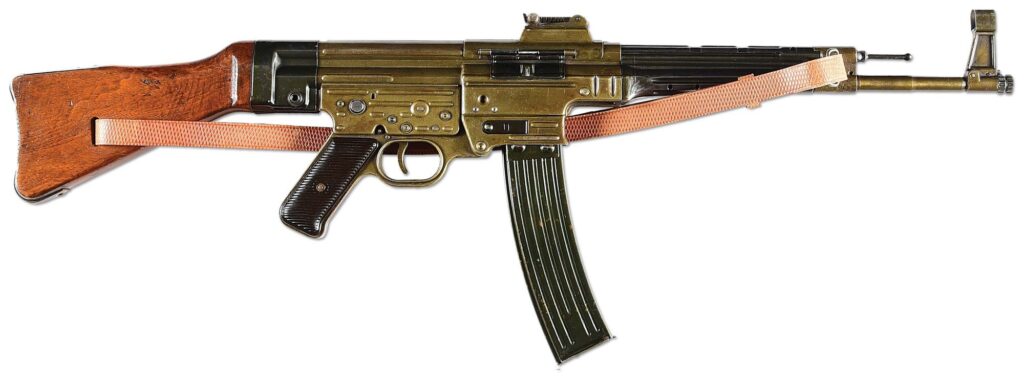
The StG 44, short for Sturmgewehr 44 or “assault rifle 44,” was the German Army’s select-fire rifle for the 7.92×33 mm Kurz cartridge. The same rifle was issued from 1943 to 1945 under three names: MP 43, MP 44 and StG 44. The German counts put production at about 415,000 to 426,000. Its German name became the general term for the type. An assault rifle fires single shots or bursts from a cartridge shorter and lighter than a full-power rifle round. The account below follows the records: the German production figures, Hugo Schmeisser’s statement to the Americans in 1945, the U.S. Army’s intelligence reports of 1944 and 1945, and the rifles themselves as Morphy Auctions has cataloged them.
StG 44 Specifications
These are the period figures, from the German records as the Lexikon der Wehrmacht and Erenfeicht give them and from the U.S. reports of 1944 and 1945.
- Cartridge: 7.92×33 mm Kurz, called the Pistolenpatrone 43 in service and later the Kurzpatrone 43.
- Action: gas operated, with the piston above the barrel and a breechblock that tilts to lock. It fires from a closed bolt, single shots or full automatic.
- Magazine: 30-round curved box.
- Length: 935 mm (about 36.8 inches), with a 412 mm (16.2-inch) barrel. The U.S. reports gave 36 3/4 to 37 inches.
- Weight: 4.5 kg (9.9 pounds) without the magazine; a loaded 30-round magazine added 0.87 kg. The U.S. reports gave weights from 10 1/2 pounds with an empty magazine to 12 pounds with a full one.
- Makers: C.G. Haenel and J.P. Sauer & Sohn of Suhl, ERMA of Erfurt and Steyr-Daimler-Puch of Steyr, Austria, with stamped parts from the Merz-Werke of Frankfurt.
- Designer: Hugo Schmeisser’s team at Haenel, with the trigger and closed-bolt firing taken from Walther’s rival design.
- Production: about 415,000 to 426,000 by the German counts (see below).
The StG 44 Caliber: 7.92×33 mm Kurz
The StG 44 caliber is 7.92 mm, the bore of the standard German service rifle, and its cartridge is the 7.92×33 mm Kurz (“short”). Leszek Erenfeicht wrote the round’s history in Small Arms Defense Journal in 2013. He says the Heereswaffenamt, the Army Ordnance Office, commissioned the Polte works of Magdeburg to develop it in the spring of 1938. At the same time it contracted C.G. Haenel of Suhl to build a weapon for it. The ammunition historian Anthony G. Williams writes that Polte kept the head, the rim and the caliber of the standard 7.92×57 mm rifle round and shortened the case. The final 7.92×33 design was approved in December 1940.
The cartridge changed its name along with the rifle. Erenfeicht lists the names in order. It was the 7.9 mm Karabinerpatrone 42 from February 1942, then the Maschinen-Karabiner-Patrone “S.” It became the Pistolenpatrone 43 mE when the program was renamed the MP 43, and finally the Kurzpatrone 43. The letters “mE” stand for mit Eisenkern, “with iron core”: the bullet had a mild-steel core to save lead.
The U.S. War Department’s Tactical and Technical Trends described the round in April 1945 as “7.92-mm necked-down ammunition” in steel cases. The bullet had “a lead sleeve surrounding a steel core” and a boat tail. It gave “an indicated muzzle velocity of approximately 2,250 feet per second.” The Lexikon der Wehrmacht gives an 8-gram bullet at 685 meters per second. These are wartime service figures, given here as history only.
The Lexikon gives the deliveries year by year: 9.7 million rounds in 1942, 23.4 million in 1943, 579.4 million in 1944 and 209.5 million in 1945 up to early March. That is about 822 million in all. The same source says the troops held 273.9 million rounds at the beginning of March 1945, with a reserve of 69.6 million.
From the MKb 42(H) to the MP 43
Haenel’s design team was led by Hugo Schmeisser, the company’s manager and chief designer. Walther of Zella-Mehlis entered a rival design. Both rifles were called Maschinenkarabiner 42, “machine carbine 1942,” with (H) for Haenel and (W) for Walther. The Lexikon der Wehrmacht says Haenel delivered its 50 trial rifles in June 1942, and 35 of them went straight into troop trials. Walther had only two finished. Erenfeicht dates the delivery to early July 1942. Trials began at the Infantry School at Döberitz on July 3 and at the Kummersdorf proving ground on July 9.
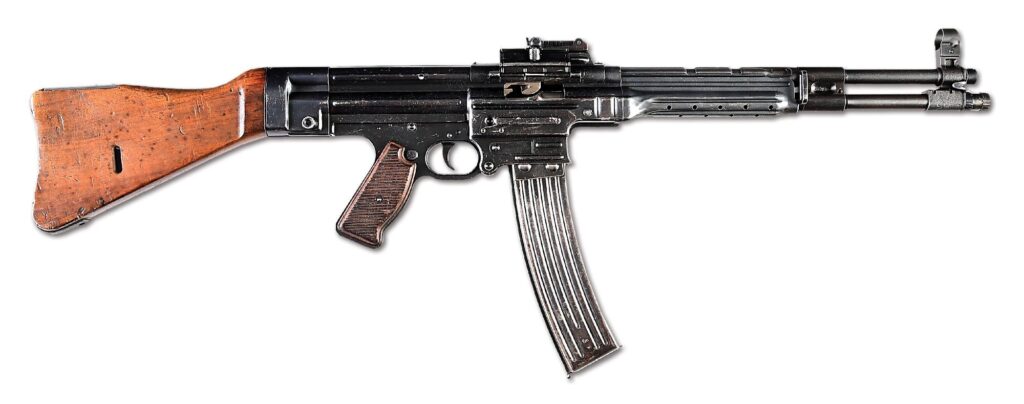
The Haenel rifle fired from an open bolt, as Schmeisser’s submachine guns did. That suits long bursts and hurts accuracy with single shots, because the bolt slams forward just before each shot. Erenfeicht writes that Haenel then built a hybrid that kept its own gas system and tilting breechblock and took Walther’s hammer trigger and closed-bolt firing. It was called first the “MKb 42(H) aufschießend,” then the MP 43B, and its development through the first half of 1943 produced the MP 43/1. Our report on Morphy’s September 2026 sale covers the MKb 42(H) pictured above.
How many MKb 42(H)s were made depends on the source. The Lexikon‘s table counts 116 MKb 42s in 1942 and 11,717 in 1943. Erenfeicht gives about 12,000, made between November 1942 and September 1943. Morphy’s catalog says 8,000 to 12,000 were made between early 1942 and mid-1943 and that nearly all went to Russia.
How the StG 44 Got Its Name: MP 43, MP 44, StG 44
The best-known version of the story is in the Lexikon der Wehrmacht. Hitler learned of the troop trials and, because of the new cartridge, ordered all work on the weapon stopped. Production went on under cover of a Gustloff machine carbine for the standard rifle cartridge. The short-cartridge weapon was named MP 43, for Maschinenpistole (submachine gun), in the hope that Hitler would take it for one. When the truth came out he allowed 30,000 to be finished. In September 1943, with about 14,000 delivered, the troops’ reports persuaded him to let the MP 43 replace the MP 40 submachine gun. After small changes the rifle was renamed MP 44 in March 1944. In July 1944, when the Waffenamt had received more than 80,000, division commanders praised it to Hitler in person. Production was given special priority, and in December the rifle received the name “Sturmgewehr.” Alexander Kulinsky, writing in the Russian magazine Kalashnikov in 2003, also says Hitler personally banned further work on the weapon in 1943.
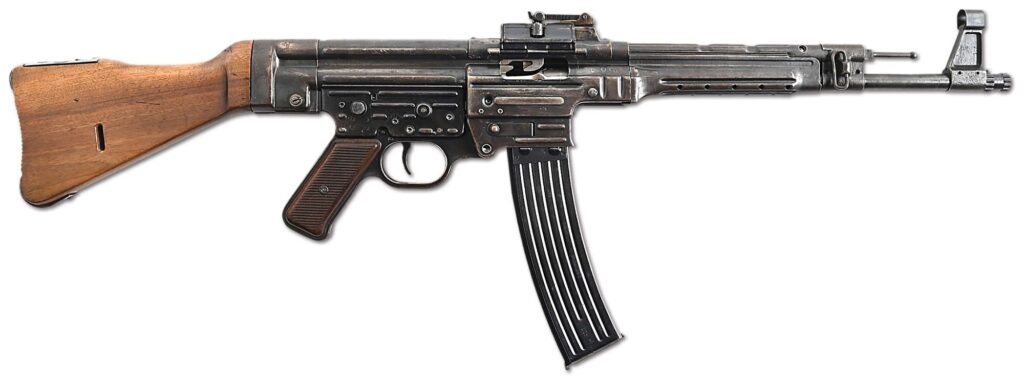
Erenfeicht argues against the cover-name story. He writes that company correspondence and reports record frequent presentations of the rifle to Hitler, with his comments and advice. He notes that Hitler had the power to end the program at any time. In his reading Hitler’s reluctance was about sending a new rifle and a second rifle cartridge to the front in numbers too small to count. He also says “it was Hitler himself, who invented the name Sturmgewehr.” The U.S. Army said much the same thing in April 1945. Tactical and Technical Trends reported that the German High Command was advertising “an automatic small arm which Adolph Hitler has personally designated the ‘Assault Rifle 44’ (Sturmgewehr 44).” It called the rifle “the familiar German machine carbine with a more chest-thumping title.”
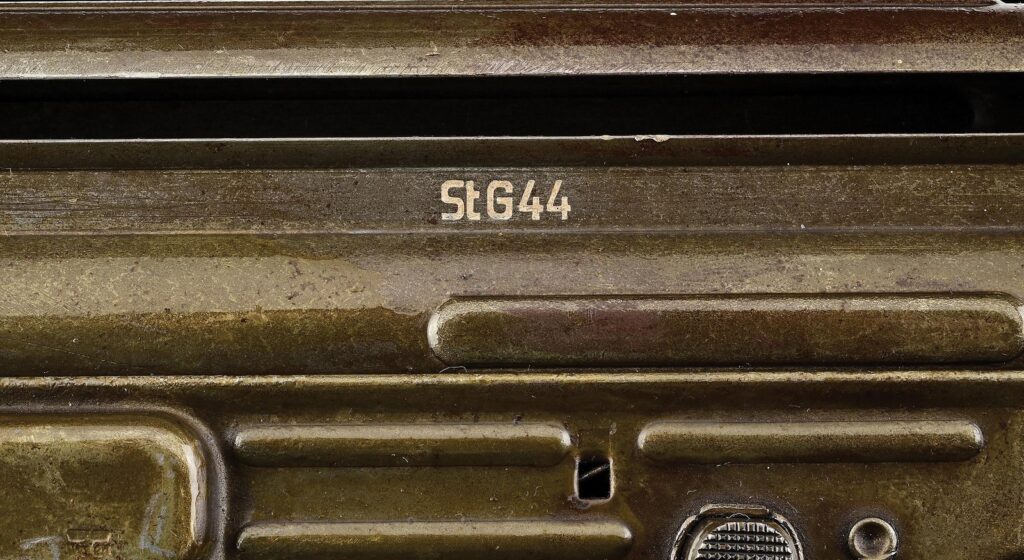
The sources also disagree on the dates. The Lexikon puts the MP 44 name in March 1944, and a caption in Kulinsky’s article April 1944 (his main text puts the Sturmgewehr name itself in April 1944). For the StG 44 name, Morphy’s catalog for the rifle above says “the official order designating the change from MP-44 came in” October 1944. The same caption in Kulinsky’s article also says October 1944, and the Lexikon says December 1944. Erenfeicht writes that a manual of December 6, 1944, was the first to use the new name. The rifles themselves are marked MP 43, MP 44 or StG44 on the receiver. The changes between the names were small. The U.S. War Department’s Handbook on German Military Forces (TM-E 30-451, March 1945) describes the MP 44 as “the M.P. 43/1 slightly modified to accommodate the standard rifle grenade launcher cup.” Erenfeicht says the production reports counted all of them as one type.
How the StG 44 Works
The StG 44 is a gas-operated rifle. Gas tapped from the barrel drives a long piston that runs in a tube above the barrel and is fixed to the bolt carrier. As the carrier moves back it cams the breechblock out of its locking recess in the receiver and carries it to the rear. The return spring brings both forward to chamber the next round. W.H.B. Smith compared the lock to the British Bren gun in the U.S. Army’s Infantry Journal of November 1944: “the locking block rising and falling to lock and unlock.” The rifle fires from a closed bolt, with a hammer, the arrangement taken from Walther’s design.
A push-through selector in the trigger housing shows an “E” on one side for Einzelfeuer (single shots) and a “D” on the other for Dauerfeuer (automatic). A separate safety lever is on the left. Tactical and Technical Trends reported that “the receiver, frame, gas cylinder, jacket, and front sight hood are all made from steel stampings.” The pins in the trigger mechanism were riveted in place, and the grip and trigger group swung down on a front pin for cleaning. The report added that “further stripping is not possible since all pins and rivets have been preened in production assembly.”
How Many StG 44s Were Made
The German counts come close to each other.
- 425,977 by April 1, 1945. The Lexikon der Wehrmacht gives yearly figures for the “Sturmgewehr,” with the MP 43, MP 44 and StG 44 counted together. It lists 19,501 in 1943, 281,860 in 1944 and 124,616 in 1945 to April 1. Those add up to 425,977. The MKb 42 is counted separately (11,833 in 1942 and 1943).
- About 415,000 by March 1945, or 420,000 by April. Erenfeicht writes that the Waffenamt’s figures survive to March 1945 and list 415,000 made. Adding the average monthly output of 5,000 gives about 420,000 by April 1945.
- 424,000, by Hugo Schmeisser’s statement. Erenfeicht says the Americans took Schmeisser’s statement while they occupied Suhl in 1945, before the Soviets took the town over. His figures: C.G. Haenel of Suhl (code “fxo”) 185,000; J.P. Sauer & Sohn of Suhl (“ce”) 55,000; ERMA of Erfurt (“ayf,” “qlv”) 104,000; and Steyr-Daimler-Puch of Steyr, Austria (“bnz”) 80,000.
No count splits the total by model. Erenfeicht writes that the production reports listed all the assault rifles as one type. He calls his figure of about 14,000 for the MP 43/1 a guess. He adds that the total fell far short of the 1.5 million ordered and the 4 million planned. The Lexikon says the Army gave up 7,215 of its rifles, among them 4,320 to the Luftwaffe, 2,069 to the navy and 17 abroad.
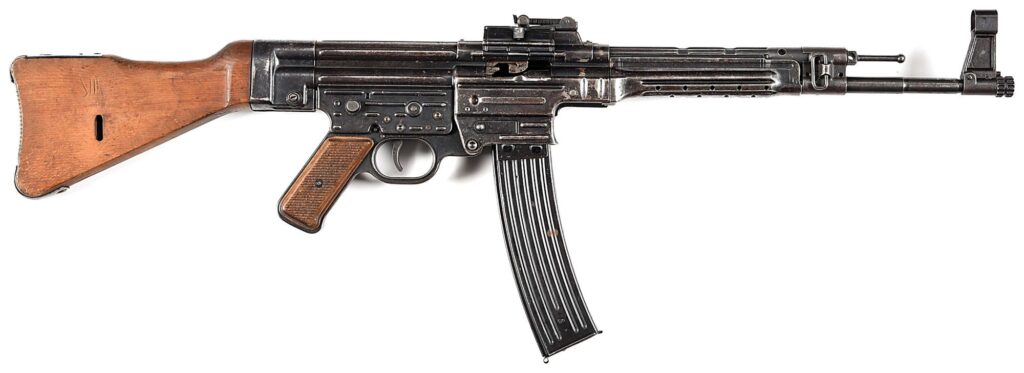
Surviving rifles carry the same maker codes. Morphy has cataloged a Haenel MP 44 of 1944 marked with the eagle over “37,” the ERMA rifle above with the eagle over “280,” a J.P. Sauer MP 44 marked “ce” and a Steyr MP 44 with part of its “bnz” code still legible. Many also carry “cos,” the code of the Merz-Werke, which pressed the sheet-metal parts.
What the U.S. and British Reports Said, 1944 to 1945
The Western Allies met the rifle in 1944, and their first reports were cool. American Rifleman collected several in 2024, in an article by Tom Laemlein.
- Intelligence Bulletin, September 1944: the “M.P. 43” served “the same tactical purpose as the U.S. carbine, M1.” It “compares very unfavorably” with the carbine, being “practically twice as heavy.” A German order forbade automatic fire because it overheated the barrel.
- ETO Ordnance Technical Intelligence Report No. 49: a test gun fired 55 rounds in five-round bursts. It could not be held on a six-foot target at 35 yards, and afterward it was too hot to hold forward of the magazine. The report cited two British War Office Technical Intelligence Summaries, Nos. 136 and 144, for the full description of the weapon and its cartridge.
- Intelligence Bulletin, February 1945: it printed German instructions attributed to General Heinz Guderian. “Up to a range of 450 yards, the M.P. 44 is as accurate as the rifle.” Bursts were to be “2 to 3 rounds,” and the weapon was generally set for single fire.
- TM-E 30-451, March 1945: the War Department’s handbook filed the “M.P. 43/1” under machine pistols. It said the weapon “has not proved very successful because it is impossible to repair in the field and because of its poor firing characteristics.” It gave the magazine as 35 to 38 rounds, where the other U.S. reports give 30.
- Tactical and Technical Trends No. 57, April 1945: the rifle was “subject to jamming” and “incapable of sustained firing.” It weighed “12 pounds with a full magazine.” The report also said “accuracy of the Sturmgewehr is excellent for a weapon of its type.” It put the effective range at about 400 yards, “although the Germans claim in their operating manual that the normal effective range is about 650 yards.”
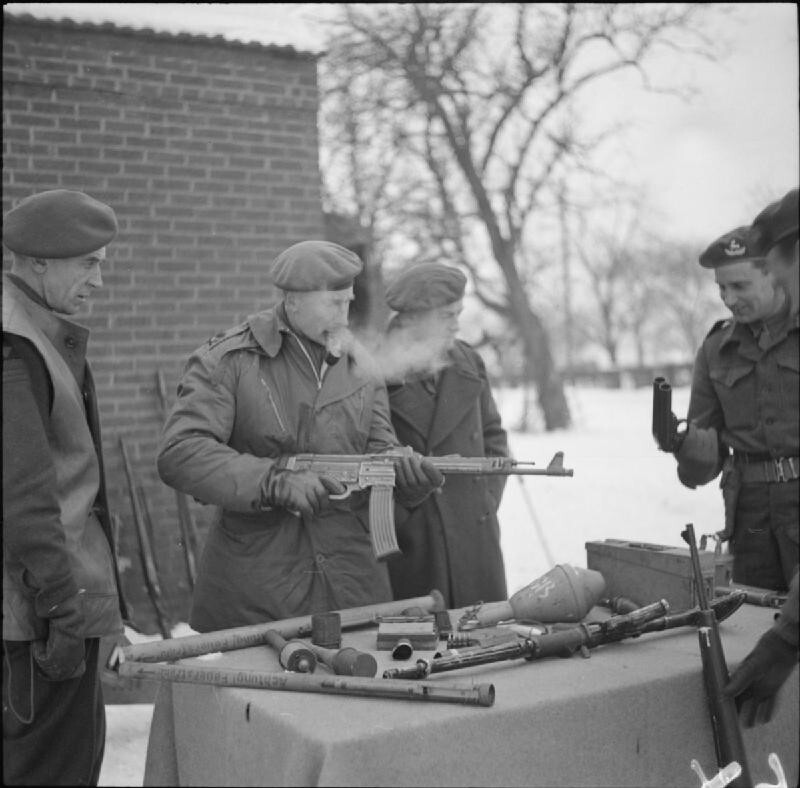
Laemlein notes that U.S. Ordnance did not take up the German short cartridge or a rifle of this kind. The closest American weapon of the period was the M2 carbine, a select-fire version of the M1 carbine. Williams says it came close to the assault-rifle description. The Army kept the full-power M1 Garand as its rifle. The German Army’s own rifle remained the Mauser Kar 98k, which the Sturmgewehr was meant to supplement.
The Krummlauf: The StG 44’s Curved Barrel
The best-known StG 44 accessory is the Krummlauf, a curved barrel attachment aimed through a prism sight. Erenfeicht writes that it deflected bullets downward, for firing from a trench or at enemy infantry in a tank’s blind spots. The program began in late 1943. In July 1944 a prototype Vorsatz P (“attachment P,” for Panzer), bent 90 degrees, put all 30 shots into a 30 cm (12-inch) square at 100 meters. Tank crews ordered 10,000, which he thinks were probably never delivered. The infantry Vorsatz J, bent 30 or 45 degrees, had its first trial in October 1944. Rheinmetall received a contract for a trial batch of 1,000 in January 1945. The attachments wore out far too fast, and no production followed before the end of the war.
The Lexikon der Wehrmacht gives a different account. It says the 30-degree Vorsatz J was made in some numbers and put single shots into 35 x 35 cm at 100 meters. The 30-degree attachment lasted just under 300 rounds and the 45-degree one only 160. About 200 of the 90-degree Vorsatz P were made.
The StG 44 and the AK-47
The clearest link between the StG 44 and the Soviet rifle is the cartridge. Williams writes that on July 15, 1943, the Technical Council of the People’s Commissariat for Armament met to consider “New foreign weapons firing lower-powered rounds.” It studied the U.S. .30 M1 carbine and a German MKb 42(H) in 7.92×33, captured during the German troop trials. The council concluded that the German gun and cartridge were important and ordered a new reduced-power round. The OKB-44 design bureau had a prototype of the 7.62 mm M1943 cartridge a month later. Williams adds that it used a slimmer case than the 7.92×33. No German cartridge has been found that the M1943 could have copied. Laemlein, in American Rifleman, writes that the Soviets “fully embraced the German 7.92×33 mm Kurz cartridge, turning it into the 7.62×39 mm round.” The 7.62×39 was confirmed in 1948, when the AK-47 was already in troop trials.
The rifles themselves work differently. The StG 44 locks with a tilting breechblock, and the AK uses a rotating bolt. Both have a gas piston above the barrel fixed to the carrier, a curved magazine and a pistol grip. Ian McCollum of Forgotten Weapons sees German influence in how the AK was refined and built. He points to the piston fixed to the carrier, the ribbed gas tube and the barrel trunnion of the production rifle. McCollum writes that Kalashnikov credited the M1 Garand for the trigger and the rotating bolt. Nathaniel F., writing for The Firearm Blog in 2016, compared the two trunnions and found almost no major features in common. Our AK-47 history covers the Soviet rifle.
The StG 44 After 1945: East Germany, Yugoslavia and Syria
The WWII After WWII research blog estimates that the Soviet Army held about 102,000 StG 44s in 1948. It did not issue them to its own troops. Czechoslovakia received them first and in the largest numbers, then East Germany. Hungary got a batch of about 4,000, Yugoslavia some before its 1948 break with Moscow, and North Vietnam a few. The same blog says the Czechoslovak army used the StG 44 from 1946 and counted it among its main rifles by 1949. It was out of front-line service there by 1955.
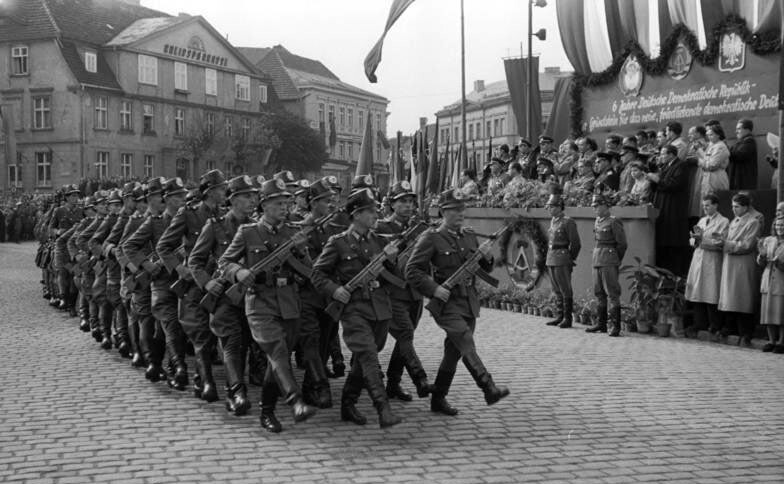
- East Germany. The same blog shows the barracked police, the forerunner of the National People’s Army, parading with StG 44s in 1954. It says the Volkspolizei carried them until Kalashnikovs replaced them in the mid to late 1960s. The workers’ militia received them from about 1958 into the early 1960s. It says East Germany made the ammunition until 1962. Morphy’s 2021 catalog for a Sauer MP 44 lists “24 boxes of post war East German production corrosive primed steel cased ammunition” in the lot.
- Yugoslavia. Lynndon Schooler, writing for The Firearm Blog, says the Yugoslav People’s Army issued the StG 44 to a few units, the 63rd Parachute Brigade above all. It retired the rifle in 1983. He says Yugoslavia received about 2,000 from the Soviet Union before 1948 and that the Užice factory, now Prvi Partizan, produced the ammunition. WWII After WWII says instead that Yugoslavia never made the round and used reboxed German wartime stock for the rifle’s whole service life.
- Syria. WWII After WWII says East Germany’s first arms deal with Syria, in 1964, covered 4,500 World War II small arms. The StG 44 was among them, with reboxed wartime ammunition. Calibre Obscura, an open-source researcher who tracks arms in the Syrian war, gives about 2,200 StG 44s from East Germany in 1964, with more from Czechoslovakia. The most cited source for the rebels’ StG 44s is a video of August 2012. It shows what was claimed to be a cache of 5,000 with ammunition, captured by the al-Tawhid Brigade. In 2019 Calibre Obscura reported StG 44s for sale in Idlib, among them one a rebel fighter sold because no ammunition could be found.
- Algeria and the Horn of Africa. WWII After WWII says French troops captured StG 44s from Algerian fighters in 1960 and 1961, supplied through Czechoslovakia. The rifle also turned up with the Western Somali Liberation Front in the Ogaden War of 1977 and 1978.
Original MP 43s, MP 44s and StG 44s in the United States are machine guns under the National Firearms Act. Morphy’s catalogs list them as requiring ATF approval before transfer. Late-war German rifles for the same cartridge also turn up at auction, such as the Gustloff Volkssturmgewehr in Morphy’s December 2025 sale. The Lexikon says the roller-delayed system of the late-war prototype StG 45(M) reappeared in the G3 rifle.
StG 44 Reproductions in .22 LR
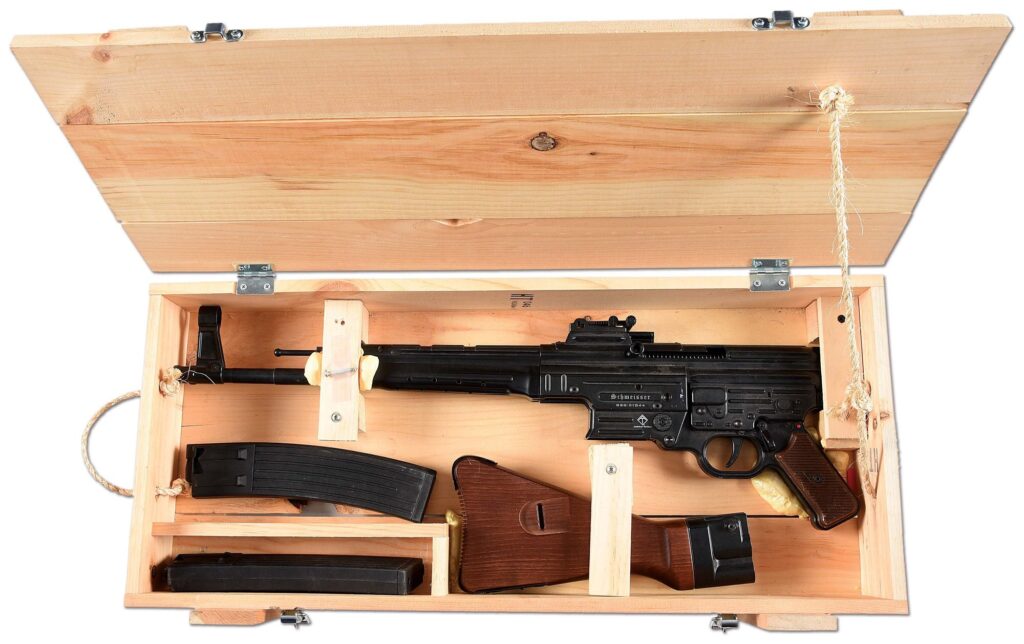
The StG 44 most shooters can buy is a .22 rimfire reproduction made by German Sport Guns (GSG). The one Morphy sold in 2021 was a semi-automatic .22 LR with a 17 1/4-inch barrel, two 25-round magazines and ATI import marks. It came in a pine crate in the wartime style. Guns.com lists the GSG STG-44 in .22 LR with a 16-inch barrel and a 25-round magazine.
Where the Record and the Legend Disagree
- “The StG 44 was the first assault rifle.” Williams names the Russian Fedorov Avtomat of 1916 as the first service weapon that fits the description. It was select-fire and used the Japanese 6.5x50SR Arisaka cartridge, a full rifle round in its day, and only a few thousand were made. The StG 44 was the first rifle of the kind built in the hundreds of thousands around a purpose-made short cartridge. It also gave the class its name.
- “Hitler banned it, and the Army hid it under the name MP 43.” The Lexikon der Wehrmacht tells that story, and Kulinsky also says Hitler banned further work in 1943. Erenfeicht, citing company correspondence and reports, argues that Hitler saw the rifle often and was reluctant only to send it to the front in small numbers. Both U.S. intelligence in April 1945 and Erenfeicht say Hitler chose the name Sturmgewehr.
- “The MP 43, MP 44 and StG 44 are different rifles.” The differences were small. The War Department’s 1945 handbook describes the MP 44 as the MP 43/1 “slightly modified” for the grenade launcher. The German production reports counted all of them as one type.
- “The renaming dates are settled.” The sources give October 1944 (Morphy’s catalog, Kulinsky’s caption) and December 1944 (the Lexikon, and Erenfeicht’s manual of December 6, 1944). For the MP 44 they give March 1944 (the Lexikon) and April 1944 (Kulinsky).
- “The AK-47 is a copy of the StG 44.” The documented link is the cartridge idea. The Soviet arms council studied a captured MKb 42(H) and its round in July 1943 and ordered its own reduced-power cartridge, which became the 7.62×39. The rifles lock differently, the StG 44 with a tilting breechblock and the AK with a rotating bolt. Kulinsky writes that Schmeisser left Suhl for Izhevsk by special train on October 24, 1946, and returned to Germany on June 9, 1952. He adds that one view holds the German specialists were kept away from design work and given only manufacturing questions. Nathaniel F. points out that the AK-47 was designed at the Degtyarev plant in Kovrov, almost 1,000 km from Izhevsk. McCollum’s case for German influence rests on details of how the production AK was built. Kulinsky writes that he has no precise information on what the Germans did at Izhevsk, and Nathaniel F. finds no real evidence that Schmeisser designed the AK.
- “U.S. experts saw a great rifle.” The 1944 and 1945 reports above called it heavy, hard to repair and prone to overheating in automatic fire. TM-E 30-451 said it had “not proved very successful.” The same reports credited its accuracy. The German instructions of the time told troops to fire single shots or short bursts.
- “The Krummlauf shot around corners.” Erenfeicht writes that the attachments deflected bullets downward, for firing out of a trench or at infantry close to a tank. He and the Lexikon disagree on how many were made.
- “Africa’s StG 44s were left over from Rommel’s Afrika Korps.” WWII After WWII writes that no StG 44 served with any German unit in Africa during the war. The rifles captured in Algeria came through Czechoslovakia.
Books on the StG 44 and Its Successors
Book links go to Amazon, and Powder & Lead earns a commission on qualifying purchases.


- Chris McNab, German Automatic Rifles 1941-45: Gew 41, Gew 43, FG 42 and StG 44 (Osprey Weapon series).
- Gary Paul Johnston and Thomas B. Nelson, The World’s Assault Rifles, third edition.
- C. J. Chivers, The Gun, a history of the Kalashnikov.
- W. H. B. Smith and Edward Clinton Ezell, Small Arms of the World.
Sources
- U.S. War Department, TM-E 30-451, Handbook on German Military Forces (March 15, 1945), Chapter VII, Section II, para. 4 (machine pistols), transcription at Lone Sentry.
- U.S. War Department, “Machine Carbine Promoted: M.P. 43 Is Now ‘Assault Rifle 44′”, Tactical and Technical Trends No. 57 (April 1945), transcription at Lone Sentry.
- Tom Laemlein, “What American GIs Thought Of The Sturmgewehr StG44”, American Rifleman, July 9, 2024. Reprints the Intelligence Bulletin (September 1944 and February 1945), ETO Ordnance Technical Intelligence Report No. 49 and W.H.B. Smith, “The New German Carbine,” Infantry Journal (November 1944).
- Leszek Erenfeicht, “Sturmgewehr: Hitler’s Only True Wunderwaffe”, Small Arms Defense Journal, 2013.
- “Sturmgewehre”, Lexikon der Wehrmacht (in German).
- Anthony G. Williams, “Assault Rifles and Their Ammunition: History and Prospects” (archived copy).
- Alexander Kulinsky, “Schmeissers: Fates and Weapons” (part 2), Kalashnikov magazine, No. 8, 2003 (in Russian, archived copy).
- Nathaniel F., “Kalashnikov Conspiracy Theories and How to Refute Them, Part 2: Schmeisser vs. Mikhtim”, The Firearm Blog, October 23, 2016.
- Ian McCollum, “AK and StG: Kissing Cousins”, Forgotten Weapons, December 12, 2012.
- WWII After WWII, “StG-44 in Africa after WWII” (2015), “WWII Firearms in East Germany’s Other Armed Forces” (2023) and “Syrian Civil War: WWII Weapons Used” (2017).
- Lynndon Schooler, “The StG 44 in Post-War Yugoslavia”, The Firearm Blog, August 19, 2025.
- Calibre Obscura, “Nazi Assault Rifles in Idlib”, August 15, 2019.
- Morphy Auctions, StG 44 dated 1945, November 2022; Haenel MKb 42(H), September 2026; Haenel MP 43/1, 1943 and ERMA MP 44, 1944, September 2024; Haenel MP 44, September 2025; J.P. Sauer MP 44, April 2021; Steyr MP 44, September 2023; German Sport Guns STG-44 .22 LR, December 2021.
The Morphy Auctions (morphyauctions.com) catalog archive is one of the standout marketplaces for rare and historically significant firearms. The StG 44 photography in this article comes from their archive: the 1945 StG 44 and its receiver marking, the MKb 42(H), the MP 43/1, the ERMA MP 44 and the GSG reproduction. Their sales are worth following whether you are buying, researching German assault rifles and their period contemporaries, or just looking at very good firearms photography.
If you know of any forums or sites that should be referenced on this listing, please let us know here.