
Some cartridges get all the glory. The .30-06 Springfield sits on a throne. The .270 Winchester has its Jack O’Connor fan club. The .308 Winchester runs the precision rifle world. And then there’s the .257 Roberts: a cartridge that does everything well, asks for nothing in return, and somehow still gets overlooked at the gun counter. That’s a shame, because the “Bob,” as it’s affectionately known, is one of the most well-balanced rifle cartridges ever designed.
Ned Roberts and the Quarter-Bore Obsession
The .257 Roberts traces its lineage to one man’s stubborn passion for .25-caliber rifles. Ned H. Roberts was a rifleman, writer, and experimenter who spent decades chasing the ideal medium-game cartridge. Roberts was a regular contributor to firearms publications in the early 20th century, and he was convinced that .25-caliber bullets offered a uniquely useful combination of flat trajectory, moderate recoil, and adequate killing power for deer-sized game.
Roberts wasn’t the only one interested in quarter-bore wildcats. Throughout the 1920s and into the 1930s, a number of experimenters were necking down the 7x57mm Mauser case to accept .257-caliber bullets. The 7x57mm parent case was an inspired choice: it’s a mild-mannered, efficient case design with a gentle shoulder angle that feeds slick as butter through bolt actions. Roberts himself worked with gunsmith A.O. Niedner (along with collaborators including Harvey Donaldson, Townsend Whelen, and F.J. Sage) on developing what he called the .25 Roberts. Niedner’s Rifle Corporation was the first to chamber the wildcat commercially.
From Wildcat to Factory Round
Remington made the cartridge official in 1934, standardizing it as the .257 Roberts. But here’s where things get interesting, and where some Roberts fans get annoyed. Remington changed the shoulder angle from Roberts’ original design. The original wildcat used a 15-degree shoulder angle, while Remington bumped it up to a sharper 20 degrees and 45 minutes, matching the shoulder angle of the parent 7x57mm Mauser case. The intent was improved headspacing, more consistent chamber dimensions across factory rifles, and reliable feeding from standard Mauser magazines.
The Roberts name stuck despite these changes, and Ned Roberts himself reportedly had mixed feelings about the commercial version bearing his name with a different shoulder. That said, the cartridge performed beautifully regardless. Remington chambered it in their Model 30 bolt-action rifle initially, and Winchester followed suit, first in the Model 54, and then in the Model 70 when it debuted in 1936.
What Makes the .257 Roberts Special
If you’ve never shot a .257 Roberts, you’re missing out on what I consider one of the most pleasant centerfire rifle experiences available. The recoil is remarkably mild for a cartridge this capable. We’re talking about pushing a 100-grain bullet to around 2,800-3,100 fps out of a standard-length barrel, or a 117-120 grain bullet to roughly 2,650-2,800 fps in standard loads (Hornady’s Superformance +P pushes a 117-grain SST to nearly 2,940 fps). That’s genuine 300-yard deer performance without the punishment of a magnum.
The .257 Roberts operates at relatively modest chamber pressures. SAAMI maximum average pressure is listed at 54,000 PSI, which is considerably lower than many modern cartridges. This is actually a sore point for some enthusiasts: many believe the Roberts was saddled with conservative pressure limits to accommodate older actions, and that the cartridge is capable of significantly more when loaded in modern rifles. The “+P” designation you sometimes see on .257 Roberts ammunition reflects loads pushed to higher pressures (58,000 PSI per SAAMI) that are safe in modern bolt actions but should not be fired in older rifles without having them inspected by a qualified gunsmith first.
Ballistic Performance in the Field
On paper and in the field, the .257 Roberts has always punched above its weight class in terms of practical performance per unit of recoil. Consider the ballistic profile: a 100-grain Nosler Partition or Sierra GameKing at 2,950 fps zeroed at 200 yards drops roughly 7-8 inches at 300 yards (exact figures vary by specific load, altitude, and conditions). That’s a hold-on-hair trajectory for the vast majority of hunting situations in North America. The wind drift is moderate: better than a .30-30 or .35 Remington, though not quite as wind-resistant as a heavy .270 or .30-06 bullet. For hunting in open prairie, foothills, or mountain terrain where shots tend to run 150-350 yards, the Roberts trajectory is nearly ideal.
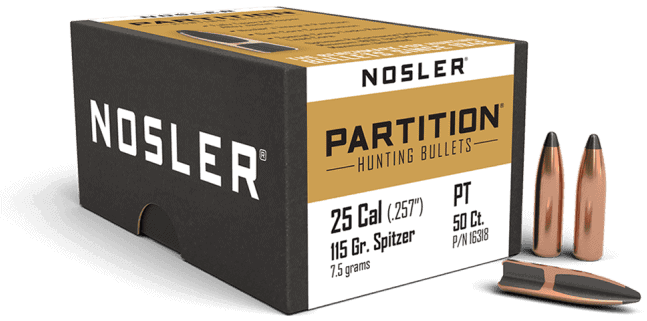
Terminal performance with quality bullets is more than adequate for deer, antelope, and similar-sized game. The .25-caliber bore diameter means slightly less frontal area than a .270 or .308, but sectional density on the heavier .257 bullets is excellent. A 115-grain Nosler Partition in .257 caliber has a sectional density of .249, which translates to deep penetration relative to caliber. Elk with the Roberts? Some people do it, and I won’t say they’re wrong if they use a tough bullet and keep shots reasonable. But the cartridge is at its best on game under 300 pounds. That’s not a weakness: that’s the vast majority of big game hunted in North America.
Barrel Life and Case Efficiency
One of the less-discussed virtues of the .257 Roberts is barrel life. Because it operates at moderate pressures with an efficient powder column, the Roberts doesn’t erode throats the way hot-rod cartridges do. Shooters routinely report barrel life of 3,000 rounds or more before accuracy degrades (this varies by barrel steel, shooting cadence, and load, but the general consensus is favorable). Compare that to overbore cartridges like the .264 Winchester Magnum or the 6.5-300 Weatherby, which can burn out a barrel in 800-1,200 rounds. For a cartridge you want to shoot regularly (whether for practice, varminting, or load development), long barrel life is a serious practical advantage.
The Roberts also makes efficient use of powder. A typical charge weight for the .257 Roberts runs in the range of 40-48 grains depending on the powder and bullet (do not use this as load data; always consult a published reloading manual for specific charge weights). That’s noticeably less than what a .25-06 burns, and the velocity difference between the two is surprisingly narrow, often only 150-200 fps in favor of the .25-06, at the cost of substantially more powder, more recoil, more muzzle blast, and faster barrel erosion. Efficiency matters, both in how far a pound of powder goes and in how long your barrel lasts.
The Competition That Overshadowed It
So if the .257 Roberts is this good, why doesn’t it dominate? The honest answer is timing and marketing. The .270 Winchester had a nine-year head start, arriving in 1925, and it had Jack O’Connor beating the drum for it in every outdoor magazine in America for decades. The .243 Winchester showed up in 1955 and carved out the “light recoil, flat shooting” niche with the advantage of using .308-family short-action rifles. The .25-06 Remington went factory in 1969 and offered similar bullet diameter with more velocity from its full-length .30-06 case.
The Roberts got squeezed from both sides. Shooters who wanted mild recoil and flat trajectory drifted toward the .243. Those who wanted more punch in .25 caliber went for the .25-06. And the .270 already owned the “do-everything” medium-bore conversation. None of this reflects poorly on the Roberts: it’s purely a market dynamics problem.
The Reloader’s Cartridge
Where the .257 Roberts really shines is on the reloading bench. The case is efficient, it doesn’t burn barrels the way overbore magnums do, and it responds beautifully to handloading. There’s a wide range of .257-caliber bullets available from manufacturers like Sierra, Hornady, Nosler, and Barnes, ranging from 75-grain varmint bullets up through 120-grain options suitable for larger game.
The case capacity is such that you can develop loads spanning everything from a varmint rifle to a solid deer and antelope cartridge. A 75-grain hollow point at maximum safe velocity makes for a devastating prairie dog load, while a well-constructed 115-120 grain partition or bonded bullet at moderate velocity will handle any whitetail or mule deer that walks. In my opinion, this versatility is unmatched at this recoil level.
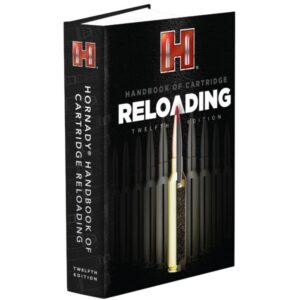
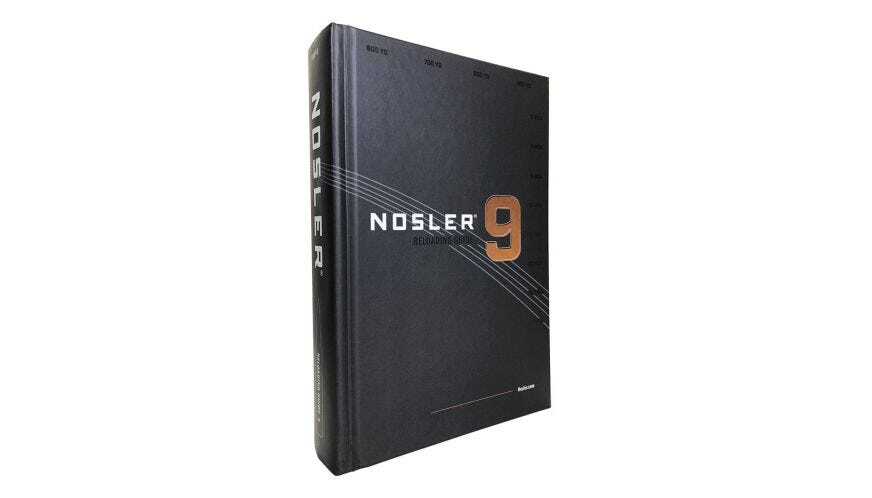
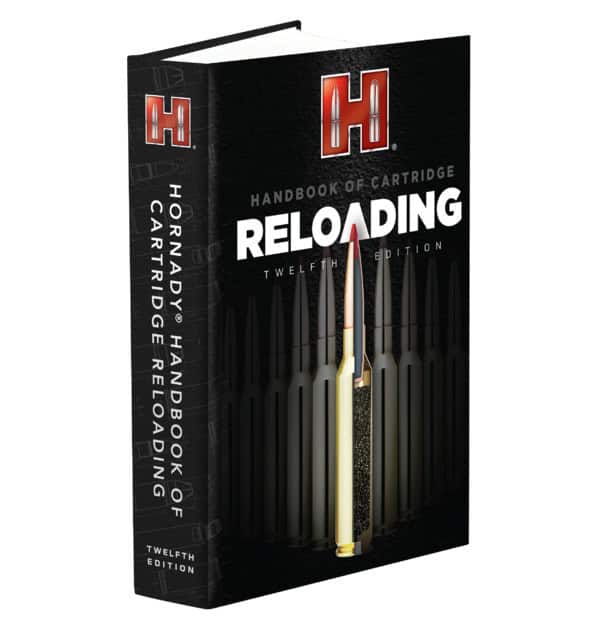
I won’t print specific load data here: that’s what your reloading manual is for. If you’re loading for the .257 Roberts, get a current edition of the Nosler Reloading Guide, Hornady Handbook of Cartridge Reloading, or Sierra Reloading Manual. All three have excellent .257 Roberts sections. For a cartridge-specific reference, the Complete Reloading Manual for the .257 Roberts is a dedicated compilation worth having on the bench. Follow their published data exactly and work up from minimum loads. This isn’t optional advice: it’s the only safe way to develop handloads.
If you’re setting up to reload the .257 Roberts, you’ll need a set of dies. RCBS’s full-length 2-die set is the standard workhorse: reliable, well-made, and widely available. Lee’s Pacesetter 3-die set is the budget entry point and includes a factory crimp die, which is a nice touch at the price. For the reloader who wants tighter tolerances, Redding’s full-length set is a step up in precision and price.
Modern Status and Availability
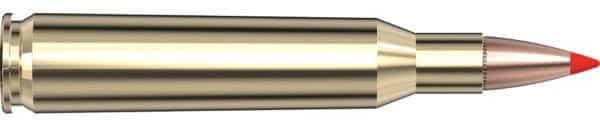
The .257 Roberts hasn’t completely disappeared, but it’s not thriving either. As of this writing, factory ammunition is available from a handful of manufacturers: Hornady, Nosler, Remington, and Winchester have produced runs in recent years, though it’s not always sitting on the shelf at your local sporting goods store. You may need to order online or, better yet, load your own. Brass is available from Nosler, Hornady, and occasionally from Remington and Winchester.
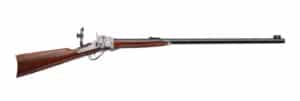
Rifle availability is more limited. Ruger has chambered the No. 1 and the M77 Hawkeye in .257 Roberts on occasion. The cartridge shows up in semi-custom offerings from companies like Cooper and Kimber from time to time. But you won’t find rows of .257 Roberts rifles at a big box store. Most shooters who fall in love with the Bob end up having a rifle built on a custom or semi-custom action, which honestly suits the cartridge’s personality just fine.


Who Is the .257 Roberts For?
In my opinion, the .257 Roberts is ideal for a few specific types of shooters. First, anyone who is recoil-sensitive but wants genuine medium-game capability: the Roberts delivers deer-killing performance at recoil levels closer to a .243 than a .270. Second, handloaders who appreciate case efficiency and barrel life. Third, anyone who hunts in open country where 250-300 yard shots are common but 500-yard bombing runs are not the goal. And honestly? Anyone who just appreciates an elegant cartridge that does its job without fanfare. You may also be interested in our coverage of The .32 Rimfire Cartridge: History and Variations.
The .257 Roberts may never reclaim a top-ten spot on the best-seller charts. The market has moved on, and there’s no going back. But cartridges don’t become obsolete just because newer ones exist. The Bob still does exactly what Ned Roberts intended it to do: put .25-caliber bullets on target with precision, efficiency, and minimal fuss. If that sounds appealing, grab a reloading manual and start down the quarter-bore rabbit hole. You won’t regret it.
If you know of any forums or sites that should be referenced on this listing, please let us know here.