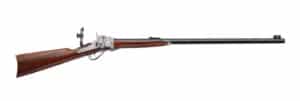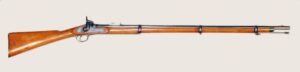

The .30-06 Springfield is the cartridge American shooting was built around. Adopted by the U.S. Army in 1906 as the .30 Caliber Model of 1906, it carried American infantry through two world wars and Korea, then went on to a civilian career that has now run longer than its military one. Rifle makers still chamber it. Every major ammunition company still loads it. A hunter who buys a .30-06 today is buying into a hundred and twenty years of accumulated bullets, powders, load data and hard-won field experience, and that inheritance is most of the reason the cartridge refuses to fade.
Why the Army Went Looking for a New Cartridge
The trouble started in Cuba. In 1898, American troops carrying .30-40 Krag rifles ran into Spanish regulars armed with Model 1893 Mausers firing the 7×57mm cartridge. The Spanish round shot flatter, its rifle loaded faster from stripper clips, and the volume of accurate fire coming off the Spanish positions made an impression on the U.S. Army that outlasted the war itself.
The Ordnance Department’s answer arrived in 1903: a rimless .30 caliber cartridge with a case 2.540 inches long, loaded with a 220-grain round-nose bullet at roughly 2,300 fps. It was designated the .30-03, and it was chambered in the new Model 1903 Springfield rifle. On paper it was a considerable improvement over the Krag.
Then Europe moved. In 1905 the German Army adopted the S Patrone for its 8×57 service rifles, a 154-grain pointed spitzer bullet leaving the muzzle near 2,880 fps. A pointed bullet holds velocity far better than a round nose, which means a flatter path, less wind drift and more usable range in the hands of an ordinary rifleman. Against that, the .30-03’s heavy round-nose projectile looked immediately obsolete. The .30-03 had been in service barely three years.
1906: A Shorter Case and a Pointed Bullet
The fix was quick and, by the standards of military procurement, remarkably clean. Springfield Armory kept the .30-03 case head and body, shortened the case from 2.540 to 2.494 inches, and loaded a 150-grain flat-base spitzer bullet at about 2,700 fps. The Secretary of War approved the result on October 15, 1906, as Cartridge, Ball, Caliber .30, Model of 1906.
Two points get garbled often enough to be worth stating plainly. First, the .30-03 is the parent of the .30-06, not a variant of it. The .30-06 came second. Second, the case was shortened by 0.046 inch, not by the 0.07 or 0.10 inch figures that circulate in older accounts. The shorter neck let the stubby pointed bullet sit closer to the rifling instead of jumping a long way to reach it.
Changing the cartridge meant changing the rifles. Between November 1906 and early 1909, Springfield Armory reworked close to 270,000 unissued M1903 rifles for the new round. Each barrel was set back at the breech, roughly two-tenths of an inch of thread removed, and rechambered; stocks and handguards were shortened to match and the rear sights were replaced. Almost every .30-03 rifle in stores went through the program, which is why original unaltered .30-03 Springfields are rare and valuable today.
Cartridge Specifications
- Bullet diameter: .308 in
- Case length: 2.494 in
- Maximum cartridge overall length: 3.34 in
- Base diameter: .4708 in · shoulder: .4425 in · neck: .3404 in
- Shoulder angle: 17.5 degrees per side
- Case capacity: about 68 grains of water
- Maximum average pressure: 60,000 psi (SAAMI); 58,740 psi (C.I.P.)
- Standard rifling twist: 1 turn in 10 inches
The Ball Ammunition, 1906 to 1954
The military .30-06 did not stay still. Three service ball loadings define its history, and knowing which is which explains a great deal about surplus rifles and surplus ammunition.
M1906 Ball (1906)
The original: a 150-grain flat-base spitzer with a cupronickel jacket, about 2,700 fps. The jacket turned out to be the weak point. At the higher velocity, cupronickel smeared metal fouling into the bore fast enough to hurt accuracy and give armorers steady work. In 1921 the service bullet jacket was changed to gilding metal, a copper-zinc alloy that fouls far less.
M1 Ball (1925)
Experience with long-range machine gun fire in France argued for a heavier, more efficient bullet. The Army adopted the M1 in 1925: a gilding-metal boat-tail of roughly 173 grains at about 2,647 fps, with a ballistic coefficient near 0.49. Published sources give the bullet weight variously as 172, 173 and 174 grains; 173 is the figure most commonly cited. M1 was noticeably more accurate than M1906 and it stretched the practical reach of the Browning guns considerably.
It also carried a great deal farther than anyone had planned for. By 1936 the Army had worked out that M1’s maximum range, around 5,500 yards, overshot the safety fans of many existing rifle ranges. Rebuilding the ranges was not practical. Changing the ammunition was.
M2 Ball (1938)
The M2 was close to a return to the 1906 pattern: a 152-grain flat-base gilding-metal bullet at about 2,805 fps, loaded with IMR 4895. The two-grain difference from the old 150-grain figure came from a different lead alloy inside the same jacket profile. Some accounts date the standardization to 1937 and others to 1938, and the changeover in production ran across both years. M2 Ball is what fed the M1 Garand through the Second World War and Korea, and it is the load every wartime Garand’s gas system was set up to handle. Wartime copper shortages also produced an M2 Alternate with a steel jacket plated in gilding metal.
Alongside ball, the Army fielded armor-piercing, tracer and incendiary types. The AP line ran from the M1917 through the M1918 and M1922 to the black-tipped AP M2, which was in service from 1939 and would defeat roughly four-tenths of an inch of armor plate at 100 yards. Production came out of Frankford Arsenal, Springfield Armory, Lake City and a string of wartime ordnance plants including Denver, Des Moines, Twin Cities, St. Louis, Utah and Eau Claire.
Military Loadings Compared
| Loading | Bullet | Muzzle velocity | Muzzle energy |
|---|---|---|---|
| .30-03 (1903) | 220 gr round nose | 2,300 fps | 2,585 ft-lb |
| M1906 Ball (1906) | 150 gr flat base | 2,700 fps | 2,429 ft-lb |
| M1 Ball (1925) | 173 gr boat tail | 2,647 fps | 2,692 ft-lb |
| M2 Ball (1938) | 152 gr flat base | 2,805 fps | 2,656 ft-lb |
The Rifles and the Guns
M1903 Springfield
The bolt-action that the cartridge was designed around, and the standard U.S. service rifle from 1903 until the Garand displaced it. The ’03 fought the First World War, soldiered on through the Second in the hands of Marines early in the Pacific campaign, and stayed in the inventory as a sniper and drill rifle long after. Wartime simplification produced the M1903A3 with a receiver-mounted aperture sight, and the M1903A4 gave the Army a scoped sniper rifle in the same chambering.
M1917 Enfield rifle
The M1917 is the rifle that most American infantrymen actually carried in France, and it is routinely confused with a machine gun of the same year. It is not one. The U.S. Rifle, Caliber .30, Model of 1917 is a bolt-action, adapted from the British Pattern 1914 that Remington, Winchester and the Eddystone plant were already tooled up to build in .303. Rebarrelling and rechambering that design for the rimless .30-06 took relatively little work, and it let American industry produce rifles at a rate Springfield Armory could not approach.
The numbers tell the story. Eddystone built 1,181,908, Remington 545,541 and Winchester 465,980, for 2,193,429 rifles between 1917 and 1920. By the armistice in November 1918, roughly three out of every four American riflemen in France were carrying an M1917 rather than a Springfield.
Browning M1917 and M1919 machine guns
These are two different guns, and neither is the rifle above. John Browning’s M1917 is a water-cooled, belt-fed, recoil-operated heavy machine gun adopted after the United States entered the war in April 1917. Tens of thousands reached the American Expeditionary Forces before the armistice, and production across the gun’s whole life came to roughly 128,000. The improved M1917A1, adopted in the late 1930s, raised the cyclic rate from about 450 to about 600 rounds per minute, and most surviving M1917s were brought up to that standard.
The M1919 is the air-cooled development of the same mechanism, first fitted to tanks in 1919 and formally designated Machine Gun, Caliber .30, M1919 in 1921. Losing the water jacket cost some sustained-fire endurance and bought a gun a crew could carry and mount almost anywhere. The M1919A4, standardized in the mid-1930s, became the most-produced version and the standard American medium machine gun of the Second World War. The M1919A6 added a bipod and shoulder stock for the squad automatic role.
M1918 Browning Automatic Rifle
Browning designed the BAR in 1917 to give American squads a shoulder-fired automatic that worked, replacing the widely detested French Chauchat. The Army adopted it in May 1918 and it reached the front that September. The M1918A2 of 1940, with a bipod, hinged butt plate and a two-speed automatic-only fire selector, carried the design through the Second World War and Korea.
M1 Garand
John Garand’s gas-operated eight-shot semi-automatic was adopted on January 6, 1936, replacing the M1903 as the standard U.S. service rifle. It was the first self-loading rifle any nation issued to its infantry as standard, and the United States went into the Second World War as the only combatant whose riflemen had one. George S. Patton called it “the greatest battle implement ever devised,” and the phrase has followed the rifle ever since. Scoped M1C and M1D variants served as sniper rifles into the 1950s. More than any other arm, the Garand is why the .30-06 Springfield is remembered as an American cartridge rather than simply a good one.
Others
The M1941 Johnson rifle and light machine gun, used in small numbers by Marine parachute units and the First Special Service Force, were chambered for it, as was the Belgian FN Model 1949 in the version sold to several foreign armies. On the sporting side, the list runs to hundreds of models and is still growing.
Replaced by the 7.62×51 NATO
Post-war powder chemistry undid the .30-06’s own case design. By the late 1940s, propellants had improved enough that a case half an inch shorter could push the same .30 caliber bullets to nearly the same velocity. The U.S. Army pushed that shorter case through NATO standardization in 1954, and it became the 7.62×51mm NATO. Commercially, Winchester had already brought it out as the .308 Winchester in 1952.
The shorter round suited what the Army wanted next. A stubbier cartridge means a shorter action, a shorter receiver and less mass reciprocating in a self-loader, and it packs more compactly in belts and magazines. The M14 rifle was adopted in 1957 and the M60 machine gun alongside it; the Garand was gone from Army units by 1958 and from the Marine Corps by 1965.
The .30-06 did not vanish from government service the day the M14 arrived. Machine guns, National Guard and reserve stocks, and allied forces kept the older round in use for years, and Lake City was still turning out .30-06 into the late 1970s with further production runs in 1993 and 2002.
The .30-06 Springfield in the Hunting Field
Civilians got hold of the cartridge almost immediately. In 1908 Winchester chambered the Model 1895 lever-action for it, the first commercially produced sporting rifle in .30-06. The Model 1895’s box magazine was the reason it could take a pointed bullet at all, since a spitzer nose resting against a primer in a tube magazine is a bad idea.
Bolt guns followed. Remington’s Model 30 of 1921 was built on surplus M1917 tooling. Winchester brought out the Model 54 in 1925 and then, in 1936, the Model 70, a rifle that did as much for the .30-06’s civilian reputation as the Garand did for its military one. Savage added the Models 40 and 45 in 1928. Alongside the factory guns ran a whole trade in sporterized Springfields, from backyard conversions to the fine custom work of shops like Griffin & Howe.
Townsend Whelen was calling it the all-around cartridge for American big game as early as 1913, and generations of hunters have since taken him at his word. The case for the .30-06 in the field is straightforward: it will drive a 150-grain bullet flat enough for open-country deer and antelope, a 180-grain bullet hard enough for elk and moose, and a 200 or 220-grain bullet deep enough for the largest North American game, all from the same rifle and the same box magazine. Very few cartridges cover that spread without a barrel change.
Ballistics: What It Actually Does
The table below uses published factory data for named loads from a 24-inch test barrel. Drop is figured from a 200-yard zero. Handloaders who verify their loads with a shooting chronograph should expect their own hunting rifles, most of which wear 22-inch barrels, to run 25 to 50 fps behind these figures.
| Load | Muzzle vel. | Muzzle energy | 300 yd vel. | 300 yd energy | Drop at 300 yd |
|---|---|---|---|---|---|
| 125 gr Remington Core-Lokt PSP | 3,140 fps | 2,737 ft-lb | 2,138 fps | 1,269 ft-lb | −7.4 in |
| 150 gr Federal Power-Shok JSP | 2,910 fps | 2,821 ft-lb | 2,081 fps | 1,443 ft-lb | −8.2 in |
| 165 gr Federal Vital-Shok Ballistic Tip | 2,800 fps | 2,873 ft-lb | 2,249 fps | 1,854 ft-lb | −7.8 in |
| 168 gr Federal Gold Medal MatchKing | 2,700 fps | 2,720 ft-lb | 2,148 fps | 1,722 ft-lb | −8.5 in |
| 180 gr Federal Power-Shok JSP | 2,700 fps | 2,914 ft-lb | 2,045 fps | 1,672 ft-lb | −9.0 in |
| 220 gr Remington Core-Lokt SP | 2,410 fps | 2,838 ft-lb | 1,632 fps | 1,301 ft-lb | −13.1 in |
Two things stand out. Muzzle energy barely moves across the whole weight range, holding between about 2,720 and 2,914 foot-pounds from 125 grains to 220. What changes is how long the bullet holds it. At 300 yards the 165-grain load is still carrying 1,854 foot-pounds while the 220-grain round-nose has fallen to 1,301, and the light 125-grain bullet, fastest of the lot at the muzzle, is down to 1,269. Sectional density and shape decide the far end of the range, not the number stamped on the box.
Picking a bullet weight
- 110 to 130 grains: varmints, predators and light reduced-recoil practice loads. Too fragile for big game at .30-06 velocities.
- 150 grains: deer, antelope, black bear, hogs. Flat, cheap and available everywhere.
- 165 to 168 grains: the best all-round choice in a modern rifle. Good ballistic coefficients, enough weight for elk, still flat past 300 yards.
- 180 grains: the classic elk, moose and big-bear loading, and the weight most .30-06 shooters default to for anything larger than deer.
- 200 to 220 grains: heavy, slow, deep-driving bullets for close work in timber and for the largest game. Trajectory falls off quickly past 250 yards.
Recoil
An eight-pound .30-06 firing a 180-grain hunting load produces free recoil in the neighborhood of 20 foot-pounds, against roughly 17 for a .308 Winchester in the same rifle weight and something nearer 12 to 14 for a .270. That places the .30-06 at the upper edge of what shooters will absorb comfortably from the bench. In the field, off a rest, with a coat on and a bull in the scope, almost nobody notices it. On a sighting bench in July, everybody does. A decent recoil pad and a rifle that fits are worth more here than any amount of stoicism.
Handloading the .30-06
The .30-06 is one of the friendliest cartridges on the bench. Brass is everywhere and cheap, the 68-grain case gives useful room without being overbore, working pressures are moderate, and a century of published data covers essentially every bullet and powder combination anyone has thought to try.
Powder selection follows bullet weight in the usual way. Medium burners such as IMR 4064, Varget and IMR 4895 suit 130 to 155-grain bullets. For 165 to 180 grains, the 4350-class powders (IMR 4350, H4350 and their equivalents) are the traditional and still the standard answer. Heavier than 180 grains, the slower powders in the Reloder 22 and H4831 range come into their own.
A few practical points:
- Trim length. Maximum case length is 2.494 inches; trim to 2.484. Cases stretch with repeated full-length sizing, and a neck grown past maximum gets pinched into the end of the chamber, holding the bullet and driving pressure up sharply. Measure every firing.
- Neck size where you can. In a bolt gun fed only from its own brass, neck sizing extends case life and often tightens groups. Anything semi-automatic gets full-length sized, every time.
- Watch overall length. The 3.34-inch magazine limit constrains how far out you can seat long, high-BC bullets. Some of the heavier match bullets have to be seated deeper than you would like, which eats powder space.
- Military brass is thicker. Cases headstamped LC and similar have less internal capacity than commercial brass. Drop your charge and work back up when you switch.
Loading for the M1 Garand: read this part twice
A Garand is not a bolt action and will not tolerate bolt-action load data. Its gas port taps the barrel well forward of the chamber, and the system was designed around the pressure curve of M2 Ball and powders in the IMR 4895 to IMR 4064 burning range. Slow powders keep pressure high at the port long after a faster powder has dropped off, and that excess port pressure drives the operating rod back harder than it was built to take. A bent op-rod is the usual result, and op-rods are neither cheap nor easy to replace correctly.
Stay with published Garand-specific data. Keep bullets at 150 to 168 grains, stay with the medium-burning powders, and leave the 4350-class and slower propellants for your bolt gun. Commercial hunting ammunition loaded with slow powders and heavy bullets carries the same risk; several makers offer M1-specific loads for exactly this reason, and a gas plug that vents excess pressure is a common aftermarket fix for shooters who want to run ordinary ammunition. Always work up from published starting loads in a manual, not from figures found on a forum.
The Cartridges It Fathered
Necking the .30-06 case up or down produces a working cartridge with almost no other change, which is why it is one of the two most prolific parent cases in the sporting world, alongside the .375 H&H Magnum. The commercially successful children include the .270 Winchester, the .25-06 Remington, the .280 Remington, the .35 Whelen and the .338-06 A-Square, with the 6.5-06 and the .400 Whelen among the wildcats that never quite made the jump to factory production.
Each of those has its own story, and they are worth more room than a paragraph here allows. We cover the whole family in .30-06 Derived Cartridges.
Where the .30-06 Stands Today
Newer cartridges beat the .30-06 on individual measures. The 6.5 Creedmoor drifts less in wind and recoils lighter. The .300 Winchester Magnum hits harder at distance. The .308 Winchester feeds shorter, lighter actions and dominates factory precision rifles. Modern long-range shooting has largely moved to high-BC bullets in cases designed around them, and the .30-06’s 3.34-inch overall length limit is a real constraint on that game.
None of that has dented it. Every major manufacturer still loads .30-06, from budget soft points to premium bonded and monolithic bullets, and you can find it on the shelf of a hardware store in a town too small to have a gun shop. Essentially every maker of bolt-action hunting rifles offers it. Ammunition is cheap by centerfire standards, brass is abundant, and the load data goes back further than for any other American cartridge in general use.
For a hunter who wants one rifle that will handle whitetail in Pennsylvania and elk in Colorado without apology, and who values being able to buy ammunition anywhere at any hour, the .30-06 Springfield remains the most defensible single choice in North America. It has been the right answer to that question for more than a century, and nothing that has come along since has quite managed to make it the wrong one.
If you’d like to discuss this cartridge, especially in the context of the M1 Garand, click here.
If you’re reloading the .30-06, this is a great resource for you:

References
- .30-06 Springfield, Wikipedia (case and chamber dimensions, SAAMI and C.I.P. pressures, ball loading service dates, Lake City production).
- Bryce M. Towsley, “.30-’06 Springfield: History & Performance”, American Rifleman (October 15, 1906 approval, early sporting chamberings, Whelen).
- “100 Year History of the .30-06”, Small Arms Review (ball and armor-piercing development, jacket materials, arsenals).
- “Steel Pennies and Alternative Ammo: A Different .30-06 M2 Ball”, NRA Shooting Sports USA (M1 Ball maximum range and the move to M2).
- M1917 Enfield and M1917 Enfield Rifle Information, Civilian Marksmanship Program (production totals by maker).
- “The U.S. Model 1919A4 Machine Gun”, American Rifleman, and M1917 Browning machine gun, Wikipedia (adoption dates, cooling, cyclic rates, production).
- “From ‘Poor Invention’ to America’s Best: The M1903 Service Rifle”, American Rifleman, and Rock Island Auction, “U.S. Model 1903 Springfield 1906 Alteration” (the 1906–1909 rechambering program).
- “Browning Automatic Rifle”, The Army Historical Foundation (M1918 adoption, M1918A2).
- “.30-06 Ballistics”, Ammunition To Go (factory load velocities and drop figures, 24-inch barrel).
- “.30-06 Springfield”, Ballistic Studies (factory load survey, handloading powder ranges).
- “What You Should Know About 8×57 mm Mauser”, NRA Shooting Sports USA (1905 S Patrone adoption and specification).
- “M1 Garand Handloads”, Handloader, and Civilian Marksmanship Program forum guidance on port pressure and operating rod damage.
If you know of any forums or sites that should be referenced on this listing, please let us know here.