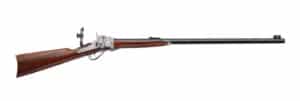

Image courtesy of Morphy Auctions (© Morphy Auctions – All Rights Reserved)
The annals of American Civil War history are punctuated by stories of innovation, desperation, and regional pride. Few artifacts encapsulate this convergence as powerfully as the elusive Columbus Armory Carbine. As one of the rarest Confederate-produced carbines, this weapon offers a compelling glimpse into the South’s ambitious but embattled wartime manufacturing efforts. This guide covers the origins, design, production challenges, and legacy of the Columbus Armory Carbine.
Introduction: A Rifle of Necessity
During the American Civil War (1861–1865), the Confederacy faced overwhelming industrial disadvantages compared to the Union. With fewer arms factories, limited rail infrastructure, and scant access to raw materials, Confederate arms producers were often forced to improvise. The Columbus Armory Carbine, produced in Columbus, Georgia, was a product of this challenging environment. Intended to arm Southern cavalry units, this .54 caliber percussion carbine embodied the Confederate war machine’s aspirations, and its limitations.
Origins: The Birth of the Columbus Armory
Columbus, Georgia, was a significant industrial hub for the Confederacy. Nestled along the Chattahoochee River, the city hosted several war-related industries including textile mills, ironworks, and weapons production facilities. Among them, the Columbus Armory stood out as a key player in small arms manufacturing.
The Columbus Armory was a private works set up by John D. Gray in the Columbus premises of Greenwood & Gray, with John P. Murray as master armorer. All arms making in Columbus stayed in private hands under close government direction, and the armory’s guns were inspected under Captain (later Major) F. C. Humphreys, who commanded the Confederate arsenal in Columbus. Unlike the larger Richmond Armory or the Macon Arsenal, the Columbus Armory operated with constrained resources and an urgent mandate: to rapidly arm Confederate troops, especially cavalry units who required short, lightweight carbines.
The Carbine Design: Specifications and Characteristics
The Columbus Armory Carbine was patterned after earlier percussion carbines, following the pattern of the U.S. Model 1841 “Mississippi” rifle. However, it was adapted for local materials and Confederate manufacturing capabilities.
Key Specifications:
- Caliber: .54 (percussion ignition)
- Overall Length: Approximately 38–40 inches
- Barrel Length: 23½ inches on a documented example, with three-groove rifling
- Barrel Type: Round, rifled barrel
- Stock: One-piece walnut with brass or iron fittings
- Action: Single-shot, percussion cap ignition
- Sights: Fixed front blade and rear V-notch
- Weight: Around 7 pounds (est.)
The carbine’s relatively short barrel and light weight made it ideal for cavalry engagements. The weapon was designed to fire paper cartridges ignited by a percussion cap, a common mechanism in mid-19th century firearms.
Though relatively primitive compared to Union breech-loaders like the repeating Spencer or the single-shot Sharps, the Columbus Carbine was robust and utilitarian, qualities vital for Confederate troops often fighting with outdated or inconsistent gear.
Production and Rarity
The Columbus Armory Carbine was manufactured in extremely limited numbers, a fact that has contributed to its near-mythic status among collectors today. Surviving records show about 421 carbines delivered: 348 to the Confederate government between July and November 1862 and 73 to the State of Alabama between October 1863 and November 1864, alongside 445 rifles.
Several factors contributed to the carbine’s low production volume:
- Resource Scarcity: The Confederacy lacked access to high-quality steel and precision tooling.
- Union Blockades: Naval blockades prevented the import of essential materials and equipment.
- Infrastructure Challenges: Transporting raw materials and finished arms was difficult due to inadequate rail systems and frequent Union raids.
- Destruction of the Armory: Union forces under General James H. Wilson launched a cavalry raid that culminated in the Battle of Columbus. During this operation, much of Columbus’s industrial district was destroyed by Wilson’s Raiders in April 1865, halting Confederate production. Although parts of the armory complex survived and were later repurposed, Confederate carbine manufacture effectively ended with the city’s capture.
Because the armory was largely destroyed in April 1865, many Columbus Carbines were either never completed or destroyed before deployment. Surviving examples today are considered among the rarest and most valuable Confederate-made firearms.
Identifying Features and Markings
Unlike more mass-produced arms, Columbus Armory Carbines exhibit inconsistencies in finish and component details: a byproduct of hand-fitting and limited quality control. However, some identifiable features do help authenticate original pieces:
- No Standardized Markings: Most Columbus Carbines are unmarked or very faintly marked. A documented example carries the “PRO / FCH” inspection stamp of Captain F. C. Humphreys on the barrel.
- Brass Fittings: Some models feature brass buttplates and trigger guards, a practical choice due to the availability of brass in Southern foundries.
- Unfinished or Crude Milling: Machining marks are often visible, and wood-to-metal fit is typically rough by Northern standards.
- Distinctive Profiles: The carbine’s short length and wide bore are visually distinctive. Compared to Union carbines, the Columbus variant looks more utilitarian.
Authentication often relies on a combination of features rather than a single definitive marking.
Combat Use and Field Reports
Despite its low production numbers, the Columbus Armory Carbine did see limited combat use, primarily among cavalry units operating in Georgia, Alabama, and the Carolinas. Due to inconsistent distribution records and battlefield losses, exact deployment details are scarce.
Confederate cavalry troops prized the weapon’s compactness and reliability, particularly when compared to outdated flintlocks or captured Northern arms. However, field reports were mixed, with some soldiers noting the weapon’s rudimentary finish and others praising its ruggedness.
The most detailed mentions of Columbus Armory Carbines come from post-war inventories and Confederate ordnance reports. A few scattered battlefield recoveries have also confirmed its field usage.
The Destruction of the Columbus Armory
The downfall of the Columbus Armory is a dramatic chapter in Civil War history. On April 16, 1865, Union General James H. Wilson’s cavalry captured and destroyed many key military facilities in Columbus, including the armory, in what is considered one of the last significant military engagements of the war. Ironically, this occurred after General Robert E. Lee’s surrender at Appomattox on April 9.
The destruction was thorough: machine tools, raw materials, unfinished carbines, and blueprints were lost in the flames. As a result, very little documentary evidence remains, making the Columbus Armory Carbine an even more enigmatic artifact today.
Legacy and Collectibility
For arms collectors, Confederate firearms hold a unique allure. They represent a chapter of American history marked by ingenuity under constraint, and the Columbus Armory Carbine is one of the rarest and most intriguing among them.
Why It’s So Valuable:
- Extreme Rarity: Only about 421 were delivered, and few survive.
- Historical Significance: It is a tangible remnant of the Confederate war industry and the Battle of Columbus.
- Mystique: The lack of consistent markings and limited documentation makes each surviving example a puzzle and a treasure.
Examples rarely come to market, and prices depend heavily on condition and provenance.
Conclusion: The Columbus Armory Carbine in Historical Context
The Columbus Armory Carbine is more than just a Confederate firearm. It’s a physical encapsulation of the Southern war effort: limited in resources, ambitious in scope, and ultimately consumed by the fire of war. Unlike the mass-produced weapons of the North, the Columbus Carbine tells a story of local ingenuity and the human cost of industrial inferiority.
While it never achieved the battlefield ubiquity of the Enfield or Springfield rifles, its value today is not in numbers but in narrative. Each surviving Columbus Armory Carbine is a fragment of a lost chapter, a relic of a nation that tried, against impossible odds, to forge its own future.
For historians, collectors, and Civil War enthusiasts, the Columbus Armory Carbine is a potent reminder that even the most obscure artifacts can offer real insight into the tides of history.
Columbus Armory Carbine image courtesy of Morphy Auctions. Check out their auctions on all kinds of collectibles!
A Memorial from the Citizens of Columbus on the Subject of an Armory and Arsenal (Amazon)
If you know of any forums or sites that should be referenced on this listing, please let us know here.