The Vortex Strike Eagle 1-6×24 is the scope that put a genuine 1-6x low-power variable optic (LPVO) on more AR-15s than almost any other model. It is cheap enough to buy without a second mortgage, tough enough to take recoil and abuse, and backed by a warranty that outlives the rifle. The second-generation version, with the AR-BDC3 reticle, is the one worth talking about — and the one you can pick up, mounted and ready, through the link in this review.
But the Strike Eagle no longer stands alone in Vortex’s own lineup. The newer Venom 1-6×24 sits right next to it at a similar price, and the Viper PST Gen II 1-6×24 looms above both as the step-up glass. This review looks hard at the Strike Eagle, then puts it side by side with the Venom and the Viper so you can see exactly what your money buys at each rung.
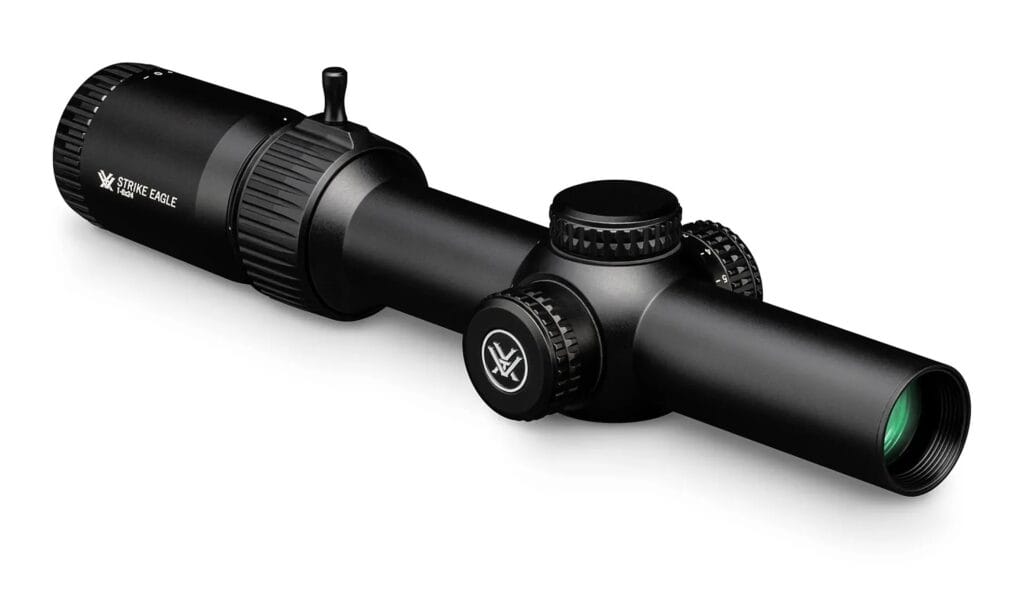
The Vortex Strike Eagle 1-6×24 Gen II at a glance
The Strike Eagle 1-6×24 Gen II (model SE-1624-2) is a second focal plane (SFP) LPVO built around a true 1x on the low end and 6x on the top. True 1x is the whole point of this class: with both eyes open at 1x it behaves like a red dot for fast, close work, then zooms to 6x when you need to reach out. The glass-etched, illuminated AR-BDC3 reticle is calibrated for 5.56, with a 1-MOA center dot and holdover references that carry a 55- or 62-grain load out to roughly 650 yards. At 18.5 ounces it is the lightest of the three scopes here, and it ships with a thread-in throw lever to make the zoom fast under time.
| Magnification / objective | 1-6×24 |
| Tube diameter | 30 mm |
| Focal plane | Second focal plane (SFP) |
| Reticle | AR-BDC3 (MOA), glass-etched, illuminated |
| Adjustment | 1/2 MOA per click |
| Elevation / windage travel | 140 MOA each |
| Eye relief | 3.5 in |
| Field of view | 116.5 ft @ 1x / 19.2 ft @ 6x (per 100 yd) |
| Length / weight | 10.5 in / 18.5 oz |
| Parallax | Fixed at 100 yd |
| Sealing | Nitrogen purged, O-ring sealed — waterproof and fogproof |
| Warranty | Vortex VIP, unlimited unconditional lifetime |
How the Strike Eagle performs
For the money, the Strike Eagle does the important things right. The 1x is honest — no tunnel, no distortion that fights a both-eyes-open presentation — and the illuminated center of the AR-BDC3 pulls the eye fast in daylight. The reticle is the real strength of this optic: the daylight-bright center dot works like a red dot up close, and the BDC ladder gives you usable holds to distance without ever touching a turret. For a carbine you are going to run hard, hold-over-and-shoot beats dial-and-hope.
The trade-offs are the ones you expect at this tier. The turrets are capped and move in coarse 1/2-MOA clicks; you zero them and leave them, because this is not a scope you dial for elevation. Parallax is fixed at 100 yards, which is exactly right for a 5.56 fighting rifle and irrelevant for a benchrest. The glass is fully multi-coated and clear enough at 6x, though it gives up resolution and edge sharpness to the pricier Viper the moment you put them side by side. Eye relief at 3.5 inches is workable but not generous, so mount position matters. Durability has never been the knock on this scope, and the Vortex VIP warranty removes the risk that usually comes with a budget optic: if it breaks, ever, for any reason, they fix or replace it, no receipt required.
Pros
- True 1x that runs like a red dot with both eyes open
- Daylight-bright, well-designed AR-BDC3 holdover reticle
- Lightest of the three at 18.5 oz, and a throw lever is included
- Genuinely tough, and covered by the no-questions VIP lifetime warranty
- The most affordable way into a capable Vortex LPVO
Cons
- Capped, coarse 1/2-MOA turrets — a hold-over optic, not a dialing one
- Glass clarity trails the Viper PST Gen II noticeably at 6x
- Eye relief of 3.5 inches is adequate but not forgiving
- Second focal plane means the BDC holds are only true at 6x
- Fixed parallax limits it for deliberate precision past a few hundred yards
Strike Eagle vs Viper vs Venom: how the three compare
All three of these Vortex LPVOs are 30 mm, 1-6×24, second focal plane scopes with the same unbeatable VIP warranty. That last point is worth stating plainly, because it is a common mistake: none of these three is first focal plane. The FFP 1x Vortex optics live in the Razor tier and the 1-8x/1-10x Strike Eagles, not here. So the choice between them is not about focal plane — it is about glass, reticle, adjustment, and weight.
| Spec | Strike Eagle 1-6×24 Gen II | Venom 1-6×24 | Viper PST Gen II 1-6×24 |
|---|---|---|---|
| Focal plane | SFP | SFP | SFP |
| Reticle | AR-BDC3 (MOA) | AR-BDC3 (MOA) | VMR-2 (MOA or MRAD) |
| Illumination | Yes | Yes | Yes, adjustable |
| Click value | 1/2 MOA | 1/4 MOA | 1/2 MOA (0.2 MRAD) |
| Parallax | Fixed @ 100 yd | Fixed @ 100 yd | Side-focus adjustable |
| Eye relief | 3.5 in | 3.7 in | 3.8 in |
| Field of view (1x–6x) | 116.5–19.2 ft | 126.0–20.2 ft | 112.5–18.8 ft |
| Length | 10.5 in | 10.3 in | 10.8 in |
| Weight | 18.5 oz | 19.5 oz | 22.7 oz |
| Glass | Fully multi-coated | Fully multi-coated | XD low-dispersion, XR coatings |
| Turrets | Capped | Capped | Exposed tactical, RZR zero stop |
| Tier | Budget | Budget (newer) | Premium |
Read down that table and the story is clear. The Strike Eagle and the Venom are close cousins at nearly the same price, both leaning on the same AR-BDC3 holdover reticle. The Viper PST Gen II is a different animal: better glass, a ranging reticle, a real dialing turret system, at close to double the price and several ounces more on the rifle.
Vortex Venom 1-6×24: the newer value sibling
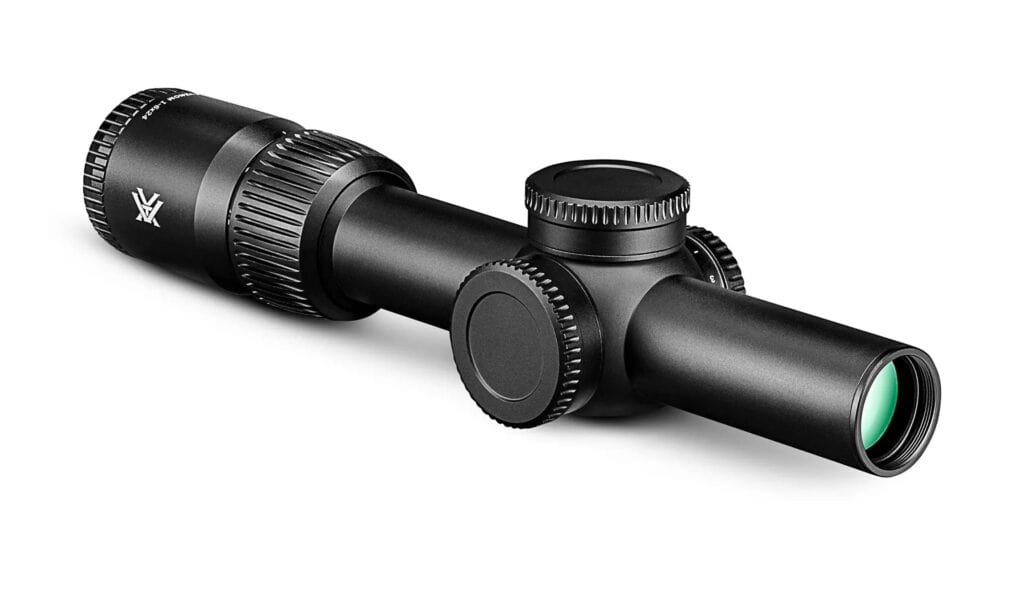
The Venom is Vortex’s newer budget LPVO, and it sits so close to the Strike Eagle that choosing between them comes down to a couple of details. It carries the same illuminated AR-BDC3 reticle, so the sight picture and the holdovers are identical. What it adds are finer 1/4-MOA clicks (versus the Strike Eagle’s 1/2 MOA) and the widest field of view of the three at 126 feet at 1x, which makes for a slightly more forgiving eye box and a bigger window up close. It gives back half an ounce, landing at 19.5 ounces. If you are buying today and the two are priced the same, the Venom is the newer design and the easy pick; if the Strike Eagle is on sale, you are not giving up anything that matters on a hold-over carbine. You can check the current Venom price through Palmetto State Armory.
Vortex Viper PST Gen II 1-6×24: stepping up to glass and dialing
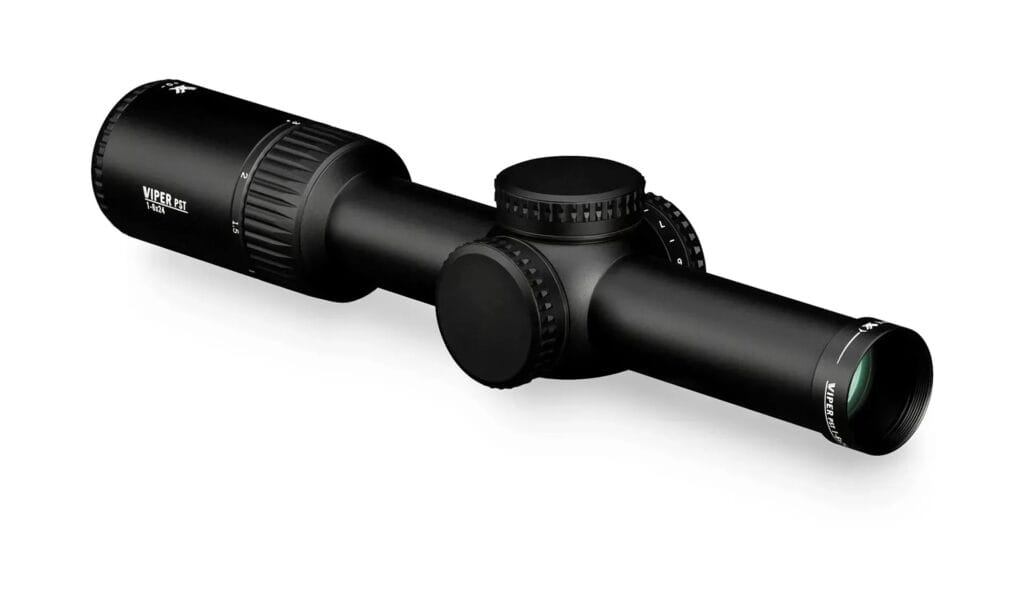
The Viper PST Gen II is where you leave the budget tier behind. The headline is the glass: XD low-dispersion elements with XR fully multi-coatings deliver visibly better resolution and color than either the Strike Eagle or the Venom, and the difference shows at 6x in flat light. The VMR-2 reticle — offered in MOA or MRAD — is a true ranging and holdover reticle rather than a simple BDC ladder, with daylight-bright illumination adjustable across multiple brightness levels. Where this scope really separates is the mechanicals: exposed, laser-etched tactical turrets with the RZR zero stop and side-focus adjustable parallax, so you can dial precise corrections and return to zero every time. The cost is weight — at 22.7 ounces it is the heaviest here — and price, roughly double the other two. This is the optic for the shooter who dials, ranges, and wants glass that earns its keep, not just a fast dot up close. Current pricing is at Palmetto State Armory.
Which Vortex LPVO should you buy?
The honest answer depends on how you shoot. If you want a capable, tough LPVO for a general-purpose AR-15 and you hold over rather than dial, the Strike Eagle 1-6×24 Gen II is still the value benchmark and the reason this whole class exists — and the mounted combo gets you shooting without buying rings separately. If you are shopping new and the price is level, the Venom is the newer design with finer clicks and a wider view, and it is the one I would put on a fresh build. And if you care about glass quality, want a ranging reticle, and intend to dial corrections, the Viper PST Gen II is worth the jump in price and weight — it is simply a better optic, for a shooter who will use what it offers.
Bottom line
The Vortex Strike Eagle 1-6×24 earned its reputation honestly: a real 1x, a smart daylight reticle, serious durability, and the best warranty in the business, all at a price that put quality glass within reach of ordinary shooters. The Venom refines the same formula, and the Viper PST Gen II shows you what another few hundred dollars buys. For most AR-15 owners who want one optic that does close and medium work without fuss, the Strike Eagle remains an easy recommendation — you can get it, mounted and ready, here at Palmetto State Armory.
References and resources
Specifications in this review are drawn from the official Vortex Optics product pages: the Strike Eagle 1-6×24, the Venom 1-6×24, and the Viper PST Gen II 1-6×24. All product photography is courtesy of Vortex Optics.
If you know of any forums or sites that should be referenced on this listing, please let us know here.