The Winchester Model 9422 is the rifle Winchester built when it decided the rimfire lever-action market deserved the same level of execution the company brought to its centerfire deer rifles. Marlin had owned the premium rimfire lever-action category for the better part of a century with the Model 1891 and its descendants. Winchester’s own rimfire lever-actions had largely been entry-tier offerings sitting below the Model 94 in price, quality, and prestige. The 9422, introduced in 1972, was Winchester’s answer: a small-frame lever-action designed in-house, built to the same standards as the centerfire 94, and chambered in .22 rimfire from the start.
Collectors and gunsmiths who’ve worked on both rate the 9422 among the highest-quality production rimfire rifles America has ever made. It has the fit, finish, walnut, bluing, and action feel of a centerfire lever-action shrunk down and re-engineered around a rimfire cartridge. That’s what Winchester built it to be. It earned a 33-year production run and a cult collector following that outlasted production itself.
Origin and Design
By the late 1960s, Winchester was in an awkward spot in the rimfire lever-action market. The company had been selling rimfire lever-actions on and off since the late 19th century (the Model 1873 had a .22 rimfire chambering, and the Model 1903 was a .22 self-loader rather than a lever-action), but Winchester’s contemporary rimfire offerings (Model 250, Model 255, Model 270, Model 275 — slide and lever-actions introduced in the mid-1960s) were aluminum-receiver, mass-market rifles built to a price point well below the centerfire 94. The premium rimfire lever-action category belonged to Marlin and its Model 39A, which had been in continuous production in one form or another since the original Marlin 1891.
Winchester’s engineering response was to design, in-house, a rimfire lever-action that was unmistakably part of the Model 94 family in look and feel: forged steel receiver, blued finish, American walnut stock, exposed hammer, side-eject (not top-eject — this point matters and is covered below), and a tubular magazine. The new rifle would slot into the Winchester catalog as a premium rimfire that finally let Winchester compete with the Marlin 39A on quality rather than price.
The Model 9422 was introduced in 1972. The “94” in the name was deliberate: Winchester wanted the small-frame rimfire to read visually and functionally as a member of the Model 94 family. “94” for the Winchester family identity, “22” for the rimfire chambering. The naming followed Winchester convention from the same period: the 9422M for the Magnum version, and later the 9410 for a .410 shotgun built on a similar small-frame action concept.
The designer question
The 9422 is sometimes loosely attributed to “Winchester engineering” without naming a specific designer, and the documentary record is thinner than for the centerfire Model 94 (which is unambiguously a John Moses Browning design). The 9422 was designed in-house at Winchester / Olin in the late 1960s and early 1970s, well after John Browning’s death in 1926, so any claim that “Browning designed the 9422” is incorrect on the timeline alone. Internal Winchester engineering teams of the period are the operative attribution. If you see a specific named designer claim in print, treat it as needing primary-source verification before being repeated as fact.
The architecture
The 9422 uses a side-eject design, not the top-eject of the centerfire Model 94. Side-eject made the 9422 immediately scope-friendly. Receiver-top scope mounting was available out of the box, unlike the centerfire 94, which required Winchester’s angle-eject conversion (introduced in 1982) to mount a scope without compromise. Side-eject was also the right engineering for a rimfire: the cartridge case is far smaller and lighter than a .30-30, ejection is cleaner, and the cleaner ejection path made the action smooth out of the box.
The locking system is a vertical cam-pin-locked bolt: the rear of the bolt cams upward into a locking recess in the receiver as the lever closes. This mechanism is borrowed directly from the Winchester Model 61 (1932–1963) pump-action .22, an in-house Winchester design from the T. C. Johnson era, rather than from Browning’s centerfire Model 94. Visually the 9422 reads as a small-frame 94; mechanically it is a lever-actuated version of the Model 61 action. Rimfire cartridges run at substantially lower pressure than centerfire rifle cartridges (.22 LR is around 24,000 PSI maximum versus the .30-30’s roughly 42,000 PSI), so the 9422 did not need (and was not given) the heavier locking lugs of the centerfire 94. The action is sized and weighted to a rimfire’s recoil and pressure budget, which is part of what gives the rifle its characteristic quick, smooth lever throw.
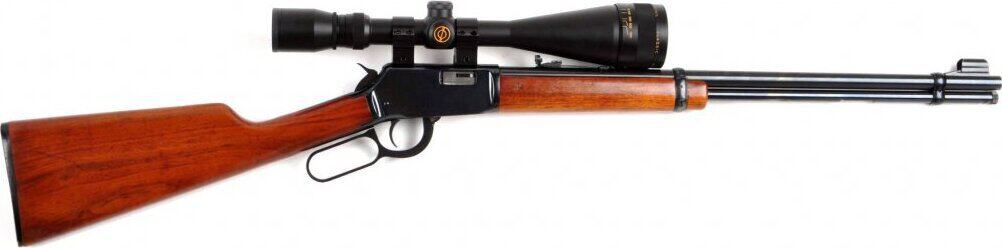
The receiver is forged steel. Blued. American walnut stock and forend, cut-checkered on the higher-grade variants. The standard 9422 runs a 20.5-inch barrel and weighs around 6 pounds, close to the weight of a Model 94 carbine but better balanced, because the 9422 carries less mass forward than a .30-30 does. Magazine capacity is 21 .22 Short, 17 .22 Long, or 15 .22 Long Rifle in the tubular magazine under the barrel. The 9422M (Magnum) variant holds 11 .22 WMR cartridges. The buttplate, the lever curve, the receiver flats, and the forend cap all read visually as Model 94 design language.
The Rifle Itself
The 9422 brings centerfire-rifle build standards to a rimfire chassis: forging, fitment, walnut grade, bluing depth, action tuning.
Fit and finish
The 9422 was built on the U.S. Repeating Arms New Haven production line that also built the centerfire Model 94 and the Model 70 bolt-action. The receivers were polished and blued to the same standard as the centerfire rifles. Wood-to-metal fit on a well-made pre-2005 9422 is tight and consistent. The walnut on the standard 9422 is plain-grade American black walnut; the XTR and High Grade variants step up to better-figured stocks (covered in the variants section below). Stock checkering on cut-checkered variants is sharp and crisp.
This level of execution on a rimfire remains unusual. Most rimfire rifles in the 1972–2005 production window were built to a price point that did not allow much in the way of forged steel, polished bluing, or hand-fit wood. The Marlin 39A was the principal exception, and the 9422 was Winchester’s direct answer to it.
Action feel
The 9422 lever is short, smooth, and quick. Lever throw is shorter than a centerfire 94 (rimfire cartridges are physically shorter, so the carrier travel is less) and the cycle effort is lower (less mass to move, less resistance from the spring weights). A well-broken-in 9422 action is glass-smooth. Few production rimfires reach that from the factory.
Trigger
The 9422 trigger is a single-stage hammer-driven design. Out of the box, factory trigger pulls run in the four-to-five-pound range with some creep. Gunsmiths can lighten and clean up the pull substantially with a careful spring change and sear-engagement work, and many pre-2005 9422s in collector hands have had trigger work done. The factory trigger is not the rifle’s strongest feature but is consistent with rimfire lever-action expectations of the period.
Sights
Standard sight setup is a hooded post front and a semi-buckhorn open rear, with the rear adjustable for elevation via an elevator ramp. The receiver is drilled and tapped for scope mounting. Some variants (the XTR, the Trapper) shipped with slightly different sight configurations, but the open-sight setup is the canonical 9422 sighting arrangement.
Variants
The 9422 was produced in a substantial variety of configurations across its 33-year production run. Several primary variants account for almost all production.
| Variant | Years | Distinguishing features |
|---|---|---|
| 9422 (standard) | 1972–2005 | .22 LR / .22 Long / .22 Short, 20.5-inch barrel, plain American walnut, blued steel receiver |
| 9422M | 1972–2005 | .22 WMR (Winchester Magnum Rimfire); 20.5-inch barrel; magazine capacity 11; otherwise mechanically identical to the standard 9422 |
| 9422 XTR | ~1978–1989 | “Extra” trim level; higher-grade walnut, cut checkering, polished receiver, deluxe buttplate. The XTR was Winchester’s premium trim designation across the catalog in the same period |
| 9422 Trapper | 1996–2001 | 16.5-inch barrel; carbine-length configuration; otherwise mechanically standard 9422 |
| 9422 Win-Tuff / Laminated | ~1987–1998 | Brown-laminated hardwood stock for weather and warp resistance; appealed to woods/trail-rifle buyers |
| 9422 Legacy | ~1990s–2005 | Pistol-grip stock and a longer 22.5-inch barrel; otherwise standard 9422 |
| 9422 High Grade / Grade I / Grade II | Various | Engraved receivers, presentation-grade walnut, gold inlay on the higher-grade examples. Made primarily for the Winchester Custom Shop and commemorative programs |
The 9422 also appeared in a long list of commemorative editions over the 33-year run: Annie Oakley, Cherokee, Cheyenne, Boy Scouts of America, and various state, regional, and event commemoratives. Commemorative 9422s typically have engraved receivers, gold or brass accents, special wood, and presentation-grade fit and finish. The commemorative market for 9422s is its own collector niche with its own pricing dynamics, generally less robust than the standard-rifle market because commemoratives were often purchased and stored unfired, leaving supply ample relative to collector demand.
The 9422M and .22 WMR
The 9422M is the Magnum variant, chambered in .22 Winchester Magnum Rimfire (.22 WMR). The .22 WMR is a more powerful rimfire than the .22 LR, with roughly twice the muzzle energy, with practical hunting range against small game and varmints extended out past 100 yards in skilled hands. The 9422M was Winchester’s bid for the small-varmint and pest-control market, and it is the variant most often praised for being more rifle than the cartridge would suggest. A 9422M with a low-power scope is, for the right shooter, a far better field rifle than a budget .22 WMR bolt-action.
Production estimates
The 9422M was introduced in 1972 alongside the standard 9422. Total 9422 production across the 1972–2005 U.S. Repeating Arms run is widely reported in the 300,000–400,000 range, with some sources citing higher figures including commemorative production. Winchester / Olin / U.S. Repeating Arms never published a definitive production total, and serial-number tables for the 9422 are less comprehensively documented than the centerfire Model 94. Treat any single specific production number as approximate.
The Marlin 39A Comparison
The Marlin 39A is the direct comparison. The Marlin 39A had a roughly 80-year head start in the premium rimfire lever-action category by the time the 9422 arrived, and built a deserved reputation as the rifle to beat. It is a takedown design (the barrel and magazine assembly separate from the receiver via a thumbscrew), loads through an inner-and-outer tubular magazine from the muzzle end, and has been continuously refined since the original Marlin 1891. The 9422 is also a takedown rifle but by a different mechanism: the receiver itself splits into two halves via a single screw on the left side, an arrangement inherited from the Model 61 pump. The 9422 uses a similar tube-fed magazine, and is the newer design with the benefit of mid-20th-century engineering and CNC-era manufacturing.
Both rifles are excellent rimfire lever-actions. Choosing between them comes down to brand, takedown mechanism, and stock fit. Both, in good pre-2005 / pre-Remlin-Marlin condition, outshoot the budget rimfire lever-actions. The 9422 is the smaller-production, more recent, and scarcer of the two.
Adjacent Rifles: Do Not Confuse
The 9422 occupies a specific corner of the lever-action world that is easy to confuse with several adjacent rifles. The most important distinctions:
| Rifle | Distinguishing features | Why confused with the 9422 |
|---|---|---|
| Marlin Model 39A | Marlin’s premium rimfire lever-action; takedown design; inner-and-outer tubular magazine; in continuous production from 1891 in various forms; the canonical rimfire lever-action prior to the 9422 | The principal direct competitor. Same market, different mechanism (takedown), different brand. The 9422 was Winchester’s response to it |
| Henry Lever-Action .22 | Modern (post-1996) U.S.-made rimfire lever-action; tube-fed; budget-friendly; Henry Repeating Arms (not the original Henry company); no side-loading gate on most models | Modern competitor in the rimfire lever-action category; positioned well below the 9422 in price and build; brass-receiver versions are visually distinct |
| Henry Big Boy | Modern Henry-designed lever-action; chambered for pistol-caliber centerfires (.357 Mag, .44 Mag, .45 Colt, .327 Federal Magnum, .41 Magnum); brass receiver | “Henry” brand name and lever-action format create casual confusion; the Big Boy is a different rifle class entirely (centerfire pistol-caliber, not rimfire) |
| Winchester Model 1894 | Winchester’s centerfire deer-rifle lever-action; .30-30 and other rifle-caliber chamberings; top-eject in original production, angle-eject from 1982 | Same Winchester lever-action family identity; the 9422 was deliberately designed to look and feel like a small-frame 94, which is the source of most confusion |
| Winchester Model 9410 | A .410 bore shotgun built on a small-frame Winchester lever-action; introduced 2001, discontinued 2006 when U.S. Repeating Arms ceased production at the New Haven plant | “94” prefix and small-frame lever-action format; the 9410 is a smoothbore shotgun, not a rifle, and not a rimfire |
| Winchester Model 250 / 255 / 270 / 275 | Earlier Winchester rimfire long guns from the mid-1960s; aluminum receivers; entry-tier build quality | These are the Winchester rimfire offerings the 9422 was designed to leapfrog; visually and mechanically different rifles |
| Browning BL-22 | Browning’s own premium rimfire lever-action; short-throw lever; tube magazine; comparable trim levels and build quality | Browning was historically the Winchester family’s design partner; the BL-22 and the 9422 are contemporaneous and compete on similar terms; mechanically distinct |
The 9422 is not the Winchester Model 94 (rimfire vs. centerfire; different size, different cartridge class, different production history). The 9422 is not the Winchester 9410 (rifle vs. shotgun). The Marlin 39A is the one direct comparison that matters.
Discontinuation and Cult Status
U.S. Repeating Arms Company, the entity that had held the Winchester sporting-arms manufacturing license since 1981 after Olin sold the New Haven sporting-arms operation, ceased production at the New Haven plant in 2006, with the final production rifles assembled in 2005. The plant closure ended in-house U.S. production of Winchester-branded long guns, including the centerfire Model 94, the Model 70 bolt-action, and the Model 9422.
The 9422 ended production with a final-year run that included a “Tribute” series and other end-of-production special editions. Pre-2005 production became the operative cutoff for collector valuation almost immediately. The 9422 was already known among shooters and gunsmiths as a high-quality rimfire; the discontinuation made it a finite collector category, and prices reflected the new supply reality within a year or two.
Through the late 2000s and the 2010s, pre-2005 9422 prices climbed steadily. A standard 9422 that had sold new in the mid-1990s for around the price of a good Marlin 39A traded in the late 2010s and early 2020s for noticeably more, with XTR, Trapper, Magnum, High Grade, and engraved variants commanding substantial premiums on top of that. Commemoratives are the partial exception, as noted above: ample supply has kept commemorative prices closer to standard-rifle prices than collectors of the commemorative editions originally expected.
The “cult status” is real but ordinary. It’s the arc of a high-quality production rifle that left production with a known supply and reputation. Pre-2005 9422s are not Pre-64 Winchester 94s: the absolute price tier is lower, the production volume is higher, and the cultural cachet is narrower (rimfire lever-actions occupy a smaller cultural footprint than centerfire deer rifles). But within the premium rimfire lever-action category, the pre-2005 9422 is one of the most desirable rifles a collector or shooter can buy.
Current Production Status
There is no current factory production of the Model 9422. Pre-2005 U.S. Repeating Arms examples are the only operative market today.
For the buyer in 2026 looking at a 9422, the realistic path is a pre-2005 U.S. Repeating Arms example on the secondhand market, where condition, originality, and variant determine the price within a reasonably well-established range. Auction houses (Morphy, Rock Island, Amoskeag), online sources (GunBroker), and dedicated rimfire-collector forums (Rimfire Central) are the operative venues. A clean pre-2005 9422 is not rare, but it is no longer being made.
Use Cases
Three use cases account for most 9422 ownership: small-game hunting, plinking and recreational target shooting, and woods-rifle / trail-rifle carry.
Small-game hunting. The 9422 in .22 LR is a competent small-game rifle out to roughly 50–75 yards on rabbit and squirrel with subsonic or standard-velocity loads. The 9422M in .22 WMR extends the practical range to roughly 100–125 yards on the same game, and adds varmint capability (groundhog, fox, coyote at moderate ranges) that is beyond the .22 LR’s energy envelope. For the hunter who values a quick-handling lever-action and the option to top up the magazine from the muzzle end without breaking position, the 9422 sits in a tighter niche than a budget bolt-action but is a more pleasant rifle to carry and shoot.
Plinking and recreational target. The 9422 is an excellent plinking rifle, and the smooth lever throw and short cycle time make rapid follow-up shots easy. Ammunition cost for .22 LR is among the lowest in centerfire and rimfire alike, which makes long range sessions economical in a way that almost no centerfire allows. The 9422M is more expensive to feed (.22 WMR runs roughly four to five times .22 LR ammunition cost) but the same handling appeal applies.
Youth training. The 9422 is a recurring choice for first rifles, especially in family hunting traditions where a child learns to shoot on a lever-action before graduating to a centerfire deer rifle. The 9422’s manual of arms (lever, hammer, magazine tube loading) maps directly onto the centerfire Model 94 the child will likely shoot later, and the low recoil and noise of the .22 LR makes the learning curve approachable. Many a deer hunter learned to run a lever-action on a 9422 first.
Woods rifle / trail rifle. The 9422 in the Trapper or Win-Tuff configuration, slung on a hunting pack or a horseback scabbard, is a competent woods rifle for the hiker, the ranch hand, or the backcountry traveler who wants a rifle along for varmint dispatch, camp protection against small predators, and the occasional rabbit for the pot. The standard 9422 is light enough and handy enough to fill the same role.
Collecting. Pre-2005 9422s in original, unaltered condition are a defined collector category. Standard 9422 carbines in good condition set the baseline. XTR, Trapper, and Legacy variants trade above that. Magnum versions sit slightly above standard. Win-Tuff laminated-stock variants have their own pricing. High Grade and Custom Shop engraved 9422s top the market. Commemoratives are their own niche with weaker market dynamics due to ample supply. Original boxes, paperwork, and accessories add value across all categories.
References and Resources
The 9422 is less heavily documented in the collector literature than the centerfire Model 94 or the Model 70; its 33-year production run is shorter than the centerfire Winchesters, and the rimfire lever-action category has historically attracted less collector scholarship. The available references are good but more compact.
George Madis, The Winchester Book (1961, with revised editions into the 1980s; ISBN 0-910156-03-4 for the 1985 Silver Anniversary Edition) is the canonical Winchester reference, with serial-number data and variant breakdowns covering Winchester production through the 1980s. The 9422 receives less coverage than the Model 94 simply because the rifle was relatively new when Madis was writing, but the entries that exist are the standard reference. Browse used copies of Madis’s The Winchester Book.
R. L. Wilson, Winchester: An American Legend (Random House, 1991; later reprints from Chartwell Books) is the accessible coffee-table reference for Winchester history and includes 9422 coverage in the late-20th-century chapters. Browse used copies of Wilson’s Winchester: An American Legend.
Online, the Winchester Collectors Association (winchestercollector.org) hosts a serial-number lookup tool, authentication forums, and an active community for 9422 questions. The official Winchester Repeating Arms website (winchesterguns.com) carries owner manuals and obsolete-parts resources for the 9422. The Rimfire Central forum (rimfirecentral.com) has a dedicated 9422 sub-forum that is the most active community for owners, restorers, and would-be buyers.
For period reviews, American Rifleman archives (the NRA’s flagship publication) contain contemporaneous reviews of the 9422 across its production run. Gun Digest’s annual edition has cataloged 9422 variants and specifications each year since 1973 and is a year-by-year reference for variant and chambering availability. Browse Gun Digest annual editions on Amazon.
If you know of any forums or sites that should be referenced on this listing, please let us know here.