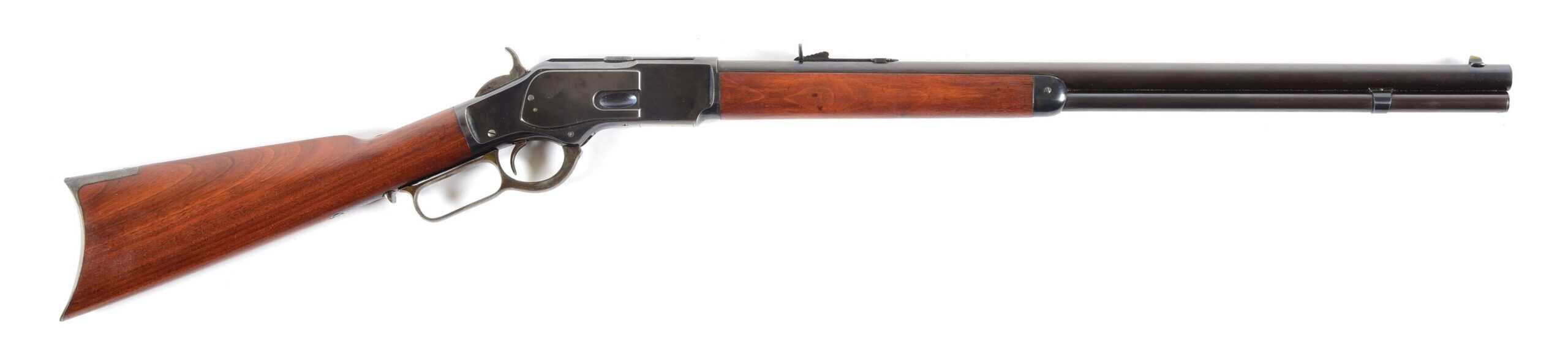
The Winchester Model 1873 is known as “The Gun That Won the West.” It’s a wonderful slogan, it appears in both museum signage and marketing copy. The problem is it’s not a 19th-century historical consensus. Fortunately, the rifle’s real story is more interesting than the slogan.
The Cavalry never carried it as a standard arm: the Army rejected it. Custer’s troops at Little Bighorn fought Natives armed with Winchesters but had none themselves; they carried Trapdoor carbines. And in original production, the 1873 was chambered in .44-40, .38-40, .32-20, and .22 rimfire; .45 Colt is a modern reproduction-only chambering.
The 1873 was the first commercially successful centerfire repeating rifle in widespread civilian hands, the rifle that defined the .44-40 / Colt SAA cartridge-commonality revolution on the frontier, and the canonical action that cowboy action shooters still tune and run a century and a half later.
Lineage: Volcanic, Henry, 1866, 1873
The 1873 was the fourth generation of a lever-action lineage that began nearly two decades earlier with a commercial failure. In 1855, Horace Smith, Daniel B. Wesson, Courtlandt Palmer, and a New Haven shirt manufacturer named Oliver F. Winchester incorporated the Volcanic Repeating Arms Company to commercialize a tubular-magazine lever-action firing a self-contained “Rocket Ball” projectile, a hollow-base bullet with powder and primer inside, no metallic cartridge case. It was ingenious and unviable. Smith and Wesson left in 1856 to start a revolver company. Winchester took control in 1857, reorganized the firm as the New Haven Arms Company, and hired plant superintendent Benjamin Tyler Henry to solve the cartridge problem.
Henry solved it in 1860 with the .44 Henry rimfire (a 200-grain bullet over roughly 26 grains of black powder in a self-contained brass case) and a toggle-link action redesigned to fire it. The Henry rifle, marked “HENRY’S PATENT. OCT. 16. 1860,” was a brass-receiver, 24-inch octagonal-barreled, fifteen-shot lever-action loaded through a slot in the muzzle end of the magazine. About 14,000 were built between 1862 and 1866 and saw limited Union private-purchase use in the Civil War, where a Confederate prisoner is said to have given the rifle its nickname: “that damned Yankee rifle you load on Sunday and shoot all week.” The Henry had three serious weaknesses, all rooted in the open-channel magazine. Loading was muzzle-end, slow and awkward. The open spring channel ran the length of the barrel and would clog with dirt and mud. And if the spring follower wasn’t carefully guided down the channel during loading, especially with a partially full magazine, it could accelerate hard enough to set off the magazine.
Plant superintendent Nelson King solved all three in 1866 with a spring-loaded loading gate on the right side of the receiver (U.S. Patent No. 55,012). King’s gate is the unsung invention that made the lever-action a practical fighting rifle. Oliver Winchester reorganized the company that year as the Winchester Repeating Arms Company, Henry departed after a failed attempt to have the firm renamed for himself, and the first product was the Model 1866: King’s loading gate, the same toggle-link action, the same .44 Henry rimfire, and the same brass receiver, the receiver that earned the 1866 its nickname, “Yellow Boy.” About 170,000 were built between 1866 and 1898. But the 1866 was a rimfire arm, and by the early 1870s the centerfire metallic cartridge was the obvious future. The 1873 was Winchester’s answer.
The 1873 Itself: What Changed
The 1873 inherited the toggle-link action of the Henry and 1866. Two pivoting links lock the bolt to the receiver behind the chamber; the lever, pulled down and forward, breaks the toggle, retracts the bolt, ejects the spent case, lifts a fresh cartridge from the carrier, and on closing chambers the new round and re-locks the toggle. It is strong enough for moderate-pressure cartridges and famously smooth. It can’t take high-pressure cartridges, and that shaped everything that followed in Winchester’s lineup.
Winchester changed the receiver for the 1873. The brass of the Henry and 1866 was replaced with iron in first production and then with steel later in the run; the exact transition year is serial-number dependent and is treated definitively in George Madis’s The Winchester Book. The steel receiver enabled the new centerfire chambering and gave the 1873 its visual signature: a side-hinged sliding dust cover on receiver-top rails. The dust cover went through three documented iterations: First Model (1873 through ~1879, no dust cover or thumbprint-grooved cover), Second Model (~1879 through 1882, dust cover with central guide), and Third Model (~1882 through end of production, dust cover on integral rails). These are cosmetic designations, not mechanical revisions. John Mason, who succeeded Nelson King as plant manager, is commonly credited with the 1873 mechanical refinements, though primary documentation is thin.
Winchester cataloged the 1873 in four basic configurations:
| Variant | Barrel | Profile | Magazine (.44-40) | Notes |
|---|---|---|---|---|
| Rifle | 24″ | Octagonal (standard) or round | 15 rounds | Most common civilian variant |
| Sporting Rifle | 22″ | Round | 13 rounds | Lighter handling |
| Carbine | 20″ | Round | 12 rounds | Saddle ring; ranch and lawman variant |
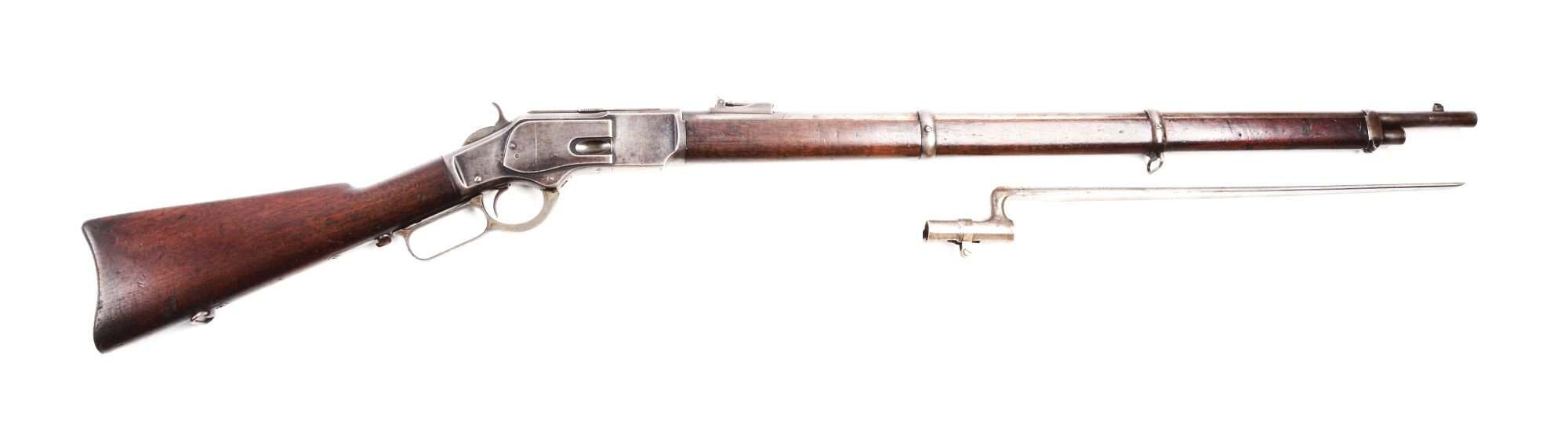
| Musket | 30″ | Round, full-length stock | 17 rounds | Bayonet lug; military and contract sales; uncommon |
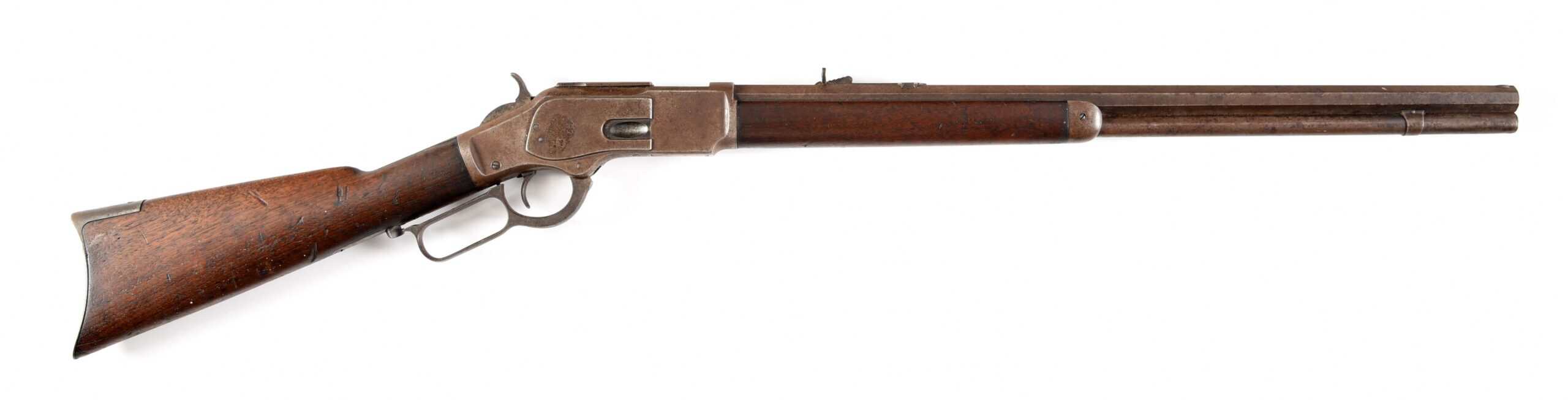
The 24-inch octagonal Rifle was the dominant civilian configuration. The 20-inch round-barreled Carbine became the iconic frontier variant, light enough for saddle-scabbard carry. The 30-inch Musket (full-length stocked, bayonet-lugged) was Winchester’s attempt at military contract sales and never sold in volume. Surviving examples command outsized auction prices today.
Production Span and the “One of One Thousand”
Production of the 1873 ran from 1873 to 1923, with parts assembly continuing into the late 1920s. Total production is cited at approximately 720,610 units in Madis and repeated by the Winchester Collectors Association. Production ended because Winchester had moved on to John Browning’s smokeless-powder designs, the Model 1894 in particular, for the modern hunting market.
Winchester ran a small high-grade special-order program from 1875 to 1878. Barrels that grouped under a quality threshold during factory test-firing were pulled, stocked with fancy walnut, fitted with set triggers, finished in charcoal blue or color-case-hardening, engraved, and sold as “One of One Thousand” rifles for roughly $100, twice the standard price, at a time when $50 was a month’s wage for a skilled laborer. A slightly less premium grade was sold as “One of One Hundred.” Production across the four-year program: around 130 to 136 “One of One Thousand” rifles, and roughly 8 “One of One Hundred.” Sources vary slightly (Madis cites 136), but the order of magnitude is hundreds, not thousands.
The “One of One Thousand” entered shooter consciousness through the 1950 Universal film Winchester ’73, directed by Anthony Mann and starring James Stewart, in which the MacGuffin is one such rifle won in a Dodge City shooting contest. The film inflated the rarity, implying that one barrel in a literal thousand was selected, and triggered Universal’s promotional “Winchester ’73 search” campaign asking owners to bring in originals for authentication. That campaign created the modern collector market. Today, an authenticated “One of One Thousand” with solid provenance can auction in the upper six to seven figures.
Cartridges in Depth
The 1873 was a centerfire arm from day one. Across its fifty-year production run Winchester chambered it in four cartridges.
.44-40 WCF (1873) was the original chambering and the cartridge that defined the rifle’s commercial success. Officially the .44 Winchester Center Fire, popularly .44-40 for its nominal 40 grains of FFg black powder behind a 200-grain lead bullet in a bottlenecked case. From a 24-inch rifle barrel the original load delivered approximately 1,200 fps and about 640 ft-lb of muzzle energy; from a 5-inch Colt SAA, roughly 750 to 900 fps and 250 to 360 ft-lb: a perfectly serviceable defensive and field-game cartridge from a sidearm. Modern smokeless loadings from Winchester, HSM, and Black Hills are held to original black-powder pressure equivalents (SAAMI maximum 11,000 psi, or 13,000 CUP) for safety in original 1873s and SAAs.
.38-40 WCF (1879) is historically descriptive rather than literal: it fires a .401-inch bullet, a true .40-caliber, on a necked-down .44-40 case. Standard 180-grain loading drove about 1,160 fps from a 24-inch rifle, with less recoil than .44-40. Colt chambered the SAA in .38-40 from 1880, preserving the rifle-and-revolver commonality logic that had made .44-40 successful. The cartridge faded after the First World War and survives today as a cowboy-action and collector chambering. .32-20 WCF (1882), a 100-grain bullet at .312 diameter, about 1,200 fps from a 24-inch barrel, was marketed as a small-game and varmint cartridge with mild recoil. It became the third major rifle-and-revolver commonality cartridge in the Winchester family: Colt chambered the SAA in it, Smith & Wesson chambered the Hand Ejector in it, and Marlin chambered the 1894 in it.
.22 rimfire (1884): Winchester added .22 Short and .22 Long variants in 1884, for indoor gallery shooting, exhibition use, and small-game work. Fewer than 20,000 of the 720,000-plus total 1873s were built in .22, which makes any surviving original a serious collector piece.
A surprise for modern buyers: the original 1873 was never made in .45 Colt
Both Winchester Miroku and Uberti offer the modern 1873 in .45 Colt today, and the chambering is widely promoted as a traditional cowboy-pairing cartridge. It was not part of Winchester’s original 1873 production lineup. The four chamberings catalogued during the 1873-1923 production run were .44-40 WCF, .38-40 WCF, .32-20 WCF, and the .22 rimfire variants. We have not found documented examples of original Winchester factory production in .45 Colt.
The reason is design, not oversight. The .45 Colt cartridge was designed in 1872 for the Colt Single Action Army revolver, where extraction is handled cylinder-by-cylinder by a hand ejector rod. The case has a small, near-rimless extraction rim: adequate for a revolver, but not generous enough for reliable extraction from a toggle-link lever-action’s hook-style extractor under repeated cycling. Winchester engineered the .44-40 WCF to solve that extraction problem: a generous rim that the 1873’s extractor could grab cleanly, in a bottlenecked case that fed reliably from a tubular magazine. There was also a competitive dimension. The .45 Colt was Colt’s signature cartridge in their flagship revolver, and Winchester had no commercial reason to chamber a rifle for it. By 1878, Colt was chambering the SAA in Winchester’s .44-40, marketed as the “Frontier Six-Shooter,” which closed the cartridge-commonality argument on Winchester’s terms.
Modern reproductions in .45 Colt, both the Winchester Miroku 1873 and the Uberti 1873, use redesigned extractors and modern brass with improved rim geometry to make the cartridge cycle reliably. They run fine. They are a 21st-century interpretation, not a faithful copy of a historical original. For period correctness, the right chambering is .44-40 WCF.
The .44-40 / Colt SAA Pairing: The Logistical Revolution
Pre-1878 personal armament looked like this: a cowboy carrying a Henry or 1866 rifle and a Colt or Smith & Wesson revolver was stocking two boxes of cartridges and running two reloading setups if he handloaded. On a frontier where every cartridge had to be brought in by wagon, that mattered.
Colt collapsed it in 1878 by chambering the Single Action Army in .44-40 WCF and marketing the result as the “Frontier Six-Shooter.” A cowboy could now carry a Winchester 1873 rifle and a Colt SAA revolver and feed both from one cartridge box; a homesteader buying fifty rounds of .44-40 was buying ammunition for the rifle on the wagon and the revolver on the hip; a man who reloaded needed one bullet mold, one set of dies, one shellholder. Smith & Wesson followed by chambering the New Model No. 3 in .44-40, Marlin chambered the 1888 and later 1894 in .44-40, and the .38-40 and .32-20 extended the principle into smaller calibers. By 1900 the .44-40 / .38-40 / .32-20 ecosystem represented something new in American firearms: a deliberately-engineered family of cartridges that worked across both rifles and revolvers, sold by multiple manufacturers.
That principle survives into modern cowboy action shooting. SASS rules don’t require matched rifle-and-revolver chamberings, but the culture assumes them, and most competitors run a lever-action rifle and a pair of single-action revolvers chambered for the same cartridge: typically .357 Magnum (firing .38 Special cowboy loads) or .45 Colt, both of which postdate the 1873 but inherit the cartridge-commonality logic the .44-40 invented.
“The Gun That Won the West”: Myth vs. Reality
Three other arms have at least equally strong claim to “winning the West”:
- The Springfield Model 1873 “Trapdoor” was the standard U.S. Army shoulder arm for the entire Indian Wars period (1873–1892). If winning the West means breaking organized Native resistance to U.S. expansion, the Trapdoor did that work.
- The Colt Single Action Army Model 1873 was carried by lawmen, outlaws, and U.S. cavalry alike, arguably broader cultural penetration than any single long arm.
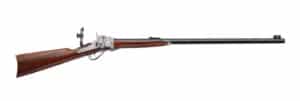
- The Sharps buffalo rifles, Model 1874 and earlier patterns, enabled the commercial bison harvest of 1871–1883, which broke Plains Native economies and rendered the open range available for cattle.
Winchester offered the 1866 and the 1873 to the Army for trials and was rejected each time. The Ordnance Department’s documented reasons: the .45-70 Government dramatically outranged .44-40; Ordnance feared troops with repeaters would burn through ammunition faster than supply trains could keep up; Springfield Trapdoors were produced in government arsenals at lower unit cost than Winchester’s contract price; and the toggle-link’s reliability under hard field use was a concern.
At the Little Bighorn (June 25, 1876), Douglas D. Scott’s forensic archaeology in the 1980s recovered cartridge cases consistent with Native-owned Henrys, 1866s, and 1873s used by combatants under Sitting Bull, Crazy Horse, and others. The Native forces may have been better-armed in sustained-fire repeaters than the cavalry was.
The slogan itself entered popular usage through Winchester’s own 20th-century promotion and Hollywood Westerns from the 1930s onward, not from how the 1873 was described in its own era.
Famous Owners and Cultural Cameos
Theodore Roosevelt was an emphatic Winchester man throughout his hunting career, including his Dakota Territory ranch years (1883–1886) and his post-presidency expeditions. He owned and used multiple Winchester models, including the 1873 (typically in .32-20 or .38-40 for light hunting, .44-40 for general work), though his more famous Winchesters were the Model 1876 in .45-75, his bison and grizzly rifle, and the Model 1895 in .405 Winchester and .30-06. Roosevelt’s own writing in Hunting Trips of a Ranchman (1885), The Wilderness Hunter (1893), and African Game Trails (1910) is the primary documentation. The 1873 wasn’t his go-to rifle; he had different favorites by quarry and period.
Buffalo Bill Cody used Winchester lever-actions extensively in his post-1880 Wild West Show exhibitions. Cody’s famous early commercial buffalo-hunting rifle, the one he named “Lucretia Borgia,” was a Springfield Model 1866 Allin Conversion in .50-70, a single-shot trapdoor, not a Winchester. Annie Oakley shot a range of makers in exhibition. Her best-documented Winchester 1873 was a smoothbore .44-40 presented to her by Cody, fired with #7.5 shot loads during stage performances, not solid bullets. For her .22 work she preferred Stevens tip-up rifles and Marlin lever-actions (including engraved Model 1897s presented by Marlin in 1903 and 1906), not 1873s.
Billy the Kid. The famous c. 1879–1880 tintype of Henry McCarty / William H. Bonney shows him holding a Winchester Model 1873 carbine; the rifle is identifiable in the image, though debate over the exact variant continues. The tintype itself sold at Brian Lebel’s Old West Auction in Denver for $2.3 million in June 2011, at the time the highest price ever paid for a historic photograph of the American West. Pat Garrett, who killed the Kid in July 1881, is commonly reported to have carried an 1873 carbine during the manhunt, though primary documentation of the specific rifle is thin. Wyatt Earp and Bat Masterson are documented Winchester carriers, with model-specific attributions varying in provenance strength; the Earp/OK Corral primary record actually names a Smith & Wesson Model 3 as Wyatt’s sidearm that day, not a Winchester rifle. Museum-held attributions with documented provenance are reliable; auction-house attributions vary widely.
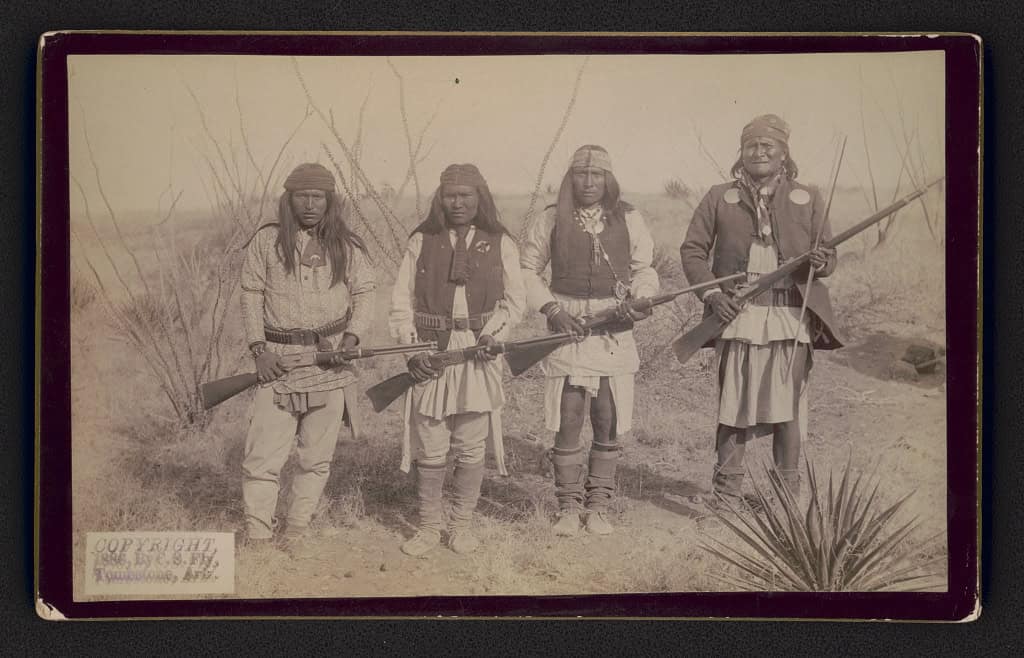
Native combatants. Two well-known museum-held Native Winchester attributions get miscredited as 1873s and aren’t. The Smithsonian’s National Museum of Natural History anthropology collection holds a Winchester Model 1866 carbine attributed to Sitting Bull (surrendered at Fort Buford, 1881), not a Model 1873. Geronimo’s surrender rifle to General Crook in 1886 was a Winchester Model 1876 .45-75 carbine, acquired by Colonel Eugene Beaumont at the surrender, later donated to the Museum of the American Indian (now part of the Smithsonian’s NMAI) in 1953, not held at Fort Sill. C.S. Fly’s March 1886 Cañon de los Embudos photographs (Library of Congress) do show Apache fighters with 1873s: Yanozha and Chappo each hold one in the image above. 1873s reached Plains, Southwest, and Plateau nations through trade at licensed posts, through capture in battle and raid, and through direct purchase.
Cinema, and a warning about misattribution. Winchester ’73 (1950, dir. Anthony Mann; James Stewart, Shelley Winters, Dan Duryea, Stephen McNally, with Rock Hudson and Tony Curtis in early roles) is the rifle’s most consequential pop-culture appearance and gives the model its modern collector-market mythology. Beyond that one film, Hollywood’s “Winchester” in Westerns is overwhelmingly not a Model 1873. Per the Internet Movie Firearms Database, John Wayne’s signature large-loop saddle-ring carbine, visible in The Searchers (1956), Rio Bravo (1959), and as Rooster Cogburn’s rifle in True Grit (1969), is a Winchester Model 1892, not an 1873; the same 1892 appears throughout most of Sergio Leone’s Once Upon a Time in the West (1968). The Dollars Trilogy leans on a Winchester Model 1866 “Yellow Boy” (most notably in Blondie’s hands in The Good, the Bad and the Ugly). Verified 1873 screen appearances include True Grit‘s villain Tom Chaney (Jeff Corey), Open Range (2003, Costner and Duvall use 1873s alongside 1866s), and parts of the Lonesome Dove miniseries (1989, alongside 1866s and other period arms). The 1873-vs.-1892 confusion is the single most common firearms error in the Western genre; films set in the 1870s routinely use 1892s because they were the readily-available Hollywood prop in the studio era.
The Modern Reproductions Market
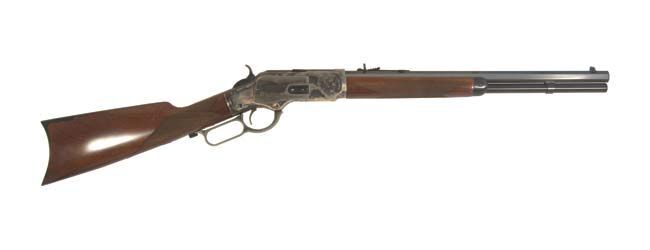
The modern 1873 market looks bigger than it is, because importer brands stack catalog entries on top of a very small number of actual manufacturers. As of 2026 there are only two: Winchester (under the modern licensing arrangement, manufactured by Miroku in Japan) and A. Uberti in Italy. Everything else (Cimarron, Taylor’s, EMF, Stoeger) is a Uberti-manufactured rifle finished and badged for a U.S. importer. Pedersoli, often listed in older buyer’s guides as a third source, does not currently catalog a 1873-pattern lever-action; its modern lever-action production is built around the Browning-designed 1886 (and 86/71 variants in modern hunting calibers), not the toggle-link 1873. If you see a “Pedersoli 1873” listed for sale today it is almost certainly a Trapdoor Springfield Model 1873: a single-shot breech-loader, a different rifle.
Winchester Repeating Arms (Miroku-manufactured)
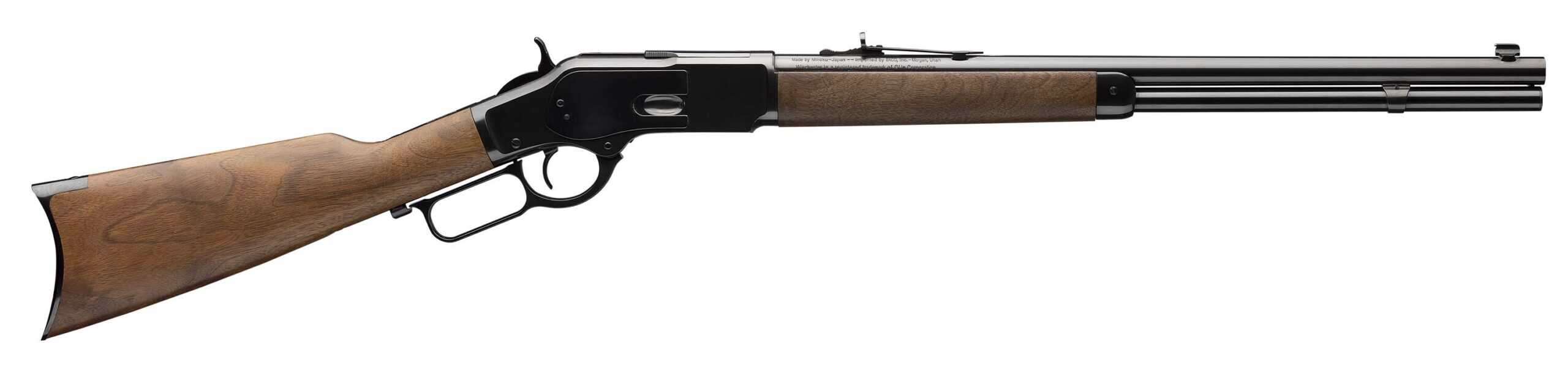
The modern “Winchester” brand is owned by Olin Corporation (Winchester Ammunition) and licensed for firearms to Browning Arms Company, which contracts manufacture to Miroku Firearms Manufacturing in Kochi, Japan (current product line: Winchester Model 1873 page). Miroku-made Winchester 1873s resumed production in 2013 after a 90-year hiatus: the original toggle-link action with modern manufacturing tolerances. Miroku production is generally considered the premium tier of modern lever-action manufacture globally. As of 2026, the current Winchester catalog covers two variants: a Short Rifle (20-inch round barrel) and a Carbine (20-inch round, saddle ring). The Sporter (24-inch octagonal) and Deluxe Sporting variants that appeared in earlier Miroku production are not in the current online lineup. Standard chamberings on the current line are .357 Magnum/.38 Special, .44-40 WCF, and .45 Colt. Street pricing in 2026 runs in the upper-mid to premium tier. Browse current Winchester Model 1873 listings at Guns.com.
Uberti
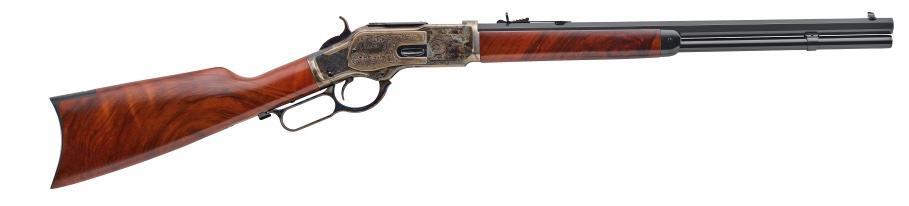
A. Uberti S.r.l. was founded in 1959 in Gardone Val Trompia and acquired by Beretta Holding in 2000. It is the dominant producer of pre-1900 American firearms reproductions globally. The Uberti 1873 line covers more variants than Winchester’s. Current Uberti USA listings include the 1873 Rifle and Carbine, the 1873 Short Rifle and Hunter, the 1873 Competition Rifle (action-jobbed, short-stroke for SASS use), the 1873 Trapper Carbine (16-1/8-inch barrel), and recent special runs including the 1873 150th Anniversary rifle. Uberti also offers matched Cattleman SAA-pattern revolvers in the same chamberings for buyers building a paired set. Chamberings across the 1873 line include .357 Magnum/.38 Special, .44-40 WCF, .45 Colt, and .44 Magnum (Hunter line); period chamberings such as .38-40 WCF and .32-20 WCF have appeared on individual catalog runs but availability moves year to year; verify on Uberti USA’s current catalog before ordering. Uberti product enters the U.S. market through Cimarron, Taylor’s, EMF, Stoeger, and Benelli USA; the same underlying Uberti-built rifle may be branded and finished differently depending on the importer. Browse current Uberti 1873 listings at Guns.com.
What about Pedersoli?
Davide Pedersoli & C. is one of the great Italian reproduction houses, but the 1873 is not in their wheelhouse. Their current lever-action catalog is built around the Browning-designed 1886 (and the 86/71 Boarbuster / Guidemaster hunting variants in cartridges like .45-70 Gov’t, .30-30 Win, and .444 Marlin), a different action entirely. They also produce the single-shot Springfield Trapdoor Model 1873, which sometimes gets confused with the Winchester 1873 in casual listings. If you are shopping a 1873 lever-action, you are choosing between Winchester Miroku and Uberti.
The importer brands: what you are actually buying
“Cimarron 1873,” “Taylor’s 1873,” “EMF 1873” and similar listings are not separately manufactured rifles. They are Uberti-built rifles, finished and badged by the U.S. importer, with cosmetic upgrades that vary (Cimarron Firearms is particularly active in charcoal-blue and color-case-hardened finishes; Taylor’s offers a slightly different configuration mix). All of them buy actions from the same Uberti factory. The manufacturer-level choice is binary: Uberti’s mechanism (in importer-finished form) or Miroku’s (in modern Winchester-branded form).
The great exception to that “all the same underneath” framing is the Taylor Tuned line. On a Taylor Tuned 1873, Taylor’s & Company doesn’t just import the Uberti and badge it: they work the action. Internals get slicked and polished, the lever throw gets smoothed, the trigger is tuned, the timing is dialed in. The result cycles like butter. Cimarron offers a parallel: their Short Stroke series shortens the lever throw for faster cycling and gets some action work as well, but the work is meaningfully lighter than the Taylor treatment. Those Taylor Tuned 1873s are really special.
Who does not make a 1873
Several manufacturers come up in buyer questions and do not make 1873 reproductions:
- Rossi (Brazil, a Forjas Taurus subsidiary) does not produce a Model 1873. Rossi’s flagship lever-action is the Model 92, a reproduction of the Winchester 1892, a different rifle on a different action. Rossi 92s are routinely confused with 1873s because both are pistol-caliber lever-actions and share several chamberings.
- Henry Repeating Arms (Bayonne, NJ) does not produce a Model 1873. Their “Original Henry” line reproduces the 1860 Henry (the 1873’s grandparent in the lineage); their “Big Boy” line is a modern Henry-designed lever-action, not a 1873 pattern. The branding is the source of the confusion.
- Chiappa Firearms (Brescia, Italy) does not produce a 1873. Their lever-action line is broad: full-size 1892s in multiple configurations and calibers, the 1892 “Mares Leg” takedown, 1886 reproductions, the 1887 lever-action shotgun, the LA322 .22 LR (which looks suspiciously like a Marlin 39A), and a Spencer carbine reproduction. None of those is an 1873.
- F.lli Pietta (Gussago, Italy) does not produce a 1873. Pietta is best known for cap-and-ball revolvers and SAA-pattern revolvers; no Winchester-pattern lever-action line.
Your real choices for a new-production 1873: Winchester (Miroku-built) or Uberti (in importer-finished forms including Cimarron, Taylor’s, EMF, Stoeger). Anything else is either an 1892 (Rossi, Chiappa), a Henry-pattern rifle from Henry Repeating Arms, a Pedersoli 1886 lever-action, or a different rifle pattern entirely.
Buyer’s Framework by Use Case
Cowboy Action Shooting (SASS). The Single Action Shooting Society, founded 1981, is the dominant cowboy-action match organization, and the Winchester 1873 is the canonical SASS rifle. Top-tier shooters favor the 1873 over the mechanically stronger Browning-designed 1892 because the toggle-link action cycles smoother and short-strokes more easily than the 1892’s stiffer vertical-locking-lug mechanism. Dominant chambering is .357 Magnum, used to fire .38 Special cowboy-action loads: low recoil, low ammo cost, commonality with Ruger Vaquero and Uberti Cattleman revolvers. Traditionalist’s choice: .45 Colt. Period-correct: .44-40 WCF. Low-recoil purist’s choice: .32-20 WCF. Entry-level SASS-ready setups run in the mid tier; competition-tuned action-jobbed builds move into the upper-mid and premium tier.
Hunting. An 1873 in any chambering is suboptimal for modern deer hunting: open sights, period stock geometry, and a roughly 100-yard practical range limit it compared to a Marlin 1895 in .45-70 or a modern bolt-action. People hunt with 1873s anyway, and it rewards close-range stalking. .44-40 WCF and .45 Colt both deliver 600 to 700 ft-lb at the muzzle from rifle barrels, adequate for whitetail at moderate range with proper bullet placement. .357 Magnum from a 20-inch barrel delivers around 1,800 fps and about 1,140 ft-lb. .32-20 is not a deer cartridge. Keep shots inside the rifle’s honest range.
Plinking, ranch use, and living history. 1873 Carbines (20-inch round barrel) are popular for casual range and ranch use: quick action, mild recoil in pistol-caliber chamberings, light at about 7 pounds. A Winchester Miroku Short Rifle or Uberti Carbine in .357 Magnum works well. For Western-era reenactment, the right rifle is a Uberti 1873 Sporting Rifle in .44-40 WCF, with importer finish packages from Cimarron or Taylor’s (charcoal-blue, color-case-hardened receivers). Originals are too valuable for repeated handling.
Collecting. Original 1873s trade actively at various auction houses, and through specialist dealers. Approximate late-2020s tiers: standard rifle in average condition, entry-to-mid four figures; fine condition with original finish, upper four to low five figures; carbines in fine condition, upper four to mid five figures (carbines saw harder field use; fewer fine examples survive); First Model 1873s with no dust cover carry a significant premium into upper four to mid five figures; “One of One Hundred,” mid six figures and up; documented “One of One Thousand” rifles, upper six to seven figures, with the highest-condition examples breaking seven figures at auction. Famous-owner provenance drives prices into the millions when the chain is solid. Authenticate the serial number against Madis’s production-date tables in The Winchester Book, or the Winchester Collectors Association’s free serial-number lookup tool. A buyer committing five figures or more without doing this lookup is doing it wrong. Browse used copies of Madis’s The Winchester Book.
Quick Buyer’s Reference: Caliber, Barrel, and the Miroku Caveat
On caliber, if period correctness matters, choose .44-40 WCF, the original chambering and the one most original buyers shot. For broadest modern ammunition availability and lowest shooting cost, choose .357 Magnum / .38 Special. For the traditionalist’s cowboy chambering with rifle-pistol commonality, accepting that it postdates the original, choose .45 Colt. .32-20 is the original-spec light-recoil option.
On barrel length, the 20-inch Carbine is handier and faster-pointing; the 22-inch Sporting is a balanced compromise; the 24-inch octagonal Rifle is the most period-evocative and the traditionalist’s choice; 28-inch-plus Long Range and Special Sporting models from Uberti and Cimarron are a 21st-century specialty for long-range silhouette and target work, not historically correct, but mechanically excellent.
One caveat that catches some buyers: a modern “Winchester” 1873 is a Japanese rifle manufactured by Miroku in Kochi, imported under Winchester’s licensing arrangement, and marked “Winchester” on the receiver. It is not made in New Haven and it is not an antique. Original Winchester 1873s ended production in 1923; the Miroku-built modern Winchester resumed production in 2013. Miroku’s manufacturing standards are widely considered the best in the modern lever-action segment, but know what you are buying.
Adjacent Rifles: Do Not Confuse
Several rifles in the Winchester lever-action lineage get confused with the 1873.
| Rifle | Distinguishing features | Why confused with the 1873 |
|---|---|---|
| Henry Model 1860 | Brass receiver, no loading gate, muzzle-loaded magazine, .44 Henry rimfire | Same toggle-link lineage; predecessor by 13 years |
| Winchester Model 1866 “Yellow Boy” | Brass receiver, side loading gate, .44 Henry rimfire | Direct predecessor; visually very similar |
| Winchester Model 1873 | Iron/steel receiver, sliding dust cover, .44-40 / .38-40 / .32-20 / .22 rimfire | (This article’s subject) |
| Winchester Model 1876 | Scaled-up toggle-link, .45-75 WCF / .50-95 / .40-60 / .45-60 | Same toggle-link family; bigger receiver |
| Winchester Model 1886 | Browning twin-lock vertical-lug action, .45-70 / .45-90 / .50-110 | Long lever-action; very different mechanism |
| Winchester Model 1892 | Browning scaled-down 1886 action, .44-40 / .38-40 / .32-20 / .25-20 | Major confusion source. Same chamberings; visually similar; mechanically very different. |
| Winchester Model 1894 | Browning single-lug rear-locking action, .30-30 WCF primary | The “deer rifle” Winchester from the smokeless era |
| Marlin Model 1894 | Side-ejecting, solid-top receiver, .44-40 / .38-40 / .32-20 / .357 / .44 Mag / .45 Colt | Period competitor; same cartridges as the 1873 |
| Rossi Model 92 | Brazilian-made Winchester 1892 reproduction | Often mislabeled “Rossi 73” |
The 1873 versus 1892 confusion is the most consequential one. Both are short-action lever-actions in pistol-caliber cartridges, widely available as modern reproductions. The mechanical difference is fundamental: the 1873 uses the toggle-link inherited from the Henry and 1866, while the 1892 uses John Browning’s twin-lug vertical-locking action, a different mechanism with significantly higher pressure tolerance. The 1892 can chamber and safely fire full-pressure .357 Magnum at modern handgun-load pressures without ammunition de-rating; the original 1873 was never chambered for anything like it. On a modern 1873 reproduction marked .357 Magnum, use only the ammunition the barrel marking and the maker’s manual specify.
The 1892 is mechanically stronger and more versatile for modern hunting; the 1873 is mechanically smoother and faster-cycling, and remains the canonical SASS competition action. Visually, the 1873 has the sliding dust cover on the receiver top; the 1892 does not, and its receiver shape is more squared.
Related historical arms: the Sharps Rifle, the breech-loading single-shot that defined long-range shooting and the buffalo harvest in the same period; the Hawken Rifle, the half-stock plains rifle that preceded the cartridge era; the Pennsylvania Rifle, the long-barreled flintlock that built American rifle culture; and the Enfield Pattern 1853, the British military percussion rifle-musket that armed both sides of the U.S. Civil War.
References and Resources
The canonical reference work for any serious Winchester research is George Madis’s The Winchester Book (1961, with revised editions through the 1980s, ISBN 0-910156-04-9 for the 1985 edition). Out of print and trading on the secondhand market; it remains the definitive authentication reference for everything Winchester produced from the Henry through the 1980s. R. L. Wilson’s The Winchester: An American Legend (Random House, 1991, ISBN 0-394-57870-2) is more accessible and visually richer but less technically deep: the right book for a general reader, where Madis is the right book for a serious collector. Herbert G. Houze’s Winchester Repeating Arms Company: Its History & Development from 1865 to 1981 (Krause, 1994, ISBN 0-87341-262-7) is the corporate-history reference.
Online: the Winchester Collectors Association (winchestercollector.org) hosts a free serial-number lookup tool and an active authentication forum. The Rock Island Auction Company catalog archive (rockislandauction.com) is a searchable historical auction database with detailed lot descriptions, provenance research, and high-resolution photographs. The Cody Firearms Museum at the Buffalo Bill Center of the West (centerofthewest.org) holds the most important physical collection of Winchester production records and rifles.
The Morphy Auctions (morphyauctions.com) catalog archive is one of the standout marketplaces for rare and historically significant American firearms. The Winchester 1873 photography that appears in this article (the round-barrel Rifle, the octagonal-barrel Rifle, and the Musket variant) comes from their archive. Their sales are worth following whether you are buying, researching original Winchesters and their period contemporaries, or just looking at very good firearms photography.
The Texas Gun Collectors Association (tgca.org) holds two shows a year that always feature a large number of historical Winchesters alongside other significant American firearms. Worth attending whether you are buying, researching, or just looking.