Wyatt Earp (1848 to 1929) was a Kansas cow-town policeman, a gambler and an occasional lawman. He became famous for about half a minute of shooting in Tombstone, Arizona Territory, in October 1881, and for a biography published two years after he died. This short biography follows the records: court papers, his own sworn statement and the Kansas newspapers. Claims the records do not support are marked as myths.
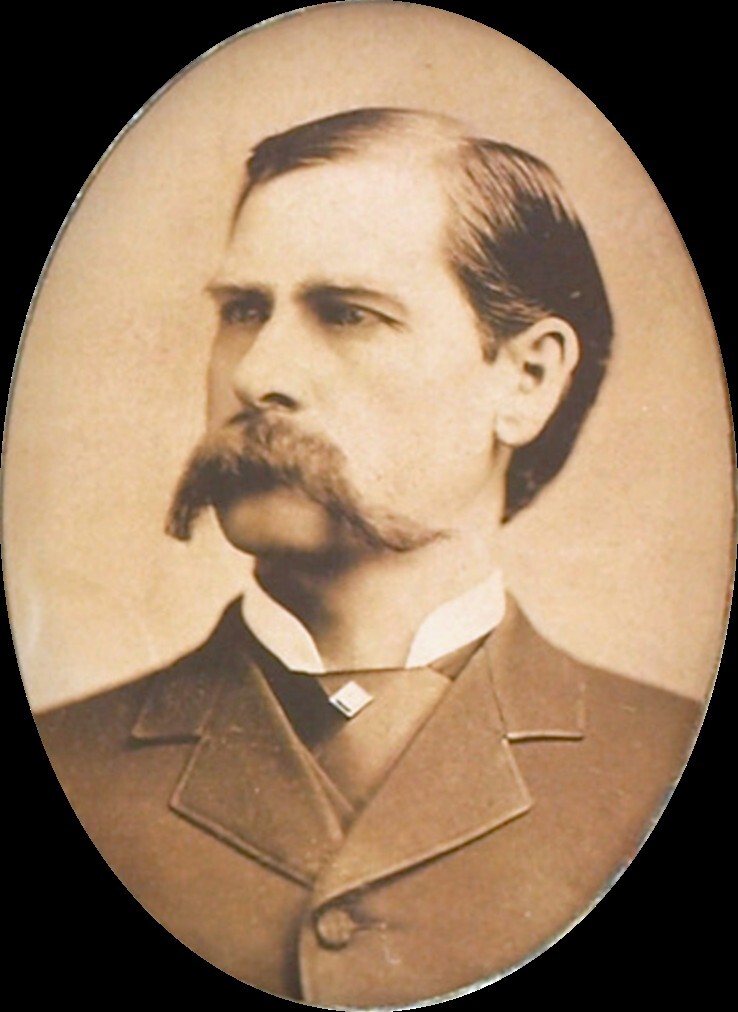
Early Life and the 1871 Horse Case
Earp was born in Monmouth, Warren County, Illinois. Most references, including the National Park Service, give the year as 1848. In November 1881 he swore that he was “32 years old last March the 19th,” which would put his birth in 1849 (Wyatt Earp’s statement).
According to the National Park Service at Fort Smith, he won election as constable of Lamar Township, Missouri, at 22, beating his half-brother Newton. His young wife, Urilla Sutherland, died soon after. In 1871, in the Indian Territory, James Keyes charged Earp and two other men in federal court with stealing two of his horses. A deputy marshal arrested Earp in the Cherokee Nation on April 6, and he was released on a $500 bond. A grand jury indicted him in May, but he jumped bail and never stood trial (NPS, “The Other Side of Wyatt Earp”).
Wichita and Dodge City
The Kansas years come from William B. Shillingberg’s 1976 study of the city records and newspapers in the Kansas Historical Quarterly. His first recorded appointment as a Wichita policeman, under Marshal Mike Meagher, is dated April 21, 1875. On April 2, 1876, he manhandled William Smith, a candidate for city marshal, and was arrested. He was fined $30 and costs, and the council later removed him from the force. The Wichita Weekly Beacon wrote on April 5: “The good order of the city was properly vindicated in the fining and dismissal of Erp.”
By the summer of 1876 he was in Dodge City. The Dodge City Times directory for October and December 1876 lists him as “Deputy Marshal” under City Marshal Lawrence Deger. That summer he also served as a Ford County deputy sheriff under Charlie Bassett. On July 7, 1877, the Times noted that “Wyatt Earp, who was on our city police force last summer, is in town again.” In January 1878 the Ford County Globe reported that “our old assistant Marshal” was in Texas. He returned in May and became assistant city marshal again. He left Dodge City in early September 1879.
Tombstone and the O.K. Corral
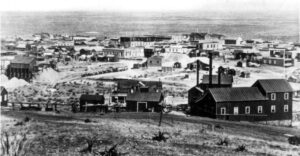
Earp reached Tombstone on December 1, 1879. He served as a Pima County deputy sheriff for part of 1880 and had a share in the faro game at the Oriental Saloon (Linder). His brother Virgil became Tombstone’s chief of police.
On October 26, 1881, Virgil, Wyatt, Morgan Earp and Doc Holliday went to disarm the Clantons and McLaurys. Billy Clanton and Frank and Tom McLaury were killed, and Virgil, Morgan and Holliday were wounded. Justice Wells Spicer heard murder charges against Wyatt and Holliday and ruled on November 30 that they were “fully justified.” Our full account, The Gunfight at the O.K. Corral: What Really Happened, follows the sworn testimony witness by witness.
Virgil was crippled by an ambush in December 1881, and Morgan was killed on March 18, 1882. Wyatt and his friends then killed Frank Stilwell, Florentino Cruz and, by Wyatt’s account, Curly Bill Brocius. He and Holliday went to Colorado, whose governor refused to send them back to Arizona (Famous Trials chronology).
After Tombstone
Earp gambled and prospected across the West for the rest of his life. In 1883 he went back to Dodge City to back his friend Luke Short in the Dodge City Saloon War (Shillingberg).
On December 2, 1896, he refereed the Bob Fitzsimmons and Tom Sharkey fight at Mechanics’ Pavilion in San Francisco. In the eighth round he stopped the fight and gave it to Sharkey on a disputed foul. Before the bout a police captain took a revolver from him at ringside, and the San Francisco Examiner printed a drawing of Earp handing it over (Shillingberg). ESPN’s account says he was fined $50 for carrying it (ESPN, 2013).
Around 1900 he ran the Dexter Saloon in Nome, Alaska (Shillingberg). He met the writer Stuart N. Lake for the first time on June 19, 1928 (Shillingberg). He died at his home at 4004 West Seventeenth Street in Los Angeles on the morning of January 13, 1929. The Los Angeles Times obituary of January 14 called him the town marshal of Tombstone and the city marshal of Dodge City. The records support neither title, and Tombstone’s marshal in 1881 was Virgil (transcription).
Wyatt Earp Myths
Much of the popular picture of Wyatt Earp comes from Lake’s Wyatt Earp: Frontier Marshal (1931), which became the basis for several films and a television series. These claims do not hold up against the record.
- Myth: Wyatt carried a “Buntline Special.” The story of a Colt with a 12-inch barrel given to him by the dime novelist Ned Buntline first appeared in Lake’s writing in 1930 and 1931. Shillingberg found no earlier account, no evidence that Buntline went to Dodge City in 1876 or 1877, and no Colt shipment that fits. Read more in our O.K. Corral account and our history of the Colt Single Action Army.
- Myth: the gun he used at the O.K. Corral is known. It is often said that he favored a Colt Peacemaker, or that he used a Smith & Wesson Schofield that day. In his sworn statement Wyatt described drawing his pistol from his overcoat pocket but never named its make, and no witness at the hearing named it either. Read more in Wyatt Earp’s revolver, and see our histories of the Schofield and the .45 Colt cartridge.
- Myth: he was the marshal who tamed Dodge City. In 1881 Wyatt swore that he had been city marshal of Dodge City from 1876. The city records and newspapers show him as deputy and then assistant marshal. The city marshals in those years were Lawrence Deger, Edward Masterson and Charlie Bassett (Shillingberg).
- Myth: Frontier Marshal is Wyatt’s own story in his own words. Lake wrote the book as if Wyatt had dictated it. Shillingberg quotes the writer Frank Waters, who said that Lake, in a letter to Waters’s publishers, “affirmed that Wyatt never dictated a word to him.” Shillingberg also shows from their letters that the two men first met only seven months before Wyatt died.
Books on Wyatt Earp
The first is a full-length biography. The second is the hearing record that much of the Tombstone story rests on. Book links go to Amazon, and Powder & Lead earns a commission on qualifying purchases.


Casey Tefertiller, Wyatt Earp: The Life Behind the Legend.
Alford E. Turner, editor, The O.K. Corral Inquest. The transcribed testimony from the Spicer hearing. Copies are scarce.
Sources
- Statement of Wyatt S. Earp, November 16, 1881, in the preliminary hearing before Justice Wells Spicer, from Alford E. Turner, ed., The O.K. Corral Inquest, as reproduced by Famous Trials.
- National Park Service, Fort Smith National Historic Site, “The Other Side of Wyatt Earp”, on the 1871 federal case.
- William B. Shillingberg, “Wyatt Earp and the Buntline Special Myth,” Kansas Historical Quarterly 42, no. 2 (Summer 1976), via the Kansas Historical Society. Quoted for the Wichita and Dodge City newspapers and records, the 1883 and 1896 events, Nome, and Lake.
- Douglas O. Linder, “The Earp-Holliday Trial: An Account” and “The Earp Trial: A Chronology”, Famous Trials.
- Decision of Justice Wells Spicer, November 30, 1881.
- Los Angeles Times, January 14, 1929, obituary of Wyatt Earp, as transcribed online.
- Kieran Mulvaney, “The fight, the foul and the lawman”, ESPN, October 26, 2013.
If you know of any forums or sites that should be referenced on this listing, please let us know here.