
Disclosure: Powder & Lead may earn a commission on purchases made through affiliate links on this page, at no extra cost to you.
The 8.6 Blackout vs 300 Blackout question starts with the size of the rifle. The 300 Blackout (SAAMI’s name is 300 AAC Blackout, short form 300 BLK) puts a .30-caliber bullet in an AR-15 with only a barrel change. The 8.6 Blackout (8.6 BLK) puts a .338-inch bullet in an AR-10-size rifle or a .308-size bolt action, again with a barrel change. Both fire supersonic and subsonic loads, and both were designed with a suppressor in mind. SAAMI issued its 300 BLK drawing in January 2011 and its 8.6 BLK drawing in January 2026.
I own and shoot both. In 300 BLK I have a Q Honey Badger, a Q Sugar Weasel, a Q Mini Fix, a 14.5-inch CMMG Dissent, a Ruger American Ranch Generation II, a Henry Lever Action Supreme and a FightLite SCR 300BLK Raider pistol. In 8.6 BLK I have a 12-inch Q Boombox and a CMMG Banshee. The specifications here come from SAAMI’s drawings, the makers’ own pages and published reviews. Every factory ballistic figure names its maker and its barrel length.
.300 is a nice round to shoot, suppresses well, and packs enough wallop to be effective. It also performs well in short-barrel configurations that lead to compact weapons.
I came across the Banshee used for a good price. Had read about 8.6 and wanted to try it out. I’ve always loved Q’s weapons, so eventually saved up and bought one. The Boombox is beautiful (also run a Porq Chop on it).
8.6 Blackout vs 300 Blackout at a glance
| 300 BLK | 8.6 BLK | |
|---|---|---|
| SAAMI drawing issued | January 17, 2011 | January 19, 2026 |
| Introduced by | AAC, with Remington | Q, LLC |
| Parent case | .221 Remington Fireball | 6.5 Creedmoor |
| Bullet diameter | .309 | .339 |
| Rim diameter | .378 | .472 |
| Case length | 1.368 | 1.685 |
| Overall length | 1.780 to 2.260 | 2.560 to 2.810 |
| Maximum average pressure | 55,000 psi | 62,000 psi |
| SAAMI test barrel | 16 inches, 1 in 8 twist | 16 inches, 1 in 6 twist |
| SAAMI listed loads | 125 gr at 2,185 fps; 150 gr at 1,900 fps; 190 gr at 1,040 fps; 220 gr at 1,020 fps | 200 gr at 2,200 fps |
| Rifle size | AR-15 | AR-10 (.308 size) |
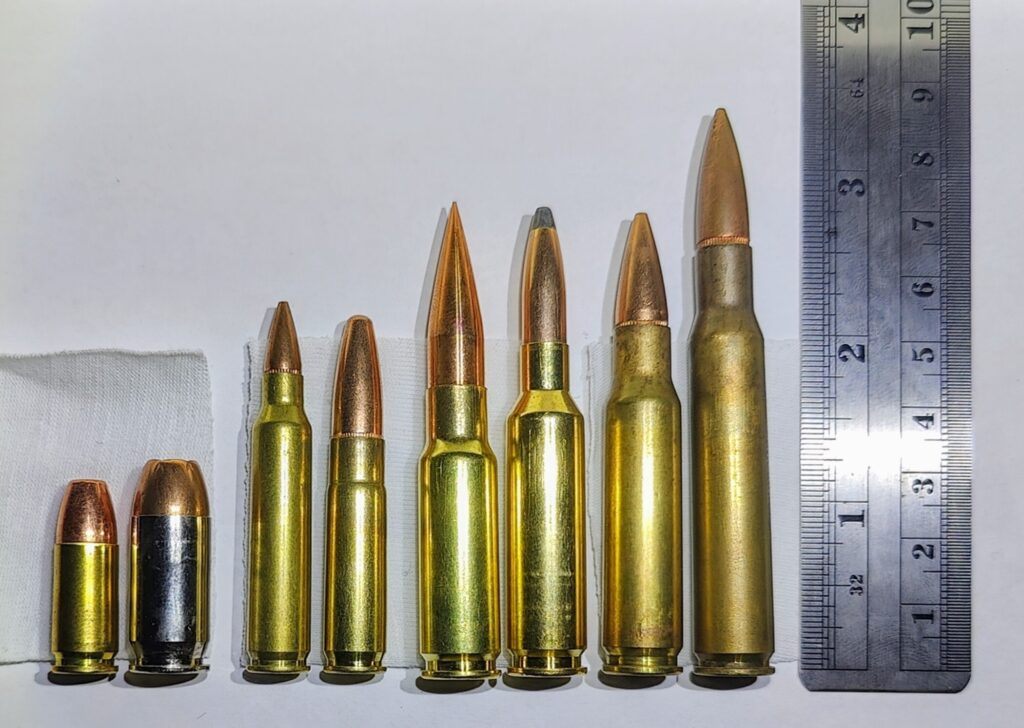
Three lines in that table explain most of what follows. The 8.6 case has a rim of .472 inch, the size of its 6.5 Creedmoor parent and within a thousandth of the .308 Winchester’s .473. That is why it needs a .308-size bolt. Its 2.810-inch maximum overall length, the same as the .308’s, is why it needs a .308-size receiver and magazine. And SAAMI allows the 8.6 a maximum average pressure of 62,000 psi, the same figure it sets for the .308 Winchester and the 6.5 Creedmoor, against 55,000 psi for the 300 BLK.
Where the 300 Blackout came from
Remington introduced the .221 Fireball in 1963 for its XP-100 pistol, and wildcatters necked it up to take .30-caliber bullets. J.D. Jones of SSK Industries did the same with his .300 Whisper, a name he trademarked, and loaded it with heavy bullets for subsonic use with a suppressor and lighter bullets for supersonic use.
Remington bought Advanced Armament Corp. (AAC), the suppressor maker Kevin Brittingham had founded in 1994, in 2009. David Fortier of Firearms News writes that in 2010 a government customer asked Robert Silvers, AAC’s research and development director, whether AAC could build guns for .300/.221 Fireball type ammunition made by Remington Defense. Silvers told Fortier what followed: “With Remington already doing the .221 and .17 Fireball, it was a natural to do the .30 caliber. But Remington is a SAAMI [Sporting Arms and Ammunition Manufacturers’ Institute] company and only makes SAAMI-approved ammunition.”
SAAMI does not accept trademarked names, which ruled out .300 Whisper. The .300 Fireball name had its own problem: there were many wildcat chamber drawings under it, and in Silvers’ words that would have meant pressure-testing the ammunition “in the tightest one.” AAC chose a new name and drew its own chamber. Silvers said they kept the exact rear dimensions of Remington’s official .221 Fireball drawing and chose a longer throat than some .300 Whisper chambers had, to let a Sierra 220-grain MatchKing be loaded to full magazine length. His stated goal was “the most powerful way to shoot .30 caliber from an AR-15 while remaining compatible with normal 30-round magazines.”
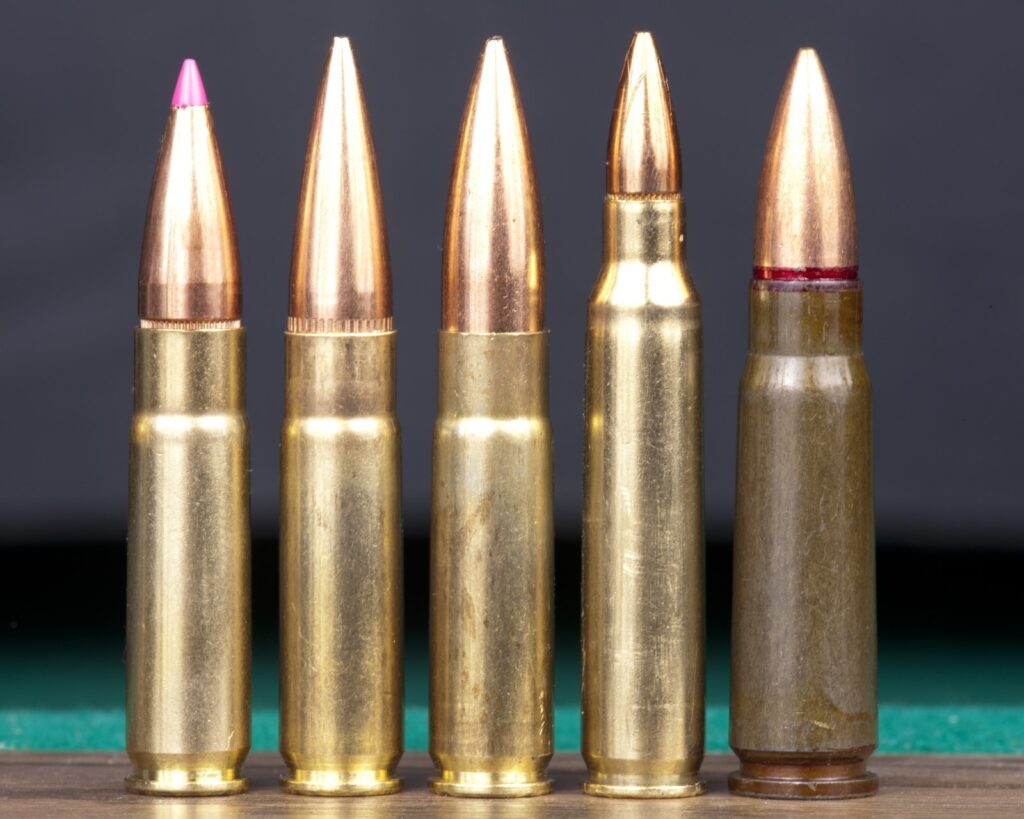
Accounts differ on who should get the design credit. Silvers gives his own account in Firearms News; Richard Mann of Shooting Illustrated, writing in 2025, says Brittingham “designed the .300 BLK.” Both men were at AAC at the time. SAAMI’s drawing is dated January 17, 2011. Barnes says it worked alongside AAC and Remington Defense during the launch and developed its 110-grain TAC-TX bullet for the cartridge then. Our 300 Blackout cartridge page covers the round on its own.
Where the 8.6 Blackout came from
After Brittingham left AAC and Remington, Shooting Illustrated reports, he worked briefly at SIG Sauer and then started his own company. American Rifleman dates Q, LLC, of Dover, New Hampshire, to 2016. Q builds the Honey Badger, which it says was originally built for a military program to replace the MP5-SD, as well as the Fix bolt action and the Boombox.
The 8.6 began under another name. AllOutdoor’s SHOT Show 2022 report says that about four years earlier it was called the 8.6 Creedmoor, and that it grew out of a collaboration between Q, the ammunition maker Discreet Ballistics and Hornady, which was said to be making the brass. Shooting Times reports that Q began production in 2018 and that COVID then derailed manufacturing and supply chains. Brittingham told Outdoor Life in 2022 that “it started as a joint project with a foreign military,” and explained the case: “We settled on shortening up the 6.5 Creedmoor case because it’s a little more efficient than the .308 case.” Outdoor Life adds that the case length was set to fit an SR-25 magazine. In Brittingham’s words, “Basically every lesson that we learned from .300 Blackout whether its barrel twist or bullet design, we put into this.”
For several years the 8.6 was a cartridge without a SAAMI standard. That changed in 2026. SAAMI’s drawing is dated January 19, 2026, and its announcement of January 29, 2026 lists the 8.6 BLACKOUT as “introduced by Q, LLC, with a 200-grain bullet traveling at a velocity of 2,200 fps and a Maximum Average Pressure of 62,000 psi.” Q is the listed supplier of SAAMI reference, dummy and proof ammunition. Barnes says it started work as soon as the cartridge was standardized, and its two 8.6 loads are listed as new for 2026.
Twist rate: the biggest design difference
SAAMI’s test barrel for the 300 BLK has a 1 in 8 inch twist, and AAC’s own early barrels used the same rate. Most of the 300 BLK guns in this comparison run faster twists, for heavy subsonic bullets. Q’s 7-inch Honey Badger and Sugar Weasel and its 8-inch Mini Fix use 1 in 5, Q’s 16-inch Mini Fix uses 1 in 6, and CMMG’s 300 BLK Dissent Mk4 pages and the Ruger American Generation II Ranch list 1 in 7. FightLite lists 1 in 8 for the 7.25-inch SCR 300BLK Raider pistol. Q explains the choice on its Sugar Weasel page: heavy 300 BLK bullets “benefit from more rotational stability out of short barrels.”
The 8.6 goes much further. SAAMI’s test barrel uses 1 in 6, but the Q and CMMG guns here use 1 in 3: the Boombox, the 8.6 Fix and the CMMG Banshee Mk3 8.6. Barnes says its 200-grain TAC-TX can turn at “more than 500,000 RPM” from a 1 in 3 barrel at typical hunting ranges, and that the same bullet also works in a 1 in 6 barrel with slightly less expansion.
The fast twist limits bullet choice. Shooting Times reports that the 1 in 3 twist is fast enough that non-bonded bullets will come apart at the muzzle at supersonic speed, and that solid copper or bonded bullets are required for supersonic loads. If you shoot a 1 in 3 barrel, check what the box says the bullet is built for. Richard Mann of Shooting Illustrated credits the fast twist with a terminal advantage as well. He puts the 8.6 bullet’s rotational velocity at about 2.6 times that of 300 BLK and 338 ARC bullets from their 1 in 8 barrels. He says the extra spin helps it expand at subsonic speed, where 300 BLK subsonic bullets are hard to get to open up.
The rifles: AR-15 against AR-10
The 300 BLK was built to run in an AR-15 with the standard bolt and standard magazines, and only the barrel changes. CMMG ships its 300 BLK Dissent with Magpul’s 30-round 300 BLK PMAG. The cartridge also runs in short bolt actions. Ruger’s American Generation II Ranch in 300 BLK (Model 46920) has a 16.1-inch barrel and takes AR-style magazines, and Q’s Mini Fix comes in 300 BLK with 8-inch and 16-inch barrels. My own Ruger American Ranch Generation II in 300 BLK has a Timney trigger and sits in a Sharps Bros. Heatseeker chassis, the 1913 Picatinny version, with a Samson S.A.S. folding stock. The build is written up in our Ruger American .300 Blackout build in the Sharps Bros. Heatseeker chassis.
The 300 BLK also runs outside the AR pattern. Henry’s Lever Action Supreme in 300 BLK (Model H023-300) is a lever action with a 16.5-inch barrel threaded 5/8×24 and a detachable 10-round Magpul PMAG, and Henry says it also takes compatible MSR-style magazines. Henry makes its own case for the lever gun as a suppressor host: “Due to the lack of a gas system, lever actions make fantastic suppressor hosts.” FightLite’s SCR (Sport Configurable Rifle) takes AR-15-pattern upper receivers on its own lower and buttstock. FightLite says it blends the strengths of “America’s longest serving infantry rifle with the classic lines of an American Sporter,” and that it accepts most modern sporting rifle magazines, upper receivers and barrels. Mine is FightLite’s own 300 BLK SCR, the SCR 300BLK Raider pistol (SKU SCR-300PM), which FightLite lists with a 7.25-inch barrel; the SCR rifle FightLite lists is chambered in .223/5.56. The 8.6 has a narrower field: the 8.6 guns in this comparison are AR-10s and Q’s Fix bolt action, all built around 1 in 3 barrels for heavy bullets.
Henry makes great firearms. No adjustments, just works. I’m a lever-gun addict, so having a modern version is a natural extension of my experiences. Single shot at a time, easy shooting. They’re great.
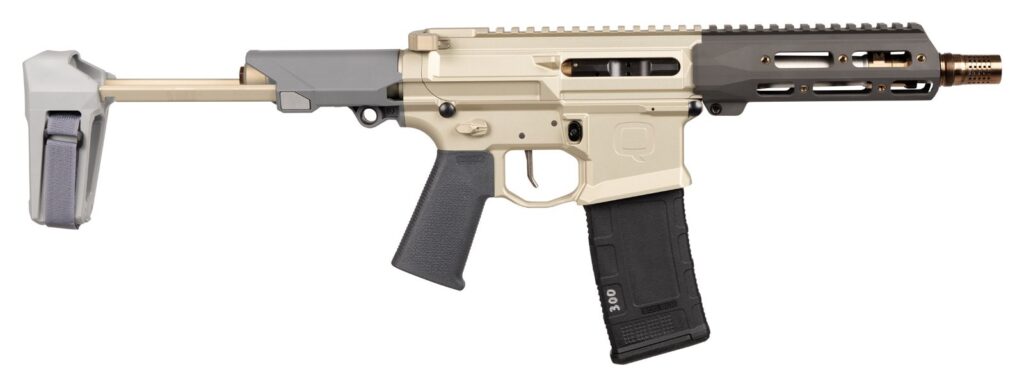
The 8.6 needs an AR-10-size rifle. Shooting Times notes that a standard .308 bolt works with it. An AR-10 or a .308-size bolt gun converts with a barrel swap. Q calls the Boombox “our compact AR-10 chambered in 8.6 BLK,” takes SR-25 pattern magazines and sells it with 8-, 12- and 16-inch barrels. CMMG builds the Banshee Mk3 8.6 BLK on its Mk3 receiver, which CMMG describes as AR-10 size and based on the LR-308/DPMS Gen 1 high-pattern design, with a 12.5-inch barrel and a 20-round Magpul PMAG. Q’s Fix bolt action changes between .308, 6.5 Creedmoor and 8.6 BLK by swapping barrels.
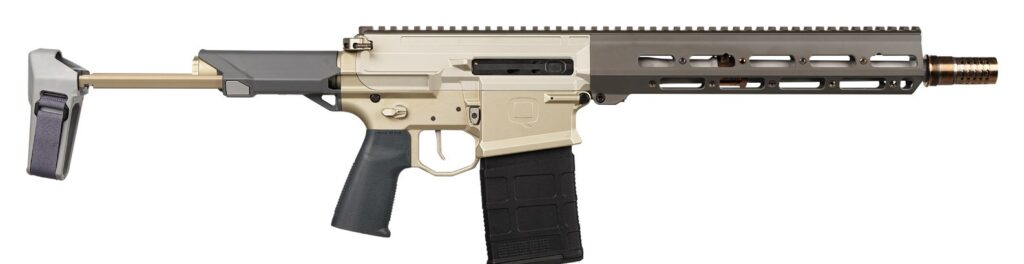
The makers’ own weights show the size step, though the 8.6 guns here also carry longer barrels. Q lists the 7-inch Honey Badger pistol at 4 lb 8 oz and the 12-inch Boombox pistol at 5 lb 8 oz. CMMG lists the 6.5-inch Dissent Mk4 in 300 BLK at 4.8 lb and the 12.5-inch Banshee Mk3 8.6 BLK at 7.4 lb.
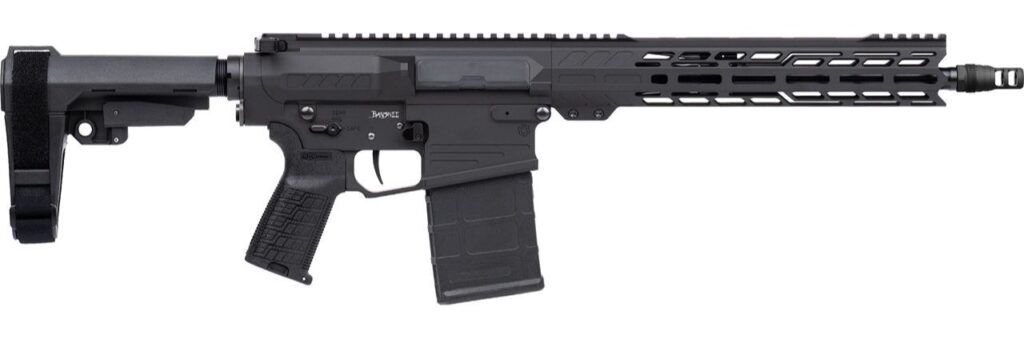
The Banshee is a good gun. Soft-shooting, decent AR-ish gun. The Boombox is a whole different class. It’s superlight, still soft-shooting, and looks and feels great. Far less recoil than an AR-10 in .308 and dead quiet suppressed.
Factory ballistics: maker figures
The table below uses factory loads only. Every velocity is the maker’s own, and so is every energy figure but one, which is marked. The 300 BLK figures and the 8.6 supersonic figures are from Barnes. Barnes publishes no velocity for its 8.6 subsonic load. That row uses Underwood’s published figures for a 300-grain subsonic load. Barrel lengths differ between rows. These are factory figures for comparison. Handloaders should work from a current published manual.
| Load | Velocity | Energy | Barrel |
|---|---|---|---|
| Barnes VOR-TX 300 BLK, 110 gr TAC-TX | 2,350 fps | 1,349 ft-lb | 16 in |
| Barnes Suppressor Series 300 BLK, 220 gr Sierra MatchKing | 1,060 fps | 549 ft-lb | 16 in |
| Barnes VOR-TX 8.6 BLK, 200 gr TAC-TX BT | 2,200 fps | about 2,150 ft-lb* | 16 in, 1 in 3 |
| Barnes VOR-TX 8.6 BLK, 200 gr TAC-TX BT | 2,065 fps | 12 in, 1 in 3 | |
| Barnes VOR-TX 8.6 BLK, 200 gr TAC-TX BT | 1,815 fps | 8 in, 1 in 3 | |
| Underwood 8.6 BLK subsonic, 300 gr hollow point boat tail | 950 fps | 601.6 ft-lb | 12 in |
From the same 16-inch barrel length, Barnes’ 200-grain 8.6 load carries roughly 60 percent more muzzle energy than its 110-grain 300 BLK load, by our arithmetic from Barnes’ published velocity. The 8.6 also loses speed in short barrels: Barnes’ figures drop 385 fps between the 16-inch and 8-inch barrels. The 12-inch row matches my Boombox. Barnes lists its 300 BLK figures from a 16-inch barrel only, 1.5 inches longer than the barrel on my Dissent.
The subsonic gap is smaller. Every subsonic load is held under the speed of sound, which Firearms News gives as 1,126 fps in dry air at 68 degrees F. At equal speed, energy rises with bullet weight. The 300-grain 8.6 bullet is about 36 percent heavier than the 220-grain 300 BLK bullet, and Richard Mann puts the 8.6’s subsonic energy advantage at “around 36 percent.” The two subsonic loads in our table run at different speeds from different barrels: Underwood rates its 300-grain load at 950 fps from 12 inches, and Barnes rates its 220-grain load at 1,060 fps from 16 inches. Their listed energies differ by only about 10 percent. For supersonic loads, Mann gives the 8.6 “50-percent more energy than the .300 BLK.”
Suppressed shooting
Both cartridges were built to fire subsonic loads through a suppressor as well as supersonic loads, and the subsonic side works only if the gun cycles with it. In a 2013 test for Shooting Illustrated, two 300 BLK rifles without adjustable gas blocks cycled subsonic loads only 50 to 60 percent of the time, and Richard Mann advised an adjustable gas block for anyone running both kinds of ammunition. The Q and CMMG gas guns named here all have one: Q’s Honey Badger, Sugar Weasel and Boombox, and CMMG’s Dissent and Banshee 8.6. The Henry needs none, since its action is worked by hand.
Brittingham told Outdoor Life that the 8.6’s subsonic loads are just as quiet as 300 BLK with better terminal performance. That is his claim, and we have found no published independent sound test that compares the two.
Both perform superbly well. All of the Q weapons come pretty close to achieving “movie quiet.”
The suppressor has to fit the bullet. Q rates its cans by caliber: its Tall Boy is listed for 7.62 mm, and its Long Chop and all-steel Porq Chop for 8.6 BLK. A .30-caliber can is the wrong can for an 8.6. Check the maker’s caliber rating before you mount one. Thread pitches differ too. The 300 BLK guns named here, as their makers list them, use 5/8×24, as does the CMMG Banshee 8.6, while the Boombox uses M18x1.5 with Q’s Cherry Bomb XL muzzle device, which Q says the Porq Chop mounts on. Our guides to multi-caliber and dedicated suppressors, suppressor mounting systems and buying your first suppressor cover the rest.
Hunting with either cartridge
Barnes classes its 110-grain 300 BLK TAC-TX for medium game and its 200-grain 8.6 BLK TAC-TX for big and medium game. For the 8.6 bullet, Barnes claims about 1.8 times diameter expansion down to 1,400 fps from a 1 in 3 barrel.
The longer-range claims come from the 8.6’s backers and reviewers. Brittingham told Outdoor Life that some subsonic loads were shooting 1 MOA at 300 meters, “which is where we think the max is for subsonic hunting,” and that he had killed four Cape buffalo with supersonic loads at 9 to 40 yards. Shooting Times calls the supersonic 8.6 “a legitimate 450-yard hunting cartridge” and says the 300 BLK “maxes out at about 200 yards.” Treat those as their judgments, and check your state’s rules on cartridges for big game before you hunt with either.
Safety notes
- Some 300 BLK loads will chamber in a .223 Remington or 5.56 NATO rifle. Shooting Illustrated warns that if that happens and you fire it, “disaster can follow.” Keep 300 BLK magazines and ammunition clearly marked and apart from 5.56.
- In a 1 in 3 twist 8.6 barrel, use supersonic loads with solid copper or bonded bullets, per Shooting Times.
- Mount only a suppressor rated by its maker for 8.6 BLK or a larger bore on an 8.6 gun.
The common 8.6 Blackout comparisons
8.6 Blackout vs .308 Winchester
The two share a bolt face, a maximum average pressure of 62,000 psi and the same 2.810-inch maximum overall length on SAAMI’s drawings. The .308 case is longer, 2.015 inches against 1.685, and SAAMI tests it in a 24-inch barrel, where its 150-grain reference load runs 2,900 fps. The 8.6 is standardized in a 16-inch barrel with a 200-grain bullet at 2,200 fps, and Q designed it from the start to fire subsonic loads as well. Our .308 Winchester page has the full story of that cartridge.
8.6 Blackout vs 6.5 Creedmoor
The 6.5 Creedmoor is the 8.6’s parent case. SAAMI gives the Creedmoor a 1.920-inch case and a 2.825-inch maximum overall length, at the same 62,000 psi. Q shortened it to 1.685 inches and opened the neck to take a .338 bullet. The Creedmoor fires a .264 bullet and is built for long-range supersonic shooting; the 8.6 trades that reach for heavy bullets, short barrels and subsonic use. Our 6.5 Creedmoor page covers the parent.
8.6 Blackout vs 338 ARC
The 338 ARC comes from Hornady, which supplies SAAMI’s reference ammunition for it, and SAAMI’s drawing is dated January 19, 2025. It is the same .338 caliber as the 8.6, with a .338-inch groove diameter, but it is sized for the AR-15. SAAMI sets a 2.260-inch maximum overall length, the same as the 300 BLK, and a 52,000 psi maximum average pressure. Its reference load is a 175-grain bullet at 2,050 fps from a 16-inch, 1 in 8 barrel. The 338 ARC is the .338 for AR-15 owners; the 8.6 is the .338 for AR-10 owners. CMMG sells rifles in both.
8.6 Blackout vs .458 SOCOM
The .458 SOCOM is a .45-caliber AR-15 cartridge built on a rebated .50 Action Express case, created in 2001 according to Shooting Illustrated. It needs a new barrel, a new bolt and a new magazine follower, and Shooting Illustrated gives it a 300-grain bullet at 1,900 fps. It has no SAAMI standard: Shooting Illustrated says it “is not SAAMI approved,” and it does not appear in SAAMI’s 2025 rifle standard or its list of newly accepted cartridges as of November 2026.
8.6 Blackout vs .45-70
The .45-70 Government is the Army’s rimmed cartridge of 1873, at home today in lever actions and single shots. SAAMI’s maximum average pressure for it is 28,000 psi, less than half the 8.6’s figure. The two overlap on heavy bullets at modest speed and fit entirely different rifles. See our .45-70 Government page for its history.
Which one to choose
If you already run AR-15s and want a .30-caliber bullet with a suppressor, the 300 BLK needs only a barrel, uses your magazines and has fifteen years of guns and factory loads behind it. If you want a heavier bullet at both speeds and accept an AR-10-size rifle or a .308-size bolt action, the 8.6 is the step up. It is also the newer cartridge. Its SAAMI standard is less than a year old, and Barnes’ two loads are new for 2026.
If you can afford weapons by Q, do it. They’re the ultimate machines. Feel great, look great, unusual and effective operating systems. If you can’t, there are plenty of great .300 BLK platforms at the low end of the market. 8.6 is wonderful, but your initial firearm purchase will shortly seem trivial when compared to the cost of ammunition.
Where to buy
Guns, each linked to a current new listing at Guns.com:
- Q Honey Badger, 300 BLK, 7-inch pistol
- Q Sugar Weasel, 300 BLK, 7-inch pistol
- Q Mini Fix, 300 BLK, 8-inch bolt-action pistol
- CMMG Dissent Mk4, 300 BLK, 6.5-inch pistol
- Henry Lever Action Supreme, 300 BLK, 16.5-inch (Model H023-300)
- Ruger American Generation II Ranch, 300 BLK, 16.1-inch (Model 46920)
- Q Boombox, 8.6 BLK, 12-inch pistol
- Q Boombox, 8.6 BLK, 16-inch rifle
- CMMG Banshee Mk3, 8.6 BLK, 12.5-inch pistol
Factory ammunition from the table, at MidwayUSA:
- Barnes VOR-TX 300 BLK, 110-grain TAC-TX
- Barnes Suppressor Series 300 BLK subsonic, 220-grain Sierra MatchKing
- Barnes VOR-TX 8.6 BLK, 200-grain TAC-TX
- Barnes Suppressor Series 8.6 BLK, 300-grain Sierra MatchKing
More on Powder & Lead
For the older cartridge on its own, see our 300 Blackout page. For the legal side of suppressors, see suppressors vs solvent traps.
Sources
- SAAMI, ANSI/SAAMI Z299.4, Voluntary Industry Performance Standards for Centerfire Rifle Ammunition (2025): 300 AAC Blackout, 308 Winchester, 6.5 Creedmoor and 45-70 Government drawings, pressure and velocity tables, test barrels.
- SAAMI, New Cartridge and Chamber: 8.6 BLACKOUT, drawing issued January 19, 2026, and SAAMI Announces Acceptance of New Cartridges, January 29, 2026.
- SAAMI, New Cartridge and Chamber: 338 ARC, drawing issued January 19, 2025, and Newly Accepted Cartridge and Chamber Designs.
- Q, LLC, product pages for the Boombox, Boombox 12″ pistol, Honey Badger, Sugar Weasel 7″ 300 BLK, Mini Fix 8″ 300 BLK, The Fix and silencers, read November 24, 2026, and Porq Chop, read November 27, 2026.
- CMMG, Pistol, BANSHEE, Mk3, 8.6 BLK, 12.5″ and Pistol, DISSENT, Mk4, 300BLK, 6.5″, read November 24, 2026, and Rifle, DISSENT, Mk4, 300BLK, 16.1″, read November 27, 2026.
- Ruger, Ruger American Rifle Generation II Ranch, Model 46920, read November 24, 2026.
- Henry Repeating Arms, H23 Lever Action Supreme Rifle (LASR), and FightLite Industries, SCR and SCR 300BLK Raider Pistol, read November 24, 2026.
- Barnes Bullets, Centerfire Rifle Ballistics chart; VOR-TX 8.6 BLK 200 gr TAC-TX BT; Suppressor Series 8.6 BLK 300 gr SMK; VOR-TX 300 AAC BLK 110 gr TAC-TX.
- Underwood Ammo, 8.6 Blackout 300gr Hollow Point Boat Tail.
- David M. Fortier, “The History of the 300 AAC Blackout Cartridge,” Firearms News, October 9, 2024, with Robert Silvers’ account in his own words.
- Richard Mann, “The New Black,” Shooting Illustrated, December 16, 2013.
- Jay Langston, “.300 Blackout Load Development Insights,” Athlon Outdoors.
- Richard Mann, “Ammo: 8.6 Blackout Review,” Shooting Illustrated, May 4, 2025, and “Ammo: .458 SOCOM,” Shooting Illustrated, January 25, 2026.
- Scott Einsmann, “8.6 Blackout,” Outdoor Life, December 2, 2022, with Kevin Brittingham’s quotes.
- Cody Eardley, “The 8.6 Blackout: New King of the Subsonic Cartridges?” Shooting Times, April 17, 2024.
- Adam Scepaniak, “[SHOT 2022] 8.6 Blackout: Discreet Ballistics, Q, and Faxon Firearms,” AllOutdoor, January 19, 2022.
- National Park Service, Springfield Armory National Historic Site, The Trap Door Rifle.
- Guy J. Sagi, “SAAMI Accepts and Standardizes Two New Cartridges,” American Rifleman, February 15, 2026.
If you know of any forums or sites that should be referenced on this listing, please let us know here.