The Browning SA-22 is a small takedown .22 rifle with its magazine in the buttstock and its empty cases thrown out through the bottom of the receiver. John Moses Browning applied for the patent in November 1912, and Fabrique Nationale (FN) began building the rifle in Belgium in 1914. Remington made its own versions in the United States from 1922 to about 1951. Browning has sold it under its own name since 1956, and Miroku in Japan has built it since the mid-1970s. More than half a million have been made, and Browning still lists five models.
For the life of the man who designed it, see our biography of John Moses Browning, who died at FN’s works in Herstal on 26 November 1926.
The Browning SA-22 patent of 1914
Browning filed the application for the rifle on 19 November 1912. The U.S. Patent Office granted it on 6 January 1914 as patent 1,083,384, titled simply “Firearm.” The printed specification names him as John M. Browning of Ogden, Utah. Browning’s company timeline gives the same day, 6 January 1914, as the day the patents were granted and production began.
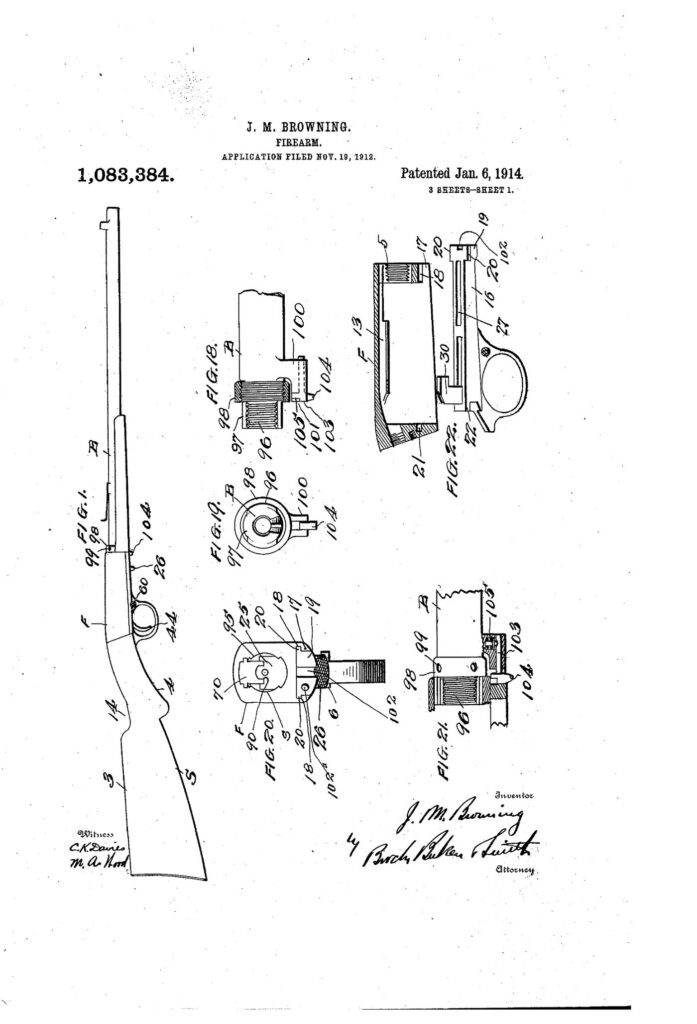
The patent states its purpose plainly. “The principal object of my invention is to simplify and improve the construction of guns of this class and to arrange the parts so that the user is protected from gases and flying particles while firing.” It adds that the mechanism is “particularly adapted to the use of rim fire cartridges.”
Two related patents were filed on 20 March 1913 and granted on 24 June 1913, before the main one. One of them, 1,065,341, covers the “take-down construction” that lets the rifle come apart in two halves. A third, 1,202,024, was filed on 18 August 1914 and granted on 24 October 1916. It modifies the 1914 design “to adapt the mechanism there shown to the use of a more powerful cartridge, such, for instance, as a 22 caliber, long cartridge.” The stronger cartridge called for a heavier breech-block, and Browning rearranged the trigger plate, sear and connector to make room for it.
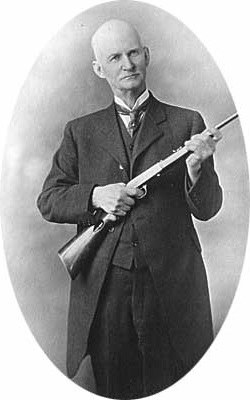
FN builds the rifle, 1914 to 1974
Browning’s long partnership with FN made the Belgian company the natural maker. FN had built his pocket pistols since 1899 and the Auto-5 shotgun since 1903 (see our history of FN Herstal). According to the Historical Breechloading Smallarms Association (HBSA), FN obtained the manufacturing rights “for Europe and for most of the rest of the world in 1914,” and production started that year. Rock Island Auction gives FN’s early names for it as the FN Browning 1914, or “The FN .22 Caliber Automatic Rifle.”
The war interrupted it almost at once. Germany invaded Belgium in August 1914, and the HBSA says production stopped “almost immediately for the duration of the First World War.” The Armourer’s Bench, a British collector site, says it began again in 1919 and ran until the Second World War interrupted it a second time.
The first rifles differed from later ones in two ways that collectors look for. The magazine was loaded through a port on top of the stock, just behind the comb, exactly as the patent drawings show. American Rifleman, the HBSA and Rock Island Auction all report that the port was later moved to the side of the stock, and American Rifleman says it was soon moved to the right side. The HBSA says the move raised the capacity from eight .22 Long Rifle cartridges to eleven. Early rifles also had a rear sight adjusted by a small wheel, later replaced by a simple folding leaf.
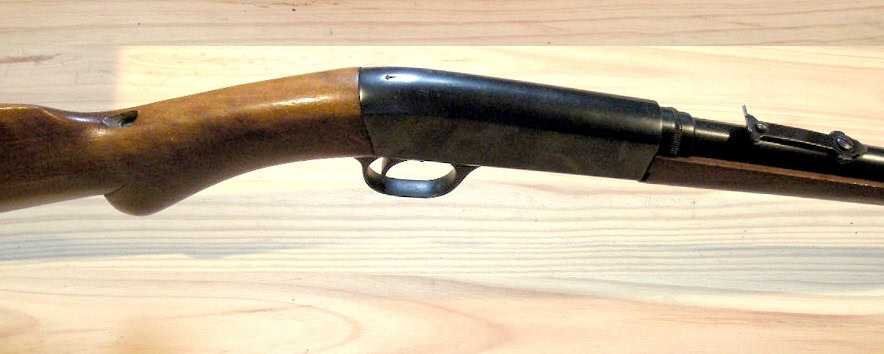
FN sold the rifle across Europe. The HBSA notes that many served as shooting-gallery rifles, often firing frangible bullets with little cleaning. Browning’s own dating guide covers FN production from 1914 to 1955 with a single line: “No serial numbers are available.”
Remington’s licensed Model 24 and Model 241
FN did not sell the rifle in the United States for more than forty years. Rock Island Auction describes a long-standing arrangement that kept FN largely out of the American market and Remington out of Europe. The HBSA records that Remington held the American manufacturing rights.
The Remington Model 24, 1922 to 1935
Remington introduced the Model 24 in 1922, four years before Browning’s death. The first rifles were chambered only for the .22 Short. Rock Island Auction quotes a Remington advertisement that called it “A Browning achievement” and “the only auto-loading rifle chambered for the regular .22 short cartridges.” A .22 Long Rifle version followed.
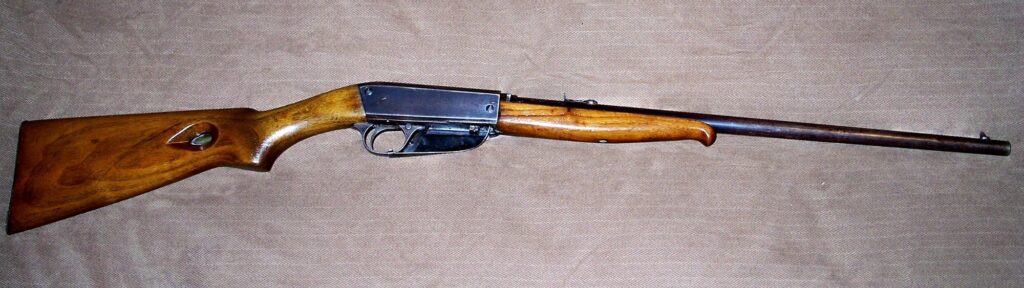
Remington changed details. American Rifleman says it was lighter than the FN rifle, used a modified headspace adjustment for takedown and reassembly, and offered a shell deflector that hooked into the receiver and clipped to the trigger guard to keep hot cases off the shooter’s supporting arm. John Gyde of the Remington Society of America puts production at “slightly over 130,000” between 1922 and 1935. One owner’s post in the society’s forum reports a Model 24 marked with a Browning patent date of 24 October 1916, the grant date of the heavier-cartridge patent.
The Remington Model 241 Speedmaster, 1935 to 1951
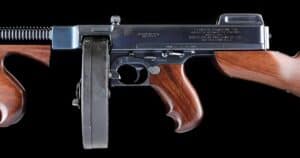
John Gyde and Roy Marcot wrote the history of the replacement for the society’s journal in 2010, using Remington’s archive records. Remington designer Crawford C. Loomis began work on an improved Model 24 in January 1935. The new Model 241 shipped in August 1935, seven months later. Remington’s first advertising called it “a man-sized gun” and said it was bigger, heavier and better than the Model 24. Because Remington treated it as a product improvement, royalties continued to be paid to Browning’s company.
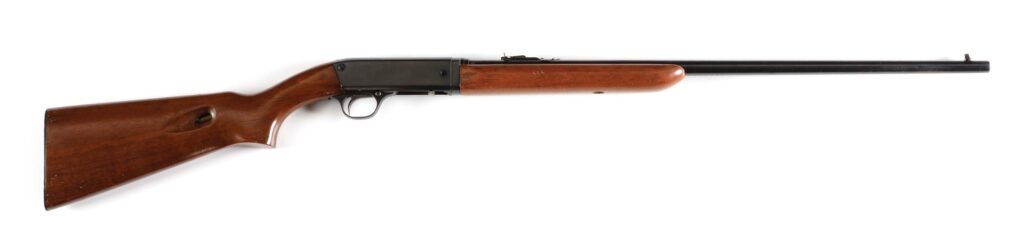
The 241 had a 24-inch barrel and a larger stock and forend. Its interrupted threads had three raised sections instead of the Model 24’s two, and the takedown button moved from the bottom of the receiver to the left side. Remington’s announcement letter of 21 June 1935 listed five grades: Standard, Special, Peerless, Expert and Premier, each in .22 Short or .22 Long Rifle, which were not interchangeable. A sixth grade, the B, was added in early 1940. The “Speedmaster” name and the Remington logo were added to the receiver in 1936.
The Model 241 was popular in shooting galleries in the late 1930s and 1940s. The Remington Society reports that a LIFE magazine cover in 1940 showed Yuen Chong Chan, whom it describes as the first man drafted into the U.S. Army, practicing his aim at a shooting gallery that used Model 241 gallery rifles. Between 1942 and 1945 Remington supplied 7,658 Model 241s to the U.S. government.
Remington’s archive table ends in 1951 with a running total of 107,345 rifles. Gyde and Marcot warn that the records grow unreliable after 1946 and that serial numbers above 132,000 have been seen. In their words, “larger quantities are possible.” The Model 550 replaced the 241, and the end was confirmed when Remington authorized scrapping the remaining tooling on 28 January 1955. Together, Gyde’s figure for the Model 24 and the factory table for the 241 come to about 237,000 Browning-designed autoloaders.
Browning brings the SA-22 to America, 1956
Browning’s company timeline lists a single line for 1956: “22 Semi-Automatic rifle introduced.” Its dating guide says the rifle “was officially imported by Browning in 1956.” The HBSA says the imports began after Remington’s manufacturing rights expired and that all of them had receivers grooved for scope mounts. The history of the importer itself is in our account of the Browning Arms Company.
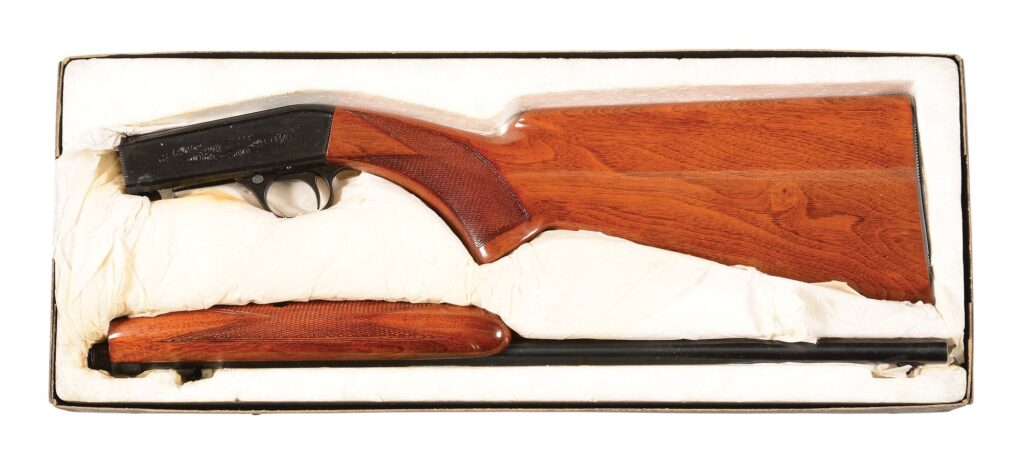
The imported rifles carry serial numbers that tell the year and the cartridge. Browning’s guide gives the codes: T for .22 Long Rifle and E for .22 Short, with a one-digit year added from 1961 (8T1000 is a 1968 Long Rifle) and a two-digit year from 1969 (69T1000). The HBSA adds that the Short code was A before it became E.
Miroku and the move to Japan
Browning began working with Miroku in Japan in 1965, according to its timeline. The date the SA-22 moved there depends on the source:
- Browning’s dating guide: “In 1974, production of the 22 Semi-Auto was moved to Miroku, Japan.” It also warns that on “many Miroku guns from 1973-75 and part of 76, the year was reversed in the serial number,” so 1000T47 is a 1974 rifle.
- The HBSA: FN built it in Herstal until 1974, and production resumed in Japan in 1976.
- American Rifleman (2019): Miroku has made them for Browning “since 1974.”
- The Armourer’s Bench: “all Browning production shifted to Japan in 1976.”
Other Browning guns made the same move. The company timeline puts the Auto-5 shotgun’s move to Japan in the latter part of 1976. In 1976 Browning also standardized its serial numbers. American Rifleman’s Dave Campbell, who owned a Miroku rifle from about 1979, judged that “the quality is awfully close to the FN guns.” The visible difference is in the engraving. The HBSA says Belgian engraving was cut by hand, while Japanese engraving is “machine initiated, including use of laser cutting, with finishing by hand.”
How the SA-22 works
The rifle is a simple blowback. Nothing locks the breech. The weight of the bolt and the recoil spring hold it closed while the low-powered rimfire cartridge fires. The feed, the ejection and the takedown are where Browning’s design departs from other .22 autoloaders.
Feeding from the stock
The magazine is a tube inside the buttstock. To load it, the shooter unlatches the inner tube at the buttplate and draws it back, drops cartridges in through the loading port, and pushes the tube home. Today’s rifles hold 10 rounds of .22 Long Rifle. American Rifleman gives 16 for the .22 Short.
The patent describes the path from there. Cartridges travel forward through a channel in the top of the receiver, above the bolt. At the front of that channel, a guide cams each cartridge downward while keeping it level, until its base drops in front of the bolt face. The bolt then runs forward and pushes it into the chamber.
Ejecting through the bottom
The extractor grips the underside of the cartridge rim. When the bolt comes back after firing, the top of the case head strikes fixed lugs, and the case is, in the patent’s words, “snapped sharply downward and the shell forcibly thrown through slot 27 to the ground.” That slot in the bottom of the receiver is the only opening the patent allows, apart from the sockets for the barrel and the magazine tube. The cocking handle is a small lug on the bolt that sticks down through the same slot.
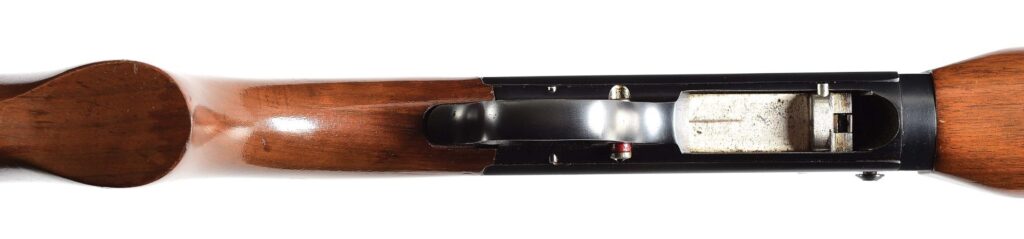
The receiver therefore has no side port. Browning’s patent says the solid top, sides and back “protect the user of the gun from explosion gases or flying particles which might otherwise strike his face,” and FN’s brochures promised “complete protection of the user from hot powder gases or defective cartridges,” as quoted by the HBSA. The HBSA’s writer adds from experience that a hot case can still go down the shooter’s sleeve. Because the brass goes straight down, the rifle works the same for left- and right-handed shooters. The safety is a cross-bolt at the front of the trigger guard.
Taking it down
The takedown needs no tools. American Rifleman, the HBSA and Rock Island Auction describe the same steps. Ease the bolt back about a quarter of an inch so the extractor clears, push the barrel lock under the forend forward, turn the barrel a quarter turn, and pull it out of the receiver. Each half then measures 19 3/8 inches, according to Browning. The barrel can be cleaned from the breech, and the firing mechanism comes out of the receiver without tools.
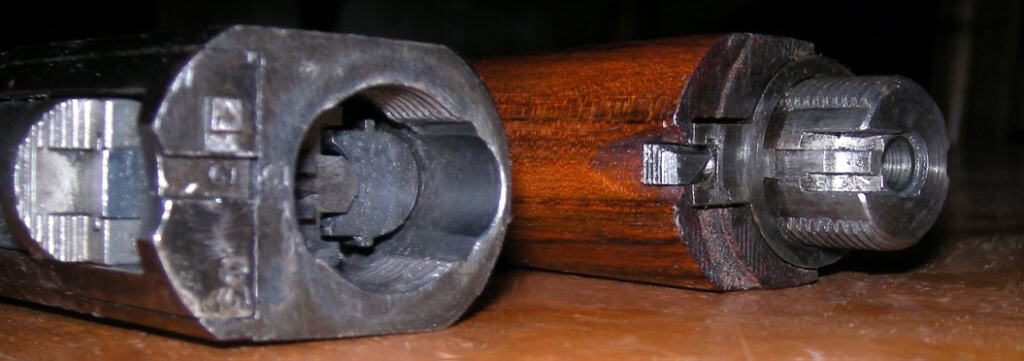
Browning expected a takedown rifle to work loose with use, and the 1913 takedown patent deals with it directly. A nut with teeth around its edge is screwed onto the barrel threads. A sliding barrel lock engages those teeth so the nut cannot turn, and the forend keeps the lock from sliding out of engagement. “If the barrel ever becomes loose in the frame for any reason, it can be tightened” by removing the forend, sliding the lock clear and turning the nut to take up the play. Browning’s current description of the rifle says the same thing in modern terms: “The knurled knob on the barrel half allows any play between the receiver and barrel to be removed.”
Grades and variants
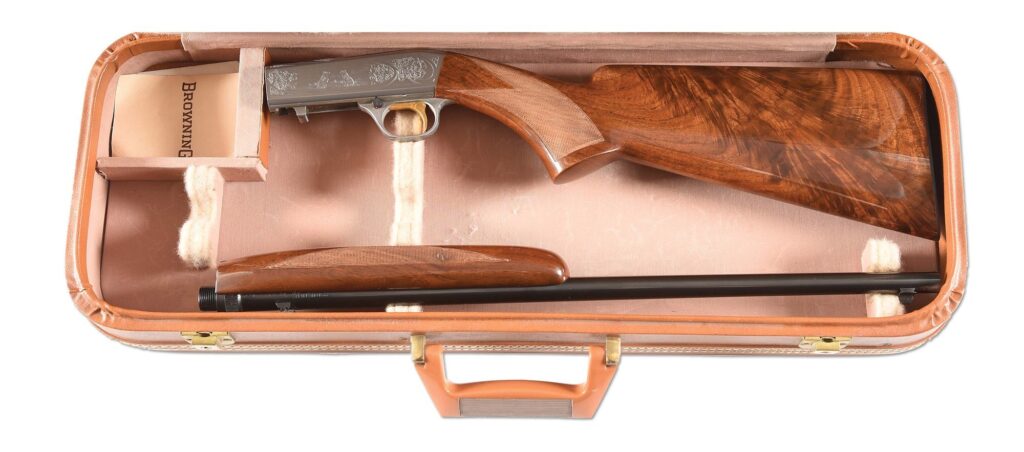
The flat-sided receiver with no ejection port leaves a large surface for engraving, and the rifle has always been sold in grades. The Belgian rifles sold by Browning came in three grades:
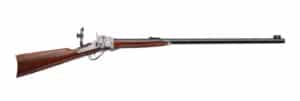
- Grade I: blued receiver with light scroll and border engraving, checkered walnut. A circa 1962 example sold at Morphy Auctions also had a receiver grooved for dovetail scope mounts.
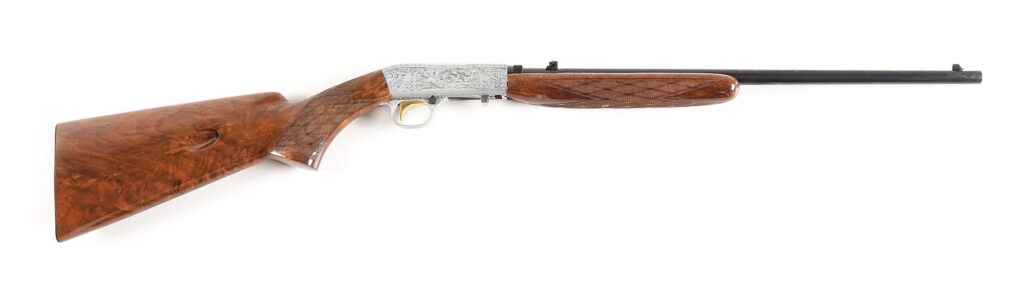
- Grade II: a grayed receiver engraved with game scenes, as on the 1969 rifle above, with better walnut.
- Grade III: fuller game-scene engraving signed by the engraver. The rifle at the top of this page is signed by L. Lambert.
I own one of the older Belgian-made rifles, and it is a beautiful and elegant gun.
The HBSA counts six grades in all, with the higher ones adding gold inlay and carved wood. Browning’s timeline adds the Grade VI in 1987. Two Miroku-era models are no longer in Browning’s catalogue. The SA-22 Challenge, introduced in 2021, had a 16 1/4-inch bull barrel fitted with a factory muzzle brake, a raised-comb walnut stock and a Picatinny scope base, according to American Hunter. The AAA Maple, Browning item 021022102, paired a satin nickel engraved receiver with an AAA maple stock, as retailer listings under that item number describe it.
The rifle was also copied. Norinco in China made a close copy, imported to the United States by Interarms as the Model ATD. American Rifleman says it “was a victim of the Clinton import ban.”
Record vs legend
Several claims about the SA-22 are repeated so often that they read as settled. The record does not always support them.
“The first semi-automatic .22”
Browning’s rifle was not the first. American Rifleman points out that Winchester’s Model 1903, designed by Thomas C. Johnson, was already on the market as a rimfire autoloader, chambered for its own .22 Winchester Automatic cartridge. The careful form of the claim is that Browning’s was “the first widely produced semi-automatic rifle chambered in .22 LR,” as Rock Island Auction puts it. American Rifleman makes the same claim, and the HBSA calls it the first production semi-automatic .22 rifle without naming the cartridge. Two records complicate even that. Browning filed a patent in August 1914 to adapt the mechanism to “a more powerful cartridge,” and Remington’s first Model 24s of 1922 took only the .22 Short.
“Patents filed in March 1913”
The Armourer’s Bench says the patents were filed in March 1913 and granted in January 1914. The scans show the main application was filed on 19 November 1912. The March 1913 filings were the takedown and related patents, and they were granted in June 1913, before the main patent.
Left-handed shooters
The rifle’s appeal to left-handed shooters is usually credited to the bottom ejection alone. Browning’s patent shows he had them in mind from the start. He wrote that the top loading hole was placed so “that it is convenient equally to right-handed or left-handed users,” and he designed the closed receiver to keep gas and debris away from the shooter’s face.
“In continuous production since 1914”
American Rifleman wrote in 2019 that the rifle “has been in continuous production ever since” 1914, and Browning says production “began in 1914” and continues today. The record shows two long stops at FN during the world wars and a change of factory in the mid-1970s, with the HBSA placing a gap between the end of Belgian production and the start in Japan. “In production, with interruptions, since 1914” is the accurate form.
Remington’s totals
Many references give exactly 107,345 Model 241s, made from 1935 to 1951. That is the last line of Remington’s own archive table, which makes it the best single figure available. The historians who published the table say the real total may be higher, and the Armourer’s Bench says manufacture ended in 1949 with sales continuing to 1951.
The Browning SA-22 today
Browning’s catalogue lists five SA-22 models, all in .22 Long Rifle. Each has a 19 3/8-inch barrel, a 37-inch overall length, a weight of 5 pounds 3 ounces, a 10-round magazine in the stock and a 1-in-16-inch twist. Browning says the receiver is “machined from solid steel.” An optional cantilever scope base mounts to the barrel and keeps the scope with it when the rifle is taken down.
- Grade I: polished blued receiver with scroll engraving and gloss American walnut. Guns.com lists the Browning SA-22 Grade I new.
- Grade II Octagon: satin nickel receiver with scroll engraving, an octagon barrel and Grade II/III walnut. See the SA-22 Grade II Octagon at Guns.com.
- Grade VI Blued and Grade VI Grayed: game-scene engraving with 24-karat gold accents and high-grade walnut. Guns.com lists the SA-22 Grade VI Grayed.
- Grade VI Birds-Eye Maple: a 2026 SHOT Show Special with a bird’s-eye maple stock and a gold-enhanced engraved receiver.
Links to Guns.com are affiliate links, and Powder & Lead may earn a commission. For other current rifles in the same cartridge, see our guide to the best .22 LR rifles.
Further reading
Book links go to Amazon, and Powder & Lead earns a commission on qualifying purchases.
-

History of Browning Firearms: A Complete Chronicle of the Greatest Gunsmith of All Time
Purchase on Amazon -

FN… Browning Armorer to the World
Purchase on Amazon -
History of Remington Firearms: The History Of One Of The World's Most Famous Gun Makers
Purchase on Amazon -

The Guns of John Moses Browning: The Remarkable Story of the Inventor Whose Firearms Changed the World
Purchase on Amazon -

John M. Browning American Gunmaker; An Illustrated Biography of the World's Greatest Inventor of Firearms, with Full Data on the Browning Guns
Purchase on Amazon
David Miller, The History of Browning Firearms. An illustrated survey of the Browning guns.
Gene Gangarosa Jr., FN… Browning Armorer to the World (1999). A history of FN and its Browning designs.
Roy Marcot, History of Remington Firearms (2005). Marcot is co-author of the Remington Society’s Model 241 history cited above.
Nathan Gorenstein, The Guns of John Moses Browning (2021). A modern biography.
John Browning and Curt Gentry, John M. Browning, American Gunmaker (1964). The family’s illustrated biography, with data on the guns.
Sources
- U.S. patents to John M. Browning, read from the scans via Google Patents: 1,083,384 (filed 19 Nov 1912, granted 6 Jan 1914), 1,065,341 (filed 20 Mar 1913, granted 24 Jun 1913) and 1,202,024 (filed 18 Aug 1914, granted 24 Oct 1916).
- Browning: historic timeline, 22 Semi-Auto dating guide, SA-22 overview and current models.
- John Gyde and Roy Marcot, “Remington Model 241 Autoloading Rifles”, Remington Society of America Journal, 2nd Quarter 2010, with production figures from the Remington Archives.
- John Gyde, reply on Model 24 production, Remington Society of America forum.
- Dave Campbell, “A Look Back at the Browning Semi-Automatic 22”, American Rifleman, 18 July 2019.
- “FN Browning .22″ Calibre Automatic Rifle”, Historical Breechloading Smallarms Association.
- “Browning .22 Rifles”, Rock Island Auction Company.
- “John Browning’s Semi-Automatic .22”, The Armourer’s Bench, 2018.
- “First Look: Browning SA-22 Challenge Rifle”, American Hunter, 17 February 2021.
- Morphy Auctions lot descriptions: Grade I, Grade II, Grade III and Remington Model 241.
The Morphy Auctions (morphyauctions.com) catalog archive is one of the standout marketplaces for rare and historically significant American firearms. The Browning SA-22 and Remington Model 241 photography that appears in this article (the Grade I, Grade II and Grade III rifles and the Speedmaster) comes from their archive. Their sales are worth following whether you are buying, researching original Brownings and their period contemporaries, or just looking at very good firearms photography.
If you know of any forums or sites that should be referenced on this listing, please let us know here.