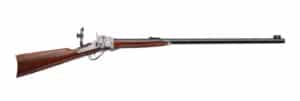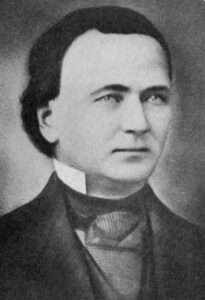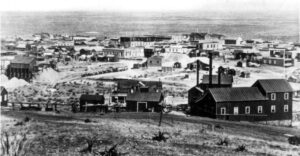
John Moses Browning died on 26 November 1926 at the Fabrique Nationale (FN) works in Herstal, Belgium, near Liège. He was 71, and 26 November 2026 is the 100th anniversary of his death. Browning was born in Ogden, Utah Territory, in 1855, the son of a frontier gunsmith. Over the next five decades he sold designs to Winchester, Colt, FN and Remington. They include lever-action rifles, pump and semi-automatic shotguns, pocket pistols, the 1911 pistol, the Browning Automatic Rifle and the machine guns the United States fought with in two world wars. Several are still in production. The company that carries his name is covered separately in our history of the Browning Arms Company.
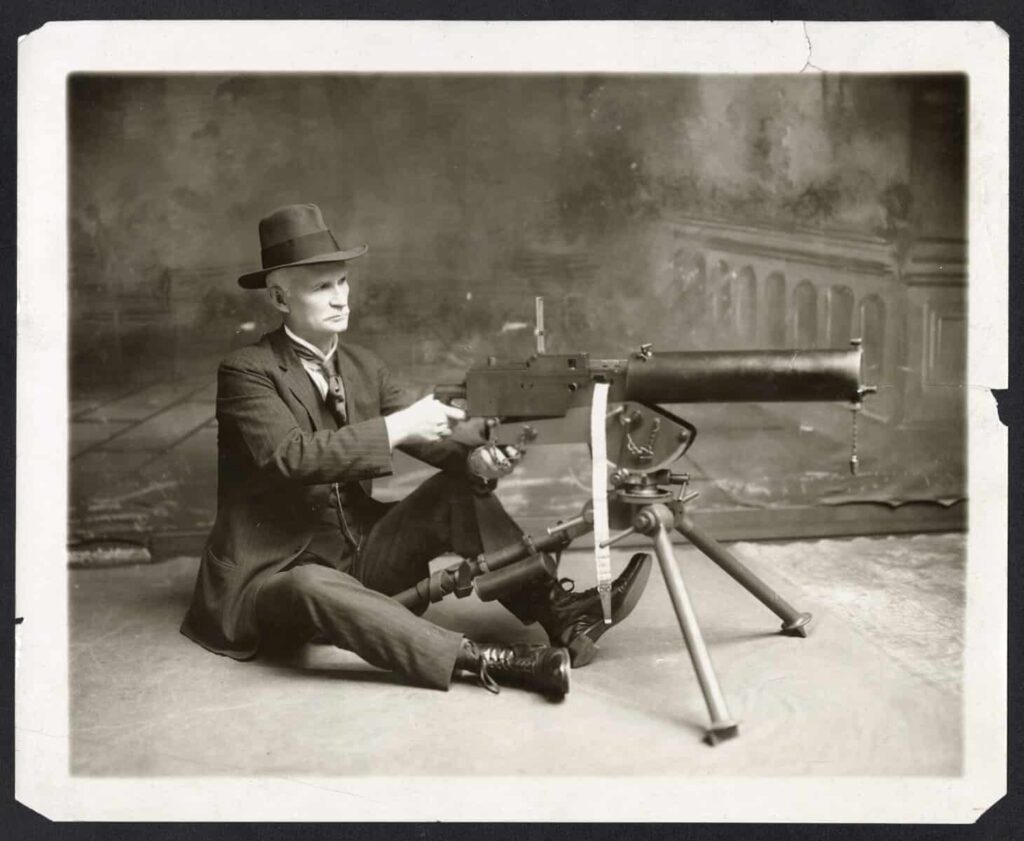
John Moses Browning’s family and boyhood in Ogden
John Moses Browning was born in Ogden on 23 January 1855. He was the second of three children of Jonathan Browning and Elizabeth Caroline Clark, according to J. Cecil Alter’s 1932 history of Utah, as quoted on Browning’s website. Jonathan had three wives, as members of the Church of Jesus Christ of Latter-day Saints sometimes did then. His 1879 obituary in the Deseret News counts twenty-two children in all.
Jonathan Browning was a gunsmith before he came west. His obituary places him in Adams County, Illinois, and then in Nauvoo from 1842. In 1849, Alter records, he advertised “revolving rifles and pistols; also slide guns, from 5 to 25 shooters.” The slide gun fed its charges from a flat bar that moved across the breech, and collectors call it the harmonica rifle. The John M. Browning Firearms Museum in Ogden displays both the harmonica rifle and one of his revolving rifles. Jonathan crossed the plains in 1852 and settled in Ogden the same year. He died there in June 1879.
John grew up in his father’s shop. The stories about his boyhood come from Browning’s company history and from accounts written after his death, and the details vary:
- Browning’s family history says that in 1865, at about age 11, he built his first gun from scrap parts and used it to shoot three prairie chickens.
- The Secretary of War’s 1926 tribute, printed in the Ogden Standard-Examiner, says that before he was 14 he “had whittled a complete gun from wood.”
- A WPA sketch typed about 1934 by Frank E. Sturdevant, now at the University of Utah and drawing on a 1926 article by Browning’s friend G. L. Becker, says that before he was 15 he had whittled “two models for small breech mechanisms out of wood” and made “several guns from odds and ends.”
The first patent and the Ogden shop
On 12 May 1879 Browning applied for a patent on a single-shot, breech-loading rifle. U.S. Patent 220,271 was granted on 7 October 1879 to “John M. Browning, of Ogden City, Utah Territory.” It was his first patent. In the same year he married Rachel Teresa Child, and his father died.
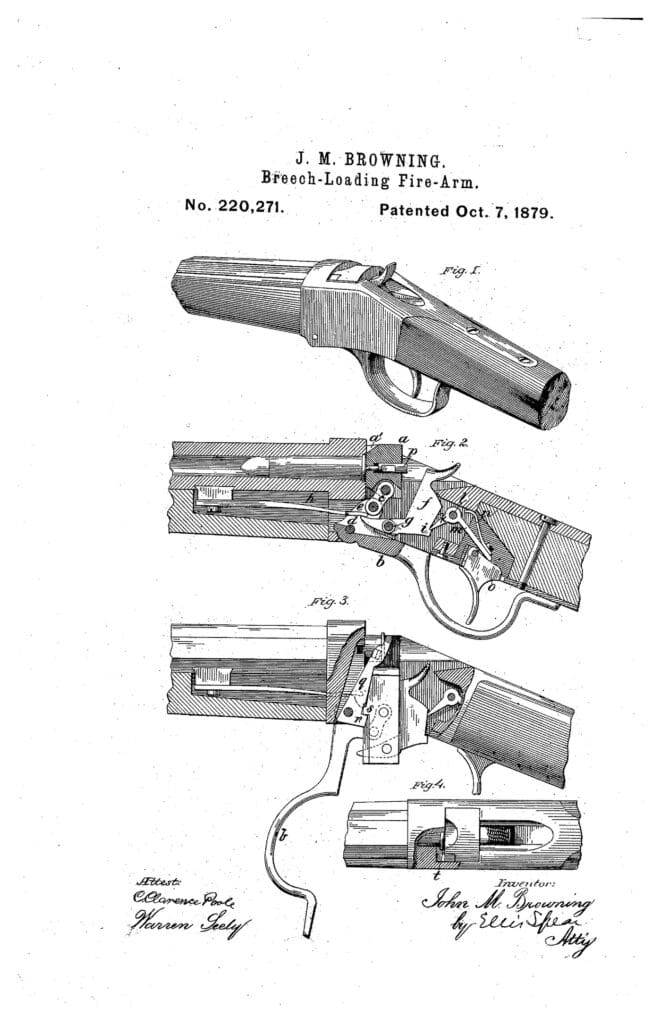
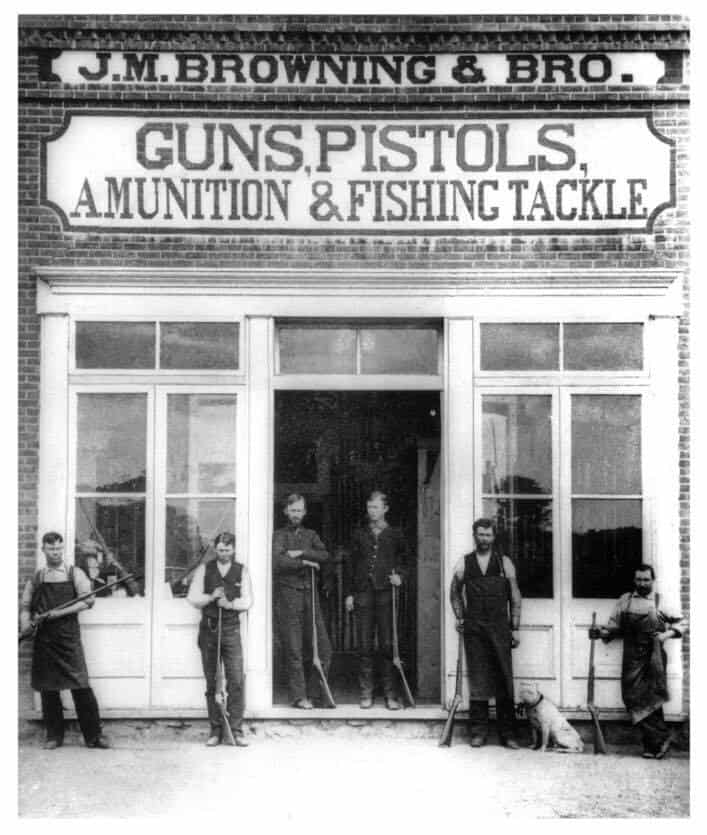
John and his brother Matthew ran the shop together. Many of the early patents name both brothers as inventors. Other brothers, among them Jonathan Edmund, Thomas Samuel and George, worked in the business as well, according to the Utah Division of State History’s History to Go. The shop built the single-shot rifle itself. The WPA sketch puts the Ogden output at “over 600 guns.”
John Moses Browning and Winchester, 1883 to 1902
In 1883 Winchester bought the single-shot rifle. Browning’s company history says Winchester’s T. G. Bennett travelled to Ogden that spring and that “a deal was quickly struck for $8,000.” The Ogden museum describes what followed as “18 years of fruitful collaboration.” Winchester made the rifle as the Model 1885.
Browning’s company history describes these sales as outright purchases, with no royalty. The NRA Museums write that Winchester bought over 44 Browning designs between 1883 and 1900, and that some were never produced. The ones it did produce include these:
- The Model 1886 lever action for large black-powder cartridges (patent 306,577, 1884). The NRA Museums put production at nearly 160,000.
- The Model 1887 lever-action shotgun (patent 336,287, 1886).
- The Model 1890 slide-action .22 rifle (patent 385,238, 1888).
- The Model 1893 slide-action shotgun (patent 441,390, 1890), strengthened in 1897 as the Model 1897. Browning puts Model 1897 production at more than 1.2 million.
- The Model 1892, a lighter lever action for revolver-size cartridges. The NRA Museums put production at over one million.
- The Model 1894 (patent 524,702, 1894), which became the .30-30 deer rifle. Browning gives production as more than 7 million.
- The Model 1895 (patent 549,345, 1895), Winchester’s first lever action with a box magazine. During World War I the Russian government bought nearly 294,000 of them, in 7.62mm, according to the NRA Museums.
Browning interrupted this work in 1887. His church called him to serve as a missionary in Georgia, according to Browning’s company history.
Colt and the first Browning machine gun
Browning began experimenting with gas operation in the fall of 1889. Browning’s company history says he fitted a flap to the muzzle of a Winchester Model 1873 to see whether the muzzle gas could work a mechanism. He filed for a patent on a gas-operated machine gun on 7 November 1892. It was granted as U.S. Patent 544,657 on 20 August 1895. Colt made the gun as the Model 1895. Its gas piston swung an arm under the barrel, which earned it the nickname “potato digger.” American Rifleman records that the Navy first used it in combat in Cuba in 1898, and that Marines used it again defending the legation compound in Peking during the Boxer Rebellion in 1900.
Browning also turned to pistols. On 20 April 1897 Browning received four pistol patents, Nos. 580,923 to 580,926. Colt sold his .38 caliber recoil-operated pistol from February 1900 as the Model 1900. Colt’s later M1902 is covered in its own article. Browning’s .32 caliber blowback design became the Colt Model 1903 Pocket Hammerless.
FN Herstal and the pocket pistols
Browning’s link with Fabrique Nationale began with a pistol contract signed on 17 July 1897, according to FN America. FN’s first Browning pistol was the .32 ACP Model 1899, refined as the Model 1900, of which FN made more than 700,000. The Model 1903 followed, then the small Model 1905 in 6.35mm (.25 ACP) and the Model 1910.
He designed the cartridges along with the guns. American Rifleman credits him with the .32 ACP, the .380 ACP and the .25 ACP, and its history of the .380 credits him with the earlier .38 Auto.
On 31 January 1914 FN marked the millionth Browning pistol with a ceremony at Herstal. The Ogden Daily Standard reported that the King of the Belgians made Browning a Chevalier of the Order of Leopold that day.
Five months later, on 28 June 1914, Gavrilo Princip shot Archduke Franz Ferdinand and his wife Sophie in Sarajevo. The Heeresgeschichtliches Museum in Vienna displays the assassins’ pistols and lists them as “Browning M.1910/12” type. The National WWI Museum identifies Princip’s pistol as an FN Model 1910 in .380 (9mm Browning Short). The museum says reference sources generally list the four pistols’ serial numbers as 19074, 19075, 19120 and 19126. It reports that the researcher Ian Howgate found the evidence lists in the Bosnian archive, and that they give Princip’s as 19075.
The Auto-5 and the break with Winchester
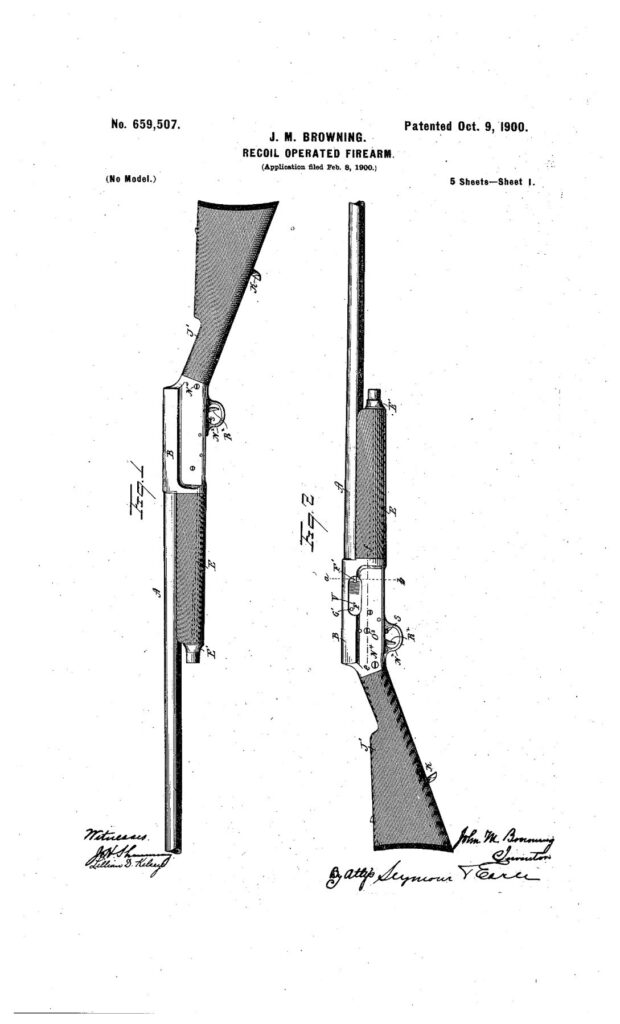
Browning applied for a patent on a recoil-operated shotgun on 8 February 1900, granted as U.S. Patent 659,507 that October. In this long-recoil design the barrel and bolt recoil together the full length of the stroke, and the barrel then returns ahead of the bolt.
This time Browning asked Winchester for a royalty instead of a single payment. Browning’s company history says Bennett “balks at the request.” Browning’s company timeline says he then arranged to meet Marcellus Hartley of Remington, and that the meeting was cancelled by Hartley’s death that afternoon, 8 January 1902. The New-York Tribune reported the next day that he died at a meeting of the American Surety Company’s executive committee. On 24 March 1902 Browning signed a contract with FN to build the shotgun with a royalty on each gun. The first Auto-5 was shipped on 17 September 1903, according to American Rifleman.
Remington did take Browning’s designs later. It made the shotgun under licence from 1905, first as the Remington Autoloading Shotgun and later as the Model 11. American Rifleman notes that Savage also made it, as the Model 720. In 1906 Remington introduced Browning’s autoloading rifle (patent 659,786), renamed the Model 8 in 1911. FN built the Auto-5 into the late 1970s before production moved to Miroku in Japan. Browning’s timeline gives 1998 as the end of production, and American Rifleman’s Auto-5 history gives 1999, the year of the Final Tribute series.
The 1911 pistol and the .45 ACP
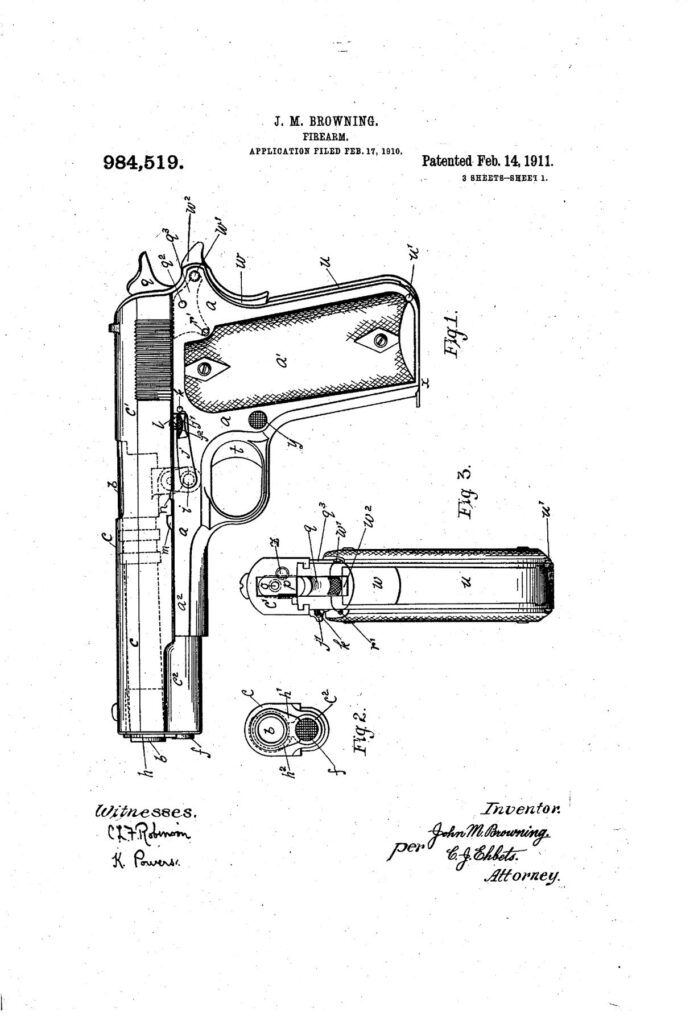
The Army wanted a .45 caliber pistol. American Rifleman notes that “the Ordnance Department specified a .45-cal. cartridge, and Browning obliged the department with a .45-cal. Model 1905 pistol.” Browning’s patent for the pistol, No. 984,519, was granted on 14 February 1911, six weeks before the Army adopted the pistol.
In March 1911 the Army put the Colt through a 6,000-round endurance test, which it passed without a failure, according to American Rifleman. The pistol and its cartridge were adopted together on 29 March 1911. Benedict Crowell, the Assistant Secretary of War, wrote in his 1919 report America’s Munitions 1917-1918 that “America owed the Colt .45 to the experiences of our fighters in the Philippines, and to the inventive genius of John Browning of machine-gun fame.” The 1911 stayed the Army’s standard sidearm until the Army adopted the Beretta 92F on 14 January 1985. In 2011 Utah named the John M. Browning-designed M1911 its state firearm.
The heavy machine gun and the BAR in World War I
Browning gave a public demonstration of his water-cooled .30 caliber heavy machine gun at Congress Heights, outside Washington, on 27 February. Browning’s timeline gives the year as 1917. American Rifleman gives 1918.
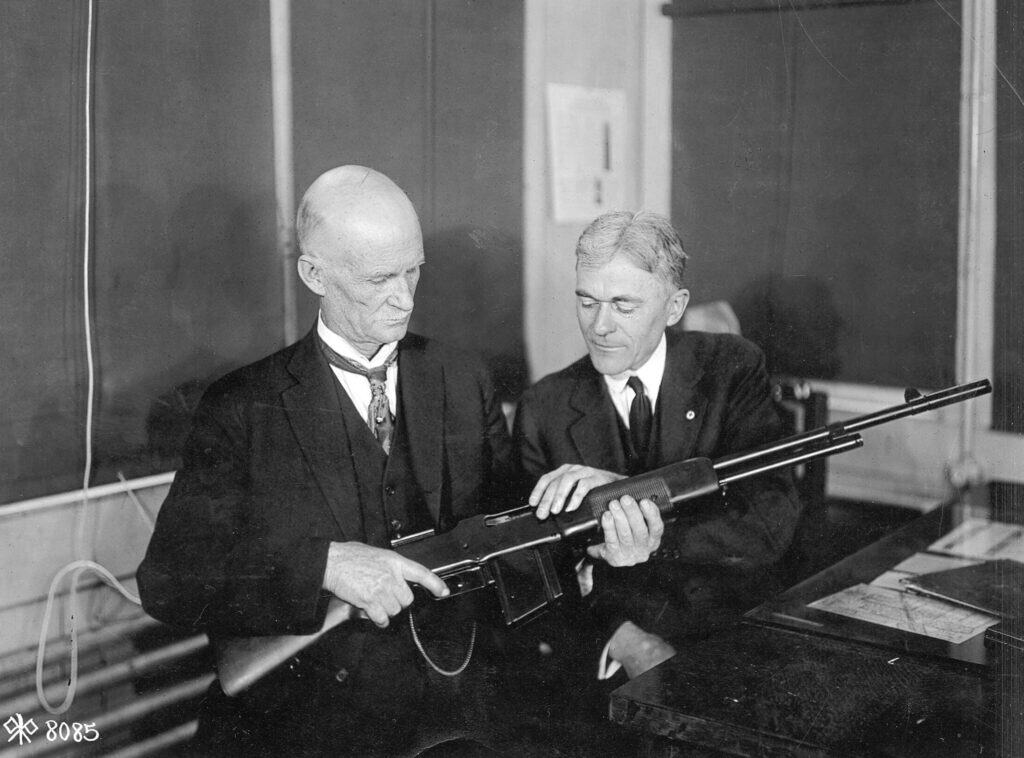
The Army tested the heavy gun and Browning’s light automatic rifle in May 1917. Crowell writes that the board “pronounced these weapons the most effective guns of their type known to the members.” American Rifleman adds two figures. In May 1917 one M1917 fired 39,500 rounds before any part broke. A later production gun fired more than 21,000 rounds in one continuous burst lasting 48 minutes and 12 seconds.
Colt held the rights to the heavy gun, but most were built elsewhere. Crowell counts about 42,000 heavy Brownings accepted by the Armistice, chiefly from Westinghouse and Remington. American Rifleman notes that the air-cooled M1919 derives much of its design from the M1917.
The light gun was the Browning Automatic Rifle. Browning applied for its patent on 1 August 1917. Crowell records that by 11 November 1918 the government had accepted 52,238 of them.
The .50 caliber gun and the M2
Browning’s family history dates the start of his .50 caliber machine gun to July 1917, at General Pershing’s request. Crowell writes: “Early in 1918 our Air Service field forces saw the need of a machine gun of larger caliber than the quick-firing weapons in general use.” For 1918, Crowell describes a different gun. The Ordnance Department took over about 1,000 Vickers machine guns at the Colt factory and modified them to fire an 11-millimeter cartridge.
Barrett Tillman, writing in American Rifleman, gives the history of the Browning gun. The Ordnance Department contracted with Winchester to design a .50 caliber cartridge, and Frankford Arsenal later took over that work. Browning, working with Colt, scaled up his .30 caliber M1917 and had prototypes ready for testing by 11 November 1918. The cartridge proved too powerful for the first design, and Browning added a buffer. After tests in 1919 and 1920 the Ordnance Department approved the gun for production as the water-cooled M1921.
The air-cooled M2 came after Browning’s death. Military Times, citing Nathan Gorenstein’s biography, says that Samuel Green, an engineer at Springfield Armory, took over development in 1927. The aircraft M2 was standardized in October 1933 and the ground gun a month later, according to the Small Arms Defense Journal. The M2 is still in U.S. service.
The last pistol: the Hi-Power
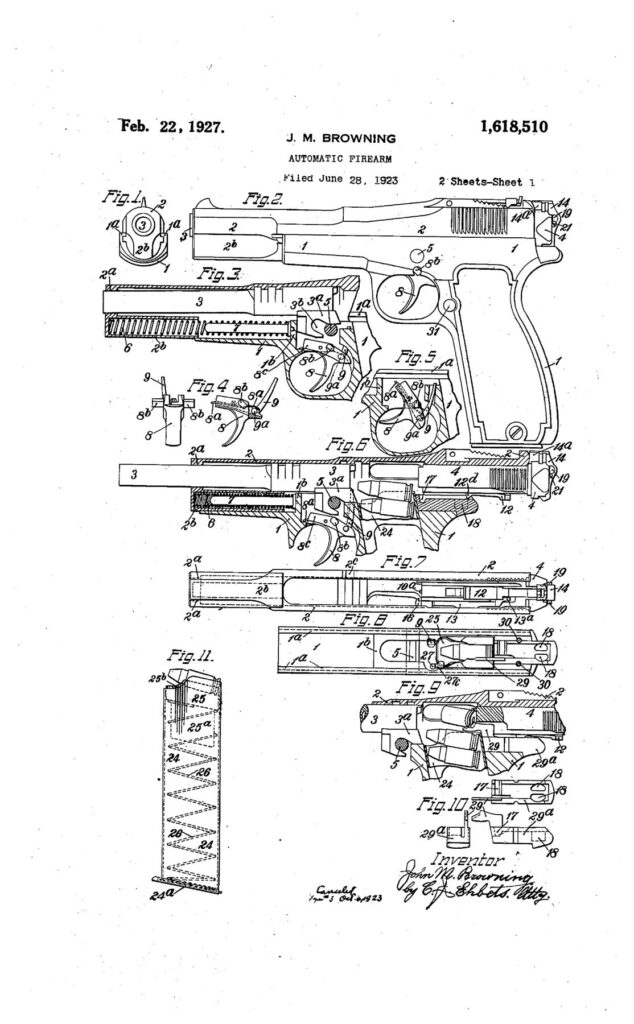
On 28 June 1923 Browning applied for a patent on a new locked-breech pistol. U.S. Patent 1,618,510 was granted on 22 February 1927, three months after his death. FN engineer Dieudonné Saive completed the design in 1934, according to FN America. The late Philip Schreier, then director of the NRA Museums, writing in Shooting Illustrated, credits Saive with the double-stack magazine and dates the first military contract, from the Belgian Army, to 1935. FN made the Hi-Power until 2018, according to American Rifleman.
John Moses Browning’s death in Herstal, 26 November 1926
His son Val Browning, his father’s liaison with FN according to Browning’s company history, was with him on the last day. Val’s account, printed in the Ogden Standard-Examiner on 11 December 1926, says the two went to Val’s office at the factory. His father then went out into the plant, where he was working on a new shotgun. He came back a few minutes later, pale, with chest pain and dizziness, and sat down while the factory physician was called. While they waited, he moved to a sofa in the office. In Val’s account the physician said death “was due to heart failure.”
An Associated Press report from Brussels the next day said he had apparently collapsed as he entered his apartment and was found dead by his valet. Val’s account has him with his father at the end.
Secretary of War Dwight F. Davis wrote to Utah’s Senator Reed Smoot, as reported in the Standard-Examiner, that “no design of Mr. Browning’s has ever proved a failure nor has any model been discontinued.” The body crossed the Atlantic on the liner Majestic and was met in New York by a military escort. The Standard-Examiner called it “the first time in the history of the country that a deceased civilian has been recognized in that manner.”
The body reached Ogden on 11 December. The funeral was held in the Ogden Tabernacle on Sunday 12 December, and Browning was buried in the Ogden City Cemetery. The Standard-Examiner reported that an Army bugler sounded taps at the grave and that officers from Fort Douglas attended for the War Department. He left his wife Rachel and eight grown children.
John Moses Browning myths and disputed claims
Many of the numbers and stories told about Browning come from his family, his company or later writers. These are the common ones, checked against sources:
- The patent count. The figure of 128 patents is the most widely quoted. Utah’s History to Go credits him with “128 gun patents,” and the American Society of Mechanical Engineers says “more than 128.” Schreier gave 125 in Shooting Illustrated. A Google Patents search run on 15 November 2026 found 121 U.S. patents naming him as inventor or co-inventor. That count is a minimum, since several older scans could not be checked.
- “He designed every type of gun.” No museum or company source makes that claim. The Ogden museum lists rifles, shotguns, pistols, machine guns and cannons among his original models.
- The Winchester deal. The $8,000 price comes from Browning’s company history. The story that Bennett arrived expecting a factory and found a young man in a frontier shop does not appear in any source we could check.
- The Remington waiting room. Browning’s family history has him waiting in Hartley’s outer office when the news of his death came. The 1902 newspapers place Hartley’s death at an American Surety Company meeting and say nothing about Browning.
- “He died at his workbench.” Val Browning’s account places his father’s death on a sofa in Val’s office at FN, after a short time in the plant.
- The Distinguished Service Medal. We found no record that Browning received it. It does not appear in the 1926 War Department letter or in any of the funeral coverage. His documented decoration is the Belgian Order of Leopold of 1914. Some 1926 accounts misdate that award to 1902, 1903 or 1913.
- “More designs in production at once than any designer.” We found no source for this. The nearest period statement is the 1914 Ogden Daily Standard’s count that 27 of his models were then on the market.
Where to see Browning’s guns
The John M. Browning Firearms Museum is on the second floor of Union Station in Ogden. It holds original models of his rifles, shotguns, pistols, machine guns and cannons. The American Society of Mechanical Engineers designated the collection Historic Mechanical Engineering Landmark No. 141.
Guns still made to John Moses Browning’s designs
Several of his designs are still in production, made by Winchester, Colt and others. These links go to new guns at Guns.com:
- Winchester 1885 single-shot
- Winchester 1886 in .45-70
- Winchester 1892
- Winchester Model 1894
- Colt 1911 Government in .45 ACP
- Springfield Armory SA-35, a modern copy of the Hi-Power
- FN High Power, FN’s redesigned version, introduced in 2022
Browning’s current A5 shotgun is a different gun from the Auto-5. Browning describes the humpback receiver as “the only feature” it shares with the original.
Further reading
The standard biography is the 1964 book by John Browning and Curt Gentry. It is long out of print, and used copies come and go. Book links go to Amazon, and Powder & Lead earns a commission on qualifying purchases.
- John Browning and Curt Gentry, John M. Browning, American Gunmaker (first published 1964). An illustrated biography of the man and his guns.
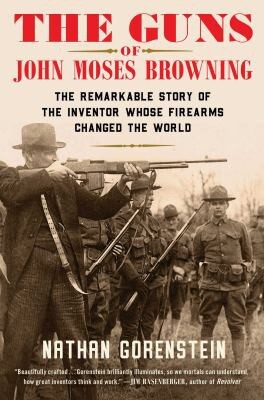
- Nathan Gorenstein, The Guns of John Moses Browning. A modern biography.
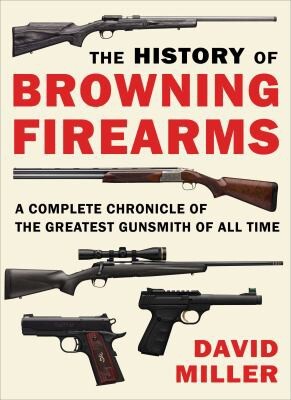
- David Miller, The History of Browning Firearms. An illustrated survey of the guns.
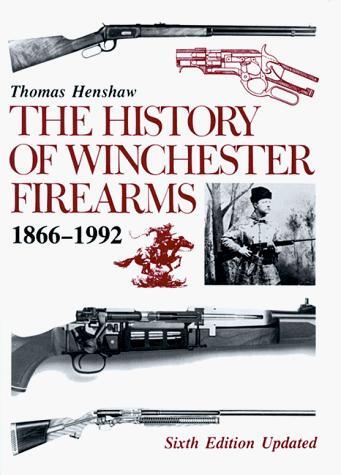
- Thomas Henshaw (ed.), The History of Winchester Firearms 1866-1992. Model-by-model coverage of the Winchester years.
- Robert R. Hodges Jr., The Browning Automatic Rifle (Osprey Weapon 15).
- Leroy Thompson, The Browning High-Power Pistol (Osprey Weapon 73).
Sources
- U.S. patents to John M. Browning, via Google Patents: 220,271 (1879), 544,657 (1895), 659,507 (1900), 984,519 (1911) and 1,618,510 (1927).
- Period newspapers, Utah Digital Newspapers: Deseret News, 23 July 1879; Ogden Daily Standard, 2 February 1914; Ogden Standard-Examiner, 6 December (p. 1 and p. 4), 11 December and 13 December 1926.
- Period newspapers, Library of Congress: New-York Tribune, 9 January 1902; New Britain Herald (Associated Press), 27 November 1926.
- Benedict Crowell, America’s Munitions 1917-1918, War Department, 1919.
- Browning historic timeline and Browning family history, Browning Arms Company.
- Browning Arms Company articles on the Models 1892 and 1894 and on the Model 1897 and the BPS.
- About FN, FN America.
- NRA Museums: Winchester Model 1886, Model 1892 and Model 1895.
- John M. Browning Firearms Museum, Union Station, Ogden.
- “John Moses Browning,” History to Go, Utah Division of State History.
- Browning Firearms Collection, ASME Landmark No. 141.
- American Rifleman: Colt 1895, Auto-5, 1911, .45 ACP, M1917, M1919, .50 caliber (Barrett Tillman), .380 ACP and The Other Great Guns of John Browning.
- John Browning and Curt Gentry, John M. Browning, American Gunmaker (Garden City, NY: Doubleday, 1964).
If you know of any forums or sites that should be referenced on this listing, please let us know here.