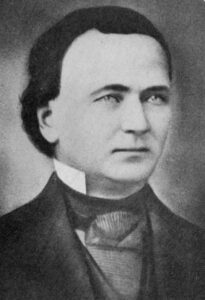

In the fall of 1884, two brothers from Ogden, Utah Territory traveled to New Haven, Connecticut with a working prototype lever-action rifle. John Moses Browning, twenty-nine, had filed for a patent that May. His younger brother (and lifelong business partner) Matthew Sandefur Browning handled the negotiation. Thomas G. Bennett, Winchester’s vice president and Oliver Winchester’s son-in-law, had already bought Browning’s first design (the falling-block single-shot that became the Winchester Model 1885). What the brothers brought to New Haven this time was different: a repeating rifle strong enough to chamber the .45-70 Government, the cartridge that Winchester’s existing toggle-link actions could not safely handle.
The patent, U.S. No. 306,577, filed May 26, 1884, was granted October 14, 1884. The rifle that came out of it, the Winchester Model 1886, was John Browning’s first Winchester lever-action and the design that pivoted the company into big-bore repeating rifles for the next half-century. From 1886 to 1935 Winchester built 159,994 of them. Theodore Roosevelt killed grizzlies with one. Bob Dalton carried one into Coffeyville. Tom Selleck handled one in Monte Walsh. And in 2026 four manufacturers (Miroku-Winchester, Pedersoli, Uberti, and Chiappa) still build them.

Browning’s First Winchester Lever-Action: The Winchester Model 1886
By the early 1880s Winchester had a problem. Its existing lever-action rifles (the Model 1866, the Model 1873, and the heavier Model 1876) all used variations of the toggle-link action carried over from the original Henry rifle and Smith & Wesson’s Volcanic. Two pivoting links flexed outward to lock the bolt against the cartridge head. The geometry worked at the pressures of the .44-40 WCF and its pistol-caliber siblings. It worked, just barely, at the .45-75 WCF pressures of the 1876.
It did not work at the pressures and length of the .45-70 Government, which the U.S. Army had adopted in 1873 for the Springfield Trapdoor and which dominated North American hunting through the 1880s. The 1876’s enlarged toggle-link receiver could not house the .45-70 case. Meanwhile Marlin Firearms had introduced its Model 1881 five years before the Winchester 1886, chambered for .45-70 from the start, proving the commercial demand. Winchester needed a response.
Browning’s solution was to throw the toggle-link away. In its place the Model 1886 uses twin vertically-sliding steel locking lugs, housed in mortises milled into the receiver walls. When the lever closes, those lugs rise and engage matching cuts in the bolt, locking it solidly against rearward thrust. Browning himself credited the inspiration to the falling-block single-shot actions of the period (the same general lockup that drives his own 1885 single-shot). What he did was adapt that lockup to operate through a lever-action’s repeating cycle.
The result was a Winchester lever-action receiver capable of chambering the .45-70 Government and substantially larger cartridges, up to the .50-110 Express. Plant superintendent William Mason is credited in several Winchester accounts with manufacturing refinements that adapted Browning’s bench prototype to mass production at New Haven. He should be cited as a production engineer rather than a co-designer; the architecture is Browning’s.
The price Winchester paid for the patent is one of those numbers that everyone repeats and no one can primary-source. Tradition holds it was around $50,000. John Browning is widely quoted as saying Winchester paid him “more money than there was in Ogden at the time.” Neither Winchester nor the Browning brothers confirmed a specific figure during their lifetimes. John and Matt used the proceeds to diversify Browning Brothers Company through the 1890s into Ogden and Salt Lake real estate, mining, sugar production, hydropower, and banking. The 1886 was the rifle that made the Browning brothers wealthy, and it was the start of a Winchester-Browning partnership that ran from 1883 to 1902 and produced essentially every iconic Winchester model of the period.
Between selling the 1885 single-shot in 1883 and parting ways with Winchester in 1902, John Browning designed for Winchester: the Model 1887 lever-action shotgun (the first practical repeating shotgun), the Model 1892 lever-action rifle (the pistol-cartridge sibling of the 1886), the Model 1893 and Model 1897 pump shotguns (the 1897 became the famous trench gun of World War I), the Model 1894 lever-action rifle, and the Model 1895 lever-action rifle. After 1902 Browning shifted his design output to Fabrique Nationale of Liège (the Auto-5 and the Hi-Power 9mm) and to Colt (the 1911). The 1886 was the first lever-action of that two-decade output, and it inaugurated the architectural lineage Browning carried forward into the 1892, 1894, and 1895.
The Rifle Itself
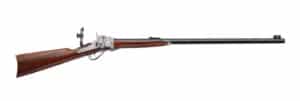
The standard cataloged Model 1886 was a sporting rifle with a 26-inch octagonal barrel, full-length tubular magazine, walnut stock with crescent steel buttplate, semi-buckhorn rear sight and blade front. Weight was about nine and a half pounds in .45-70 trim. Magazine capacity in that configuration ran to eight rounds. Round barrels were available at a small discount. Variations off the standard included a 22-inch carbine with saddle ring (the form most associated with ranch and lawman use), a 30-inch musket aimed at military contracts that never materialized in significant numbers, and a takedown variant that disassembled at the receiver for transport.
The configuration that Winchester collectors prize most heavily is the Extra Light Weight, cataloged from 1896 to 1919 and again from 1928 to 1931. Trim handling and a hard-rubber shotgun buttplate brought the rifle down to under eight pounds, with a tapered nickel-steel barrel, half-magazine, and straight-grip stock. Deluxe and Fancy Sporting variants added engraving, fancy walnut, and special-order finishes at modest premiums over the standard catalog price.
The operating cycle is conventional Winchester lever-action: a side loading gate on the right of the receiver (the Nelson King patent carried forward from the 1866), an external hammer with half-cock notch as the only safety, and the twin vertical locking lugs doing the work the toggle-link did on earlier Winchesters. Magazine capacity ran from roughly eight rounds in a full-length 26-inch .45-70 rifle down to five or six in the half-magazine Extra Light Weight.
Original 1886 receivers were forged for black-powder pressures. The design proved strong enough that Winchester introduced a smokeless cartridge, the .33 Winchester, in 1903, accompanied by nickel-steel barrels stamped “NICKEL STEEL” on the barrel flat. From roughly 1903 forward (the serial range is approximately 117,000 and up, though the Madis tables are the proper authentication reference), 1886s shipped with the nickel-steel barrel rated for smokeless ammunition at standard pressures. Pre-1903 examples were not. A pre-1903 original 1886 is safe with original-specification black-powder loads or modern equivalents loaded to the same pressure tier, but it is not safe with heavy modern smokeless loads (the Garrett, Buffalo Bore, and Grizzly Cartridge “+P” tier). The mistake to avoid is assuming “all 1886s are big-bore so they handle the hottest loads.” They do not.
The Cartridges
The 1886 was cataloged in roughly ten factory chamberings over its production life. Popular accounts sometimes list “up to nineteen” when very rare special orders and proof-house variations are counted. The well-documented core list is shorter.
The canonical chambering was the .45-70 Government, the cartridge the rifle existed to repeat. The original Army load was a 405-grain lead bullet over 70 grains of FFg black powder, leaving a 26-inch barrel at roughly 1,200 to 1,300 feet per second for about 1,300 ft-lb of muzzle energy. The civilian Express load (a 300-grain bullet at roughly 1,500 fps) sat above the Army specification, and the 1886’s strength accommodated it comfortably. Modern .45-70 ammunition is loaded across three pressure tiers by industry convention: a trapdoor/black-powder tier at about 18,000 psi, a “modern lever” tier around 28,000 psi safe in modern 1886 reproductions and Marlin 1895s, and a “Ruger No. 1 / falling-block” tier at about 40,000 psi that is not safe in any lever-action, original or reproduction.
Winchester rolled out additional chamberings across the rifle’s first decade. The .45-90 WCF (a longer-cased hot-rod sibling of the .45-70, a 300-grain bullet for flatter trajectory) and the .40-82 WCF appeared in 1886 alongside the .45-70. The .40-65 WCF and .38-56 WCF followed in 1887, both popular medium-bore chamberings; the .40-65 still has a following in modern BPCR competition. The .50-110 WCF Express, also 1887, was the largest factory chambering: a 300-grain or 450-grain bullet over 110 grains of FFg, designed as a buffalo and large-bear cartridge. Winchester adopted the “Express” suffix from British double-rifle nomenclature to signal high velocity and flat trajectory relative to the rest of the period catalog.
The .40-70 and .38-70 WCF arrived in 1894 as less-common chamberings with intermittent production. The .50-100-450 WCF (often shortened to .50-100) arrived in 1895 as the heavy-bullet sibling of the .50-110. And in 1903, with smokeless cartridges dominating the new sporting-rifle market, Winchester introduced the .33 Winchester: a necked-down .45-70 case throwing a 200-grain jacketed .338 bullet at about 2,200 fps from a 24-inch barrel. The .33 WCF was the only purpose-built smokeless cartridge cataloged for the 1886, accompanying the nickel-steel barrel introduction. It was discontinued in 1936, one year after the 1886 itself, and brass remains uncommon today; reloaders typically form .33 WCF cases from .45-70 brass.
The .50-110 deserves a paragraph on its own. In an original black-powder load the cartridge ran 300 grains at roughly 1,600 fps for about 1,720 ft-lb of muzzle energy: enough for any North American game of the period. In a modern Miroku-made 1886 with modern smokeless propellants, Grizzly Cartridge and Buffalo Bore “+P” loads push 450-grain to 525-grain bullets to muzzle energies approaching 6,000 ft-lb. That makes the .50-110 in a modern 1886 the most powerful tube-magazine lever-action cartridge in current commercial production: the Alaska guide rifle for buyers who want maximum effective energy in a traditional repeating action.
By 1903 the smokeless transition was effectively complete in the U.S. military (the .30-40 Krag in 1892, the .30-06 Springfield arriving in 1906) and the sporting market had followed. Winchester’s own .30-30 in the Model 1894 was already eclipsing the 1886 in volume. The .33 WCF, accompanied by the nickel-steel barrel, was Winchester’s bid to keep the 1886 commercially relevant for hunters who wanted the lever-action’s repeating cycle paired with a flatter-shooting smokeless cartridge. It worked, partially, for about three decades. The cartridge was always a second-tier seller, and when Winchester wound 1886 production down through the early 1930s, .33 WCF went with it.
I own an original 1886 in .33 WCF, a 1922 production rifle with an A-suffix serial number, which Winchester used to mark rifles produced after a design or mechanical change during the model’s production lifecycle. The barrel carries the standard post-1902 marking: “NICKEL STEEL BARREL / ESPECIALLY FOR SMOKELESS POWDER.” I collect odd things, and the .33 WCF qualifies: a smokeless-era cartridge in a black-powder-era rifle, on a Browning action that was already being eclipsed by lighter sporting designs by the time this one left the factory.
Theodore Roosevelt’s .45-90
Roosevelt was a Winchester user before he was an author and before he was president. His Hunting Trips of a Ranchman (1885), Ranch Life and the Hunting-Trail (1888), and The Wilderness Hunter (1893) document the Dakota and Montana years and the rifles he carried through them. Before the 1886 existed, his favorite was a Winchester Model 1876 in .45-75 WCF, a deluxe-grade rifle with custom engraving that reached him in the Badlands in July 1884 (which is a story for the 1876 article). It was not his bison rifle. His one Dakota bison, in September 1883, came before the 1876 arrived, on a trip when he carried a Sharps Model 1874 in .45-120.
The 1886 was a later rifle for him. Roosevelt acquired a Winchester Model 1886 chambered in .45-90 WCF in 1887, the year after the rifle’s introduction, while he was still ranching in the Dakota Territory. It was a deluxe-grade order with a pistol-grip stock, half-magazine, special wood, and engraving. Roosevelt sent it back to Winchester for refinishing five separate times across his lifetime, which says something useful about how hard he ran the rifle. This was not a collector piece kept in a presentation case. This was a working rifle that the most-photographed outdoorsman of his generation kept rebuilding because he kept wearing it out.
The 1886 .45-90 became Roosevelt’s primary heavy-game rifle through the late 1880s and 1890s: grizzly, moose, and elk hunts across the American West. The famous grizzly story is documented in his own writing. In the fall of 1889, near the Idaho-Montana line, a grizzly he had already hit twice, once through the lung and once through the heart, charged him out of a laurel thicket. He hit it again in the chest as it came over a fallen tree, then fired for the forehead; the bullet went into its open mouth, and the bear swept past him and died a few jumps on. Roosevelt’s own account does not name the rifle. Firearms writers attribute it to the .45-90 1886, which he had owned since 1887.
One disambiguation. For his 1909 to 1910 African safari, Roosevelt’s primary rifles were Winchester Model 1895s in .405 Winchester (the famous “Big Medicine”) and .30-06 Springfield, not the 1886. The .405 1895 is the African rifle; the .45-90 1886 is the North American grizzly and elk rifle. Some auction listings conflate them, and the conflation has spread; for the record, Roosevelt’s documented Africa battery was 1895s.
Bob Dalton, Coffeyville, and Other Owners
On October 5, 1892, the Dalton Gang rode into Coffeyville, Kansas to rob two banks at once. The town recognized them, armed up, and met them with shotguns and rifles. Four of the five raiders died on the street. Bob Dalton was one of them. The rifle he carried was a Winchester Model 1886 carbine, serial 40302, chambered in .38-56 WCF. Its provenance is well documented; the rifle has appeared in major auctions including a Bonhams sale (lot 15, 27262). It survives as one of the most specifically attributable outlaw firearms in the American collection market.
Beyond the famous individual examples, the 1886 was the default heavy-game lever-action for two generations of professional guides, market hunters, and ranchers across the American West and the Canadian provinces from 1886 through roughly 1900. Specific working-hunter attributions are weaker than Roosevelt or Dalton, but the rifle’s commercial role is firmly established: when a working man needed a repeating big-bore for elk, moose, grizzly, or bison country between the late 1880s and the smokeless revolution, the 1886 was the answer.
Commercial buffalo hunting had collapsed by the time the 1886 reached market (the southern herd by roughly 1875, the northern by 1883), which took the single-shot Sharps Model 1874 and its rolling-block competitors out of their primary commercial market. The hunting economy was shifting from market hunting toward sport hunting (elk, moose, bear, deer) and for sport hunting the lever-action’s repeat-shot capability was a meaningful advantage over a single-shot black-powder rifle. The 1886 did not “replace” the Sharps; different rifles for different uses, and BPCR target shooters today still prefer the Sharps for long-range single-shot accuracy. But in the practical hunting market of 1886 through 1910, the 1886 was the next generation.
By the 1920s the smokeless Model 1894 in .30-30 had eclipsed the 1886 as Winchester’s hunting volume leader, and the 1886 became progressively a specialist’s rifle for shooters who wanted the biggest practical cartridges in a Winchester lever-action. Production wound down through the early 1930s, with parts assembly continuing to 1935.
On Screen: Monte Walsh, Crossfire Trail, and the Sharps Confusion
The 1886 has had a quieter cinematic career than the 1873 or the 1894, but it shows up in one of the better Westerns of the early 2000s. In Tom Selleck’s Monte Walsh (2003), directed by Simon Wincer for TNT, Selleck’s character carries a Winchester Model 1886 carbine in .50-110: an authentic 1891-production rifle with a 22-inch barrel, documented on IMFDb (and treat that attribution as widely reported rather than confirmed by production materials). The .50-110 carbine is one of the more historically careful firearm choices in Selleck’s run of Westerns, alongside Crossfire Trail and the Jesse Stone films.
One disambiguation worth getting on the record. Crossfire Trail (2001), also Selleck, also TNT, also Wincer-directed, features Selleck carrying a Winchester Model 1876, not the 1886. Different rifle. Different cartridge generation. Different lockup. The 1876 is the toggle-link predecessor; the 1886 is the vertical-lug Browning design. The two get confused regularly.
The other film conflation worth correcting is Quigley Down Under (1990), also Selleck, also Australian setting. The rifle is not a Winchester 1886. It is a Shiloh Sharps Model 1874 single-shot in .45-110, custom-built for the production and advised on by gun historian Phil Spangenberger. Quigley is the Sharps movie, not the 1886 movie. The confusion is common enough in popular firearms writing to be worth flagging explicitly: if someone says “the 1886 from Quigley Down Under,” they have the wrong rifle.
Modern Reproductions: The Four-Producer Market
The 1886 is unusual among 19th-century Winchester designs in that four legitimate manufacturers build new reproductions in 2026. (For comparison, the 1876 has only one current producer, Uberti.) Each of the four 1886 producers occupies a different price tier and a different design philosophy.
Winchester Repeating Arms (Miroku, Japan)
The modern Winchester brand is owned by Olin Corporation and licensed for firearms to Browning Arms Company, which contracts manufacture to Miroku Firearms Manufacturing in Kochi, Japan. Miroku has built Winchester-branded 1886s in special-edition runs since the 1990s and in regular cataloged production from the early 2010s onward. The current catalog covers a Model 1886 Short Rifle (24-inch round barrel, .45-70), a Model 1886 Deluxe (octagonal barrel, fancy walnut, color-case-hardened receiver), and Extra Light Weight runs that come and go as limited editions.
Chamberings are predominantly .45-70 Government, with .45-90 WCF appearing in some runs and .50-110 in special-edition Deluxe production. Miroku’s manufacturing quality is widely recognized as the premium tier of modern lever-action production globally: tight tolerances, polished actions, period-correct fit and finish. The Short Rifle is the volume product; the Deluxe is the heirloom-grade option. Find current Miroku-built Winchester 1886s on Guns.com’s Winchester 1886 inventory.
Davide Pedersoli (Italy)
Davide Pedersoli & C. of Gardone Val Trompia is the dominant European producer of historical American firearm reproductions, and the 1886 line is among their best-regarded. The cataloged variants include the Sporting Classic and Premium (26-inch octagonal barrels, eight-round magazines, color-case receivers, walnut stocks) and the 1886/71 Boarbuster Evolution (a purpose-built modern European driven-boar rifle with a tactical stock, short barrel, and accessory rails). The Boarbuster is mechanically an 1886 but visually unlike the period rifle.
Chamberings are primarily .45-70 Government. Pedersoli’s reputation among traditionalists rests on clean fit-and-finish work and the absence of “lawyer scripting” on the barrels (no required warning text engraved into the steel): a point in their favor for buyers who care about period correctness. Catalog availability varies year to year; confirm current production before committing to a specific variant. New Pedersoli 1886s appear on Guns.com’s Pedersoli inventory.
Uberti (Italy)
A. Uberti S.r.l., also in Gardone Val Trompia and part of Beretta Holding, builds the Model 1886 Sporting Rifle in 25.5-inch to 26-inch octagonal barrels, .45-70 Government, eight-round magazines, case-hardened receivers, A-grade American walnut, fully adjustable sights drilled and tapped for a Lyman receiver peep. Uberti is the value-for-quality tier of the 1886 market: cleaner work than the entry tier, less expensive than Miroku, and broadly available through multiple U.S. importers.
Uberti reaches the U.S. market through Cimarron, Taylor’s & Company, EMF, Stoeger, and Benelli USA, which means the same Uberti-built 1886 may appear with several different brand names on the receiver. Cimarron Firearms (a Texas importer) and Taylor’s & Company (Virginia) finish and badge Uberti-built rifles with their own touches: charcoal-blue finish, premium wood, additional color-case work. The underlying mechanism in any “Cimarron 1886” or “Taylor’s 1886” is Uberti’s. Find current Uberti production on Guns.com’s Uberti 1886 inventory.
Chiappa Firearms (Italy)
Chiappa Firearms of Brescia builds the most accessible 1886 price tier and the most modernized variants. The traditional catalog covers a Model 1886 Carbine (22-inch barrel, color-case receiver, walnut, seven-plus-one) and a Model 1886 Rifle (26-inch barrel, color-case, walnut, eight-plus-one). The variant that separates Chiappa from the other three producers is the 1886 Kodiak: an 18.5-inch barrel, stainless steel, black synthetic stock, M-Lok or Picatinny rail options in some configurations, built as a modern Alaska-guide-gun analogue to the Marlin 1895 SBL. The Wildlands is an additional modernized variant.
Chiappa’s 1886 platform is mechanically the same Browning design as the other three producers. What Chiappa applies that the others do not is aggressive modernization for shooters who want the 1886 architecture but not the period aesthetic. The Kodiak is the buyer’s-guide option for big-bear country at a price point under what Miroku-Winchester charges for traditional walnut and steel. Current Chiappa 1886s, including Kodiak and Wildlands variants, on Guns.com’s Chiappa 1886 inventory.
A note on Italian forgings
Enthusiast forum discussions report that Pedersoli, Uberti, and Chiappa share a common Italian supply base for receiver and parts forgings, with each manufacturer adding their own barrels, fitting, stocks, finishing, and quality control. The same supply chain reportedly feeds Turnbull Restoration’s high-end custom builds. Treat the shared-forge claim as reported on enthusiast forums rather than confirmed by the manufacturers; the practical implication, if accurate, is that fundamental metallurgy is broadly comparable across the three Italian producers and the differentiation is at the finishing and quality-control stage.
Use Cases in 2026
The 1886 is, in current production, primarily a hunting rifle and secondarily a collector’s rifle. The cowboy-action shooting market gravitates to the 1873 in pistol-caliber chamberings for fast-cycling main-match stages; the 1886 appears in long-range and big-bore side categories at SASS events but is not the dominant cowboy-action rifle.
For big-bore hunting the 1886 is the iconic choice. A modern Miroku, Pedersoli, Uberti, or Chiappa 1886 in .45-70 Government is arguably the most period-correct, traditional, and aesthetically satisfying hunting choice in current production for elk, moose, brown or grizzly bear, and the largest North American game. The .45-70 with modern Marlin-tier loads (300 to 405 grains at 1,800 to 2,000 fps) is effective on all North American game at typical lever-action ranges of 150 yards and inside, with skilled hunters and modern peep sights extending that to 250 to 300 yards. The Chiappa Kodiak specifically targets the Alaska and Canadian bear-country guide-rifle market, competing with the Marlin 1895 SBL and Henry Big Boy variants for the same buyer.
For long-range black-powder cartridge shooting, the 1886 in .45-90 or .40-65 can compete in some BPCR matches, though dedicated single-shot Sharps and Remington Rolling Block reproductions dominate purpose-built long-range BPCR. The 1886 fills the niche for shooters who want a repeating BPCR-adjacent rifle for plains shooting, casual long-range, and historical-pattern target practice.
For collecting, original 1886s trade across a wide range. A standard sporting rifle in .45-70 with average bluing and stock condition typically sells in the low-to-mid four-figure range at 2026 auction levels. Deluxe-grade examples with documentation, special wood, or famous-owner provenance can clear well into the five-figure range and above; the Bob Dalton 1886 and Roosevelt deluxe examples sit at the top of that market. Original Extra Light Weight, Takedown, and high-grade Deluxe examples carry significant premiums over the standard catalog form. Madis-documented serial-number research is the standard authentication path; the major auctions (Rock Island, Morphy, Bonhams) provide written letters of authenticity with significant lots.
Adjacent Rifles Worth Knowing
The 1886 sits inside a family of Browning-designed Winchesters that get confused regularly. Three of those siblings matter for buyers comparing rifles:
The Winchester Model 1876 is the toggle-link predecessor: Winchester’s first attempt at a big-bore lever-action, chambered in .45-75 WCF, .45-60 WCF, .50-95 Express, and .40-60 WCF. The 1876 could not chamber the .45-70 Government, which is precisely the gap Browning’s 1886 design was built to close. Production ran 1876 to 1897, total around 63,800 units. The 1876 is the rifle Selleck carries in Crossfire Trail.
The Winchester Model 1892 is essentially a scaled-down 1886 (same twin vertical locking lugs, smaller receiver) sized for pistol-cartridge chamberings: .44-40, .38-40, .32-20, .25-20 originally, and .357 Magnum, .44 Magnum, .45 Colt in modern reproductions. The 1892 replaced the toggle-link 1873 for new pistol-caliber production. Same architecture as the 1886, smaller scale, different cartridge family.
The Winchester Model 1894 is the smokeless-era Browning lever-action: a different mechanism (a falling receiver floor that drops down during cycling to feed longer cartridges through a shorter action), chambered originally in .38-55 and .32-40 black-powder cartridges and then redesigned for the smokeless .30-30 WCF in 1895. The 1894 became the all-time best-selling sporting rifle in U.S. history, with over seven million produced from 1894 to the present. Visually similar to the 1886, mechanically different, sized for shorter smokeless cartridges. The 1886 cannot chamber .30-30; the 1894 cannot chamber .45-70.
And outside the Winchester family, the Marlin Model 1881 is the rifle that triggered the 1886’s existence: the first lever-action chambered for .45-70 Government, introduced five years before the 1886, with around 20,000 units produced through 1892. The modern Marlin descendant is the Marlin Model 1895, produced from 1895 to 1917 and in its modern form since 1972 (current production by Ruger after the 2020 Marlin acquisition), chambered for .45-70 plus .444 Marlin, .450 Marlin, .35 Remington, and .338 Marlin Express. The Marlin 1895 SBL guide gun is the closest modern competitor to the Chiappa Kodiak.
References and Resources
The canonical reference work for Winchester research is George Madis’s The Winchester Book (first edition 1961, with revised editions through the 1980s, ISBN 0-910156-04-9 for the 1985 edition). Out of print and trading on the secondhand market, it remains the definitive authentication reference for Winchester serial-number dating, configuration identification, and variant documentation, including the 1886 serial-range tables and the nickel-steel transition. Madis also wrote a dedicated 1886 monograph (The Winchester Model 1886) which is the most specific reference work on this model. R. L. Wilson’s Winchester: An American Legend (Random House, 1991, ISBN 0-394-57870-2) is the accessible coffee-table history with strong photography; lighter on technical detail than Madis but stronger on cultural context. Herbert G. Houze’s Winchester Repeating Arms Company: Its History & Development from 1865 to 1981 (Krause, 1994, ISBN 0-87341-262-7) is the corporate-history reference. For cartridge specifics, Cartridges of the World by Frank Barnes (latest edition by W. Todd Woodard) is the standard. Browse used copies of Madis’s The Winchester Book on Amazon.
Roosevelt’s own writing is the primary source for the .45-90 1886’s working life: Hunting Trips of a Ranchman (Putnam’s, 1885), Ranch Life and the Hunting-Trail (Century, 1888), and The Wilderness Hunter (Putnam’s, 1893). All three remain in print in modern editions, and Project Gutenberg hosts public-domain texts. The Theodore Roosevelt Center at Dickinson State University (theodorerooseveltcenter.org) hosts a digital archive of TR papers, letters, and photographs. Sagamore Hill National Historic Site (nps.gov/sahi) is Roosevelt’s home and physical collection. The Cody Firearms Museum at the Buffalo Bill Center of the West (centerofthewest.org) holds physical Winchester collections and serial-number records. The Winchester Arms Collectors Association (winchestercollector.org) hosts the free serial-number lookup tool and an active authentication forum.
The Morphy Auctions (morphyauctions.com) catalog archive is one of the standout marketplaces for rare and historically significant American firearms, and a reliable source for documented original Winchester 1886s: standard sporters, carbines, deluxe-grade examples, and the occasional famous-owner provenance rifle that moves through specialty auctions. Their catalog archive is worth following whether you are buying, researching, or just looking at very good firearms photography.
The Texas Gun Collectors Association (tgca.org) holds two shows a year that consistently feature original Winchesters and their period contemporaries. Worth attending whether you are buying, researching, or just looking.
If you know of any forums or sites that should be referenced on this listing, please let us know here.
Further Reading
-

The Winchester Book
Purchase on Amazon -
Sale!

History of Browning Firearms: A Complete Chronicle of the Greatest Gunsmith of All Time
Original price was: $19.99.$18.63Current price is: $18.63. Purchase on Amazon -
Sale!

The Guns of John Moses Browning: The Remarkable Story of the Inventor Whose Firearms Changed the World
Original price was: $28.00.$24.34Current price is: $24.34. Purchase on Amazon