
On a September morning in 1877, outside a fortified Bulgarian town called Plevna, Russian and Romanian infantry advanced on Ottoman trenches in the kind of close-order assault that European armies had been winning with single-shot rifles for a generation. The Turks waited. At roughly two hundred yards they set their long-range Peabody-Martini rifles aside, picked up brass-framed lever-actions from New Haven, Connecticut, and opened fire. The advance broke. The defenders, badly outnumbered, inflicted casualties at a ratio that ended the European general-staff consensus on what a repeating rifle could do to a regular infantry assault.
The rifle was the Winchester Model 1866, the “Yellow Boy.” It was Winchester Repeating Arms Company’s first product, and the gun the company was built on.
The 1866 is sometimes overshadowed by its more famous descendants. The Model 1873 took the centerfire-cartridge headlines and the cowboy-action mythology. The 1894 took the deer woods. But the architectural decision that made every later Winchester lever-action possible was made in 1866, by a plant superintendent named Nelson King, in the form of a small spring-loaded door on the right side of the receiver. Before King’s loading gate, repeating rifles loaded from the muzzle end of the magazine like very slow muzzleloaders. After it, a rider could top off his magazine one round at a time, from horseback, in the rain, behind cover. The line of inheritance runs straight from that gate through every Winchester lever-action sold for the next half-century.
Lineage: Volcanic, Henry, 1866
Three companies in succession built the lever-action line that became the 1866. Each solved part of the problem and handed the rest forward.
The Volcanic Repeating Arms Company, formed in 1855 by Horace Smith, Daniel B. Wesson, Courtlandt Palmer, and a New Haven shirt manufacturer named Oliver F. Winchester, commercialized a tubular-magazine lever-action firing a self-contained “Rocket Ball” projectile. The Rocket Ball was a hollow-base bullet with the powder charge and primer tucked inside its skirt. There was no metallic cartridge case at all. It was ingenious. It also could not, in the period phrase, kill a rabbit. Smith and Wesson left in 1856 to start a revolver company. (The longer story of the Volcanic is in our Volcanic Pistol article.)
Winchester took control in 1857, reorganized the firm as the New Haven Arms Company, and hired plant superintendent Benjamin Tyler Henry to fix the cartridge. Henry’s answer in 1860 was the .44 Henry rimfire: a 200-grain lead bullet over roughly 26 to 28 grains of black powder in a self-contained brass case, generating about 1,125 feet per second from a rifle barrel. The cartridge had a thin folded rim with the priming compound spun out to the edge; the firing pin struck the rim and set the cartridge off. He also redesigned the toggle-link action to fire it. The Henry rifle, patented October 16, 1860 and marked “HENRY’S PATENT. OCT. 16. 1860,” was a brass-receivered, 24-inch octagonal-barreled lever-action holding fifteen rounds in a tubular magazine beneath the barrel.
The Henry had a fatal weakness in field use. Its magazine loaded from the muzzle end through an open slot along the bottom of the magazine tube. The shooter pulled the spring-loaded follower forward against magazine spring tension, dropped cartridges nose-first into the slot one by one, and released the follower onto the stack. The procedure was two-handed, slow, awkward standing, and effectively impossible from horseback or behind cover. The slot was also exposed: dirt, twigs, snow, and mud fouled the follower track. The rifle had no forend protecting the magazine tube. Confederate soldiers who encountered Henrys in Union private-purchase hands during the Civil War called it “that damned Yankee rifle you load on Sunday and shoot all week.”
Roughly 14,000 Henrys were produced between 1862 and 1866. By the war’s end, B. Tyler Henry and Oliver Winchester were no longer on speaking terms. Henry had attempted to have the firm reorganized under his own name and lost the political fight. He departed; Winchester reorganized New Haven Arms as the Winchester Repeating Arms Company on the strength of a new patent filed by plant superintendent Nelson King.
Nelson King’s Loading Gate
King’s patent, U.S. No. 55,012, was the design enabler for everything that followed. The patent issuance date is May 22, 1866; the date marked on production rifles is March 29, 1866, which is the date the rifle’s barrel marking was first applied. Both dates appear in the literature and refer to the same patent.
King’s idea was simple in retrospect: a spring-loaded gate set into the right side of the receiver, opening inward against a leaf spring, large enough to admit a .44 Henry cartridge head-first into the magazine tube. The shooter pressed a cartridge against the gate, the gate pivoted inward, the cartridge slid into the magazine behind the follower, and the gate sprang shut. Cartridges fed nose-forward into the action exactly as before; the difference was entirely on the loading side.
Three further design changes followed from the gate. The magazine tube became a closed tube with no exposed follower slot. A wooden forend ran beneath the barrel and magazine, protecting both. And the operator gained the option of topping off the magazine one round at a time without disassembling anything. Together, these turned a clever Civil War-era curiosity into a working frontier and military arm.
The barrel markings on an original 1866 honor both patents: HENRY’S – PATENT – OCT. 16, 1860 / KING’S – PATENT – MARCH 29, 1866. The Henry-patent line was dropped from production in the early 1870s, which is one of the markers collectors use to date the variant.
The Rifle Itself
The receiver, forend cap, sideplates, and crescent buttplate were cast in gunmetal, a tough bronze alloy of copper, tin, and zinc that is castable, machinable, and highly corrosion-resistant. Modern reference works call it “brass” out of convention; the metallurgy is bronze. Gunmetal is still in use today in marine valves and hydraulic components, which is a good way to think about its toughness. Its golden color gave the rifle the nickname “Yellow Boy.” The nickname is universal in modern usage; primary-source documentation of period 19th-century use is thin, so the safest phrasing is that the rifle is known then and now as the Yellow Boy without claiming a specific period origin.
Three production configurations were cataloged:
| Variant | Barrel | Profile | Magazine capacity | Notes |
|---|---|---|---|---|
| Rifle | 24″ | Octagonal (standard) or round | 17 rounds | Most common civilian variant |
| Carbine | 20″ | Round | 13 rounds | Saddle ring; favored for mounted use |
| Musket | 27″ | Round, full-length stock | 17 rounds | Bayonet lug; military contract |
The action is the two-piece toggle-link inherited from the Henry. A pair of pivoting links locks the bolt to the receiver at the moment of firing. The action is strong enough for the moderate pressures of .44 Henry rimfire and the later modern handgun-class chamberings used in reproductions; it is not strong enough for high-pressure cartridges like .45-70 Government, which is why Browning’s Model 1886 with twin vertical locking lugs exists.
The hammer is external. The First Model omitted a half-cock safety notch; later variants added one (see below). Extraction was by the toggle-link cycle, lifting the spent rim of case rearward and ejecting upward.
The only chambering in original production was the .44 Henry rimfire, the same cartridge the Henry had introduced. A late-production .44 Henry centerfire variant was offered for the Turkish military contract and in small quantities afterward; the chamber and rim could accept either rimfire or centerfire .44 Henry cases. This is not the later .44-40 WCF; the two cartridges share a caliber number and a common diameter but are not interchangeable, and the 1866 was never originally chambered in .44-40 or any modern smokeless cartridge.
Production Span and the Four Sub-Variants
Winchester produced the 1866 from 1866 to 1898 at the New Haven plant. Production continued for a quarter-century after the introduction of the Model 1873 because the 1866 was cheaper to manufacture, the .44 Henry rimfire ammunition remained widely available, and Latin American markets continued to want it. Total production is most reliably cited at ~170,101 units by George Madis in The Winchester Book and by the Winchester Collectors Association. (A “nearly 160,000” figure appears in some secondary sources; the 170,101 number is the well-supported one.)
Collectors recognize four sub-variants within that production run. None of them are mechanical revisions of the firing action; all four shoot identically. The distinctions are receiver geometry, screw count on the upper tang, hammer detail, and serial number placement.
The First Model (1866 to roughly 1867) has a flatside receiver with a prominent “Henry drop,” the downward curve of the receiver near the hammer, inherited directly from the Henry. The serial number is on the side of the upper tang. There are two screws in the upper right rear of the receiver and tang. The most diagnostic trait is the absence of a half-cock safety notch on the hammer. First Models are uncommon and carry a significant collector premium.
The Second Model (roughly 1867 to 1869) added the half-cock notch, reduced the upper tang to a single screw, and introduced a slight receiver flare at the forearm to ease the transition from receiver to wood.
The Third Model (roughly 1869 to 1872) smoothed the Henry drop into a gentler curve. The serial number moved to the exterior of the receiver behind the trigger guard. The Henry patent line dropped off the barrel marking. The Third Model is the most commonly encountered original variant.
The Fourth Model (roughly 1873 to 1898) smoothed the Henry drop almost completely. The serial number relocated to the rear of the tang in most examples, and the font shifted from blocky to a more script-like style. The Fourth Model spans the longest portion of the production run by year count and unit volume.
For any significant purchase of an original, the Winchester Collectors Association serial-number lookup and the Madis sub-variant tables are the working references. The collector market separates First Models from Fourth Models by a factor of three to ten.
Plevna, 1877: The First Repeating-Rifle Battle
Oliver Winchester courted the Ottoman government in the late 1860s with fancy presentation-grade .44 Model 1866 rifles sent to selected Turkish officers and government officials. The lobbying worked. In 1870 and 1871 the Sultan’s government placed orders totaling 5,000 carbines and 45,000 muskets with bayonets. That fifty-thousand-rifle order was the largest single customer in the entire production history of the 1866. Most were the Musket variant: 27-inch barrel, full-length stock, bayonet lug, purpose-built for infantry use. Some were chambered in the late-production .44 Henry centerfire variant.
On April 24, 1877, Russia declared war on the Ottoman Empire. Russian and Romanian armies invaded Ottoman territory in the Balkans. The Ottoman commander Osman Pasha fortified the town of Plevna (modern Pleven, Bulgaria) and held it against three Russian and Romanian assaults between July and September 1877, then under siege until December. The Turkish infantry doctrine was simple and devastating: single-shot Peabody-Martini rifles for long-range fire, Winchester 1866 muskets for close-range repeating fire. When the attacking infantry closed to within roughly 200 yards, the Turks set their Peabodys aside and took up their Winchesters.
Plevna held for five months. The third Russian assault, on September 11, 1877, suffered casualties so heavy that the Russian command shifted to siege rather than continued assault. The town fell only when Osman Pasha attempted a breakout, was wounded, and surrendered on December 10, 1877. Russian and Romanian casualties across the siege ran to roughly 38,000 men against an Ottoman garrison that started at 15,000 and grew to perhaps 50,000 at peak.
Plevna is the first major engagement in which fast-loading magazine-fed repeating rifles in defensive use against close-range infantry assault produced a decisive tactical effect. European general staffs noticed. Germany, France, Britain, and Austria-Hungary accelerated their own repeating-rifle programs in the years that followed. The Mauser 71/84 tubular-magazine repeater entered German service in 1884; the French Lebel of 1886 was the first smokeless-powder magazine service rifle; the British Lee-Metford followed in 1888. The era of the single-shot service rifle, which had run from the Dreyse needle gun of 1841 to Plevna, was over within a decade.
Native Acquisition and Sitting Bull’s Smithsonian Model 1866
The 1866 reached Plains, Southwest, and Plateau nations through frontier trading posts, intertribal trade, capture, and direct purchase from licensed traders. Combined with surviving Henry 1860s, it was the most-encountered repeating rifle in Native hands across the late 1860s and 1870s.
The best-documented battlefield case is Little Bighorn, June 25-26, 1876. Forensic archaeology led by Doug Scott of the National Park Service and the University of Nebraska, conducted across multiple seasons between 1984 and 2004, recovered .44 Henry rimfire cartridge cases across the battlefield in significant numbers, alongside .44-40 WCF and .50-70 Government cases. Firing-pin signatures on individual cases allowed Scott’s team to identify specific individual rifles and map the movement of armed combatants across the terrain. The .44 Henry rimfire cases could have come from either Henry 1860s or Winchester 1866s (the cartridge is the same), but the 1866 was substantially more numerous in Plains use by 1876. Sioux and Cheyenne combatants fired thousands of .44 Henry rimfire rounds at the 7th Cavalry that day. Custer’s troops carried single-shot Springfield Trapdoor carbines and Colt revolvers. The Native fighters were materially better-armed with repeaters, and the archaeological record is one of the strongest 19th-century cases of asymmetric repeating-rifle firepower documented anywhere.
The strongest named-owner attribution for a Model 1866 is Sitting Bull’s rifle in the Smithsonian National Museum of Natural History anthropology collection. Sitting Bull (Tȟatȟáŋka Íyotake, c. 1831-1890) led Hunkpapa Lakota forces at Little Bighorn, fled with his band to Canada following the battle, and returned to surrender at Fort Buford in present-day North Dakota on July 19, 1881. The rifle he surrendered, along with other arms turned in by his band, entered federal custody at Fort Buford and was subsequently transferred to the Smithsonian. The rifle is a Winchester Model 1866. Some secondary sources misattribute it as a Model 1873; the Smithsonian’s own catalog identifies it as the 1866. Surrender documentation from Fort Buford and the subsequent transfer paperwork support the 1866 attribution.
Other Famous Owners and Cultural Cameos
Native leaders of the Plains and Apache wars period used 1866s in significant numbers. Specific named-individual attributions other than Sitting Bull’s Smithsonian rifle are weaker, partly because surviving documented rifles tend to be later models (1873 and 1892) reflecting the timing of capture or surrender, and partly because the 1866 was a working-class rifle that wore hard, was passed along, and did not always leave a paper trail. Geronimo, often associated in popular imagination with Winchester repeaters, is most reliably documented with later 1873 and 1892 rifles; his career into post-surrender life (he lived until 1909) covered the era when those later models dominated. The C.S. Fly photographs of Geronimo and his lieutenants in 1886 show 1873s, not 1866s. Geronimo’s documented Winchester-era rifles are covered separately.
Buffalo Bill Cody used Winchesters extensively in his Wild West Show exhibitions from the early 1880s onward; the specific attributions are most secure for 1873s, with 1866 attributions less common. Period photography of frontier scouts, lawmen, and outlaws shows the 1866 in regular field use through the late 1870s and into the 1880s, particularly in Mexico and the Southwest.
Hollywood property departments standardized on the 1873 as the visual shorthand for “Winchester,” which is why the 1866 appears less frequently on screen than its numbers in actual frontier use would predict. The Internet Movie Firearms Database lists documented 1866 appearances across Westerns from the 1950s onward.
Theodore Roosevelt was not an 1866 user. His Winchester years started in 1883, when the 1873 was the standard product and the 1866 was a holdover for export markets. Anyone telling you about Roosevelt’s Yellow Boy is mixing up rifles.
The U.S. Military Story: Offered and Rejected
Winchester offered the 1866 to the U.S. Army for trials and to the U.S. Navy for marine service. The Army rejected it for general issue in favor of the single-shot Springfield Trapdoor in .45-70 Government, adopted in 1873. The reasoning was the same set of arguments the Army would deploy against the 1873 a few years later: cartridge power (the .45-70 with its 405-grain bullet at roughly 1,350 feet per second dramatically outranged the .44 Henry rimfire), ammunition-consumption concerns (“the men will waste rounds”), per-unit cost against arsenal manufacture, and the standardization-on-centerfire shift that was underway in the early 1870s. The Navy purchased small quantities of 1866 carbines for marine service. The Army never did.
The persistent claim that the U.S. Cavalry adopted the 1866 is wrong. The U.S. Cavalry carried Springfield Trapdoor carbines through the entire Indian Wars period. At Little Bighorn the cavalry had Trapdoors and Colts; the Sioux and Cheyenne had the Winchesters.
The Modern Reproductions Market
Modern 1866 reproductions are dominated by a single manufacturer, with one premium-tier producer offering occasional runs. The rest of the market is importer-finished product from that one dominant maker.
Uberti
A. Uberti S.r.l., founded in 1959 in Gardone Val Trompia, Italy by Aldo Uberti and acquired by Beretta Holding in 2000, is the dominant global producer of 1866 reproductions. Uberti‘s 1866 line covers more variants than any other modern manufacturer:

- 1866 Yellowboy Rifle: 24¼-inch octagonal barrel, brass crescent buttplate, brass forend cap. The flagship reproduction.
- 1866 Yellowboy Short Rifle: 20-inch octagonal barrel; lighter handling, popular for Cowboy Action Shooting.
- 1866 Yellowboy Carbine: 19-inch round barrel, brass crescent buttplate, saddle ring optional.
- 1866 Yellowboy Sporting Rifle: premium walnut, charcoal-blue or polished steel furniture options.
- 1866 Yellowboy Deluxe: engraved receiver, presentation-grade walnut.
Uberti chambers the modern 1866 in .22 Long Rifle, .38 Special, .44 Special, .44-40 WCF, and .45 Colt. None of these are the original .44 Henry rimfire. That cartridge is essentially out of commercial production, so the modern lineup substitutes shootable modern handgun-and-rifle commonality cartridges. Mid-tier street pricing for an Uberti 1866 rifle runs roughly $1,200 to $1,900 in 2026 depending on configuration and finish; Deluxe and engraved examples run higher.
Uberti product reaches U.S. buyers through several importer brands. Cimarron Firearms in Texas, Taylor’s & Company in Virginia, EMF, and others import Uberti rifles, finish them to brand specification (sometimes with charcoal-blue receivers, color-case-hardened components, or premium wood), and badge them under their own marks. The underlying rifle is the same Uberti product; the visible differences are cosmetic.
Winchester Repeating Arms (Miroku-made)
The modern “Winchester” lever-action brand is owned by Olin Corporation, licensed for firearms manufacture to Browning Arms Company, which contracts production to Miroku Firearms Manufacturing in Kochi, Japan. Miroku has produced limited runs of the Model 1866 Short Rifle (20-inch octagonal) and Model 1866 Deluxe Sporting Rifle (24-inch octagonal), generally in .44-40 WCF and .38 Special. Production has been intermittent. The 1873 is Miroku’s mainstream Winchester lever-action, and the 1866 appears on the catalog episodically rather than continuously.
Miroku 1866s are the premium tier of modern production: polished receivers, hand-fitted walnut, charcoal-blue receiver finish on the Deluxe variants. Street pricing when available runs roughly $1,800 to $3,200. The practical caveat for the buyer is to check current Winchester catalog availability before settling on this option. A Miroku Winchester 1866 is a high-quality reproduction made in Japan, not an original New Haven Winchester; the receiver markings say “Winchester” because the brand is licensed.
Don’t bother looking for one, they don’t make it
The 1866 reproduction market generates persistent buyer confusion because of three other manufacturers whose lever-actions are commonly searched alongside it:
- Pedersoli produces a Model 1886 lever-action family in .45-70 Government and other heavy cartridges. They do not produce a Model 1866. The digit transposition trips up buyers who type the wrong year into a search engine.
- Henry Repeating Arms, based in Bayonne, New Jersey, is a different company from B. Tyler Henry’s original New Haven Arms operation. Their “Original Henry” line reproduces the 1860 Henry, not the 1866. Their “Big Boy” lever-action is a modern Henry-designed action mechanically closer to a Marlin 336 than to any toggle-link Winchester.
- Rossi, a Brazilian manufacturer owned by Forjas Taurus, produces the Model 92 lever-action, a reproduction of the Winchester 1892. They do not produce an 1866.
Chiappa Firearms in Brescia has no current 1866 in its catalog. Pietta does not produce one. The effective producer count for the 1866 is one dominant manufacturer (Uberti) plus one premium intermittent producer (Miroku-Winchester). Everything else is an importer brand on Uberti product.
For buyers ready to look at current inventory, the Uberti and Cimarron 1866s show up consistently at Guns.com across a range of configurations.
The brass-frame durability question
The most persistent myth about the 1866 is that the brass receiver is structurally weaker than the steel receiver of the 1873. It is not. The toggle-link action locks the bolt to the receiver through the toggle pins, not through the receiver walls; the receiver itself is not the primary pressure-bearing component the way a bolt-action receiver is. Gunmetal is mechanically adequate for the chamber pressures of .44 Henry rimfire, .44-40 WCF, .45 Colt, and .38 Special, which is the entire chambering range the 1866 has ever been built for. What is true is that gunmetal shows handling wear, dings, holster rub, and patina more readily than blued steel. Original 1866s with crisp unmarred receivers are uncommon because the soft alloy records every saddle scratch and every cleaning-rod ding. That is a cosmetic and collectibility issue, not a strength issue.
Use Cases: Who Buys One and Why
Cowboy Action Shooting
The Single Action Shooting Society allows the Winchester 1866 as a main-match rifle. It is less common in competitive SASS than the 1873, which has a faster toggle-link action when tuned by a specialist gunsmith, but the 1866 holds a steady share of the firing line among traditionalists and shooters who value the brass-receiver visual signature. The dominant chambering for modern competitive use is .38 Special, firing soft cowboy loads. .45 Colt and .44-40 WCF are the traditionalist choices. Buyers planning SASS use should budget for a competent action job from a SASS-experienced gunsmith. A stock factory 1866 cycles adequately; a tuned one cycles fast.
Western reenactment and living history
The 1866 is period-correct for any Western or Frontier-era setting from 1867 onward. Ranch interpretation, frontier military (Turkish-contract Musket variant), Native American interpretation, and Mexican vaquero impressions all match the rifle’s historical footprint. For Civil War-adjacent impressions, the Henry 1860 reproduction is the period-strict choice; the 1866 is post-war by its May 1866 patent date, though it sees use in Reconstruction-era impressions. Wild Bunch, the SASS subset set 1900-1920, allows the 1866 but is genuinely out of period for it; the 1873 and 1892 are the right rifles for that game.
Plinking and recreational shooting
An Uberti 1866 in .38 Special or .22 LR is one of the most pleasant lever-actions on the market for casual range work. Mild recoil, period style, low ammunition cost. The .22 LR version in particular has a following among shooters who want a piece of frontier rifle history that any new shooter can run without flinching.
Collecting originals
Original Winchester 1866s trade actively at the major American firearms auction houses. Approximate market tiers, drawn from recent Rock Island Auction and Morphy Auctions results: a standard 1866 rifle in average condition (Third or Fourth Model) sits in the low four-figure range. A standard rifle in fine condition with original finish sits in the upper four-figure to low five-figure range. Carbines in fine condition run higher because they saw harder field use and fewer fine examples survived. First Models, with the flatside receiver, full Henry drop, and no half-cock notch, carry a significant premium and reach well into five figures. Turkish-contract Muskets occupy a specialty collector niche. Presentation-grade engraved examples with documented attribution to specific recipients reach six and seven figures at the top of the market.
The .44 Henry rimfire cartridge is essentially unavailable commercially. Original 1866s are wall-hangers, family heirlooms, and collector pieces in practice; they are not practical modern shooters. Anyone planning to shoot a Yellow Boy should buy a reproduction.
Adjacent Rifles: The Family Around the 1866
The 1866 sits between two rifles in the Winchester lever-action family that are commonly confused with it, and is part of a broader generation of 19th-century American long arms that share collector and shooter markets.
The Henry 1860 is the immediate predecessor: same toggle-link action, same .44 Henry rimfire cartridge, same brass receiver and crescent buttplate. The visible differences are the muzzle-loaded slot magazine and the absence of a forend on the Henry. The Henry is rarer, more valuable as an original, and the period-strict choice for Civil War impressions.
The Winchester 1873 is the immediate successor. It introduced a steel receiver, centerfire cartridges (.44-40 WCF most famously), and the cartridge-commonality story with the Colt Single Action Army that defined the frontier. The 1873 is the Winchester everybody talks about; the 1866 is the rifle that made the 1873 possible.
The Winchester 1876 scaled the toggle-link action up for larger bison-and-grizzly cartridges. The Winchester 1895 is the Browning-designed lever-action that broke the tubular magazine constraint with a non-detachable box magazine; it is the rifle Theodore Roosevelt carried to East Africa.
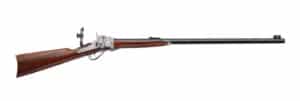
Outside the Winchester family, the Sharps single-shot rifles defined long-range buffalo hunting in the same period. The Enfield Pattern 1853 was the standard British military rifle-musket of the Civil War era and saw heavy Confederate use. The Hawken and Pennsylvania rifles cover the earlier American long-rifle tradition. Each occupies its own niche; the 1866 occupies the moment the repeater first worked, in the field, at scale.
References and Resources
The canonical reference work for any serious Winchester research is George Madis’s The Winchester Book (1961, with revised editions through the 1980s; ISBN 0-910156-04-9 for the 1985 edition). Out of print and trading on the secondhand market, it remains the definitive authentication reference for everything Winchester produced from the Henry through the 1980s, with detailed sub-variant tables for the 1866. R. L. Wilson’s Winchester: An American Legend (Random House, 1991, ISBN 0-394-57870-2) is the photographic reference, with full-color plates of original 1866s including presentation-grade examples. Herbert G. Houze’s Winchester Repeating Arms Company: Its History & Development from 1865 to 1981 (Krause, 1994, ISBN 0-87341-262-7) covers the corporate history, the King’s patent and New Haven Arms reorganization, and the Turkish contract. Douglas D. Scott’s Archaeological Perspectives on the Battle of the Little Bighorn (University of Oklahoma Press, 1989, and later editions) is the foundational text for the .44 Henry rimfire archaeology at Little Bighorn and the strongest documentary basis for Native repeating-rifle use in the period.
Online, the Winchester Collectors Association hosts a free serial-number lookup tool, an active authentication forum, and a dedicated 1866 sub-forum. The Rock Island Auction Company catalog archive is a searchable historical database with detailed lot descriptions and provenance research. The Cody Firearms Museum at the Buffalo Bill Center of the West holds original 1866s and serial-number records.
The Morphy Auctions catalog archive is one of the standout marketplaces for rare and historically significant American firearms. Their sales are worth following whether you are buying, researching original Winchesters and their period contemporaries, or just looking at very good firearms photography.
The Texas Gun Collectors Association holds two shows a year that always feature a large number of historical Winchesters alongside other significant American firearms. Worth attending whether you are buying, researching, or just looking.
If you know of any forums or sites that should be referenced on this listing, please let us know here.